
Classic GMC 100 Buyer's Guide
Complete buyer's guide for the classic GMC 100 half-ton pickup (1947–1959). How the GMC differs from its Chevrolet twin, what to inspect, and why smart buyers have been quietly acquiring these trucks for years.

The GMC 100 is the half-ton pickup that lived in the shadow of its Chevrolet twin — and that's exactly why smart buyers have been quietly acquiring them for years. Mechanically identical to the equivalent Chevrolet 3100 and C10 through most of its production, the GMC 100 carries the same parts availability and the same durability at a consistent discount in the collector market. The styling is subtly different, the grille is distinctive, and the badge on the hood says something different from every other classic truck in the parking lot.
History & Generations
Advance Design Era (1947–1955)
The GMC 100 ran parallel to the Chevrolet 3100 through the Advance Design years, sharing the same cab, the same frame, and the same basic drivetrain — but wearing its own grille, its own badges, and its own instrument cluster. The GMC version used a slightly different engine in the early years: where Chevrolet fitted the Stovebolt inline-six, GMC used its own inline-six derived from a different engineering programme. By the early 1950s the engines had converged considerably, but early GMC 100 trucks have a distinct character that purists appreciate.
The rounded cab styling of the 1947–1955 Advance Design trucks is as iconic on the GMC as it is on the Chevrolet — and the GMC grille, with its horizontal bars and distinct badge treatment, is arguably the more elegant of the two. These are the trucks most in demand in the current collector market.
Task Force Era (1955–1959)
The 1955 redesign — which GM called the "Task Force" generation — brought a completely new body shared between Chevrolet and GMC. The Task Force trucks are lower, wider, and more car-like than the Advance Design trucks that preceded them. The GMC 100 in Task Force trim is a clean, purposeful design with a distinctive grille that differs noticeably from the Chevrolet equivalent. The 1955–1959 trucks are underappreciated in the broader market, particularly relative to the later C10 generation, and represent genuine value for buyers willing to look.
What to Inspect
The inspection protocol for a GMC 100 is identical to that of a Chevrolet 3100 or C10 — because the trucks are fundamentally the same vehicle. Cab corners, floor pans, cab mount points, and the frame rails under the cab are the primary rust zones. The running boards and their flanges rust from water pooling. The firewall should show original stampings; a replaced firewall indicates major accident history.
| Era | Years | Engine | Notes |
|---|---|---|---|
| Advance Design | 1947–1954 | GMC 228 / 248 I6 | GMC-specific engine, not Stovebolt |
| Advance Design (late) | 1954–1955 | GMC 248 / 270 I6 | Converged with Chevrolet architecture |
| Task Force | 1955–1959 | GMC 270 / 302 I6, V8 options | Shared platform with Chevrolet |
"Every time I see a clean GMC 100 priced lower than an equivalent Chevrolet 3100 sitting next to it, I shake my head. Same frame, same cab, same drivetrain — different badge. If your goal is a great truck to drive and not a trophy to wave at people who know the difference between a Chevy and a GMC, buy the GMC and keep the money in your pocket."
— Robert Halloran
Market Outlook
The GMC 100 collector market tracks about one cycle behind the Chevrolet equivalent. Advance Design GMC 100 trucks in driver-quality condition run $22,000–$40,000 — consistently $5,000–$10,000 less than equivalent Chevrolet 3100 trucks. Concours-quality examples and professionally built restomods are priced closer to the Chevrolet market, but entry-level originals remain a genuine bargain. For the buyer who cares more about having a great truck than a Chevrolet badge, the GMC 100 is one of the best values in the classic American truck market.
Browse GMC 100 listings
 Dealer
 United States
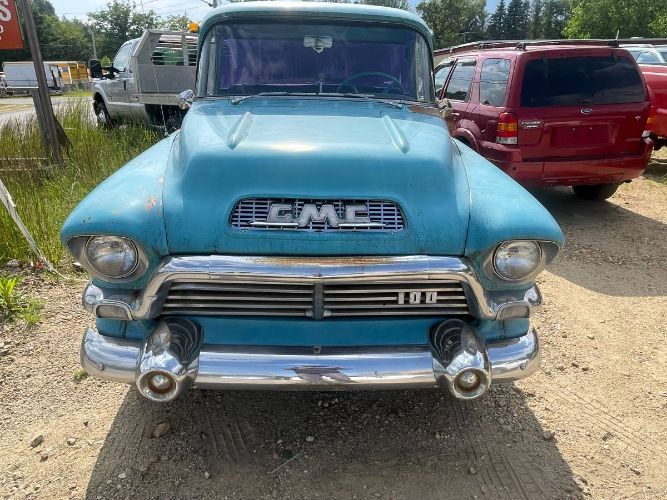
1957 GMC 100
 Dealer
United States
Dealer
United States
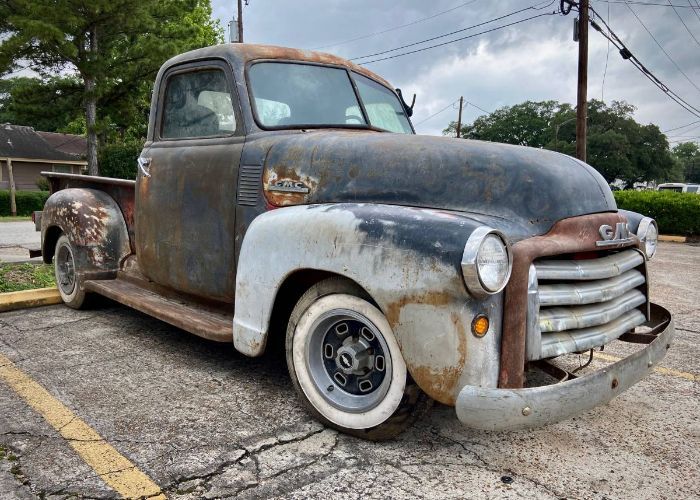
1950 GMC 100
What to Look For
Structure first: same as any Advance Design or Task Force truck. Cab mounts, floor pans, cab corners. The frame and cab are the foundation — everything else is replaceable.Engine identity second: verify whether the truck has its original GMC engine or a Chevrolet substitute. For original-GMC collectors, this matters. For practical drivers and restomods, it doesn't.
GMC-specific trim and badging: an original GMC 100 with correct GMC grille, badges, and instrument cluster is worth more to the GMC collector community than one assembled from mixed Chevrolet parts. Verify what's original before paying a premium.
Pre-Purchase Checklist
-
Inspect cab corners with flashlight and magnet
Same rust zones as Chevrolet 3100: lower front and rear cab corners. Magnet test for filler depth. -
Check cab mount points on frame
Where body bolts to frame. Rust-through here is a structural concern — inspect with torch from underneath. -
Pull floor mats and inspect pans
Both sides. Replacement pans are available and cross-reference with Chevrolet parts. -
Verify original GMC engine vs Chevrolet swap
Early GMC 100s had GMC-specific inline-sixes. Casting numbers identify engine origin. Original GMC engine adds value to GMC-focused collectors. -
Inspect GMC grille condition
GMC-specific grilles are harder to source than Chevrolet equivalents. Check for cracks, missing sections, and chrome condition. -
Examine firewall stampings
Original firewall should have VIN stampings. Replaced firewall = major accident or rust-through repair. -
Check running board flanges
Water pools here and rots flanges. Inspect attachment points for rust-through. -
Test brakes and steering
Hydraulic drum brakes all around. Firm pedal, straight stopping. Steering should have minimal dead travel. -
Verify trim and badge originality
GMC-specific trim pieces and badges. Check that hood badge, tailgate badge, and cab trim are correct GMC items, not Chevrolet substitutes. -
Document with photos before purchase
Every panel, grille, engine bay, firewall stampings, undercarriage.
Common Issues
The GMC 100 shares all rust patterns with the Chevrolet 3100: lower cab corners, floor pans, running board flanges, and cab mount points. The inspection protocol is identical.GMC-specific concerns: the early GMC inline-six engines (GMC 228 and 248, 1947–1954) are less common in the parts market than Chevrolet Stovebolt units. While they are robust engines, specialist parts may require more hunting. Many surviving GMC 100s have had their original GMC engines replaced with Chevrolet Stovebolt or small-block V8 units — this reduces value for GMC purists but makes the truck more practical.
GMC-specific trim pieces — particularly the grille and the instrument cluster — are harder to source than Chevrolet equivalents. Budget for this when assessing restoration cost.
More 100 for sale
 Dealer
United States
Dealer
United States
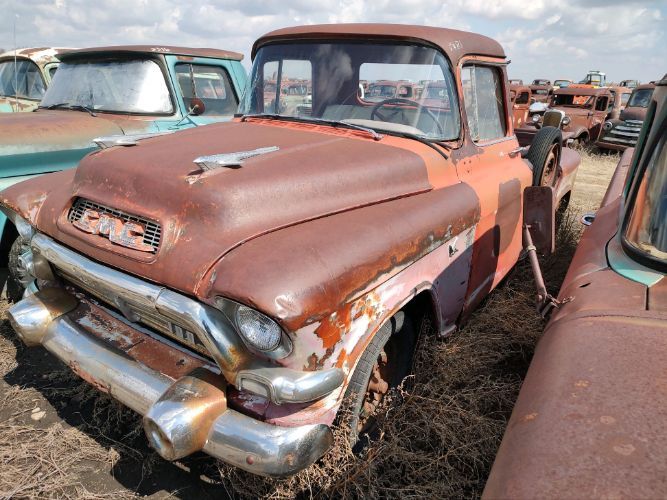
1957 GMC 100
 Dealer
United States
Dealer
United States
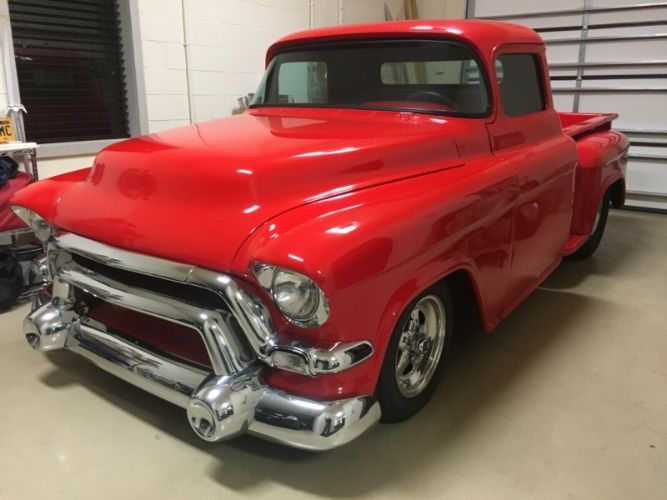
1956 GMC 100
Pricing Guide
Advance Design GMC 100 (1947–1955): driver-quality originals run $22,000–$40,000 — consistently $5,000–$10,000 less than equivalent Chevrolet 3100 trucks. Concours-quality examples: $48,000–$70,000.Task Force GMC 100 (1955–1959): $15,000–$30,000 for clean drivers; $35,000–$55,000 for professional restorations. These trucks are undervalued relative to their quality and scarcity.
Restomod builds command similar prices to equivalent Chevrolet builds when the execution quality is comparable. The badge discount largely disappears at the show-quality level.
Fun Facts
During the 1950s, GMC trucks were sold through Pontiac dealerships — a positioning that gave them a slightly more upmarket image than equivalent Chevrolets sold through Chevrolet dealers. This dealer-channel distinction is long gone, but it created a subtle brand differentiation that persists in the collector market.The GMC 100 designation was replaced by the C10/C15 system in 1960 — the same naming change that happened at Chevrolet. After 1960, GMC and Chevrolet trucks shared identical model codes, making the early 1947–1959 period the last era of distinctly GMC-branded truck model designations.
Frequently Asked Questions