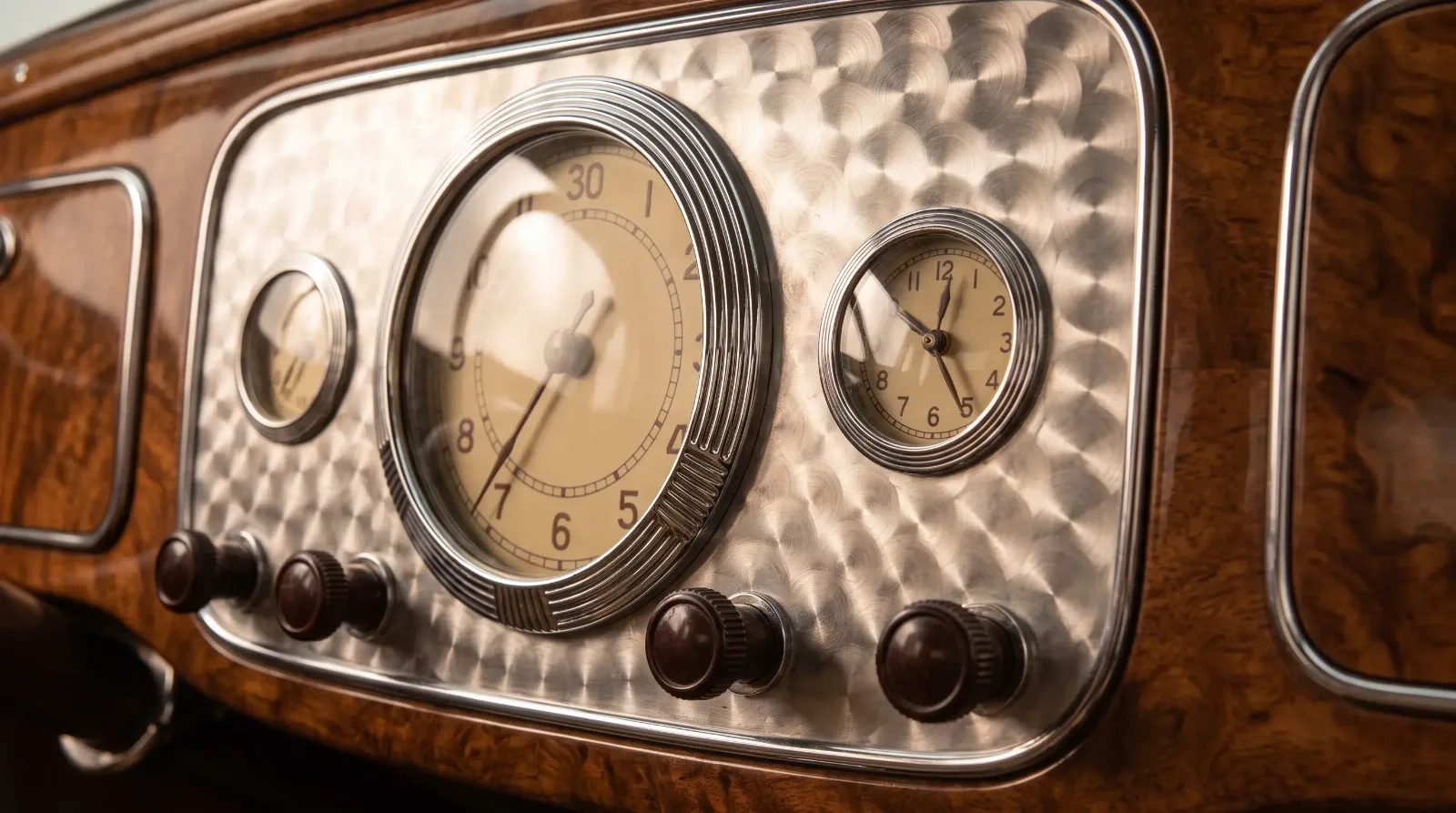
Sit inside a well-preserved 1930s car and the first thing that hits you is not the engine, it is the dash. Engine-turned metal catching the light, gauges set into little jeweled bezels, a clock face treated with the same care as a wristwatch. Nobody had to make an instrument panel this beautiful. They chose to, because by the 1930s the interior of a car had become a stage for the same design language that was reshaping buildings, furniture, and everyday objects across the country.
Art Deco did not stay outside the car. It walked right in through the door and took over the dashboard, and what it left behind is some of the finest small-scale design of the era.
Where the look came from
Art Deco as a style had already swept through architecture and product design by the time car interiors caught up, drawing on geometric patterning, stepped forms, and a fascination with speed and machinery as beautiful things in themselves rather than just functional ones. Skyscrapers, radios, even toasters were getting the treatment. Cars were a natural next canvas, and the dashboard was the most intimate part of the car, the piece every owner touched and looked at every single drive.
Designers borrowed motifs freely. Sunburst patterns radiating from a clock or speedometer. Chevron and zigzag trim on wood veneer. Symmetrical layouts that treated the whole panel as a composition rather than a collection of separate gauges bolted wherever they fit. The dashboard stopped being just an instrument carrier and became a piece of applied design.
Materials that made it work
Engine-turned aluminum, a finish made by spinning a small abrasive tool across metal in overlapping circles, gave dash panels a shimmering, almost fabric-like texture that caught light differently depending on the angle. It had been used in aviation instrument panels before it migrated into cars, which tells you something about how these designers were thinking. A dashboard should feel like precision equipment, not a plank with holes cut in it.
Wood veneer was still common, especially in British and higher-end American cars, but the wood grain itself often got a geometric treatment, book-matched panels arranged in symmetrical patterns rather than laid out at random. Chrome and nickel trim framed the gauges in stepped, faceted bezels instead of plain circles. Bakelite, one of the first true plastics, showed up in knobs and switches, molded into clean geometric shapes that would have looked at home on a radio cabinet from the same decade.
The instruments themselves as jewelry
Look closely at a good 1930s speedometer and you will often find it set inside a stepped, sunburst, or fan-shaped bezel, the needle sweeping across a face with typography chosen as carefully as the numbers on a wristwatch. Clocks got the same attention, sometimes positioned as the visual centerpiece of the whole dash rather than tucked to one side. Ashtrays, glove box latches, even the window cranks picked up the geometric vocabulary.
This was not accidental prettiness. It reflected a real belief among designers of the period that the machine age deserved a beautiful visual language of its own, one that celebrated speed, precision, and modernity rather than dressing new technology up in old-fashioned ornament. A dashboard was where a driver spent every mile, so it got the most careful treatment of all.
| Dashboard element | Typical 1930s treatment |
|---|---|
| Metal panel finish | Engine-turned aluminum |
| Gauge bezels | Stepped, sunburst, or faceted chrome |
| Wood trim | Book-matched veneer, geometric grain |
| Knobs and switches | Molded Bakelite, clean geometric shapes |
| Layout philosophy | Symmetrical composition, not scattered gauges |
Why originality matters so much here
A dashboard is one of the hardest things to restore correctly, because engine-turning, veneer matching, and period-correct Bakelite are all specialist crafts that few people practice today. A car with its original dash intact, even if worn, is often worth more to a serious buyer than one with a beautifully redone but slightly-off reproduction. The proportions, the exact pattern of the engine-turning, the typeface on the gauges, small details separate a faithful restoration from a good-enough one.
This is a case where I would tell a buyer to look past a tired paint job before I would tell them to look past a compromised dashboard. Paint is straightforward. A correctly recreated 1930s instrument panel is not, and getting it wrong is very easy to spot once you know what to look for.
"People walk right past the dashboard on their way to the engine bay and I understand why, but that panel tells you more about a car's originality than almost anything else. A honest, unmolested dash from this period is a small museum piece, and I treat it that way."
— Sarah Whitfield
The dashboard was never designed in isolation either. It answered to the same design instincts shaping the rest of the cabin and the body, a story covered in more depth in the full look at Art Deco cars of the period.
What it tells us about the decade
The care poured into a 1930s dashboard says something about how people related to their cars at the time. This was often the biggest purchase a family made outside of a house, and it was treated with a level of design attention that would be hard to justify commercially today. Every knob, every gauge face, every strip of trim was somebody's deliberate decision about beauty, not just function.
That is worth remembering the next time you sit behind the wheel of a well-kept 1930s car. You are not just looking at old instruments. You are looking at a small, complete design statement from a decade that believed even the inside of a dashboard deserved to be beautiful. For more on how that thinking carried through to the exterior lines of the same cars, the 1930s car interior story covers the connective tissue between cabin and body, and a related read picks up where the exterior design kept evolving through the decade.