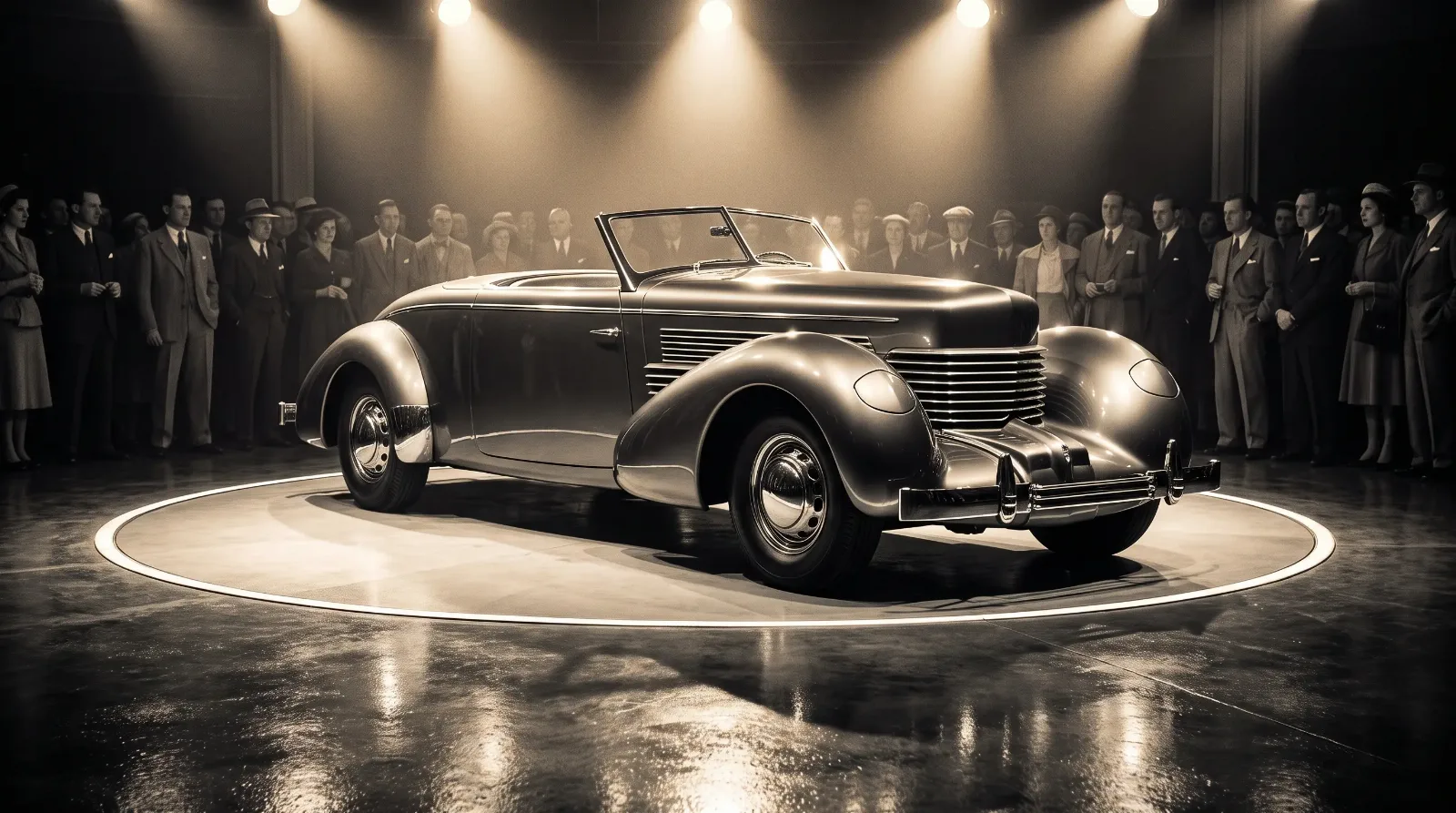
Buick built a car in 1938 called the Y-Job, and it never went on sale. Nobody was ever meant to buy one. It existed to answer a question: what happens if you build a car with no compromises, no cost sheet, no production line to satisfy? The answer sat on Harley Earl's own driveway for years afterward, because he liked driving it too much to let it go. That is the concept car in a nutshell, a machine built to test an idea rather than fill an order.
The 1930s produced a small handful of these prototypes, and tracking them down in the historical record tells you more about where automotive design was actually headed than almost any production car from the same years.
Why prototypes existed at all
Building a one-off show car is expensive and it does not sell a single unit, so the practice needed a real business reason to survive the Depression years. That reason was research. A concept car let a manufacturer test styling ideas, materials, and mechanical concepts in public and gauge reaction before committing tooling money to a production version. It was market research with a body on it.
General Motors formalized this thinking under Harley Earl, who ran the company's Art and Colour Section and pushed the idea that a manufacturer needed a dedicated team imagining cars years ahead of what the factory could actually build. The Y-Job was the clearest expression of that philosophy, and its influence on postwar Buick styling, hidden headlamps, a low beltline, power-operated features, is documented well enough that historians point to it directly.
What made these cars radical for their time
Features that felt like science fiction in 1938 read as ordinary options today. The Y-Job had power windows and a power-operated convertible top at a time when hand cranks were standard everywhere. Its headlights retracted into the fenders, a full decade or more before that became common on production cars. The grille design, a horizontal bar theme, would echo through Buick's production lineup for years.
Other manufacturers ran similar experiments, though few survive in the record with the same documentation as the Y-Job. Independent coachbuilders and smaller manufacturers built one-off show cars for auto salons throughout the decade, testing aerodynamic bodies and unusual mechanical layouts, though many of these cars were scrapped, sold off, or simply lost once their moment on the show stand passed. The 1930s were not kind to record-keeping around prototypes that were never meant to be permanent.
Why so few survived
A concept car had no production run to protect it and no owner base pushing for parts availability. Once a prototype had served its purpose, showing off ideas at a salon, testing public reaction, providing photos for the press, many manufacturers simply scrapped them rather than store or maintain a car that would never generate revenue. Materials could be reused, and storage space was not free.
The survivors that do exist, the Y-Job among them, tend to have survived because someone influential inside the company personally valued the car enough to keep it running and stored rather than let it go to the crusher. That is a thin thread for history to hang on, and it means the record of 1930s concept cars is almost certainly missing designs that never got a second chance at preservation.
| Prototype | Builder | Notable feature |
|---|---|---|
| Y-Job | Buick / GM Art and Colour | Power top, retractable headlights |
| Various salon show cars | Independent coachbuilders | Experimental aerodynamic bodies |
What they tell us today
Reading the 1930s through its surviving prototypes gives a different picture than reading it through showroom cars alone. Production models had to answer to cost, tooling, and a Depression-battered buyer, so they moved cautiously. Prototypes did not carry that weight, and they show design teams already imagining features that would not reach ordinary buyers for another decade or two. The gap between what a 1938 concept car could do and what a 1938 production car actually offered is a good measure of how far ahead these design teams were thinking.
"The production record tells you what buyers were willing to pay for in a hard economy. The prototypes tell you what the engineers actually believed a car could become. Read them side by side and you get the real story of the decade, not just the sales-floor version."
— Tom Ramirez
This forward-looking streak connects directly to everything covered in our deep dive on rare 1930s concept cars, where the production side of the same design revolution gets the full treatment.
The engineers behind the sketches
It is worth naming who actually built these things, because prototype work in this era was often credited to a design chief while the hands-on engineering fell to a small team working under real time pressure. At GM, Harley Earl's Art and Colour Section pulled in modelers, sheet metal specialists, and engineers who had to translate a stylist's sketch into something that could actually roll under its own power, steer, and stop. That translation step is where most concept cars of any era fail. The Y-Job succeeded because Earl insisted on a fully functional car rather than a static mockup, which is part of why it survived long enough to influence real production styling.
Independent coachbuilders working the salon circuit operated under different pressure entirely. They were often building a one-off for a specific paying client or for their own shop's reputation, which meant the engineering had to be sound enough to actually drive away from the show, even if the styling choices were more extreme than anything a factory would greenlight for volume production. That client relationship is also why so many of these cars vanished without a trace. Once the original owner lost interest or passed the car along, nobody downstream had a reason to preserve what was, to them, just an unusual used car.
Where to go from here
The prototype story is really a preview of the safety story too, because several of the ideas tested in show cars during this period, better glazing among them, became mainstream engineering concerns by the end of the decade. Keep reading for how that particular shift played out, and for the fuller arc of the era, the full pre-war story ties the styling, engineering, and market forces of the period together in one place.