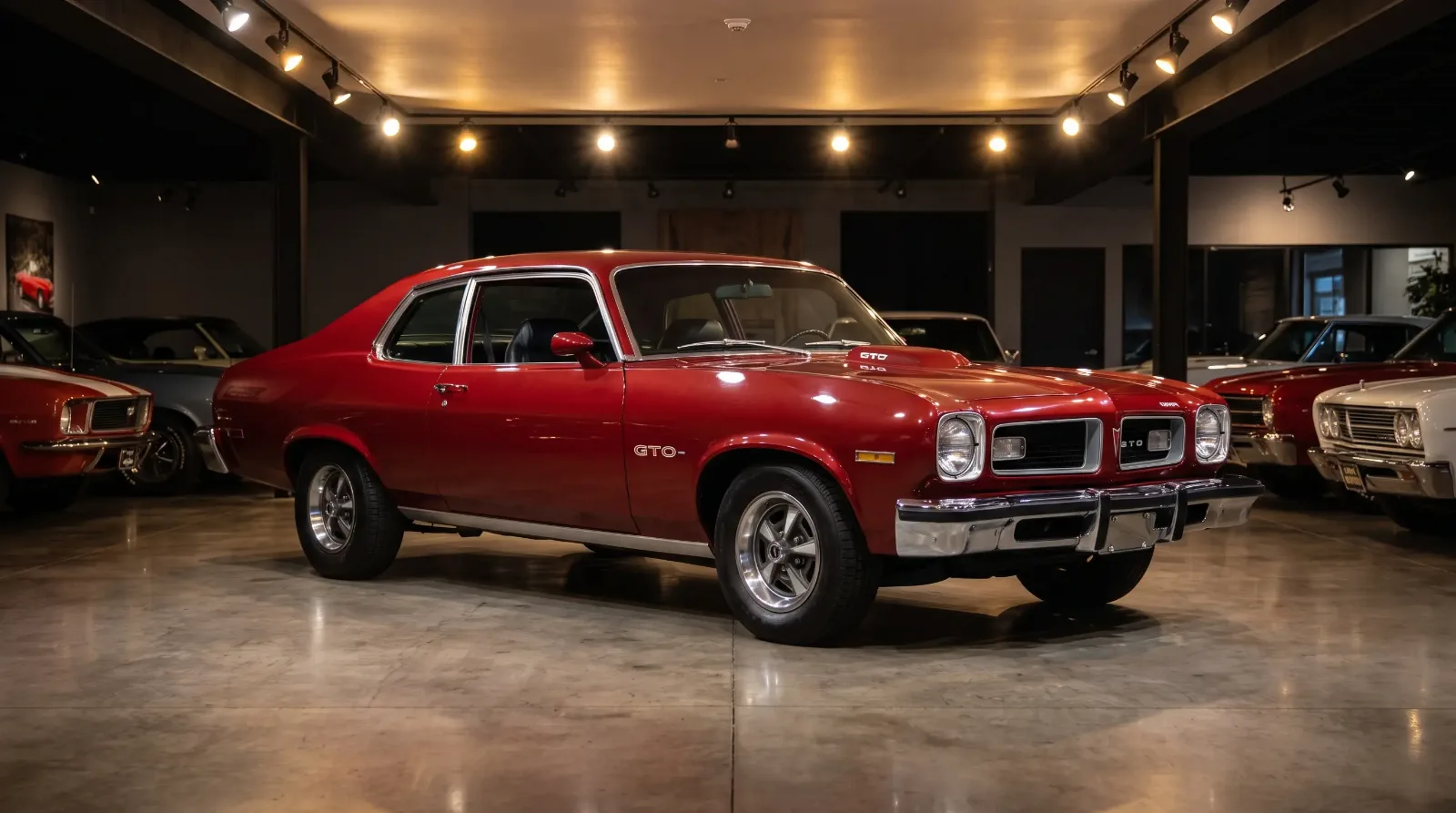
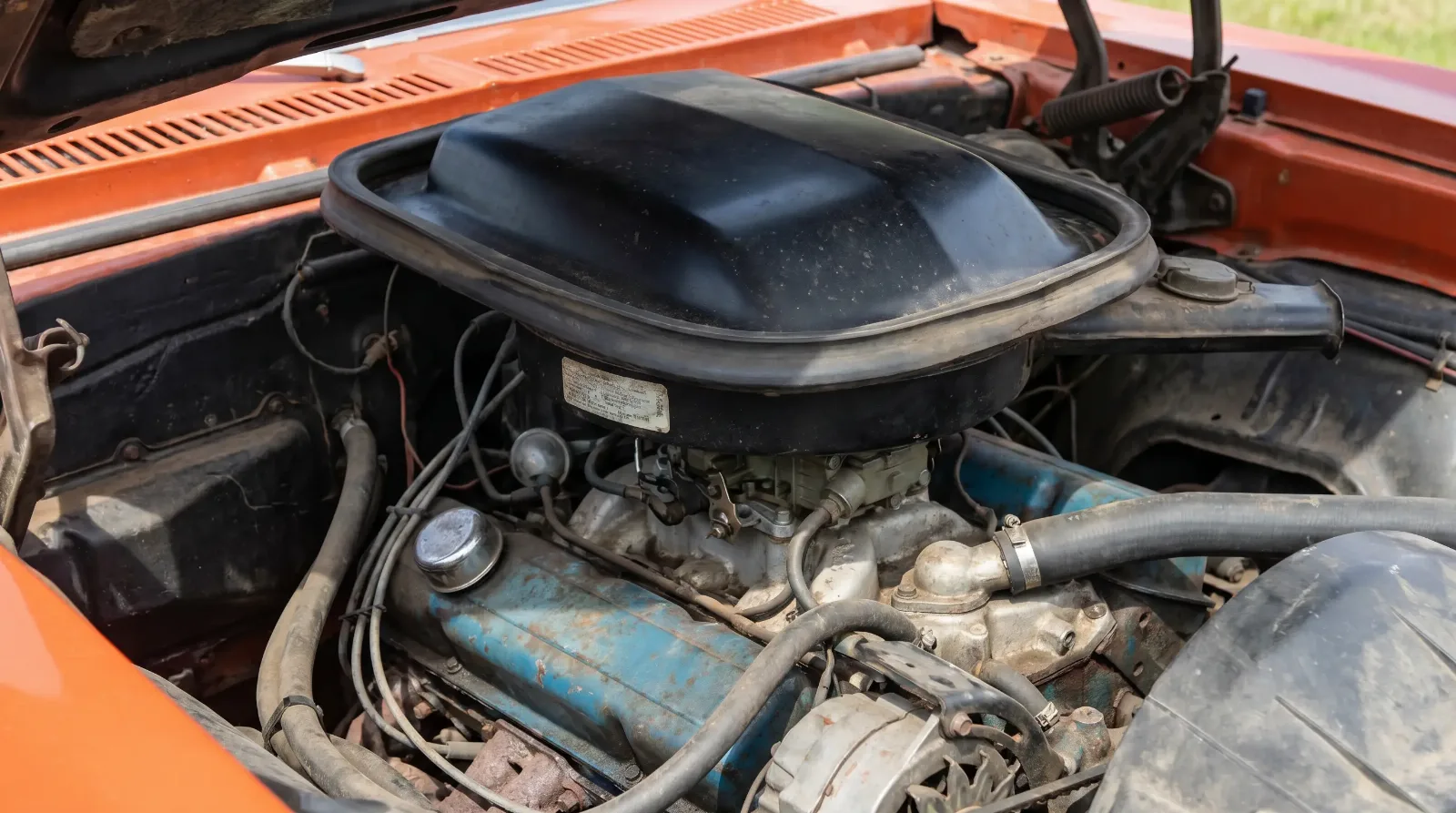
Pop the hood latch on a 1974 GTO with the Shaker option and you'll see something that has no business being on a compact car built at the tail end of the muscle era: a functional, vibrating air scoop bolted directly to the top of the air cleaner, poking up through a hole cut in the hood itself. It shakes when the engine shakes. That's the whole point, and that's where the name comes from.
How the Shaker actually works

Most hood scoops on 1970s performance cars were dummies, plastic or fiberglass pieces bolted to the hood for looks with no ductwork behind them. The Shaker is a different animal entirely. Instead of mounting to the hood, it mounts directly to the top of the carburetor's air cleaner assembly, which sits on the engine itself. A rubber seal fits around the opening cut into the hood, letting the scoop poke through without the hood touching it. When the engine rocks slightly on its mounts under acceleration, the scoop moves with it, visibly shaking independent of the hood sheet metal around it. It's a genuine cold-air induction system, pulling outside air directly into the carburetor rather than drawing in hot air trapped under the hood.
Pontiac didn't invent this design for the GTO. The Shaker had already proven itself on the Trans Am, where it became one of that car's signature visual details. Bringing it over to the GTO for 1974 put a real performance component, not just a styling cue, on a car that was otherwise built around a compact platform and a detuned 350. It's one of the clearest signs that Pontiac's engineers hadn't fully given up on the GTO meaning something, even as the rest of the car's spec sheet was shaped by compliance rather than ambition.
"I've had customers ask why Pontiac bothered with a working scoop on a car this compromised. Simple answer: because somebody in Pontiac engineering still wanted it to feel like a GTO, not just wear the name."
— Mike Sullivan
Fitting it to the compact body
Adapting the Shaker for the GTO's compact X-body hood wasn't a straight parts swap from the Trans Am. The hood stamping, the clearance underneath, and the way the scoop's opening lined up with the smaller engine bay all needed their own engineering rather than a direct carryover. Pontiac's team had to make sure the scoop cleared the lower-profile hood line of the compact car without interfering with the wiper cowl or the cooling airflow the radiator needed, all while keeping the same functional cold-air principle intact. It's a small detail that gets lost in most retellings of the car's story, but it represents real engineering hours spent on a feature that easily could have been cut entirely from a car already being built down to a tighter budget than any GTO before it.
What it's like to own one
Working on a Shaker-equipped 350 tells you a few things fast. The seal between the scoop and the hood opening needs to be in good shape or you'll pull in water during a hard rain, and original rubber seals on a car this old are usually shot or missing entirely. Check that gasket before you assume the system is sealed correctly. The scoop's mounting hardware also takes abuse from constant engine movement, so look for cracked or elongated mounting points where the assembly bolts to the air cleaner base. None of this is exotic maintenance, it's the same kind of inspection you'd run on any air induction system, but a lot of shops unfamiliar with the compact-era GTO don't know to check it because they assume the car is basically a dressed-up Ventura under the skin.
The scoop's flapper is solenoid-actuated, triggered by a manifold-vacuum switch under hard acceleration and gated by a coolant-temperature switch that keeps it from opening until the engine's up near operating temperature, closing again at idle and light throttle to keep water and debris out. That vacuum switch, its wiring, and the solenoid itself are common failure points on a car this age. If the Shaker isn't opening under throttle, you're not getting the cold-air benefit the system was designed to deliver, you're just carrying a scoop for looks, which defeats the entire reason Pontiac engineered it this way.
Sourcing parts for a Shaker system today
Finding correct replacement parts for a 1974 GTO's Shaker system is harder than sourcing the same components for a Trans Am, simply because Pontiac sold far fewer Shaker-equipped GTOs than Shaker-equipped Firebirds. The scoop assembly itself, the rubber hood seal, and the vacuum-operated flapper valve are the three components most likely to need attention on a fifty-year-old car, and none of them are as easy to find off the shelf as Trans Am parts are. Some restorers cross-reference Trans Am Shaker components since the underlying hardware shares enough in common to make certain parts interchangeable, though buyers should verify fitment carefully before assuming a Firebird part will bolt straight onto a GTO application without modification.
A shop unfamiliar with this car will sometimes recommend deleting the functional Shaker and replacing it with a sealed, non-functional version to solve a persistent water leak rather than diagnosing the actual seal failure. That's the wrong fix for a numbers-matching or documentation-focused restoration, since it permanently changes what the car is and hurts its value with informed buyers down the road. The correct approach is almost always to source or fabricate a proper replacement seal and verify the flapper valve's vacuum actuation is working as designed, preserving the functional system rather than working around it.
Why it matters more than its size suggests
A functional cold-air hood scoop doesn't transform a 200-horsepower 350 into a genuine performance engine. What it does is signal intent. Everything else about the 1974 GTO, the compact Ventura platform, the single detuned engine option, the smaller overall footprint, reads like a car built to survive regulation rather than to thrill anyone. The Shaker is the one piece of hardware on the car that says otherwise, a real functional system carried over from Pontiac's most credible remaining performance nameplate at the time. It's a small detail with an outsized amount of character, and it's a big part of why enthusiasts who actually spend time around the compact GTO tend to come away with more respect for the car than its reputation suggests it deserves.
Where this fits in the bigger picture
The Shaker hood is one small bright spot inside a much larger story about compromise. To understand the full set of pressures Pontiac was navigating during the final GTO years, it helps to step back from any single component and look at how the market itself was treating cars like this by the mid-1970s. That shift in perception, from performance icon to overlooked footnote and eventually back toward collector respect, is its own story. Read on for where the 1974 GTO stands with today's buyers and whether the market is finally starting to give this car the credit its engineering earned.
Sources and notes
- Hagerty - why the forgotten 1974 Pontiac GTO is worthy of the name
- Wikipedia - Pontiac GTO
- Mac's Motor City Garage - 1974: The Last Pontiac GTO (For a While)
- Pontiac GTO Forum - 1974 GTO hood scoop discussion
- Pontiac GTO Forum - 1974 hood scoop vacuum hookup
- Automobile Catalog - 1974 Pontiac GTO full specs