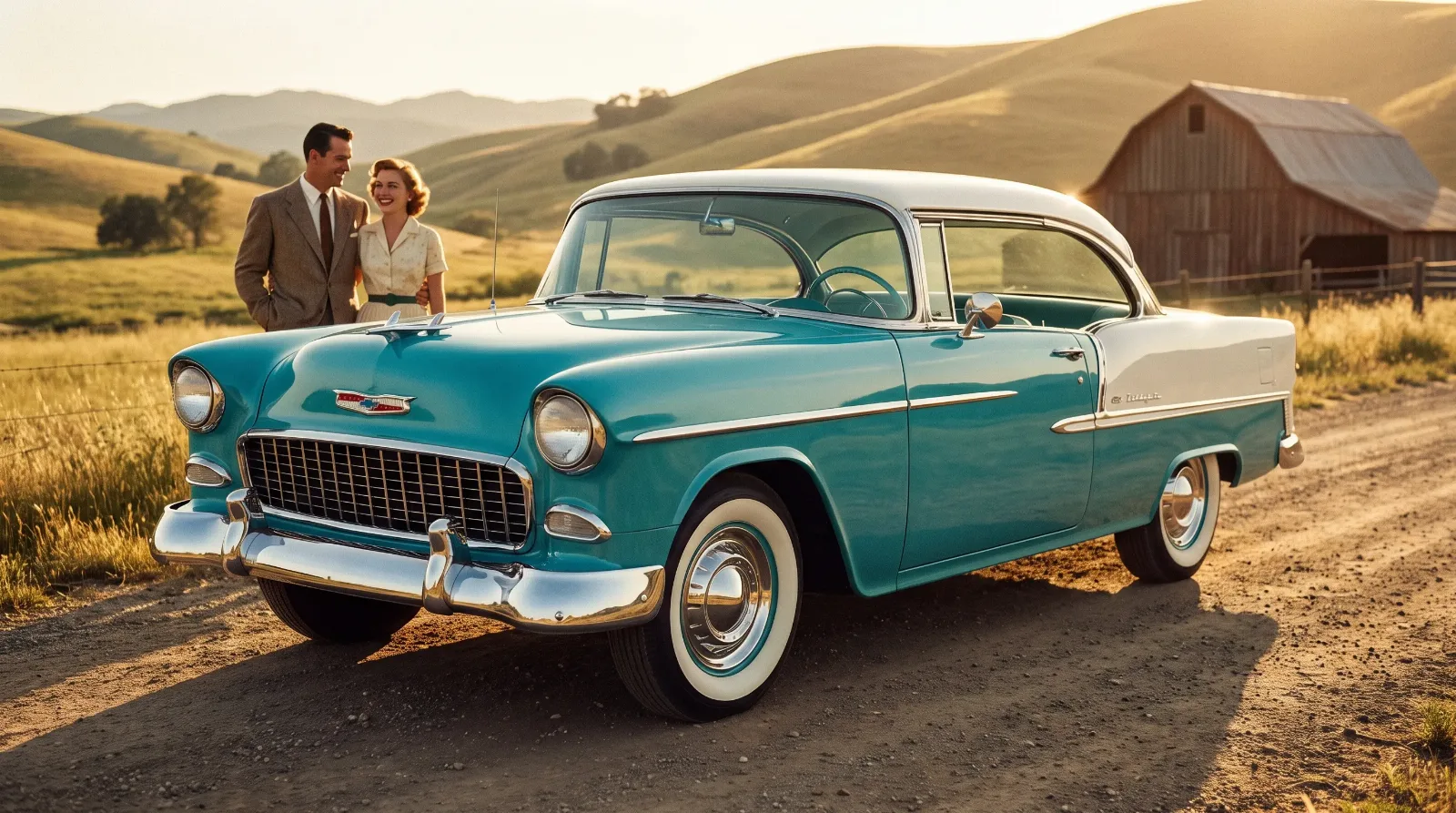
Chevrolet did not simply advertise the 1955 Bel Air. It staged it. The Motoramic Chevrolet campaign, built around the "Motoramic" name Chevrolet borrowed from General Motors' traveling Motorama shows, treated the redesigned 1955 lineup as an event rather than an annual model change. The phrase appeared on window stickers, in dealer signage, and across a run of print advertisements that framed the 1955 Chevrolet as something closer to a concept car than a mass-market sedan. For anyone studying period Chevrolet marketing, the 1955 Chevrolet Motoramic push is one of the clearest examples of a manufacturer using theater to sell an ordinary car.
Borrowing the Motorama name
General Motors' Motorama shows, running through the 1950s in cities including New York, Los Angeles, and Miami, were built to display dream cars and design concepts under Harley Earl's styling leadership. Chevrolet's marketing division saw an opportunity in that association and applied "Motoramic" to the entire 1955 production lineup, not just to a show car. The word never referred to a single vehicle. It was a brand umbrella, applied to advertising copy, dealer banners, and even some factory literature, meant to transfer some of the glamour of the traveling concept shows onto cars that customers could actually drive off a dealer lot. This is a documented, deliberate piece of period marketing strategy, not an informal nickname that grew up after the fact.
What the print campaign actually showed
The advertisements themselves leaned on illustration more than photography, a common approach for the period, with idealized settings, resort backdrops, and families dressed for an evening out rather than a grocery run. Copywriters used phrases built around motion, styling, and modern engineering rather than technical specification sheets. Where competitor advertising from Ford and Plymouth in the same year tended toward straightforward value claims, Chevrolet's Motoramic material read more like an invitation to an experience. The V8 engine, new for 1955 and a genuine engineering milestone, was folded into that same aspirational language rather than presented as a standalone selling point, which tells you something about how Chevrolet wanted the car perceived: modern first, powerful second.
Why the campaign mattered for Bel Air specifically
Within the Motoramic push, the Bel Air trim got the most prominent placement, since it carried the styling cues, two-tone paint options, and available V8 that best matched the campaign's forward-looking tone. Print advertisements frequently centered the Bel Air hardtop or convertible rather than the 150 or 210 series cars, using the top trim as the visual anchor for the entire model year even though the 150 and 210 accounted for a large share of actual sales volume. That editorial choice by Chevrolet's ad agency, Campbell-Ewald, shaped public perception of the whole 1955 lineup around a car most buyers were not actually purchasing. It is a pattern still familiar in automotive marketing: sell the aspiration, move the volume car.
| Element | Detail |
|---|---|
| Campaign name | Motoramic Chevrolet, 1955 |
| Ad agency | Campbell-Ewald |
| Primary trim featured | Bel Air hardtop and convertible |
| Source association | General Motors Motorama traveling shows |
Reading the artifacts today
Original 1955 Motoramic print advertisements, dealer brochures, and showroom posters have become collectible in their own right, sought by the same buyers who chase numbers-matching cars. Condition and completeness of a period brochure follow the same logic as a car's documentation file: a torn or incomplete piece is worth a fraction of a clean, complete one, and reproductions circulate widely enough that provenance matters as much as it does with the vehicles themselves. These paper artifacts are also one of the more reliable ways to date a car's original color and trim combination, since Chevrolet's brochures listed the full palette and options available at a given point in the model year.
"A brochure tells you what Chevrolet wanted the buyer to believe. A build sheet tells you what actually left the plant. You need both to understand a 1955 car properly."
- Sarah Whitfield
Readers who want the broader model year context, beyond the advertising and into the mechanical and production history, can find the full story covering how the 1955 redesign came together as a whole.
What it tells us about 1955 Chevrolet
The Motoramic campaign is a useful reminder that the 1955 Chevrolet was sold, from day one, as a styling and image statement as much as a mechanical one. The engineering underneath, particularly the new small-block V8, was genuinely significant, but Chevrolet's own marketing department chose to lead with glamour rather than horsepower figures. That choice shaped how period buyers understood the car, and it still shapes how collectors and historians frame the 1955 lineup today. Anyone researching a specific car's history should treat period advertising as evidence of intent and perception, distinct from the harder documentation of build sheets and factory records.
Dealer signage and the showroom experience
The Motoramic branding extended well past magazine pages and into the physical showroom, with window banners, illuminated signs, and floor displays that carried the same script lettering and color scheme used in the print campaign. Dealers were supplied with promotional kits from Chevrolet's national office rather than left to design their own materials, which kept the visual identity consistent from one city to the next. A customer walking into a Chevrolet dealership in Ohio would see essentially the same Motoramic signage as one walking into a dealership in California, a level of coordinated branding that was still relatively new for the auto industry in the mid-1950s. That consistency mattered to Chevrolet's broader strategy, since the company was trying to build a unified national image at the same moment it was expanding dealer networks aggressively across the country.
Some dealerships went further, staging small in-store events built around the Motoramic name, complete with local radio tie-ins and newspaper co-op advertising that let individual dealers stretch their marketing budgets by riding on Chevrolet's national campaign. These local events rarely survive in any documented form beyond a newspaper clipping or two, but they represent the last mile of a campaign that started with a corporate marketing department and ended with a salesman on a showroom floor trying to close a deal using the same language and imagery the national ads had already put in front of the customer.
How the campaign compares to Chevrolet's later advertising
Chevrolet would return to aspirational, lifestyle-driven advertising many times in the decades after 1955, but the Motoramic campaign stands out for how directly it borrowed the language of a specific, real event, the Motorama shows, rather than inventing a generic tagline from nothing. Later Chevrolet campaigns tended to build original slogans rather than lean on an existing corporate property the way Motoramic did. That makes 1955 a useful case study for anyone tracing how automotive marketing borrowed credibility from adjacent brand experiences, a technique that shows up again and again across the industry in the decades that followed, just rarely with as much documented specificity as Chevrolet applied to 1955.
For those drawn to the era after reading the ad copy, it is worth taking the time to browse classic Air listings currently on the market to see how that 1955 image has aged.