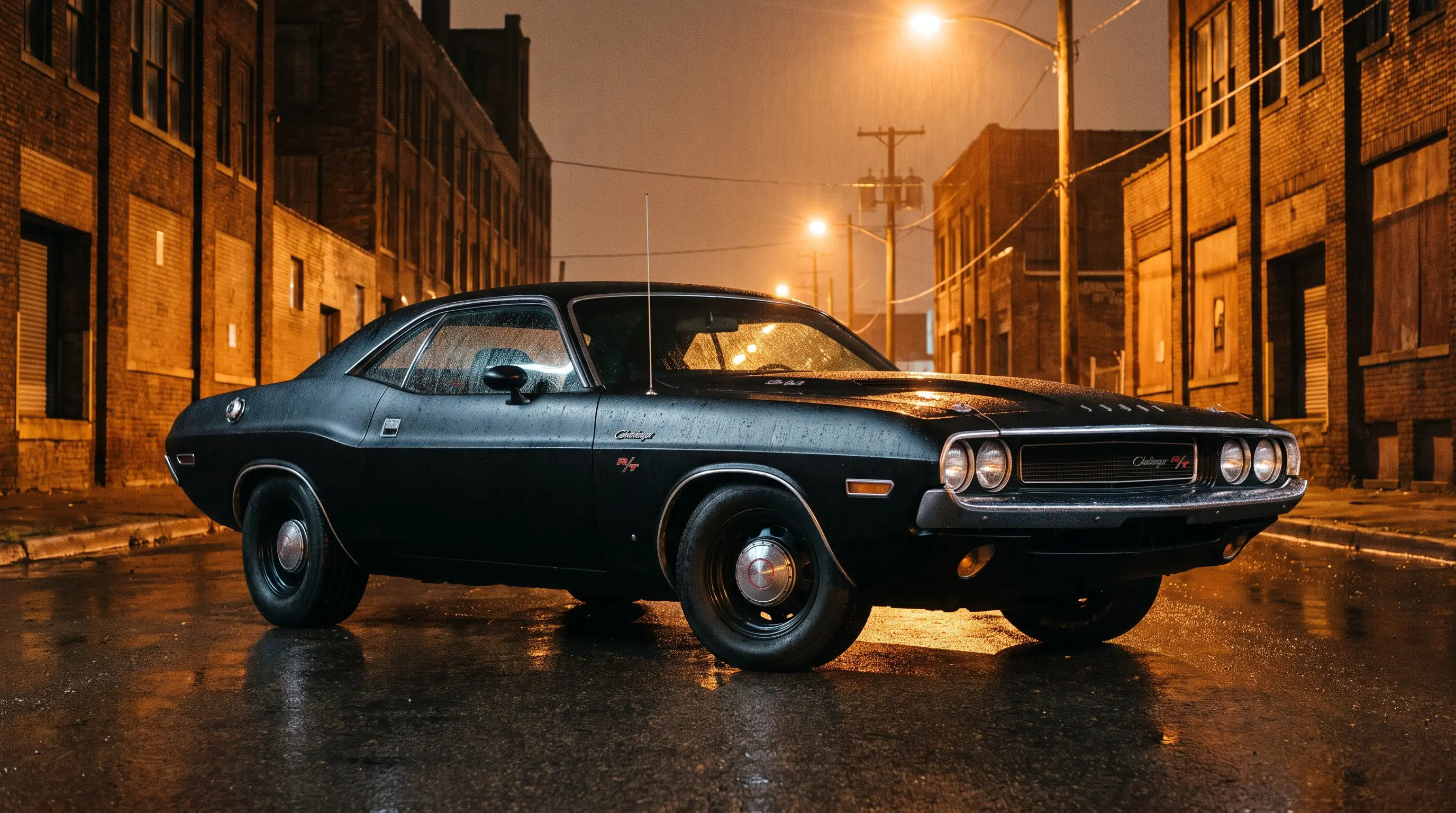
For decades, the black ghost challenger history was mostly a rumor passed around Detroit street racing circles, a story about a mysterious black 1970 Hemi Challenger that would appear at night, beat local racers, and vanish before anyone could learn who was behind the wheel. Stories like that usually stay stories. This one turned out to be true, and the reveal, when it finally came, reframed how people think about anonymous street legends from the muscle car era.
The rumor that would not die
Through the 1970s, street racers in the Detroit area told versions of the same tale. A black Challenger R/T SE, running a 426 Hemi four-barrel and a pistol grip four-speed, would show up at informal race spots, take on the fastest cars around, win convincingly, and then disappear, sometimes for weeks or months, before reappearing to do it again. No one seemed to know who owned it or where it went between appearances. The car earned its nickname from that pattern, showing up like something less than fully real, then fading back into the dark.
Car culture is full of stories like this that eventually get debunked or quietly forgotten, half-remembered legends that turn out to be composites of several different cars and several different drivers exaggerated into one figure. The Black Ghost was different because there was an actual car and an actual driver behind it the whole time, and eventually that driver's family was willing to tell the real story.
The man behind the legend
The driver was Godfrey Qualls, a Detroit police officer who kept his ownership and his racing activity almost entirely separate from the rest of his life. That detail alone explains the disappearing act that fueled the legend. A police officer moonlighting as an undefeated street racer had every reason to keep a low profile, and Qualls did exactly that for years, racing the car, winning, and returning it to obscurity rather than letting his identity or his hobby become public knowledge in a department and a community where that kind of attention could have created real problems for him.
Qualls kept the car until his death, and his family held onto it afterward, largely out of the public eye, for years. The full story did not become widely known until his descendants chose to share it, and eventually the car itself resurfaced in a way that let the public actually see what had been racing Detroit's streets under cover of anonymity for so long.
Why the return mattered so much
Most muscle car legends lose something when they get fully explained. The mystery was part of the appeal, and pinning down every detail can occasionally deflate a story that worked better as folklore. The Black Ghost did the opposite. Learning the real story, a working police officer quietly building and racing a Hemi Challenger on his own terms, added a human dimension that made the legend more compelling, not less. It turned an anonymous street racing ghost story into a specific, documented account of one person's private passion, which is arguably a better story than the rumor ever was.
The car's eventual public reappearance, complete with documentation connecting it directly to the decades-old rumors, gave collectors and historians something rare in this hobby: a legend that checked out. Most stories this good stay unverifiable. This one had a name, a family, and a car that matched the description people had been repeating for years.
"Most of these stories fade because nobody can prove them. The Black Ghost is the rare one that turned out to be exactly true, and that is what made it matter to people who had heard the rumor for thirty years."
- Nora Beckett
Its place among Challenger legends
The Black Ghost now sits alongside a small handful of Challengers whose reputations rest on a specific documented history rather than general model year rarity. It joins the ranks of Challengers whose stories are inseparable from a specific person or moment rather than a production number, which is exactly what keeps this particular chapter of Challenger history circulating among enthusiasts years after the full story became public. Readers interested in how this case fits alongside other documented street legends of the era can find the black ghost challenger history history covered in more detail, tracing how anonymous street racing folklore around the Challenger nameplate developed over the decades.
There is also a companion piece worth a look too, covering another Challenger story built on a specific driver's identity rather than a factory build sheet alone.
Why Detroit itself is part of the story
It matters that this legend grew out of Detroit specifically, a city where muscle car culture was not a hobby imported from car magazines but something that lived on actual streets, in actual neighborhoods, among people who worked at the plants that built these cars during the day and raced informally at night. Qualls was not an outsider chasing a reputation. He was a product of that same culture, working a demanding job and finding his release the same way plenty of his neighbors did, just with more talent and a faster car than most of them had access to.
That context explains why the story resonated so strongly once it became public. It was not a wealthy collector's tale of acquisition and provenance. It was a story about a regular working man who happened to own one of the fastest cars on his block and quietly declined to let anyone make a bigger deal out of it than he wanted. Detroit's street racing scene produced plenty of fast cars and plenty of talented drivers over the decades, but very few stories combine anonymity, documented proof, and this much genuine restraint from the person at the center of it.
What the story teaches buyers and fans alike
The Black Ghost's return is a reminder that the most valuable stories in this hobby are the ones that can actually be proven, not just repeated. A car with a documented, verifiable history, even an unusual one involving decades of secrecy, carries more weight with serious collectors than an unverifiable rumor ever could, no matter how good the rumor sounds around a campfire or a car show tailgate.
For anyone drawn to this story who wants to own a piece of the same era, there are classic Challengers on the market worth comparing against the documented history the Black Ghost represents. Few of them will carry a story this specific, but the appeal of the original body style and the same engine options remains the same. What the Black Ghost proves, more than anything else, is that the best stories in this hobby are still out there waiting to be confirmed, one family archive at a time.
Sources and notes
- RK Motors: Black Ghost added to National Register of Historic Vehicles
- Fox News: Black Ghost added to Historic Vehicle Register
- Hagerty: The mysterious 1970 Challenger that dominated Detroit street racing
- MotorBiscuit: This police officer's 1970 Challenger was secretly a street racing legend
- Metro Times: A requiem for Detroit's legendary Black Ghost