
Every legendary car needs a driver worth remembering, and the white 1970 Dodge Challenger from Vanishing Point got one of the strangest, most compelling drivers in car movie history. Kowalski is a former police officer, a Medal of Honor Vietnam veteran, and a former race car and motorcycle racer turned car delivery man who takes on an impossible bet and spends the rest of the film running from consequences the movie never fully spells out. He is the reason the Challenger's disappearance down that highway means anything at all.
Car Features
7 min read
Kowalski: The Character Who Defined the Challenger
Vanishing Point's Kowalski turned a white 1970 Challenger into a symbol of restless motion, a character defined by absence rather than backstory.
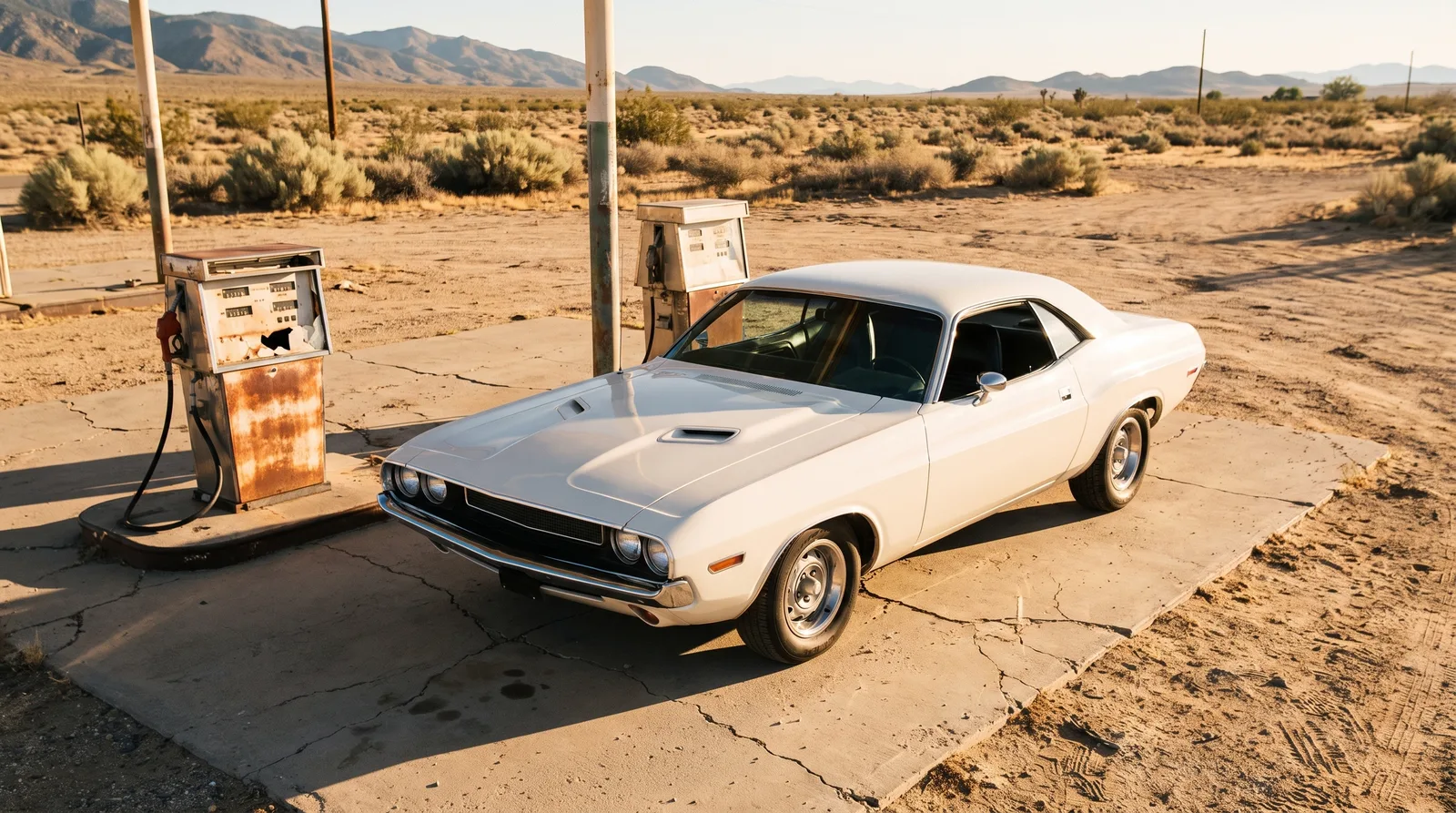
A man defined by absence rather than backstory
Vanishing Point gives Kowalski a past in fragments, flashbacks to police work, war service, and a career racing cars and motorcycles, but it deliberately refuses to connect those pieces into a tidy explanation for why he is doing what he is doing. He is not running from a specific crime or a specific person. He appears to be running from something closer to his own restlessness, a character built almost entirely around motion rather than motive.
Actor Barry Newman reportedly approached the role with a similar restraint, playing Kowalski with a flat, largely unreadable expression rather than the more overt emotional beats that a conventional leading man performance might have leaned on. That choice matched the script's refusal to explain him, giving the audience a driver who reveals almost nothing about his internal state even during the film's most intense chase sequences, and letting the car itself carry much of the emotional weight the script withholds from its human lead.
That vagueness frustrated some critics in 1971 who wanted a clearer psychological throughline. It is also exactly why the character has aged into something closer to an archetype than a conventional movie protagonist. Kowalski is less a person with a plan than a force moving through the landscape, and the Challenger under him is the physical expression of that restlessness, a machine built to go fast without any particular destination in mind.
The bet that sets the whole film in motion
The plot's inciting incident is almost absurdly simple. Kowalski bets he can deliver a car from Denver to San Francisco faster than seems reasonable, then spends the rest of the film making good on that bet while outrunning a growing pursuit of police cruisers across state lines. There is no larger criminal enterprise, no romantic subplot driving the chase, no ticking clock beyond the one Kowalski invented for himself. The entire film runs on the momentum of a man who decided, for reasons even he might not fully understand, that finishing the drive mattered more than anything the police could threaten him with.
That stripped-down premise is part of why the character and the car became so tightly fused in audiences' memories. Without a complicated plot to distract from it, the film's real subject becomes the simple, sustained image of a white Challenger moving fast across open country, chased for reasons that matter less with every passing mile.
A radio DJ who narrates the legend in real time
The film introduces a blind radio disc jockey named Super Soul, who tracks Kowalski's run across the desert via police scanner and turns the chase into a running broadcast for his listeners, effectively narrating Kowalski into a folk hero in real time as the events are still unfolding. That device gives the film a strange, self-aware quality, a character within the story actively building the myth of Kowalski and his Challenger while the audience watches the same events play out directly.
Super Soul's broadcasts frame Kowalski explicitly as a figure of resistance against an unnamed establishment, language that resonated heavily with early 1970s countercultural audiences even if the film itself stays fairly ambiguous about what, specifically, Kowalski is resisting. The effect is that the audience receives the legend and the raw events simultaneously, which is part of why the character felt mythic on first release rather than needing decades to acquire that reputation.
"Kowalski works precisely because the film never explains him. The second you try to pin down exactly why he is running, the character falls apart. He only makes sense as motion, as a man and a white Challenger refusing to stop, and that refusal is the whole story."
- Nora Beckett
A character built from period anxieties, not just plot mechanics
Vanishing Point arrived in 1971, a moment when American audiences were absorbing a steady stream of disillusionment, an unpopular war still grinding on, a counterculture movement losing some of its earlier optimism, and a growing distrust of official institutions across the board. Kowalski's flight from the police, undertaken for reasons the film never fully justifies, tapped directly into that mood without ever stating it outright. He is not a criminal in any conventional sense. He has simply decided, for his own private reasons, that outrunning authority matters more than following its rules, and audiences of the era recognized that impulse even if they could not have articulated exactly why it resonated.
That specificity to its moment is part of why the character has aged unevenly. Some viewers coming to the film decades later find Kowalski frustratingly opaque, a symbol without enough substance behind it. Others read that same opacity as the film's central strength, a refusal to over-explain a mood that speaks for itself if you are willing to sit with the ambiguity rather than demand a tidy resolution.
Why Kowalski still defines how people see the Challenger
Decades after the film's release, Kowalski remains the reference point for a certain strain of Dodge Challenger appreciation, one less concerned with horsepower figures and more interested in the car as a symbol of restless, unexplained momentum. Owners who chase Vanishing Point tribute builds are not usually chasing period-correct specifications so much as they are chasing that specific feeling, the sense of a car and driver united in a single, uncomplicated act of forward motion.
For the fuller context of how this character and this film shaped the classic Challenger's identity across decades of pop culture, where this started covers the complete arc. And for anyone who has watched Kowalski's run enough times to want a real Challenger of their own, classic Challenger for sale is a good place to see what is actually available, no impossible bet required to get behind the wheel.
It is worth noting how differently this character would likely be written today. A modern version of the same story would almost certainly give Kowalski a clearer motive, a wronged family member, a specific injustice, something the audience could point to and say that is why he is running. Vanishing Point's refusal to do that is precisely what has let the character keep working across five decades of changing tastes. Audiences bring their own reading to an empty vessel in a way they cannot to a character whose motivations are already fully explained, and Kowalski, more than fifty years on, is still empty enough for each new viewer to fill in their own reasons for why a man and a white Challenger kept driving.
Sources and notes
Related Reading
Have a
Dodge Challenger
for Sale?
Reach thousands of serious classic car collectors across the US.
Sell It Here →
Are You a Classic Car Dealer?
List your full inventory and connect with targeted classic car buyers.
Join as a Dealer →

About the author
Nora Beckett
Automotive features writer and photographer who tells the human stories behind the cars, from show fields to cross-country road trips.
Related Listings - Dodge Challenger



Comments
Be the first to comment on this article.