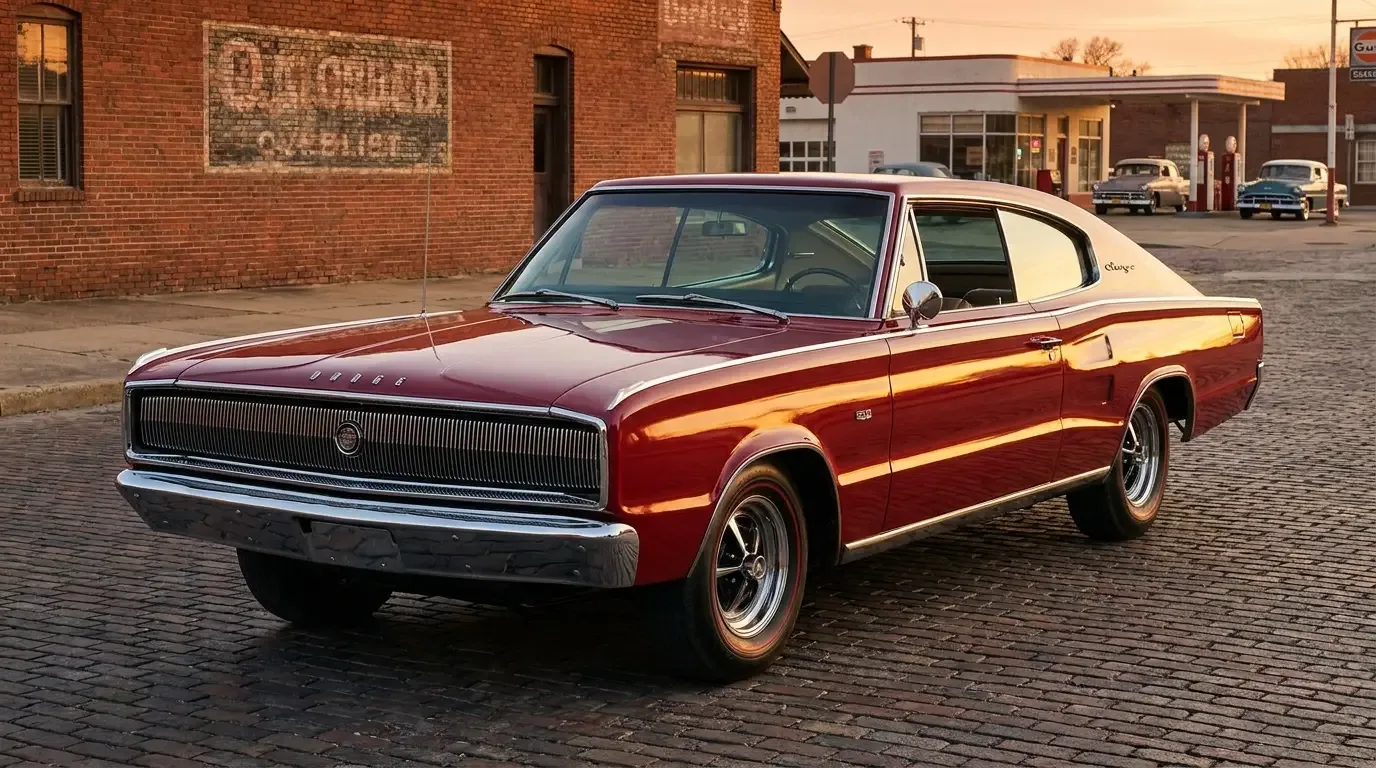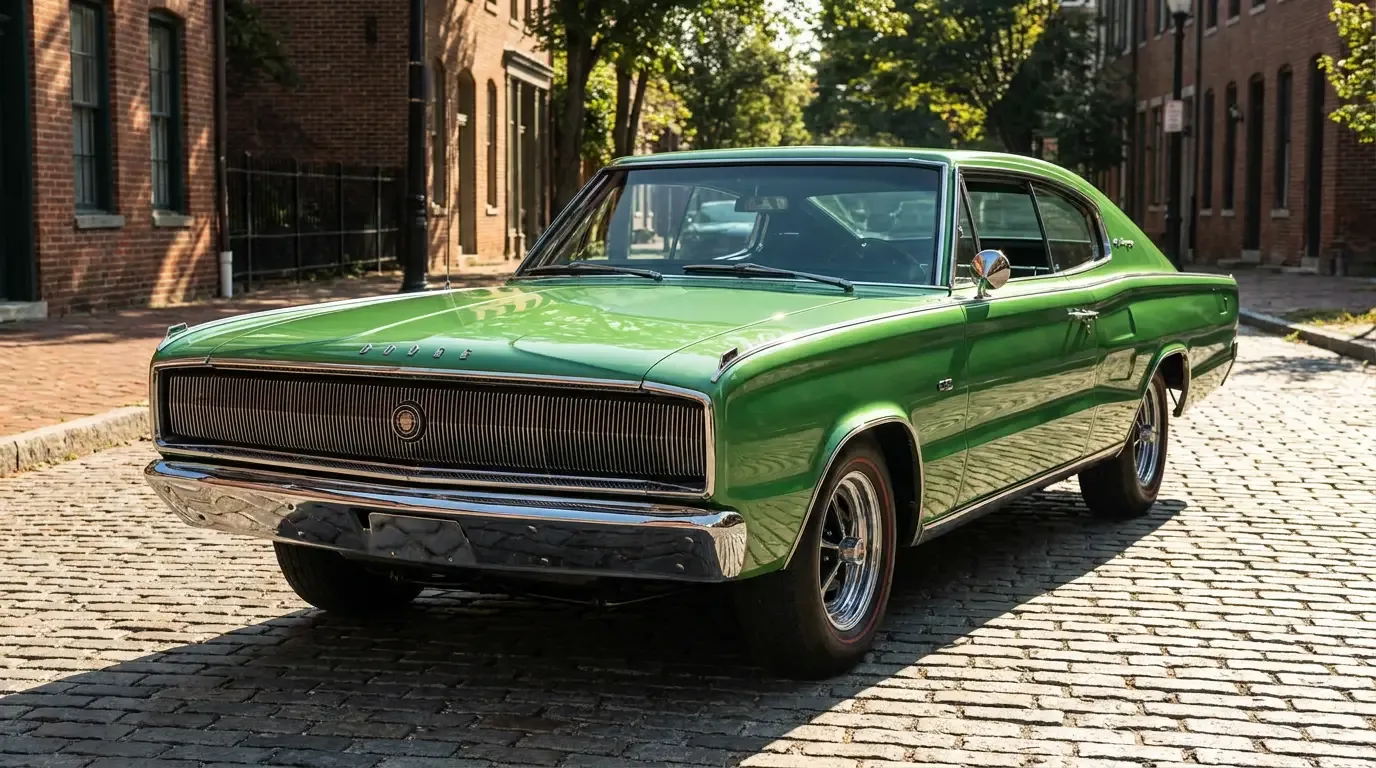
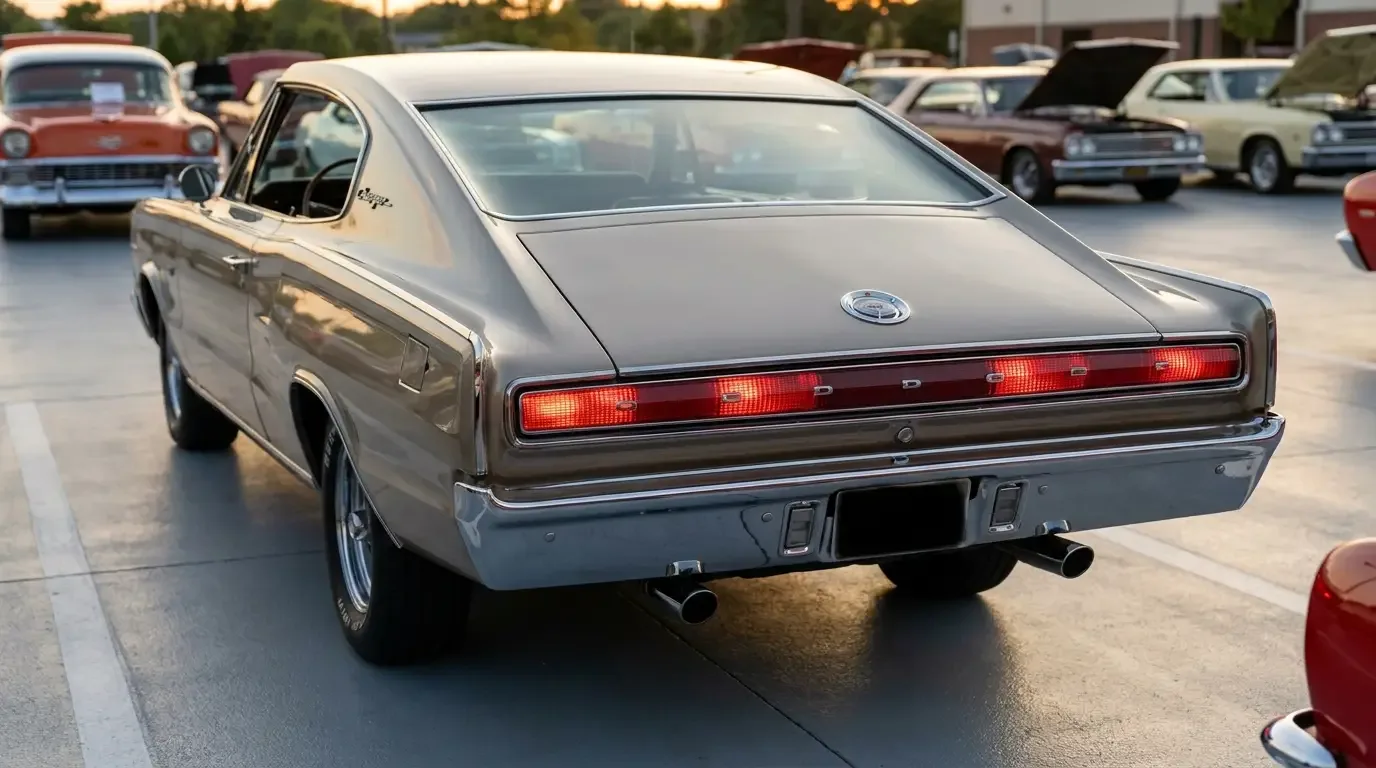
I've had my hands inside enough 1966 and 1967 Chargers to know the taillight is one of the first things people point at, and one of the last things they actually understand. Everybody remembers the fastback roof. Fewer people stop to look at what Dodge did across the whole rear panel, because it's not flashy in the way a hood scoop is flashy. It's just correct. That full-width red lens, running door to door with the exhaust tips and the Charger script tucked in the middle, was doing something the rest of Detroit hadn't figured out yet.
Most of Chrysler's competitors in 1966 were still running individual round or rectangular taillights stuck at the corners of the car, the way they'd done it since the 1950s. Dodge went the other direction on the first-gen Charger. One continuous lens, backlit evenly, no gaps. It reads as a single horizontal bar at night, which was the point. You can see the details in period photography and it still looks modern next to a 1966 Coronet parked beside it, even though they share the same B-body understructure.
How the lens actually works
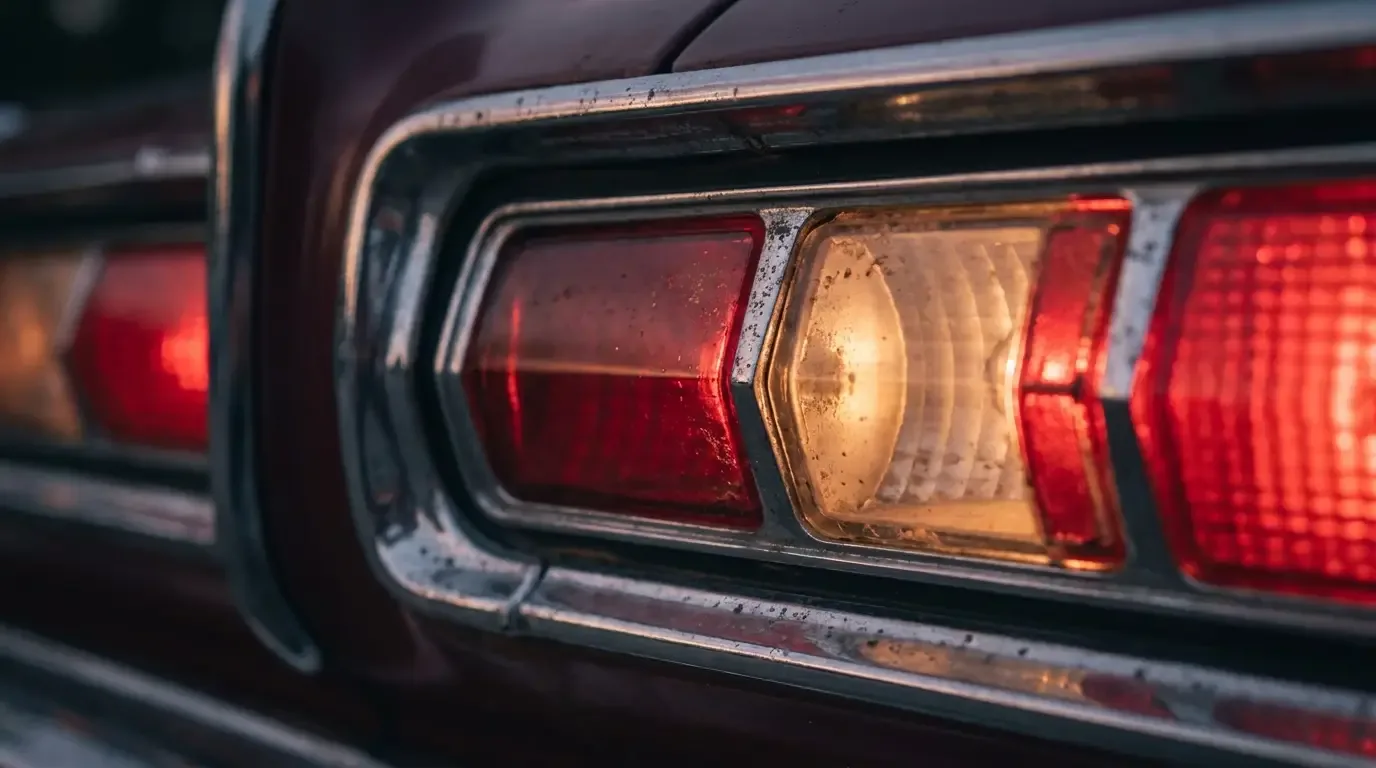
The taillight isn't one piece of plastic, whatever it looks like from fifteen feet away. It's a lens assembly built from several segmented sections mounted behind a chrome trim bezel that runs the width of the rear panel, with the fuel filler hidden behind a flip-down section of the driver's side lens on some cars, depending on year and trim. The backup lights are integrated into the inboard sections rather than added as an afterthought, which was unusual for the era. Bulbs sit behind the lens in individual pockets, and the whole assembly is sealed against the rear body panel with a gasket that, on a sixty-year-old car, has usually turned to something resembling a dried leaf.
That gasket failure is the first thing I check on any Charger somebody's trying to sell me as "all original." Water gets behind the lens, the reflective backing inside the housing starts to flake, and you end up with a taillight that looks dull and patchy even under fresh paint. A lot of restoration shops will tell you the lens itself is the expensive part. It's not, usually. It's the pot metal bezel and trim pieces that pit and corrode, and those are getting harder to source in good condition every year.
Why Dodge built it this way
The full-width taillight wasn't just styling for styling's sake. Dodge was trying to give the Charger a signature that separated it from every other Coronet-based car in the showroom, and a rear-end treatment is cheap advertising. You don't need to see the badge to know what's coming up behind you on the highway. That's the same thinking that put the hidden headlights up front and the electroluminescent gauge cluster in the dash. The whole car was designed around distinct identity markers you could recognize from a distance, front or back.
It worked. The taillight treatment became enough of a signature that when Dodge redesigned the Charger for 1968, they kept a version of the horizontal theme even as the rest of the body went to the coke-bottle shape with the tunnel-back window. That's not an accident. Somebody in Highland Park knew the rear end was one of the few things people remembered clearly about the first-gen car, even years later.
Original versus reproduction lenses
If you're buying a driver-quality 1966 or 1967 Charger today, expect the taillight lens to be either an original with visible age or a reproduction. Reproduction lenses have gotten decent over the past decade, but the fit against the trim bezel is rarely perfect, and the red tint on some batches runs a shade darker or lighter than factory. I've seen judged cars docked points for a reproduction lens that looked fine at a glance but read wrong under show lighting. If originality matters to you, or to a future buyer, an NOS or well-preserved original lens is worth chasing even at a premium price, often running to several hundred dollars per side depending on condition.
| Component | Notes | Common failure |
|---|---|---|
| Lens assembly | Segmented, full-width, integrated backup lights | Cracking, sun fade, discoloration |
| Chrome bezel | Pot metal, trims lens edge | Pitting, corrosion at mounting points |
| Sealing gasket | Rubber, seals lens to rear panel | Hardens and shrinks, lets water in |
| Reflective backing | Inside housing behind bulbs | Flaking, dulls output over time |
What to check before you buy
Pull the lens if the seller will let you, or at least get a flashlight behind it. Look for water staining on the trunk-side sheet metal below the taillight panel, because that's where a bad gasket dumps its water, and that metal rusts from the inside out before it ever shows on the surface. Check that both sides match in tint and clarity. Mismatched lenses, one original and one reproduction, are a common shortcut on cars that have had partial rear-end work, and it tells you the seller either didn't care enough to match them or couldn't find a matching original.
"The paint looks right at fifteen feet. Under the hood there's a rebuilt carb on an engine that hasn't seen fresh oil in two years. A taillight lens is no different. It looks fine until you get close, and by then you've already decided you like the car."
— Mike Sullivan
Living with it today
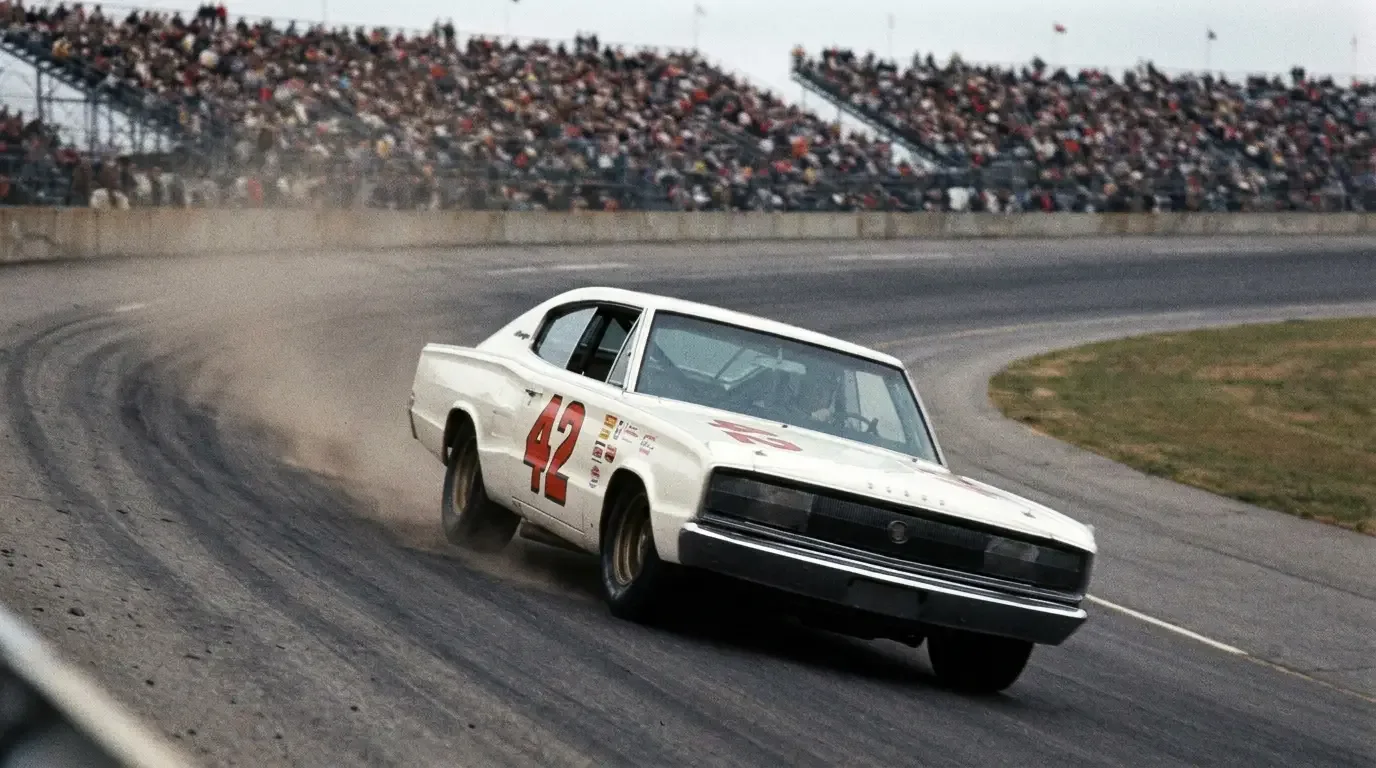
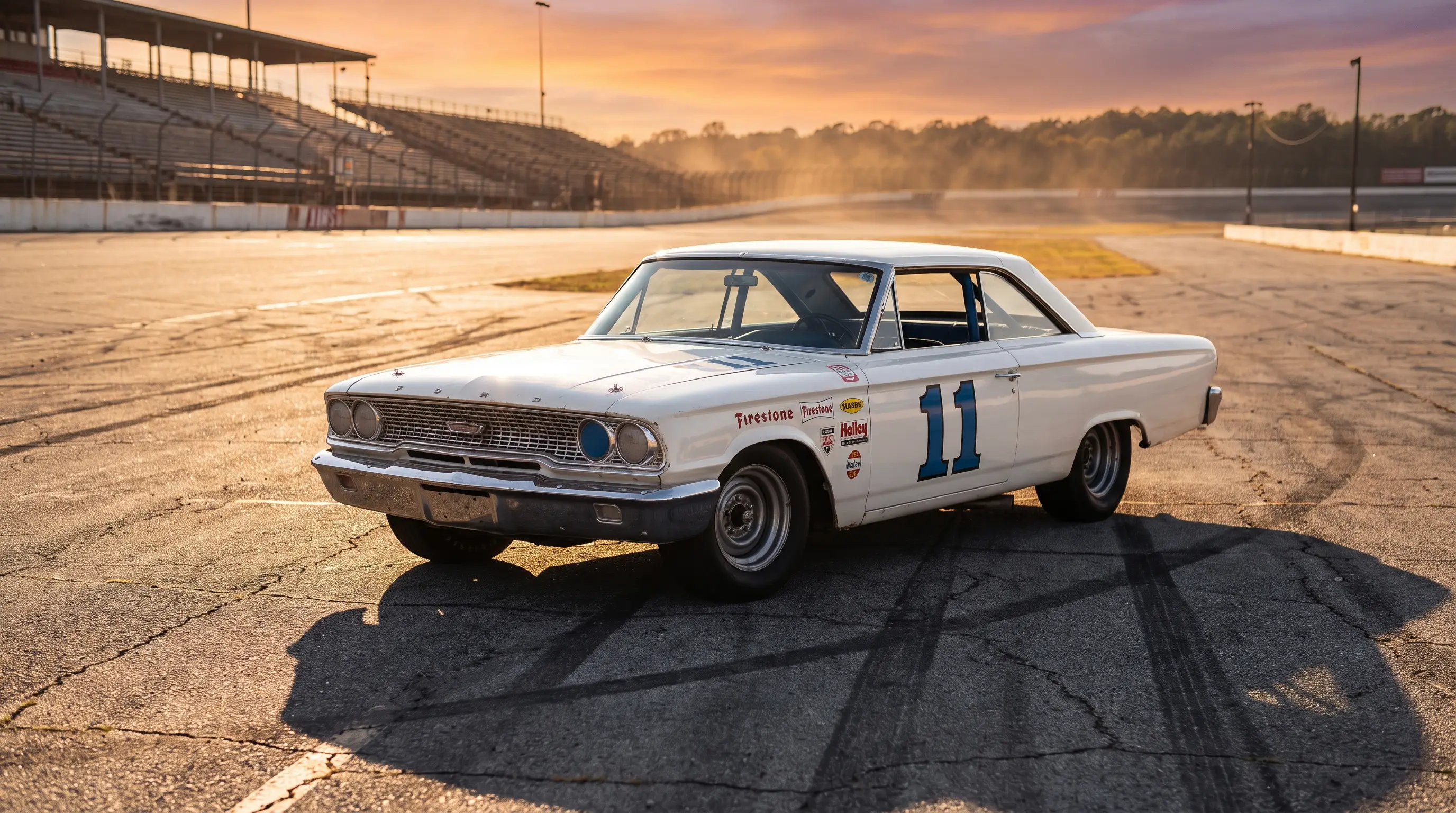
If you're running one of these cars regularly rather than trailering it to shows, budget for the gasket replacement early. It's not expensive labor, a few hours if the trunk trim comes off cleanly, but it's the kind of job that gets skipped because nothing looks broken from outside. By the time the lens itself is cloudy or the trim is bubbling with rust underneath, you're looking at real money instead of a ten-dollar gasket. This is the same logic that applies to 1966 charger nascar cars that raced hard and got worked on constantly. Small maintenance items got attention because ignoring them cost races. Street cars don't have that discipline built in, so it falls on the owner.
The full-width taillight is a small detail in the grand scheme of what makes a first-gen Charger worth owning, but it's exactly the kind of small detail that separates a car somebody actually understands from a car somebody just bought because it looked good in photos. Check it before you check anything else back there.
Sources and notes
- Dodge Charger (1966) - Wikipedia - confirmed the full-width six-lamp taillight with chromed "CHARGER" lettering and the first-gen body details.
- Ate Up With Motor - 1966-1967 Charger history - confirmed the full-width taillight's six bulbs and the car's overall design rationale.
- Muscle Car Facts - 1966 Charger - cross-checked trim, options, and first-gen production context.
- Horsepower Memories - 1966-1967 Dodge Charger - background on the fastback body and its distinguishing exterior details.
- automobile-catalog - 1966 Charger 426 Street Hemi - reference for first-gen dimensions and construction of the era.