
The story I keep coming back to is the one about the wing that wasn't there yet. In 1966, Dodge showed up to NASCAR superspeedways with a car that looked like nothing else on the grid, a fastback with a roofline that swept down into that full-width taillight, and for about half a season nobody quite understood why it wanted to leave the ground at 180 miles an hour.
Car Features
6 min read
NASCAR's First Charger and the 1966 Aero Experiment
The 1966 Charger looked incredible on the showroom floor and unsettled at 180 miles an hour, a lesson that shaped Dodge's aero wars years later.
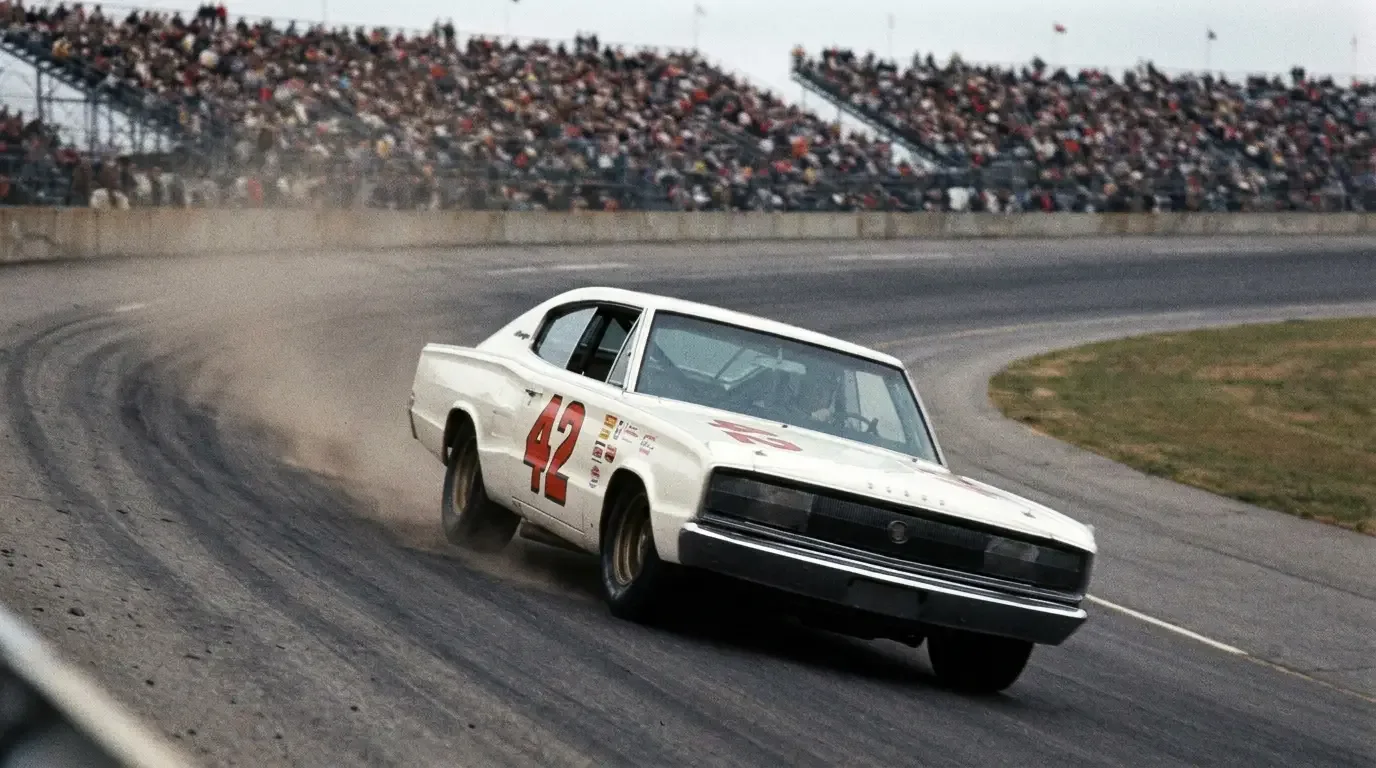
Richard Petty had already put the Hemi on the map in 1964, and by 1966 Dodge wanted its own version of that story with the new Charger. The car had the engine. What it didn't have, at first, was the aerodynamic manners to go with it. Drivers came off Daytona and Charlotte talking about a car that felt light in the back end at speed, and that's not a complaint you want to hear about a race car built to run flat out for 500 miles. For more on the first-gen Charger, the road-car story runs parallel to what was happening on the track that same season.
A fastback that fought itself
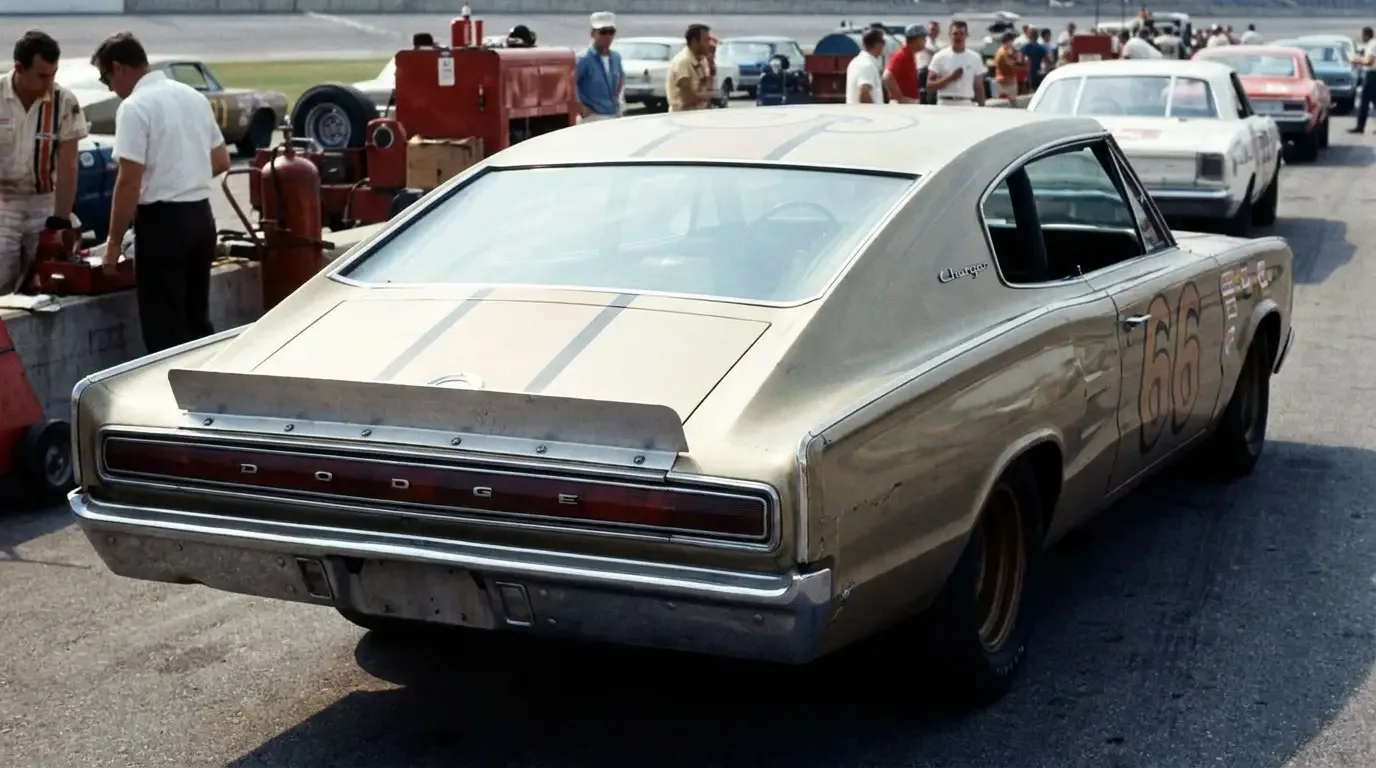
Here's the part that took me a while to fully appreciate. The same sloped roofline that made the Charger look so good on a showroom floor was working against it on a superspeedway. Air moving over that fastback shape wanted to separate from the sheet metal before it got to the tail, and that separation created lift right where you don't want it, over the rear wheels, at the exact moment a stock car needs the most grip. Drivers like David Pearson and Bobby Isaac were running Chargers that season, and the feedback coming back to the Dodge camp was consistent: stable through the corners, nervous down the straights when the speed built up.
The fix, for 1966, wasn't elegant. Teams added a small lip spoiler to the trailing edge of the trunk lid, sometimes just a strip of aluminum bent up at an angle and bolted on, to try to break up that lift before it got out of hand. It helped. It didn't solve the underlying problem, which was that the whole rear third of the car was shaped like something that wanted to fly a little at the wrong moment. That's a strange thing to say about a car built to stay on the ground, but that's racing at 180 miles an hour. Small shapes matter enormously.
What the Charger actually accomplished that year
It's easy, looking back from 2026, to focus only on the aerodynamic headaches and miss that the 1966 Charger still won races. The Hemi engine underneath all of it was strong enough to compete even while the body was still being figured out, and Dodge treated the season as exactly what it was: a first attempt at a shape nobody in Highland Park had tested in a wind tunnel the way later aero cars would be. David Pearson took the 1966 NASCAR Grand National championship driving for the Cotton Owens team, racking up 15 wins across a mix of Chargers and Coronets, and the fastback proved competitive enough to convince Dodge the approach was worth refining rather than abandoning.
What matters for the bigger story is what came after. The lessons from that first season, the lift over the rear axle, the instability at speed that didn't show up until a car was running flat out for hours, fed directly into how Dodge and Plymouth approached the aero wars that followed. You can trace a direct line from a bolted-on spoiler on a 1966 Charger to the nose cones and towering rear wings that showed up a few years later on the winged cars. Nobody sets out to build a Daytona or a Superbird. You get there by losing time in 1966 and refusing to accept it.
The drivers who lived it
I talked to a longtime Mopar racing historian a few years back who put it simply: the guys behind the wheel in 1966 weren't thinking about wind tunnels. They were thinking about whether the car would still be pointed straight when they lifted off the throttle entering a corner at 170 miles an hour with the field bunched up around them. That's a visceral kind of engineering feedback, and it's the reason the aero problems on the early Charger got fixed as fast as they did. Nobody wanted to have that conversation twice.
"The guy I talked to at a Mopar reunion a few years back had crewed on one of those 1966 cars, and he told me the drivers knew something was wrong before the engineers had a name for it. That's how a lot of racing history actually gets written, not in a lab, but in a driver's seat at speed."
Patrick Walsh
Why this still matters to Charger owners
If you own or want to own a first-gen Charger today, this isn't just trivia. It's part of what makes the car interesting beyond its styling. The 1966-67 body isn't remembered the way the 1968-70 generation is, and part of the reason is that the second-gen car benefited directly from what Dodge learned fighting these aerodynamic problems on the track. You can read more here about how the first-gen car carved out its own identity on the street even while the race program was still working out the kinks at speed.
The full story of how this rivalry escalated into nose cones, towering wings, and cars purpose-built to break 200 miles an hour is covered in depth in the Daytona aero-wars feature. But it starts here, with a fastback that looked incredible and handled like it had a mind of its own at speed, and a group of engineers and drivers who spent one hard season figuring out why.
Sources and notes
- Dodge Charger (1966) - Wikipedia - confirmed the fastback's high-speed lift, the trunk-lid lip spoiler, and David Pearson's 1966 Grand National title.
- Cotton Owens Garage - 1966 Charger race car - confirmed the period-correct NASCAR rear spoiler on the trunk lid and quarter panels, and Pearson's championship car.
- Cotton Owens Garage - David Pearson - confirmed Pearson's 15 wins and the 1966 championship for the Owens team.
- Ate Up With Motor - 1966-1967 Charger history - confirmed the fastback roofline generated enough lift to make the rear tires' grip tenuous at speed.
- Old Cars Weekly - 1966 Pearson-Owens Charger - background on the Pearson/Owens Dodge program and the car's racing season.
Related Reading
Have a
Dodge Charger
for Sale?
Reach thousands of serious classic car collectors across the US.
Sell It Here →
Are You a Classic Car Dealer?
List your full inventory and connect with targeted classic car buyers.
Join as a Dealer →
#aero wars
#1966 dodge charger
#first generation charger
#charger nascar history
#Mopar racing
#David Pearson
#Charger aerodynamics
#stock car racing 1966

About the author
Patrick Walsh
Automotive journalist covering classic car shows, events, and the enthusiast community across North America.
Related Listings - Dodge Charger
Comments
Be the first to comment on this article.