The Big Three did not have the American car market to themselves after the war, not at first. Studebaker, Nash, Hudson, Packard, Kaiser-Frazer, Willys, and Crosley all fielded full lineups in the late 1940s, and for a few years the sales charts actually reflected that. Pent-up demand meant almost anything with four wheels and a waiting list sold, and the independents rode that wave as hard as General Motors, Ford, and Chrysler did.
What makes this period worth tracking closely is how briefly the window stayed open. The independents had real engineering talent and, for a moment, real market share. Then the arithmetic of Detroit caught up with them. Understanding why is as much about production economics as it is about the cars themselves, and it sets up the post war independent car brands guide if you want the wider decade first.
Who the independents actually were
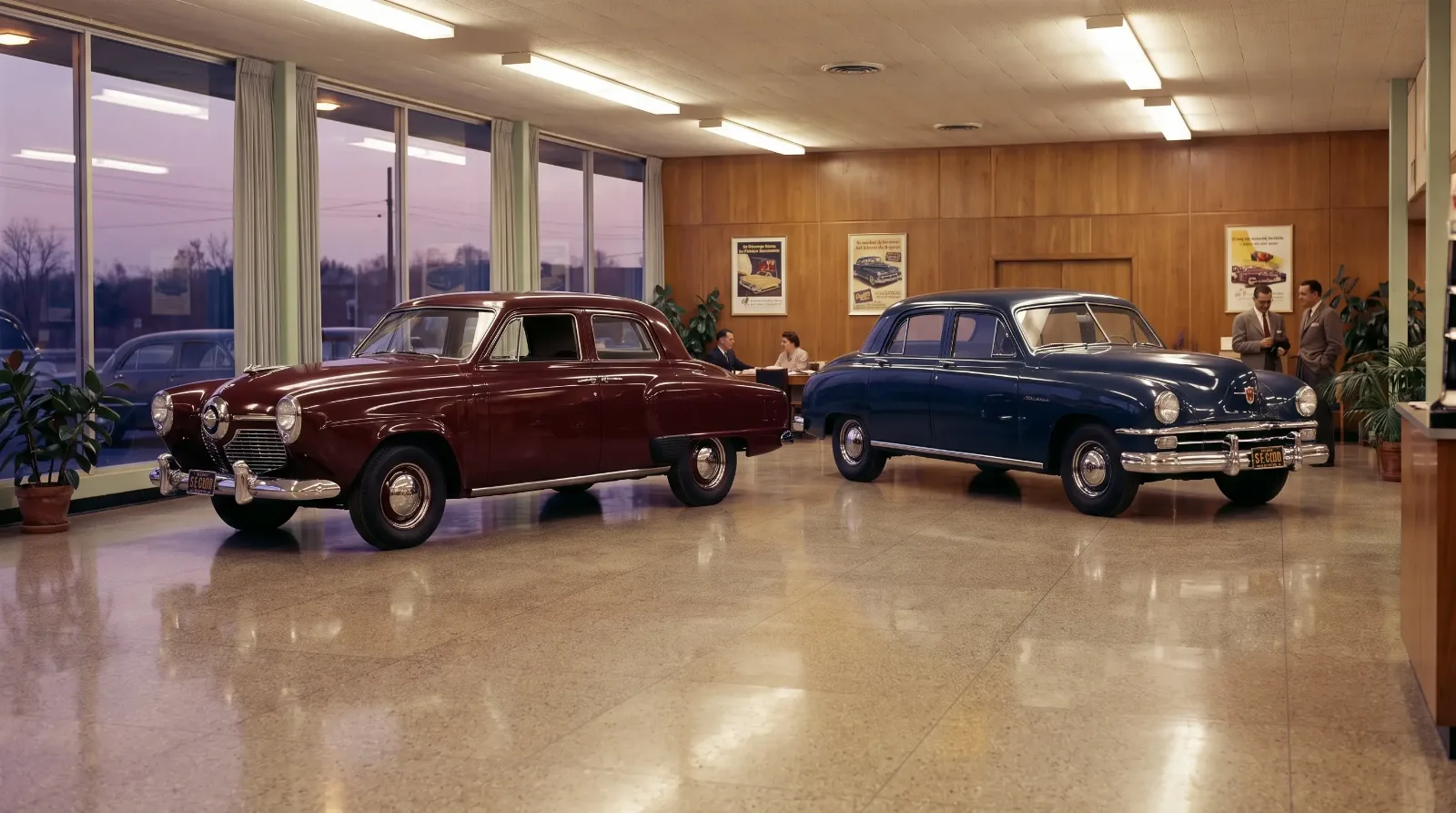
Studebaker moved first and moved smart. Its 1947 models reached dealers before the Big Three had finished retooling from wartime production, giving Studebaker a genuine head start with a car that looked and felt new when competitors were still selling warmed-over 1942 designs. Nash built solid, efficient cars and would go on to pioneer the compact segment with the Rambler. Hudson had the step-down unibody design, low and rigid, that gave it a handling advantage on the street and on the track. Packard still carried prestige from its pre-war luxury standing, though that standing was starting to erode. Kaiser-Frazer was the newest name in the group, a genuine startup automaker backed by industrialist Henry Kaiser, building cars from a standing start rather than a pre-war base.
Each of these companies made a real product decision in the late 1940s, and each bet reveals something about how they read the market. Studebaker bet on styling and speed to market. Hudson bet on engineering distinctiveness. Nash bet on efficiency and later on the compact idea. Kaiser-Frazer bet that a fresh company with no legacy tooling could compete on modern design alone. Only some of those bets paid off long term.
Why the postwar boom favored them, briefly
From roughly 1946 through 1948, American car buyers faced genuine scarcity. Wartime production had gone entirely to tanks, planes, and ordnance, and civilian car assembly had been halted for years. When it resumed, demand vastly outran supply, and buyers took what they could get. That leveled the field in a way that would not last. A Studebaker or a Kaiser sold nearly as fast as a Chevrolet or a Ford, because the alternative for many buyers was no new car at all.
The independents used that window well in specific ways. Studebaker's early-to-market 1947 design gave it a styling lead that lasted a couple of years. Kaiser-Frazer, with no old tooling to amortize, came out with clean, modern bodies that looked more contemporary than some Big Three offerings still riding on pre-war platforms. For a company with no prior car business, Kaiser-Frazer's early sales numbers were genuinely impressive: it built roughly 145,000 cars in the 1947 model year alone, making it the top-selling independent automaker in the country that year.
Where the model changed against them
The scarcity era ended once the Big Three caught up on production and rolled out genuinely new postwar designs of their own. When that happened, the independents were competing on the actual merits again, and the merits favored scale. General Motors, Ford, and Chrysler could spread tooling costs, dealer networks, and advertising budgets across far higher volumes. An independent selling a fraction of the units still had to fund a full engineering and styling program, and that math got harder every year prices and expectations rose.
Hudson's step-down design is a good case study in engineering strength not being enough on its own. The unibody chassis sat the passenger compartment down between the frame rails rather than on top of them, lowering the center of gravity and giving the car a real handling edge that showed up on the stock car racing circuit. It was a genuinely clever piece of engineering. It also could not, by itself, offset the cost disadvantage of being a smaller producer competing against Detroit's giants.
"I look at Kaiser and Hudson and Studebaker the way I look at any small company up against giants with better cost structures. Good engineering bought them a few years. It did not buy them the volume they needed to survive on their own terms."
— David Mercer
What happened to each of them
Nash and Hudson merged in 1954 to form American Motors, a defensive consolidation that let the combined company survive longer than either would have alone, largely on the strength of Nash's later Rambler compact strategy. Studebaker merged with Packard in 1954 as well, though that pairing struggled and Studebaker limped on in reduced form into the 1960s before closing its American operations. Kaiser-Frazer exited the passenger car business in the United States by the mid-1950s, though the Kaiser name continued in other ventures. Willys focused increasingly on the Jeep line, which turned out to be the more durable asset. Crosley, the smallest of the group with its economy cars, folded operations in 1952.
The pattern across nearly every one of these companies is the same: a genuine postwar sales window, a real engineering or styling advantage, and then a slow loss of ground once volume economics reasserted themselves. None of them lacked talent. What they lacked was the scale to survive on talent alone once the scarcity years ended.
What that means for collectors today
Cars from these independents occupy an interesting niche in the collector market. They are less common than equivalent Big Three models from the same years, simply because fewer were built, and that scarcity has real appeal to buyers who want something their neighbor is not driving. A well-kept Hudson step-down or an early Kaiser has genuine engineering and design interest behind it, not just novelty.
Values on these cars tend to run below comparable Big Three offerings from the same period, in part because parts and specialist knowledge are thinner on the ground, which matters if you plan to drive the car rather than display it. That is worth weighing carefully before you buy, since ownership cost is not just the purchase price. If you want to see how the era's biggest sales stories shaped up on the collector side, the next installment covers the cars from these years that command the strongest interest now.