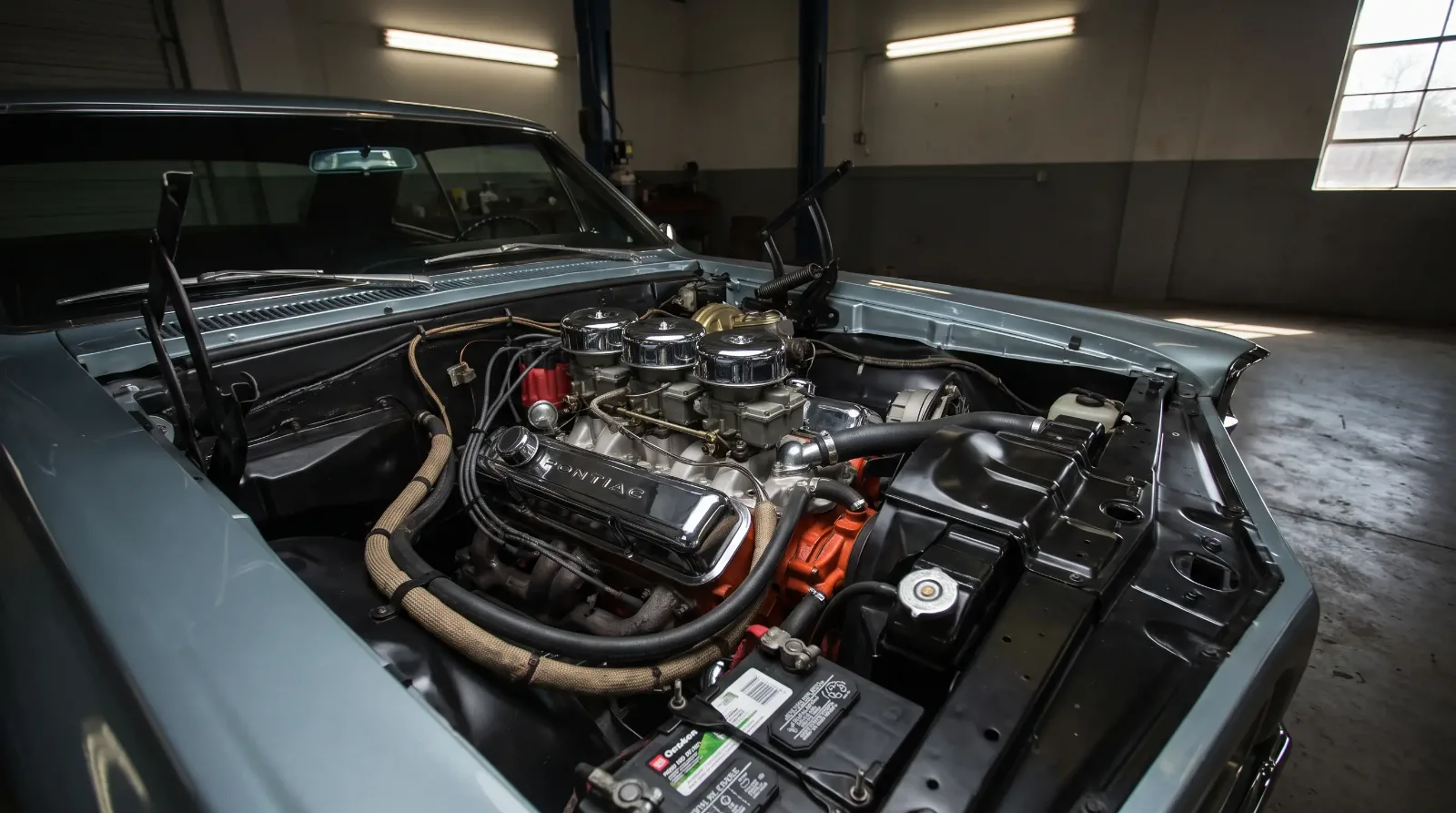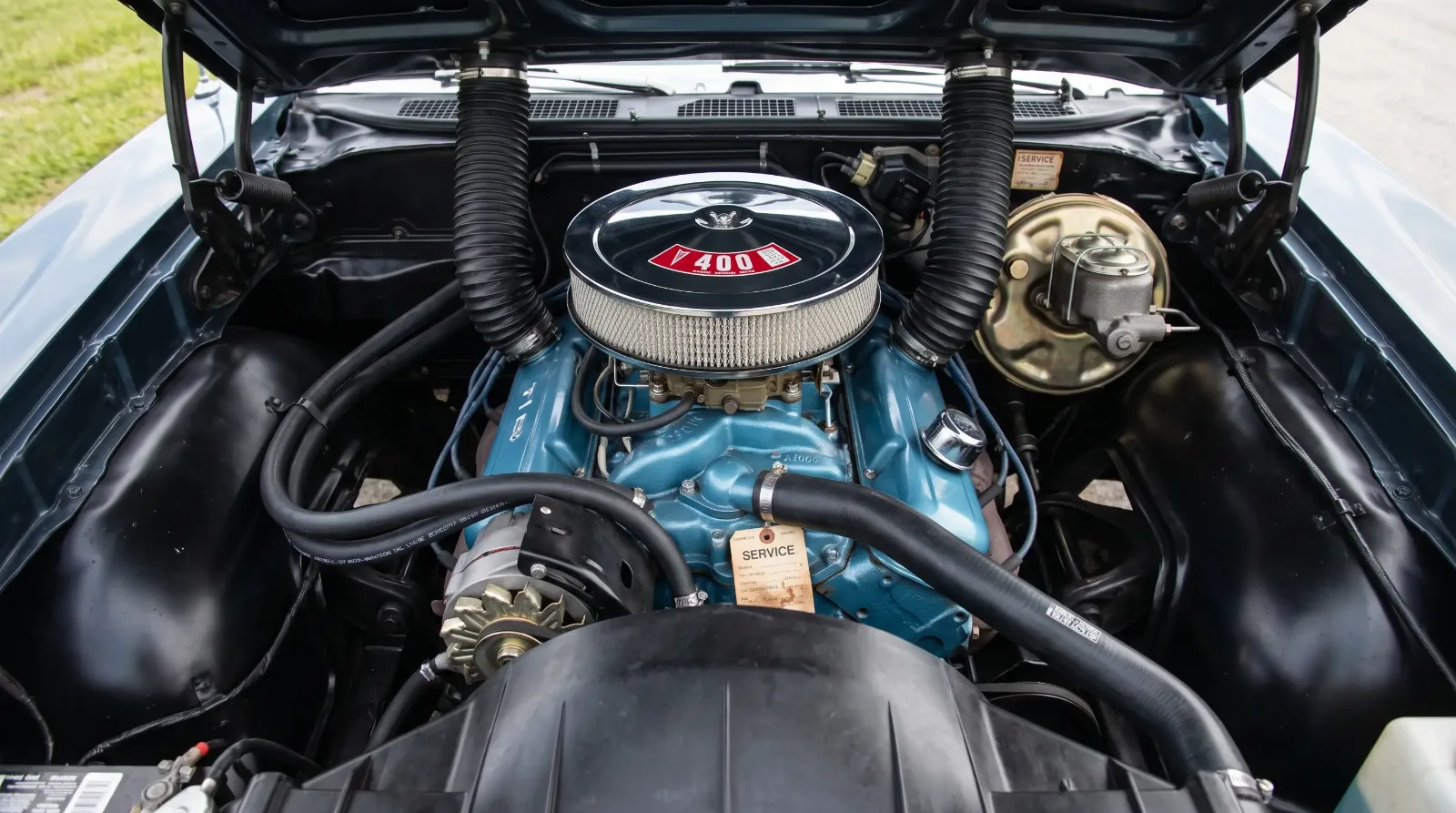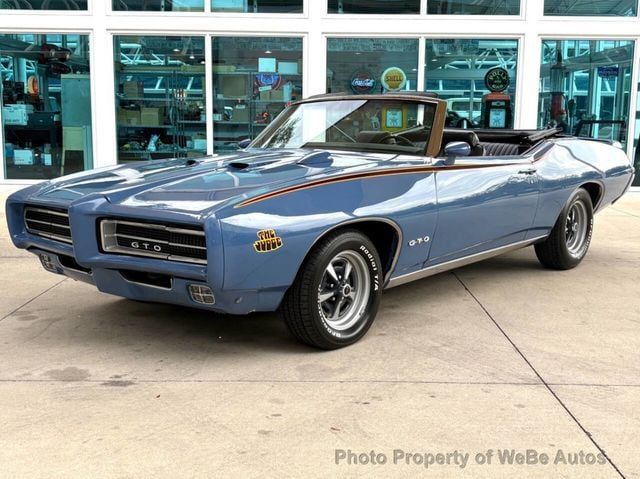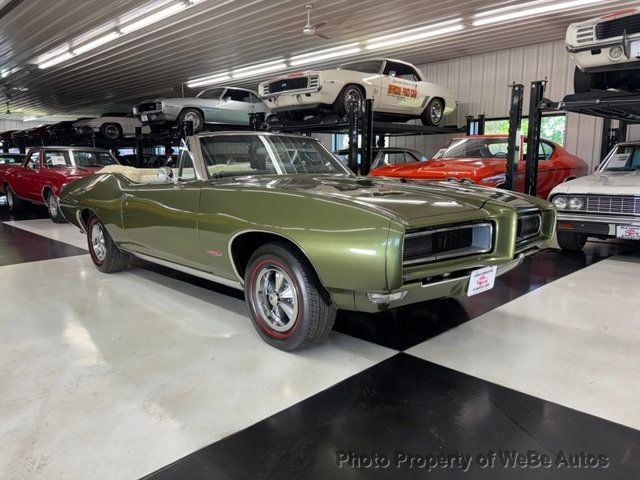
Every GTO registry, every club newsletter, every serious appraisal starts talking differently the moment a Ram Air IV comes up. This wasn't a mass-production engine, and it wasn't meant to be. It was Pontiac's answer to the question of how far a factory 400 could realistically be pushed while still being sold over the counter to a regular customer, and the documentation trail around these cars reflects just how seriously collectors take getting the details right.
An engine built for the top of the rev range
The core of the Ram Air IV story is a set of cylinder heads reworked for airflow at rpm levels most 400-cubic-inch engines of the era never saw regularly. Larger valves, revised ports, and a camshaft with more aggressive lift and duration than the Ram Air III gave this engine a completely different personality. It wasn't the engine you wanted for smooth, lazy cruising. It was the engine you wanted if you planned to keep your foot in it and let the tachometer climb past where most factory muscle car engines started running out of breath.
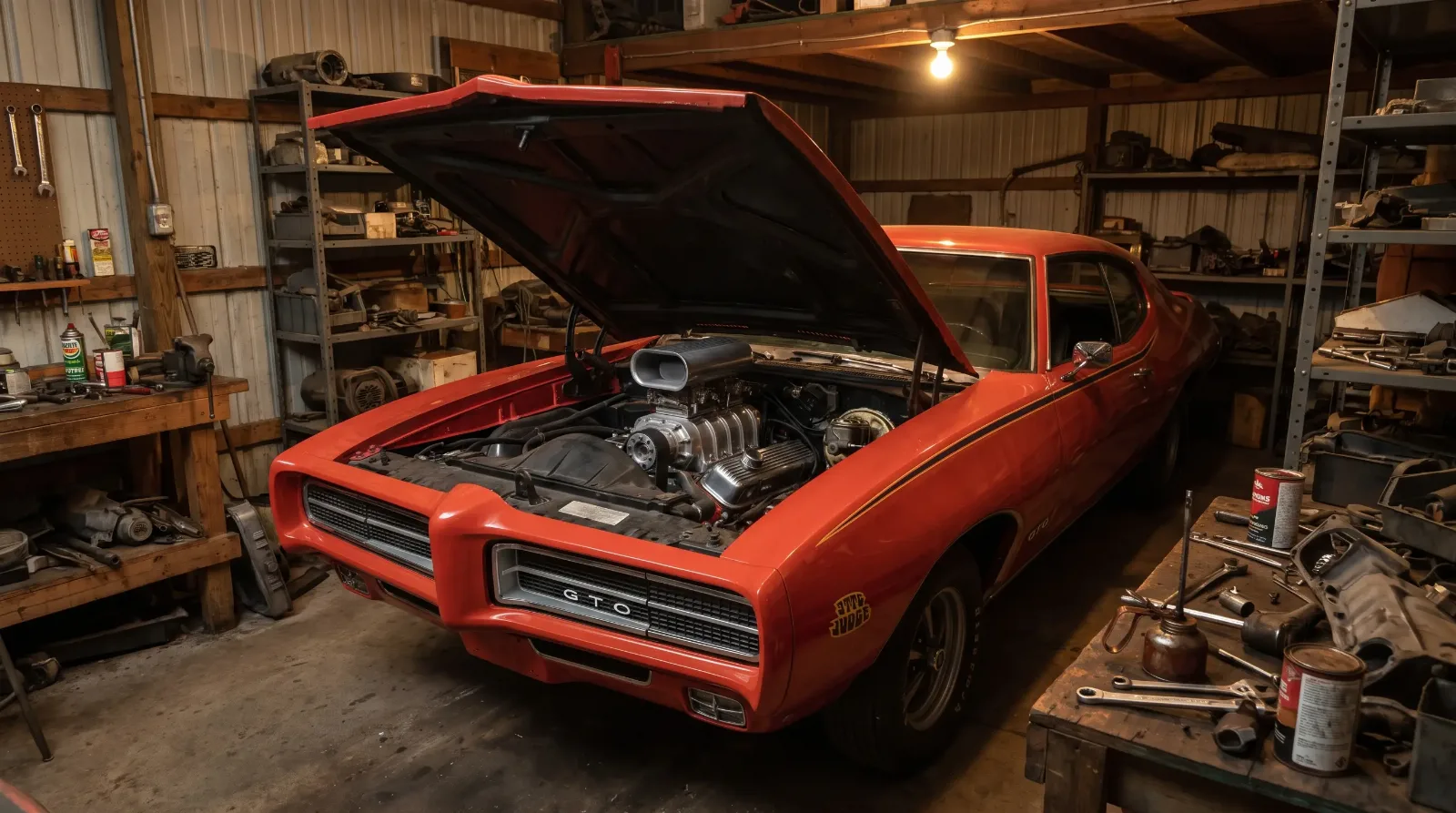
Pontiac paired this top-end-focused hardware with an aluminum intake manifold, a genuinely meaningful weight savings over the cast-iron piece used on lesser 400 variants, and functional Ram Air induction feeding cool outside air through hood-mounted scoops directly to the carburetor. Rated output landed at 370 gross horsepower and 445 lb-ft of torque, a figure that undersells how the engine actually behaved once it got up into its working range.
How rare is rare
Production numbers for Ram Air IV-equipped GTOs were low relative to the model's overall output across the years it was offered. In 1969, roughly 300 GTOs left the factory with the Ram Air IV, split between Judge and non-Judge cars, and 1970 landed in a similar range, with only a few hundred cars across both trims and just a handful of Judge convertibles built with the engine each year. It was never the volume seller, and it wasn't meant to be. Pontiac offered it as the serious option for buyers who understood exactly what they were ordering and were willing to live with a less tractable street engine in exchange for real high-rpm performance. That scarcity is the foundation of everything that follows in today's collector market, from pricing to the intensity of documentation scrutiny before a sale.
| Feature | Ram Air IV specification |
|---|---|
| Intake manifold | Aluminum |
| Cylinder heads | Round-port, reworked for high-rpm flow |
| Camshaft | High lift, longer duration |
| Rated horsepower | 370 hp gross |
| Typical transmission pairing | Close-ratio 4-speed manual, favored over automatic |
What the registries and clubs actually check
Because Ram Air IV cars carry such a premium, and because the parts that define the engine, the heads and the intake manifold specifically, can be sourced separately and installed on a lesser 400, verification has become a genuine discipline within GTO ownership circles. Serious buyers cross-reference block casting numbers, cylinder head casting numbers, and the car's original build sheet or PHS documentation before treating a car as a true, numbers-matching Ram Air IV. This isn't paranoia. It's a reasonable response to how much money separates a correctly documented car from one wearing the right parts without the paper trail to back them up.
"The engine tells you the truth if you know how to read it. Casting numbers, date codes, the way the heads were machined. I've turned down cars represented as Ram Air IV because the numbers didn't add up, and I've found real ones sitting overlooked because the seller didn't know what they had. Do the homework either way."
— Wayne Coburn
The Judge connection worth knowing
Ram Air IV wasn't exclusive to any single GTO trim, but it's closely associated in enthusiast circles with the more performance-focused end of the lineup, including cars ordered with The Judge package. That association has done as much for the engine's reputation as anything on a spec sheet. A documented Judge with a correct, verified Ram Air IV underneath sits near the very top of what collectors chase in this entire silo, combining the visual and marketing punch of The Judge with the mechanical substance of Pontiac's most serious factory 400. Buyers should understand, though, that Ram Air IV also appeared in GTOs without Judge equipment, and those cars deserve just as much respect from a mechanical standpoint even without the stripes and the spoiler drawing attention.
This distinction matters because the market sometimes conflates the two, treating any Judge as automatically more valuable than any non-Judge Ram Air IV car regardless of condition or documentation quality. A well-documented, mechanically correct Ram Air IV in a plainer body is arguably the better buy for someone who cares more about the engine and the driving experience than the visual statement. Know which one you're actually chasing before you start shopping, because the two goals lead to different cars and different price expectations.
Owning one and keeping it right
A correctly sorted Ram Air IV rewards an owner who understands what it wants. It likes to be driven with some enthusiasm rather than babied at low rpm constantly, and a car that spends its life idling in parking lots isn't doing the engine any favors long term compared to one that gets exercised the way it was designed to run. Parts for the specific high-performance pieces, the aluminum intake, the correct heads, the specific camshaft, are more expensive and harder to source correctly than equivalent parts for a base 400 or even a Ram Air III, so budget accordingly if a rebuild is ever needed.
This engine sits at one end of a spectrum that starts with the original 389 and runs through the 400 and eventually the 455, each one telling a different part of how Pontiac balanced performance, cost, and regulation across the GTO's production life. For the complete arc of that story, the GTO engine story covers every generation, and for the origin of the model that made all of this possible in the first place, how the GTO began is worth reading as the foundation piece for this entire silo.
Where the story goes from here
By 1970, Pontiac shifted its performance flagship focus toward the newly introduced 455, a bigger-displacement engine built more around torque and less around the high-rpm character that defined the Ram Air IV. That transition marks a real turning point in what the GTO was becoming as the muscle car era approached its regulatory and insurance-driven ceiling. so, read on to see how the 455 stacked up against the 400 it eventually overshadowed as Pontiac's big-block flagship.