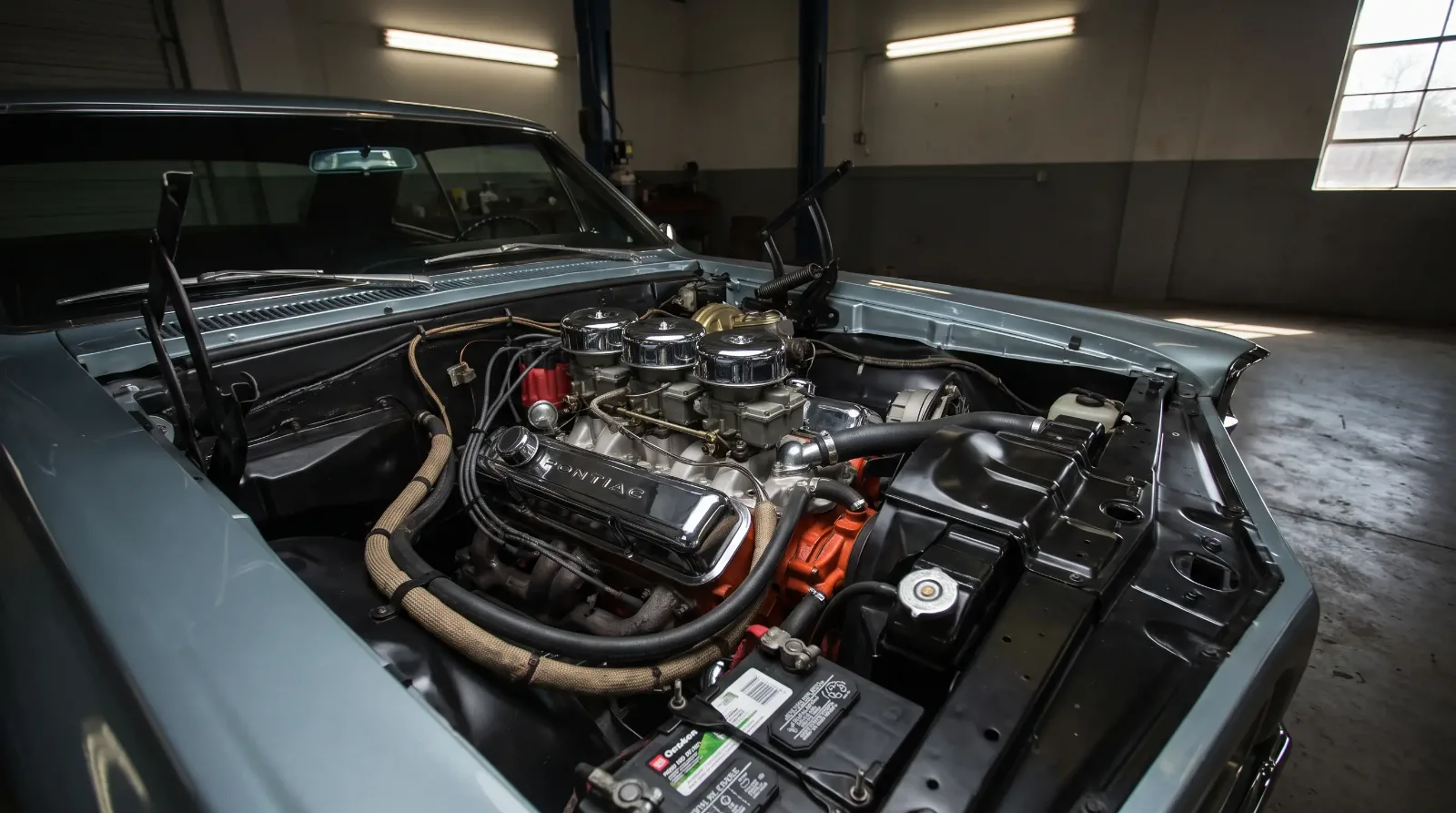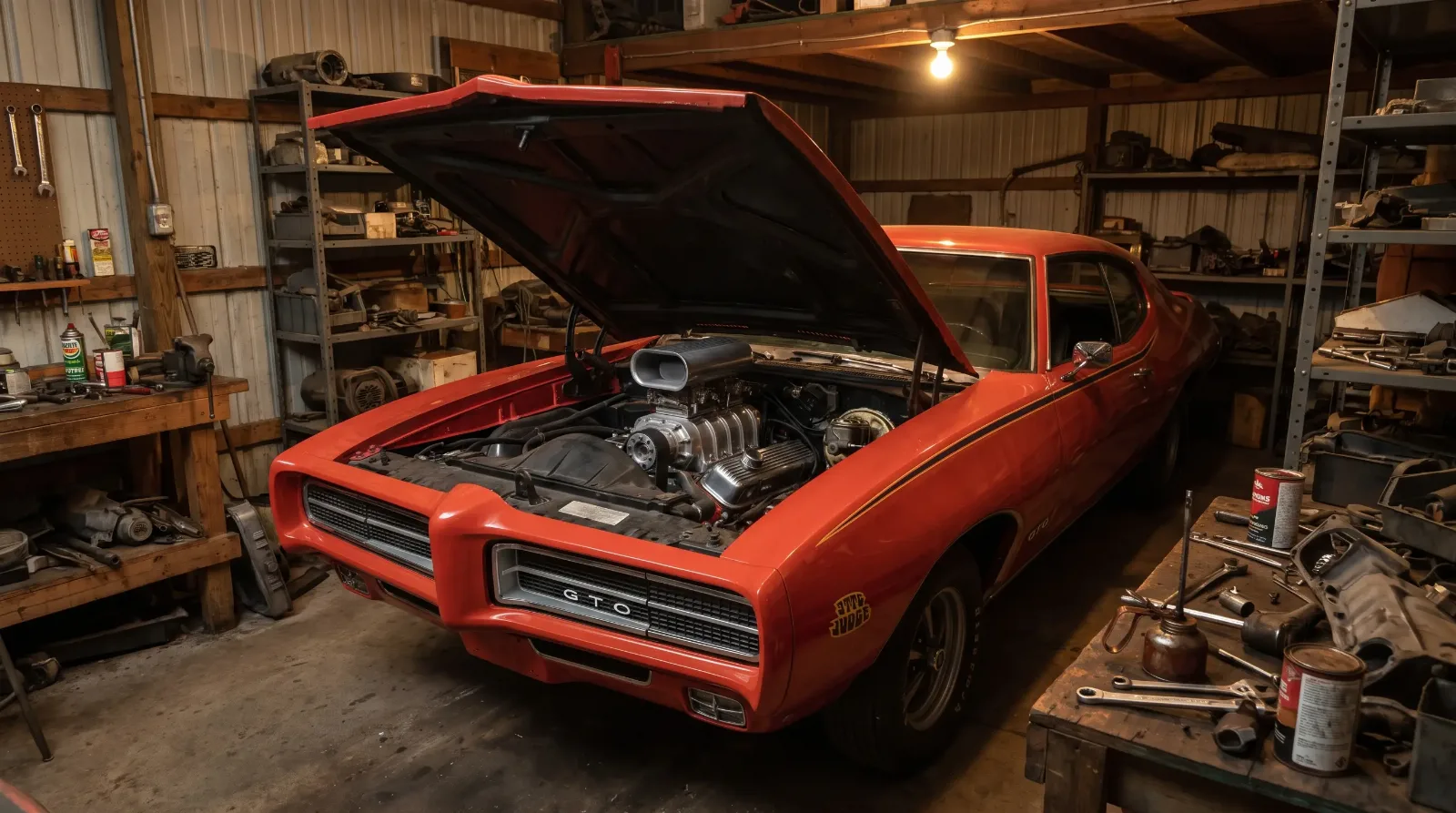
By 1970, the muscle car math had changed. Insurance companies were pricing high-horsepower cars into a corner, emissions regulations were tightening year over year, and the industry-wide answer, Pontiac's included, was to lean on displacement rather than high-rpm tricks to keep performance numbers respectable. That's the environment the 455 was born into, and it's the reason comparing it to the 400 it eventually replaced as flagship isn't as simple as bigger-number-wins.
Two different philosophies under the hood
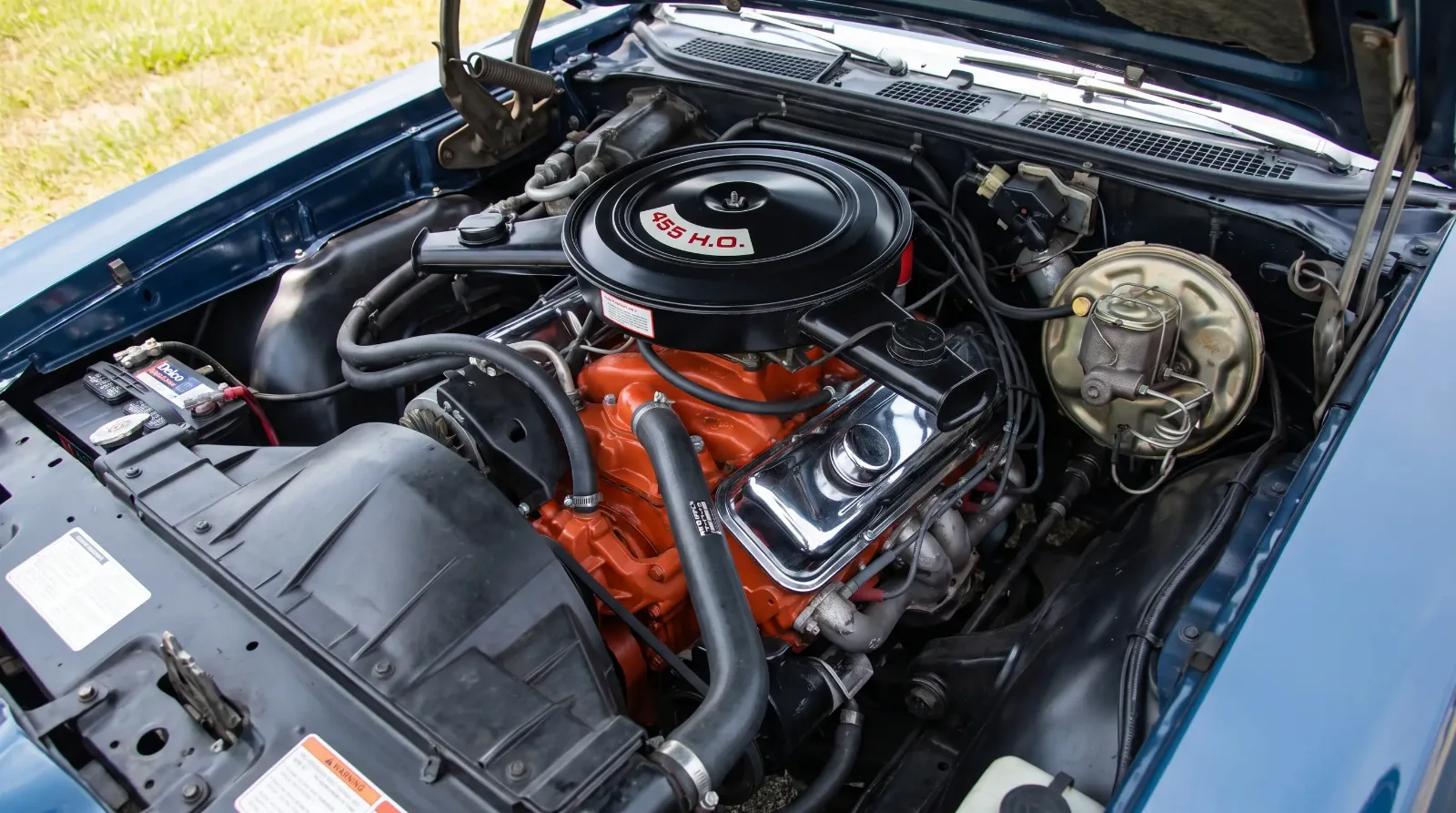
The 400, in its various states of tune covered in Pontiac's GTO engines lineup, was built around a philosophy of revving. The Ram Air III and Ram Air IV variants in particular wanted rpm, and they made their best power well up in the range where a lot of period big-block engines had already run out of breath. The 455, by contrast, was built around torque delivered low and pulled hard through the middle of the rev range, a completely different way of getting a heavy car moving quickly.
Displacement grew from 400 to 455 cubic inches through a longer stroke rather than dramatically more bore, which is exactly the recipe for more torque at lower rpm rather than a higher-revving engine. That's not a knock on the 455. It's a description of what the engineers were actually trying to accomplish, and it worked. A 455-powered GTO pulls hard from just off idle in a way a high-strung Ram Air IV never quite matches at the same rpm.
| Spec | 400 (Ram Air III) | 455 HO |
|---|---|---|
| Displacement | 400 cid | 455 cid |
| Horsepower (gross) | 366 hp | 360 hp |
| Torque (gross) | 445 lb-ft | 500 lb-ft |
| Power delivery | Rewards high rpm | Strong from low rpm |
| Introduced | 1967 | 1970 |
Notice the horsepower numbers don't tell a dramatic story by themselves. The 455 HO's 360 gross horsepower actually sits a touch below the Ram Air III's 366, and neither approaches the Ram Air IV's 370. Torque is where the 455's real personality shows up: 500 lb-ft against the Ram Air III's 445, and that's what most drivers actually feel from behind the wheel in daily, real-world driving rather than a dyno chart.
The compression and fuel reality
Both engines lived through the same industry-wide compression squeeze as the early 1970s progressed and unleaded, lower-octane fuel became the standard. Neither the late 400 nor the 455 ran the aggressive compression ratios of the mid-1960s 389 or the early Ram Air engines, and that shows up in how each behaves. Neither is going to feel as edgy as an early Tri-Power car revving through its powerband. What the 455 offers instead is effortless, low-rpm shove that doesn't demand the driver work for it the way the earlier high-compression, high-rpm engines did.
"People ask me which engine is 'better' like there's one answer. The 455 pulls like a freight train from 1,500 rpm. The Ram Air 400s want to be wound out and rewarded for it. Different tools, different jobs. I've owned both and I still can't pick a favorite."
— Dan Reeves
Weight, handling, and what changes with the bigger engine
A 455 is a heavier engine than a 400, and that weight sits over the front axle in a way that does affect how the car turns in and handles compared to a lighter-engined GTO. It's not a dramatic difference, and most drivers who aren't actively autocrossing the car won't notice much beyond slightly heavier steering feel at low speed. For a car mostly driven in a straight line, or driven for the pleasure of the engine's character rather than corner-carving, the tradeoff favors the 455 without much downside.
Reliability and ownership differences
Both engines share enough architecture and parts commonality that neither one is a nightmare to maintain, but they do age a little differently in practice. The 455's lower state of tune in most applications means it tends to run cooler and tolerate stop-and-go traffic a bit better than a highly tuned Ram Air 400, which can run hotter under the same conditions given its more aggressive cam timing and higher operating rpm range. Owners who plan to actually drive their GTO regularly, not just show it, often find the 455 the less fussy engine to live with week to week.
On the other hand, the 455's added weight and larger displacement do put slightly more strain on transmissions and rear-end components not upgraded to handle the extra torque, particularly on cars that still carry an original, lower-capacity driveline. It's worth checking whether a 455-equipped car has had its transmission or rear gear set upgraded to handle the engine's output, especially on a car that's seen hard use or drag strip time over the decades. A worn original driveline paired with a strong-running 455 is a common combination that needs attention sooner rather than later.
Which one makes sense for a buyer
If the priority is a numbers-matching, historically significant high-performance engine with real collector cachet, a documented Ram Air III or IV 400 has an edge in prestige and, often, in resale value at the very top of the market. If the priority is an engine that's genuinely enjoyable and easy to drive hard on a real road without needing to keep the tachometer near redline to feel the power, the 455 is arguably the more satisfying daily proposition, and it's frequently more affordable to buy into than a documented Ram Air car.
There's also a simpler, more personal way to decide, and it's the one most buyers end up using anyway: drive both if you can. Numbers on a page, mine included, only get a shopper so far. The 400's willingness to rev and the 455's shove off the line feel completely different from the driver's seat in ways that a spec table can gesture at but never fully capture. Buy the one that matches how you actually want to drive on a Sunday afternoon, not the one that wins an argument on a forum.
Neither engine tells the whole story of GTO performance by itself. Rated horsepower figures from this era, especially comparing a 1969 400 to a 1972 455, get complicated by a change in how the industry measured and reported power in the first place. so, read on for the real numbers behind every GTO model year, and why some of the later cars look weaker on paper than they actually were on the road.