1969 road runner production numbers tell a story that the styling and engine options alone cannot. Plymouth built the Road Runner for its second full model year in numbers that dwarfed the original 1968 launch, and those figures explain why 1969 remains the year every serious collector points to when they talk about the nameplate's commercial peak. Understanding how the factory built these cars, across three body styles and a widening menu of engines, is essential to understanding why certain 1969 Road Runners command real money today while others remain accessible entry points into the hobby.
How volume grew from 1968 to 1969
The original 1968 Road Runner, offered strictly as a pillared coupe, exceeded Plymouth's own sales projections almost immediately, proving there was real demand for a stripped down, honestly priced muscle car built around straight line performance rather than luxury trim. Plymouth's product planners responded for 1969 by expanding the body style lineup to include a pillarless hardtop and a convertible, broadening the car's appeal well beyond the original budget minded buyer. That expansion, combined with growing brand recognition from the cartoon licensing tie in with Warner Bros, pushed total production for the model year well past the prior year's totals.
The hardtop quickly became the dominant body style within that total, outselling the coupe by a wide margin once buyers had the option, while the convertible remained a small fraction of overall volume given its higher cost and the practical tradeoffs that came with a soft top on a performance oriented car. That distribution across body styles, heavily weighted toward the hardtop, thinly weighted toward the convertible, is a pattern that shows up consistently across factory records and continues to shape which body styles collectors consider genuinely rare today.
| Body style | Production weighting within the model year |
|---|---|
| Hardtop | Majority of total production, new for 1969 |
| Coupe | Continued from 1968, smaller share than hardtop |
| Convertible | Smallest share, new for 1969 |
Engine mix across the production run
Most 1969 Road Runners left the assembly line with the standard 383 cubic inch V8, the engine that defined the car's original value proposition of serious performance without a premium price tag. The 440 cubic inch Super Commando accounted for a meaningfully smaller slice of total production, appealing to buyers willing to pay more for additional torque and top end performance. The mid year 440 Six Barrel package, built under the A12 designation with its triple carburetor induction and lift off fiberglass hood, represented a genuinely small fraction of the year's output, since it arrived only partway through the model year and targeted a narrow band of performance focused buyers rather than the general market.
The 426 Hemi sat at the extreme low end of the production spread. Available across the Road Runner range in theory, very few buyers actually checked that option box given its substantial price premium and its reputation for being difficult to live with on the street, from stiff clutch pedal effort in manual cars to a notoriously rough idle that many daily drivers found impractical. Hemi equipped 1969 Road Runners, particularly convertibles, rank among the rarest and most valuable configurations from the entire model year specifically because so few were built in the first place.
Why these numbers still matter to buyers today
Production figures shape value in a fairly direct way across the classic car hobby, and the 1969 Road Runner is a clean illustration of that principle. A base 383 hardtop, built in the largest numbers of any 1969 configuration, remains one of the more accessible entry points into Road Runner ownership precisely because so many were built and a reasonable number survive today. Move up to a 440 car, further still to an A12 Six Barrel example, and further again to a documented Hemi, and each step up the ladder trades increasing rarity for increasing acquisition cost and, often, increasing complexity in verifying authenticity.
That relationship between original production volume and present day scarcity is exactly why serious buyers lean so heavily on documentation, fender tags, broadcast sheets, and matching numbers verification, rather than trusting a seller's description alone. A car built in genuinely small numbers, correctly documented, holds a different position in the market than a common configuration dressed up to look rarer than it actually is.
"Every production number Plymouth's plants generated in 1969 eventually becomes a research question fifty years later, because the paperwork that proves a car is what it claims to be is often harder to find than the car itself."
- Tom Ramirez
Assembly plants and dealer allocation
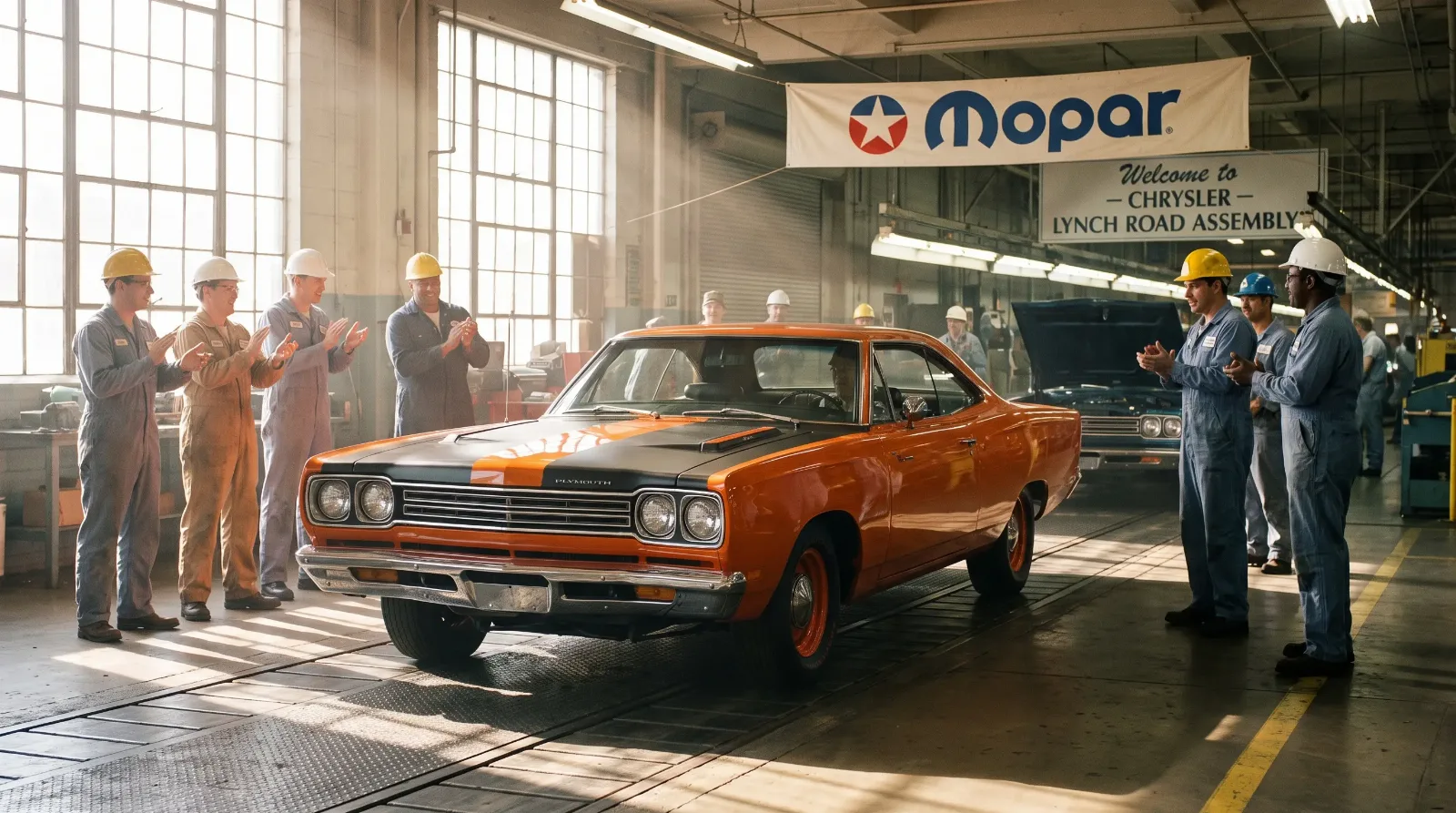
Plymouth built the 1969 Road Runner across multiple assembly plants rather than concentrating production in a single facility, a common approach across Chrysler's B-body lineup that let the corporation match output to regional dealer demand more efficiently. Dealers ordered cars against a factory allocation system that balanced popular configurations, like a 383 hardtop in a common color, against special orders for buyers who wanted a specific engine and options combination. That allocation system is part of why certain color and engine combinations turn up more often in one region of the country than another even decades later, since dealer stock patterns in period tended to cluster around what local buyers actually wanted rather than an even national spread.
Records from this era are incomplete by modern standards, since Chrysler's own retention of build documentation varied by plant and has been supplemented over the decades by private researchers and marque clubs working from surviving dealer invoices, magazine road tests, and owner submitted broadcast sheets. That patchwork of sources is why serious 1969 road runner production research today often involves cross referencing multiple independent archives rather than relying on a single official number, and why estimates for specific configurations, particularly rare engine and body style combinations, sometimes carry a range rather than an exact figure.
Where 1969 sits in the bigger picture
The overall production surge of 1969 did not happen in isolation. It reflected a broader muscle car market at its commercial high point across the entire American industry, with intermediates from every manufacturer competing hard on price, performance, and image before insurance surcharges and tightening emissions rules began reshaping the segment in the years that followed. For the fuller account of how the Road Runner reached that peak, including the specific model changes that drove buyers toward the car in such numbers, our 1969 plymouth road runner retrospective covers the year in complete detail beyond just the production figures discussed here.
Some of the performance features Plymouth introduced around this same period extended beyond the drivetrain and into functional details like the Air Grabber hood system offered on related Mopar models, and readers interested in how that technology intersected with the Road Runner's broader performance story can find a related story on that specific option. For anyone looking to translate this production history into an actual purchase decision, comparing documented examples against asking prices is the practical next step, and browsing Runners for sale now is a reasonable way to see how these production realities play out in today's market.