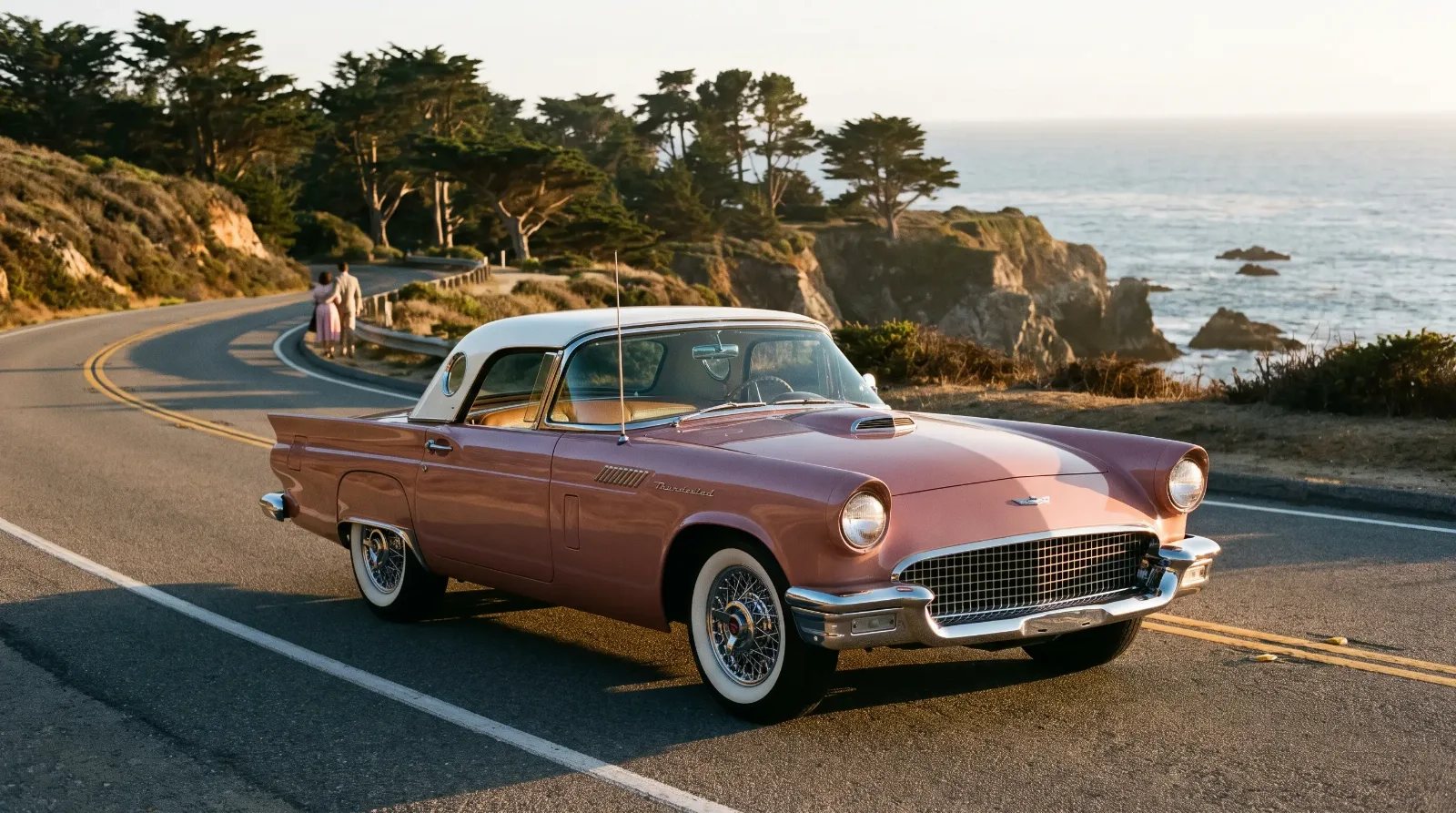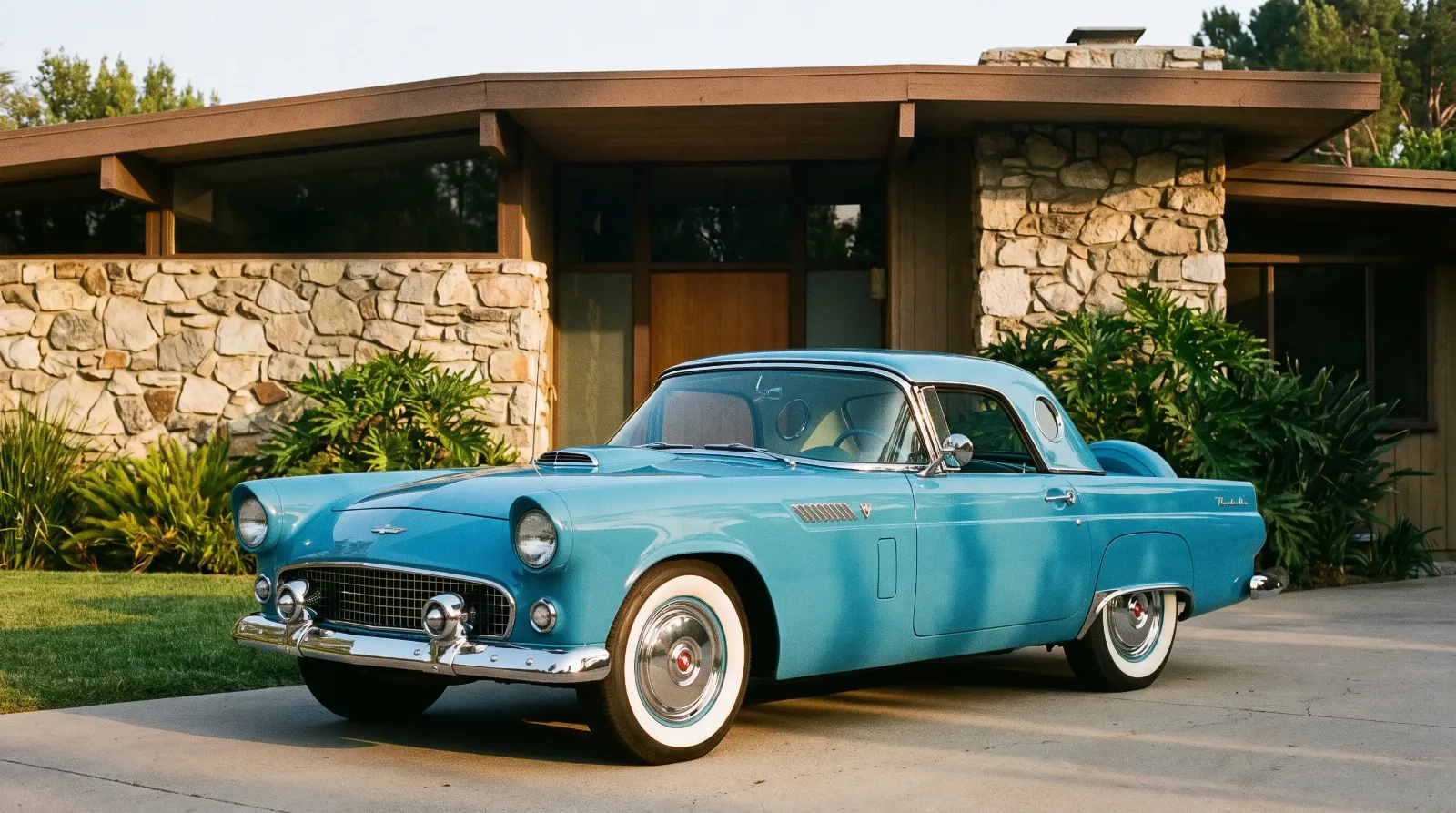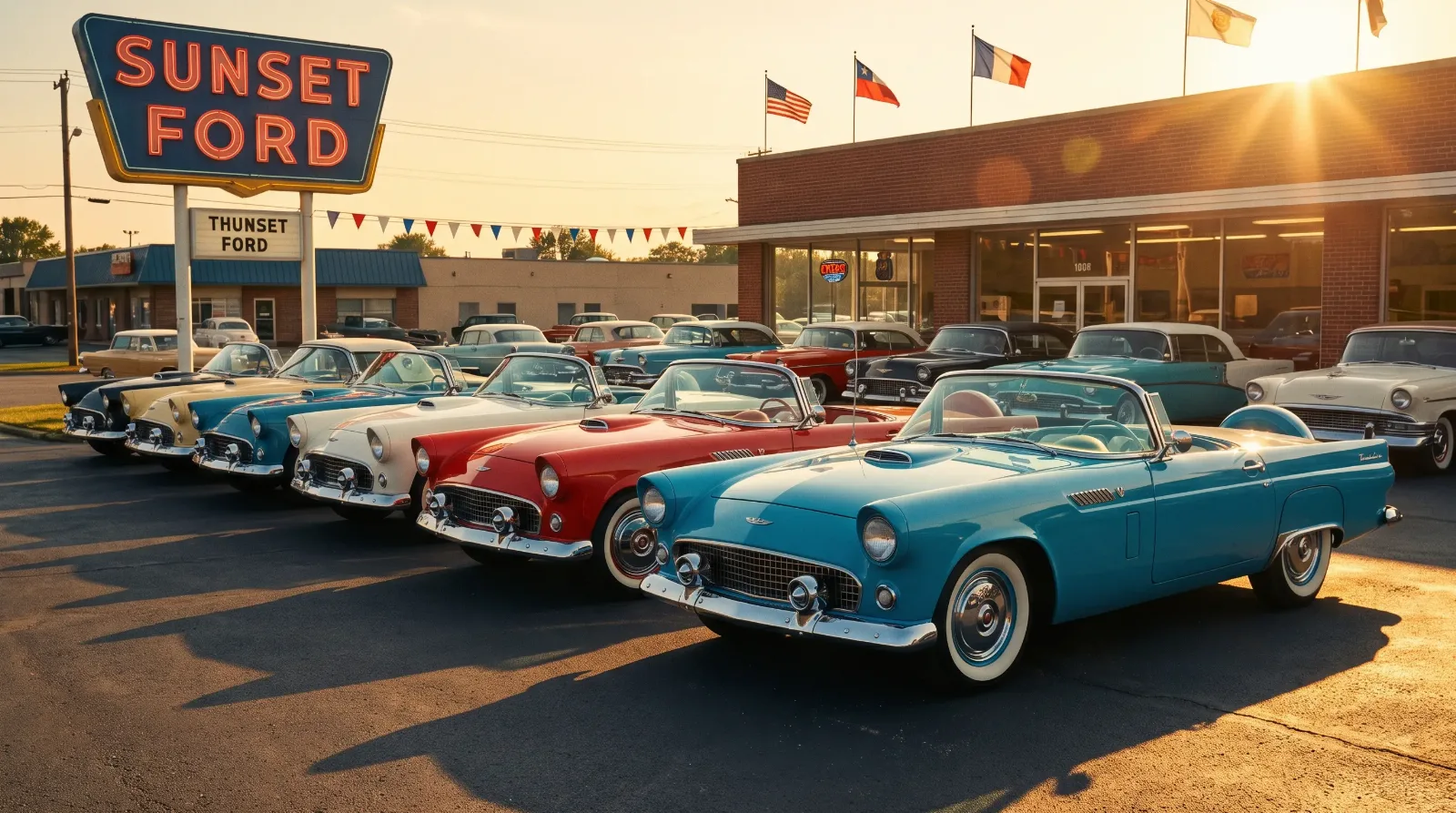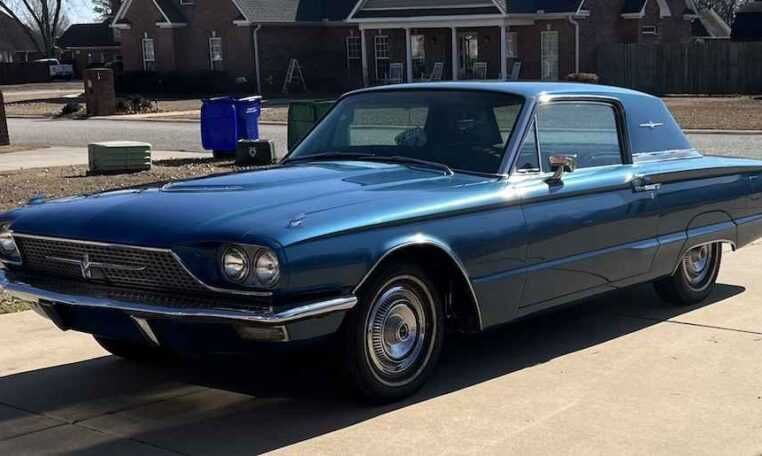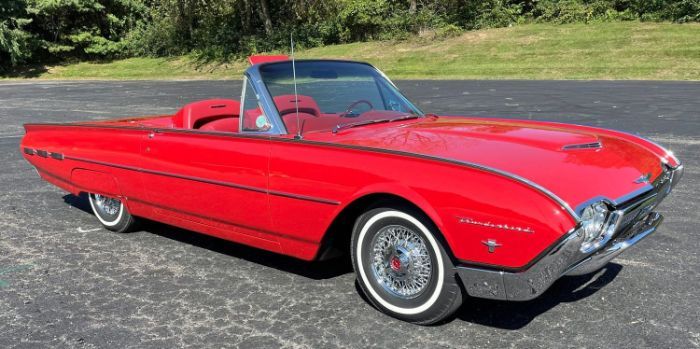
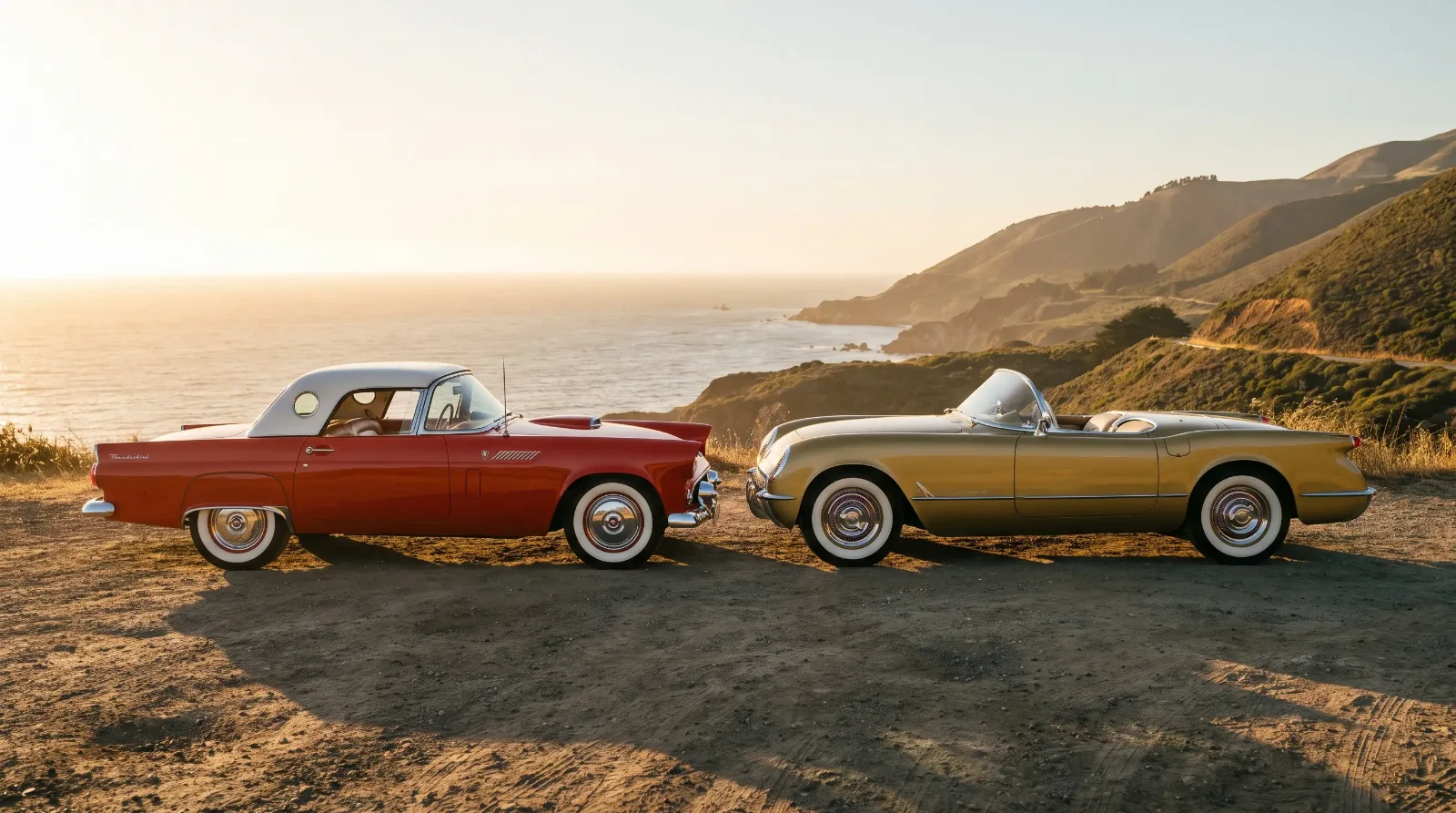
Set a 1955 Thunderbird next to a 1955 Corvette and the differences are immediately legible, even to someone who has never opened a hood on either car. One is upholstered, glassed, and finished like a Ford sedan wearing a shorter, lower body. The other is a fiberglass experiment still working out basic assumptions about what an American sports car should be. The comparison sounds like it should favor Chevrolet, given how the Corvette nameplate is remembered today, but the 1955 sales numbers and the period record tell a very different story.
Two cars built for different jobs
Both cars debuted within roughly two years of each other, the Corvette as a 1953 Motorama concept turned limited production car, the Thunderbird as a 1955 model rushed into development partly in response to seeing the Corvette on the show circuit. But Ford and Chevrolet were not actually building the same car with different badges. The Corvette launched with a Blue Flame inline six and a two-speed Powerglide automatic as its only transmission, side curtains instead of roll-up windows, and a fiberglass body chosen partly out of wartime-era steel supply caution and partly as a genuine engineering experiment. It was, by any period definition, a true sports car, uncompromising in ways that made it difficult to live with daily.
The Thunderbird, by contrast, offered a 292 cubic inch V8 producing 193 to 198 horsepower depending on transmission, conventional roll-up windows, a steel body, and a factory options list that included power steering, power brakes, and a power seat. Ford's own literature called it a "personal car," a label chosen specifically to avoid the sports car comparison rather than invite it. The two companies were solving different problems for different customers, even though history has flattened them into a single rivalry narrative.
| Spec | 1955 Thunderbird | 1955 Corvette |
|---|---|---|
| Engine | 292 V8 | Blue Flame inline six |
| Horsepower | 193 to 198 hp | 155 hp |
| Transmission | Manual or Ford-O-Matic | Powerglide automatic only (early 1955), manual added mid-year |
| Body | Steel | Fiberglass |
| 1955 production | 16,155 | 700 |
The sales numbers that settled the argument fast
Ford built 16,155 Thunderbirds for the 1955 model year. Chevrolet, by comparison, produced a small fraction of that figure for the Corvette in the same year, a gap frequently cited in period and retrospective coverage as evidence that the market had rendered a clear verdict. The scale of that difference is not a rounding error or a matter of interpretation; it reflects two fundamentally different products being evaluated by the same pool of American buyers, most of whom chose comfort and usability over an uncompromising sports car formula still working out its early mechanical shortcomings.
Chevrolet's own internal response to the sales gap is well documented in later interviews with GM engineering staff: the Corvette nearly got cancelled after its rocky 1954 and 1955 sales performance, saved in large part by Zora Arkus-Duntov's push to fit a V8 for 1955 and by GM leadership's decision to keep investing rather than concede the segment. That near-cancellation is worth remembering whenever the Thunderbird versus Corvette story gets told purely as a triumphant Corvette narrative in hindsight; in the moment, during the years these two cars actually competed for the same showroom traffic, the Thunderbird was winning decisively.
What period reviewers actually said
Automotive journalists writing in 1955 did not treat this as a close contest on paper. Road test coverage from the period consistently praised the Thunderbird's comfort, power steering feel, and overall drivability, while raising real concerns about the Corvette's fit and finish, its underpowered six-cylinder engine in early production, and the impracticality of side curtains in everyday use. That contemporary reception matters because it was formed without the benefit of hindsight; these writers had no way of knowing the Corvette would eventually become the dominant American sports car nameplate for the next seven decades. They were evaluating two 1955 products on their own terms, and on those terms, the Thunderbird was the more finished, more market-ready car. For the broader account of how Ford's two-seat Thunderbird evolved after this debut comparison, the full story covers all three model years in detail.
"Judge the 1955 comparison by what actually shipped, not by what either nameplate became decades later. On delivered product, in that specific year, the Thunderbird was simply the better executed car, and the sales figures from the period back that up without needing any modern reinterpretation."
- Sarah Whitfield
Pricing tells the same story from a different angle
Base price offers another useful comparison point. The 1955 Thunderbird carried a base price of $2,944, while the 1955 Corvette listed at roughly $2,774 with its base six-cylinder engine, a lower sticker for a car offering far less standard equipment and, in six-cylinder form, less power. Once a buyer optioned a Corvette up toward Thunderbird-level equipment, adding the V8, Powerglide, and available extras, the two cars landed much closer together on price. That combination, a nominally cheaper base sticker that still could not match the Thunderbird's standard comfort equipment without extra options, put Chevrolet at a real disadvantage with the exact buyers most likely to cross-shop the two nameplates in a Ford or Chevrolet showroom in 1955.
Sources and notes
- 1955 C1 Corvette Guide - CorvSport
- 1955 Corvette Specs - National Corvette Museum
- Chevrolet Corvette (C1) - Wikipedia
- Ford Thunderbird (first generation) - Wikipedia
- 1955 Ford Thunderbird Production Numbers/Specifications - Automotive Mileposts
Dealer-level anecdotes from the period, preserved in later interviews with retired Ford and Chevrolet sales staff, describe Corvette dealers struggling to move inventory that sat on lots for extended periods, while Thunderbird allocations reportedly moved quickly once cars reached dealerships. Neither company's internal sales data from that granular a level survives in complete form today, so these accounts function as supporting color rather than hard verification, but they are consistent with the production and pricing numbers that do survive in documented form.
Why the rivalry narrative outlasted its own accuracy
The two cars diverged sharply after 1955. Chevrolet kept pushing the Corvette toward a genuine sports car identity, eventually building the reputation that makes today's retrospective framing feel inevitable. Ford moved the Thunderbird toward a four-seat personal luxury format for 1958, walking away from the two-seat segment entirely and, with it, away from any direct comparison to the Corvette's trajectory. That divergence is why modern retellings tend to treat the Corvette as the long-term winner of a rivalry that, in its actual founding year, the Thunderbird won clearly and by a wide margin.
Documenting this accurately matters for anyone researching either nameplate's history, because the popular narrative often imports a Corvette-favorable outcome backward onto a year where the sales data, the road tests, and Chevrolet's own internal panic tell a different story. If you are researching 1955 Thunderbirds specifically or comparing documented examples against period Corvettes, current listings offer a useful reference point. You can browse classic Thunderbird listings to see how surviving examples from this era are priced and documented today, a market that still reflects, in its own way, how thoroughly Ford won the argument it never actually set out to have.