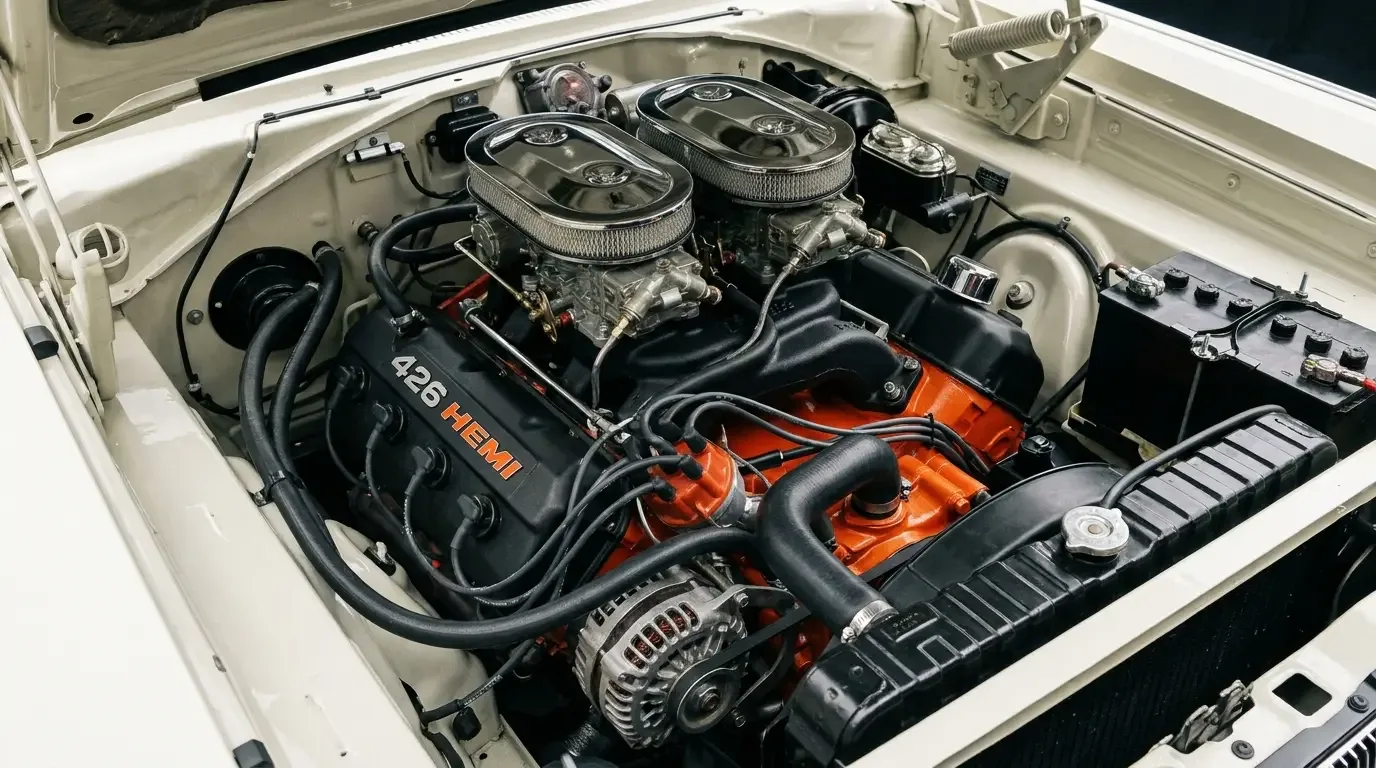
425 horsepower. That's the number Dodge printed for the street 426 Hemi in the 1966 Charger, and it's the number that gets argued about at every show field this engine shows up on. The real output was almost certainly higher, but 425 is what's on the build sheet, so 425 is where the conversation starts.
The number that matters: how the street Hemi got there
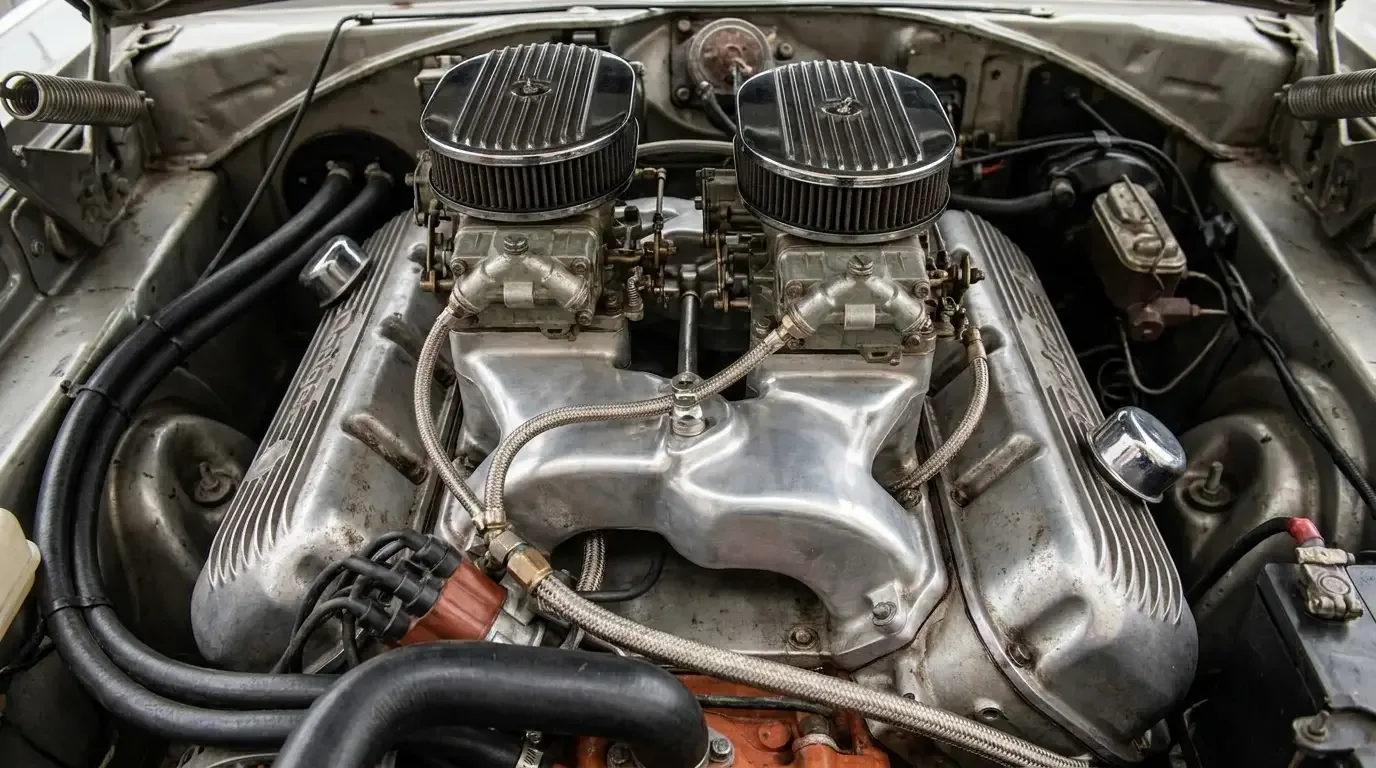
The 426 Hemi had proven itself on the NASCAR ovals in 1964 before Chrysler pulled it back to build a street-legal version for 1966, partly to satisfy homologation pressure and partly because Dodge wanted a genuine flagship engine for the new Charger. The street version used a milder camshaft, lower compression at roughly 10.25:1 against the race engine's much higher figure, and dual four-barrel carburetors on an aluminum cross-ram intake. Dodge rated it at 425 hp at 5,000 rpm and 490 lb-ft of torque at 4,000 rpm. Independent dyno work done since then, and plenty of period road tests, suggest the real crank number was closer to 450 hp, but Chrysler's own advertised figure is what went on the window sticker and what most price guides still reference today.
That gap between advertised and actual isn't unique to the Hemi. Most manufacturers underrated big-block engines through the 1960s to keep insurance underwriters and NHRA class rules happier. What's unusual here is how large the gap likely was on this specific engine.
The engineering behind that gap is worth understanding too. The street Hemi shared its basic architecture, hemispherical combustion chambers and a forged crank and rods, with the race version that had already been humiliating the competition on NASCAR ovals. Chrysler detuned it for street use with a smaller camshaft and a lower compression ratio, but the fundamental breathing advantage of that hemispherical head design carried over almost fully intact. That's the technical reason independent dyno numbers kept running ahead of the factory rating year after year.
What it actually meant on the road
Road testers who got their hands on a 426 Hemi Charger in 1966 recorded 0-60 times in the low six-second range and quarter-mile passes in the low 14s at around 96 mph, numbers that put the car ahead of nearly everything else on a dealer lot that year, Corvette included at certain trims. Those are gross, as-tested figures from magazines running a warmed-up factory car with a good driver, not the number you should expect out of a tired 60-year-old example on street tires today.
"Dodge said 425 horsepower. The dyno sheets from cars built the same way that year say otherwise. When the printed number and the measured number disagree, believe the dyno."
— Dan Reeves
Why so few buyers actually ordered it
The 426 Hemi option cost a real premium over the base 383, several hundred dollars at a time when that was a meaningful fraction of the car's total price, and it came with a mandatory heavy-duty suspension and driveline package to handle the torque. Total 1966 Charger production with the Hemi option landed at a genuinely small number, documented at 468 cars (250 four-speed, 218 TorqueFlite automatic), out of the 37,344 Chargers built that year. That scarcity is the entire reason a documented 1966 Hemi Charger commands the kind of money it does now, while a 383 car of the same year, visually near-identical from the outside, sells for a fraction of the price.
| Spec | 1966 Charger 426 Hemi |
|---|---|
| Advertised output | 425 hp @ 5,000 rpm |
| Advertised torque | 490 lb-ft @ 4,000 rpm |
| Induction | Dual four-barrel, cross-ram aluminum intake |
| Compression ratio | Approximately 10.25:1 |
| Hemi units built (1966) | 468 (250 four-speed, 218 automatic) |
Because so few left the factory this way, verifying that a car is a genuine Hemi car and not a clone matters more here than almost anywhere else in the muscle car market. The dodge rebellion charger campaign that Dodge ran that year leaned hard on the Hemi's reputation even though most buyers who walked into a dealership left with a 318 or 383 instead, which tells you the engine did more marketing work than actual sales volume.
What this means for a buyer today
Any car represented as an original 426 Hemi needs a matching numbers block, correct casting numbers on the heads and intake, and ideally a broadcast sheet or fender tag confirming the factory build. Engine swaps into lesser Chargers happened decades ago and continue to happen, and the price gap between a genuine car and a clone is large enough to make fraud worth someone's time. Get a specialist inspection before money changes hands, full stop.
Insurance and financing come into the math too. A documented Hemi car often carries an agreed-value policy well above what a standard classic car policy would offer, and lenders familiar with the collector market treat verified numbers-matching Hemi cars differently than they treat a Hemi-badged clone with a 383 underneath. None of that changes the driving experience, but it changes the math on what you're actually paying for, and it's a conversation worth having with an insurer before you commit to a purchase.
Beyond the drivetrain, the rest of the car is the same 1966 Charger covered in the full write-up, and the complete Charger history puts the Hemi's short first-gen run in context against the engines that followed it. If you're shopping the model year generally rather than chasing a Hemi specifically, classic 1967 Chargers carried the same engine option into a second, even rarer year.
The takeaway is simple. 425 hp on paper, more than that in reality, and fewer than 500 cars built that way. Every number involved argues for verifying before you buy, not after.
Whatever the true dyno figure turns out to be on any given example, the 426 Hemi's reputation in the 1966 Charger was earned honestly. It was the fastest thing Dodge sold that year, by a comfortable margin, and the small production count only sharpens the case for treating documentation as the deciding factor in any purchase.
Sources and notes
- Wikipedia - Dodge Charger (1966) - confirmed the 426 Street Hemi's 425 hp / 490 lb-ft rating and that only 468 Chargers were built with it in 1966.
- HowStuffWorks - 1966 Dodge Charger 426 Hemi - corroborated the 468 total and the 250 four-speed / 218 automatic split.
- Automobile-Catalog - 1966 Charger 426 Street Hemi - engine spec, 10.25:1 compression and factory output figures.
- Ate Up With Motor - Dodge's 1966-1967 Charger - period road-test performance context (0-60 in the low sixes, low-14s quarter).
- Street Muscle - Rare Rides: 1966 Charger 426 Hemi - background on the mandatory heavy-duty package and Hemi rarity.