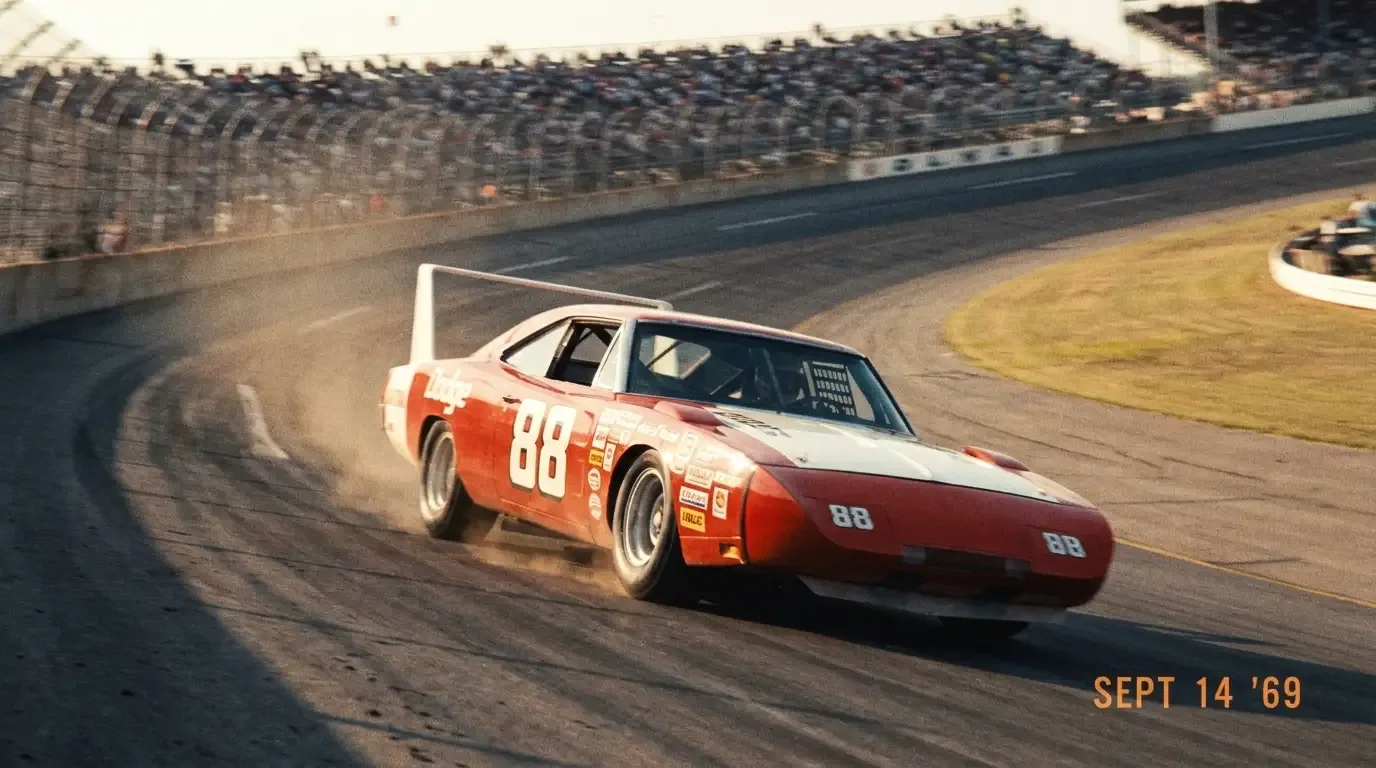
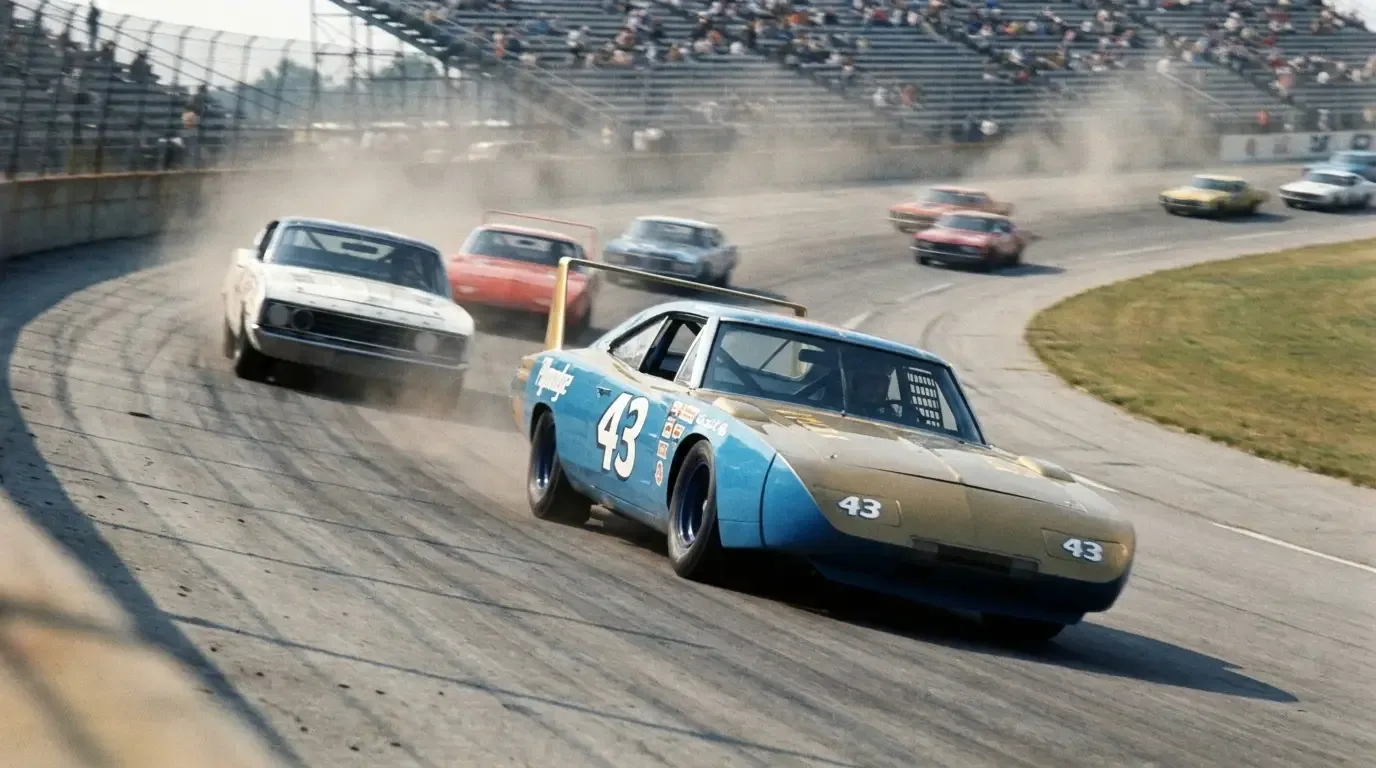
The guy I talked to at a Talladega vintage race weekend in 2019 still had the program from the September 1969 race, folded soft at the creases from being carried in a glovebox for decades. He pointed at the entry list and said the same thing everybody who was there says: nobody had ever seen anything like the Dodge Charger Daytona coming off pit road. It looked like it belonged in a different sport.
That reaction, repeated across garages and grandstands for one wild season, is why NASCAR eventually killed the winged cars. Not because they were slow. Because they were too fast, too weird looking, and too expensive for anyone but a factory-backed team to build. Read the Charger feature on Classic Cars Arena for the full arc of how this started, but the short version is that Dodge went to war with Ford over aerodynamics, and the war ended with the sanctioning body pulling the plug.
The Charger Daytona was built to solve one problem
By 1968 the standard Charger, handsome as it was, had a fastback roofline that acted like a parachute at superspeedway speeds. Ford's Torino Talladega and Mercury Cyclone Spoiler were slipperier, and they were winning. Dodge's engineers, working under pressure from Chrysler's racing program, needed a shape that would cut through the air at over 190 mph without lifting the rear end off the pavement.
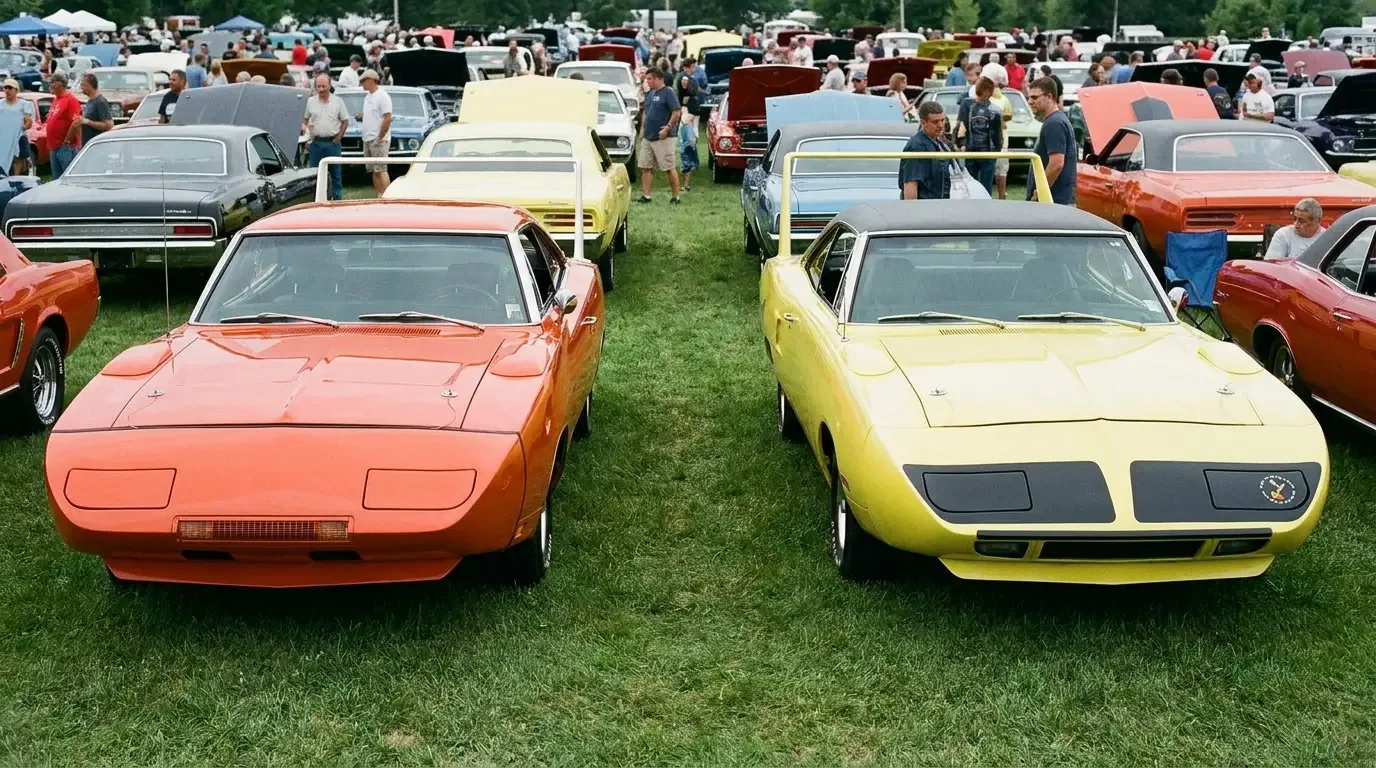
Their answer was the pointed nose cone, stretching the car roughly 18 inches longer than a standard Charger, and the towering rear wing mounted on tall struts. The wing height was not arbitrary. Wind tunnel work at the time, some of it reportedly done with help from Chrysler's missile engineers, showed the wing needed to clear the turbulent air coming off the trunk lid to actually generate usable downforce. Sitting it any lower would have put it in dead air and wasted the whole effort.
The homologation rules of the day required manufacturers to build a minimum number of street versions to legalize a race car for NASCAR competition. Dodge built the required run for 1969, badged Charger Daytona, and Plymouth followed a year later with its own version, the Superbird. For the details on how many Daytonas actually rolled off the line, charger daytona production numbers tell a more interesting story than most people expect.
On track the winged cars simply dominated
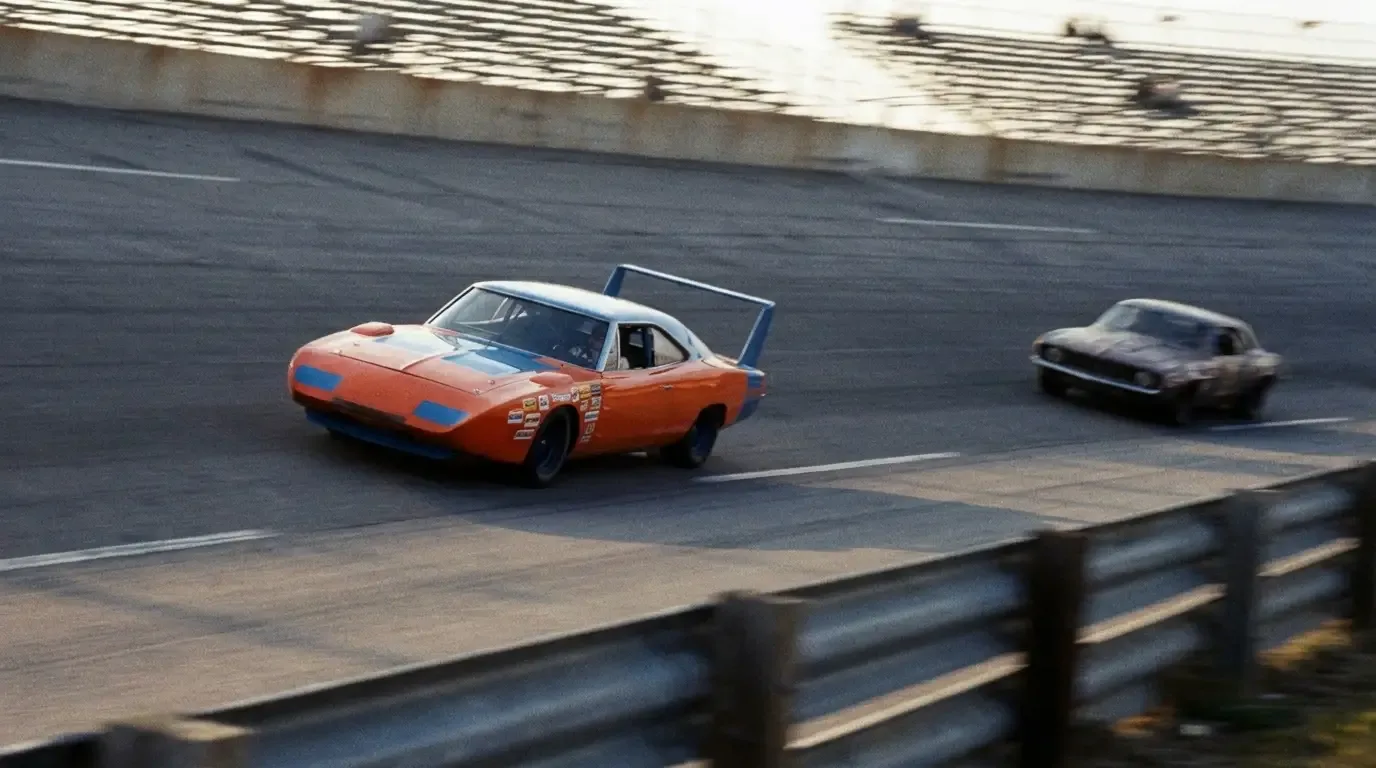
Once the Daytona and Superbird hit the superspeedways, the results were lopsided. Winged Mopars won a string of races through 1969 and 1970, and Buddy Baker became the first driver to officially top 200 mph in a stock car, doing it in a Daytona at Talladega in March 1970. That run was as much a public relations triumph for Dodge as it was a technical one, and it put every other manufacturer on notice.
The problem for NASCAR was that the field started to look like two classes of cars. Teams without the wing and nose cone were giving up several miles per hour on the straights, and the racing got predictable in a way that hurt the show. Car counts on ovals like Daytona and Talladega started skewing toward whoever had access to the aero package, and that concentration of competitive equipment in a handful of teams was not good for a sport that depended on full fields and unpredictable finishes.
"Everybody at the club had a theory until somebody pulled the paperwork, and just like that the bench-racing was over. The wing wasn't a gimmick. It was a half-second-a-lap piece of engineering, and that's exactly why it had to go."
— Wayne Coburn
NASCAR's rulebook response arrived in stages
NASCAR did not ban the winged cars outright in one swing. Through the 1970 season the aero cars ran their big engines freely and simply dominated, with the winged Mopars reportedly combining for something like 38 wins in 48 races. For 1971 the sanctioning body restricted aero-bodied cars to a maximum of 305 cubic inches, a number that effectively neutered the 426 Hemi and 440 Magnum combinations that made the cars competitive in the first place. Teams could keep running the big engines only in the standard, non-aero bodies, which pushed most owners back toward conventional Chargers and Road Runners.
That 305-cubic-inch cap made the winged cars pointless from a competitive standpoint. Nobody was going to build an 18-inch nose extension and a wing tower for a car that could no longer keep pace on raw power. A lone 305-powered Daytona did turn up at the 1971 Daytona 500, proving the cars were never literally outlawed, but the winged era on NASCAR's premier ovals was effectively over after the 1970 season.
| Season | Rule change | Effect on winged cars |
|---|---|---|
| 1969 | None, homologation only | Daytona debuts late season, wins immediately |
| 1970 | No aero-specific engine limit | Winged Mopars dominate, ~38 of 48 wins |
| 1971 | Aero bodies capped at 305 cubic inches | Big-block advantage removed, winged cars effectively retired |
Why the manufacturers walked away without much of a fight
Chrysler's racing budget was not bottomless, and the broader auto industry was already sliding toward the insurance and emissions pressures that would reshape the muscle car market by the mid-1970s. Racing an aero car nobody could buy in meaningful numbers, against a rule package designed to slow it down, was not where Dodge wanted to keep spending. Plymouth made the same calculation with the Superbird. Both cars quietly disappeared from the front of the field, and NASCAR's aero wars ended almost as fast as they had started.
What NASCAR left behind, unintentionally, was one of the rarest and most collectible bodies in American performance car history. A rule written to level a racetrack turned a low-volume homologation special into a car that would be worth seven figures decades later. For buyers today looking at classic Dodge Chargers for sale, the winged cars sit in an entirely different tier from the rest of the Charger lineup, precisely because the ban froze production at numbers nobody expected to matter this much.
The winged Chargers never lost a straight fight. NASCAR simply decided it did not want that fight to keep happening, and wrote the rules to make sure it wouldn't. That is the whole story behind the complete Charger history, distilled into two seasons and a rulebook nobody expected to matter this much fifty years later.
Sources and notes
- Dodge Charger Daytona - Wikipedia - confirmed the 1971 rule capping aero-bodied cars at 305 cubic inches and the effective end of the winged era.
- Plymouth Superbird - Wikipedia - confirmed the 305 rule applied for 1971, not 1970, and that a lone 305-powered car ran the 1971 Daytona 500.
- Hagerty - Dodge Daytona vs. Plymouth Superbird - confirmed the winged Mopars' 1970 dominance (roughly 38 of 48 wins).
- Classic Industries - The Mopar Wing Cars - confirmed Buddy Baker's 200 mph run and the homologation-driven build.
- Old Cars Weekly - 1969 Daytona number one - background on the aero program and Creative Industries build.