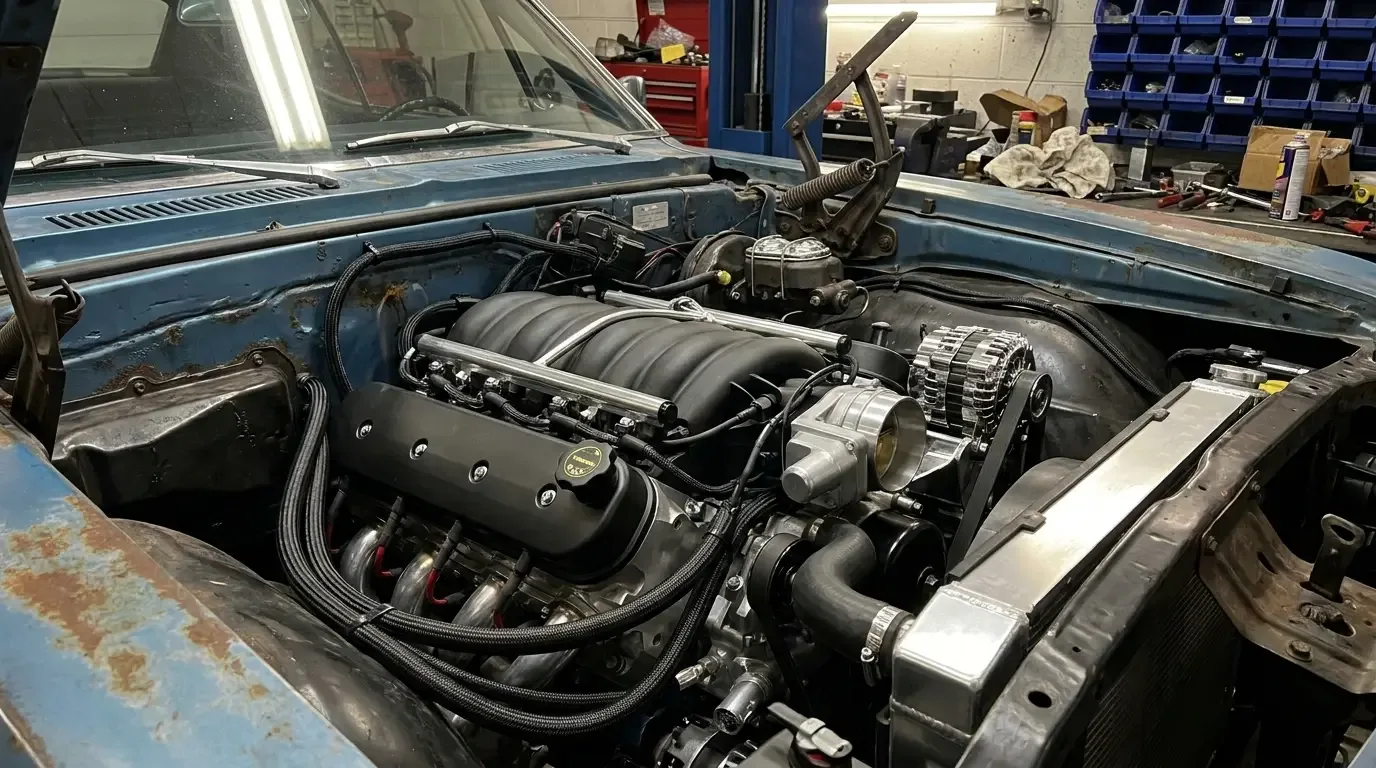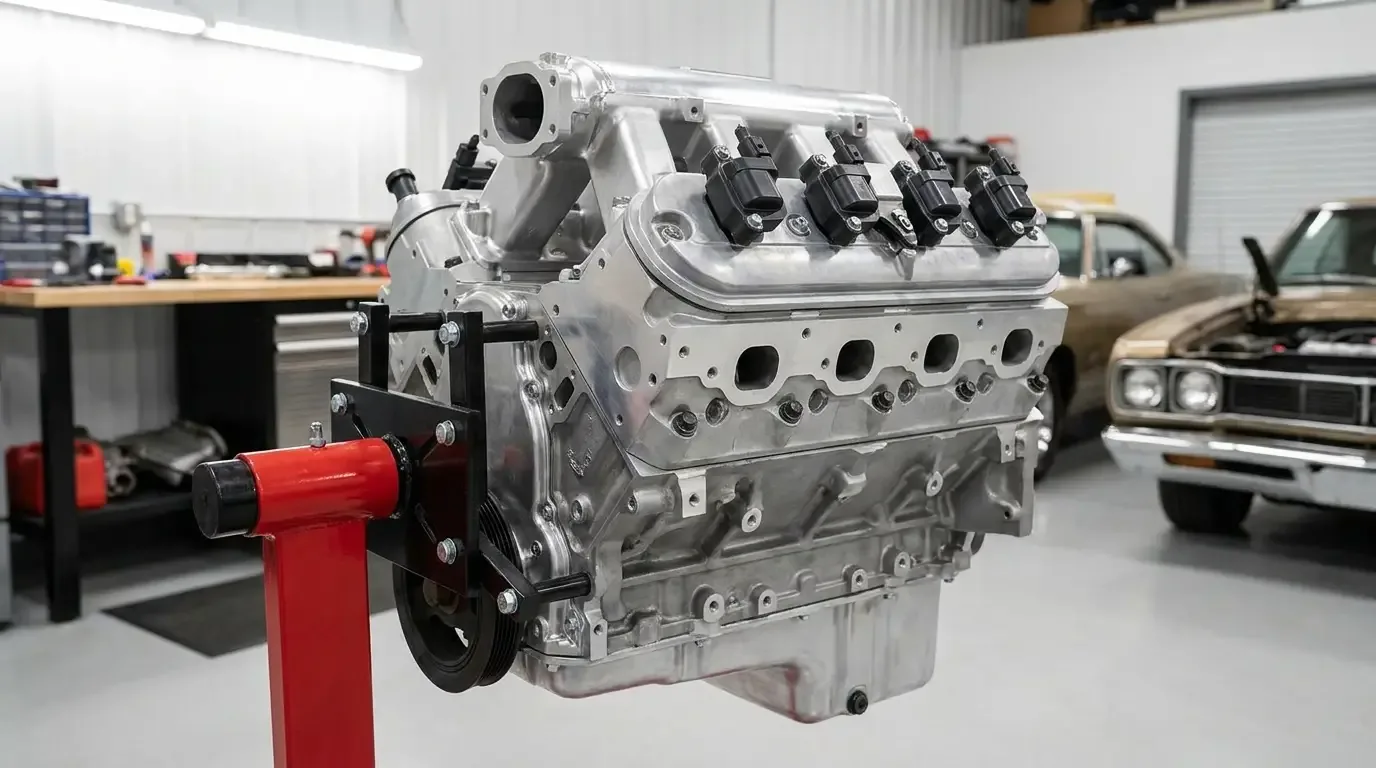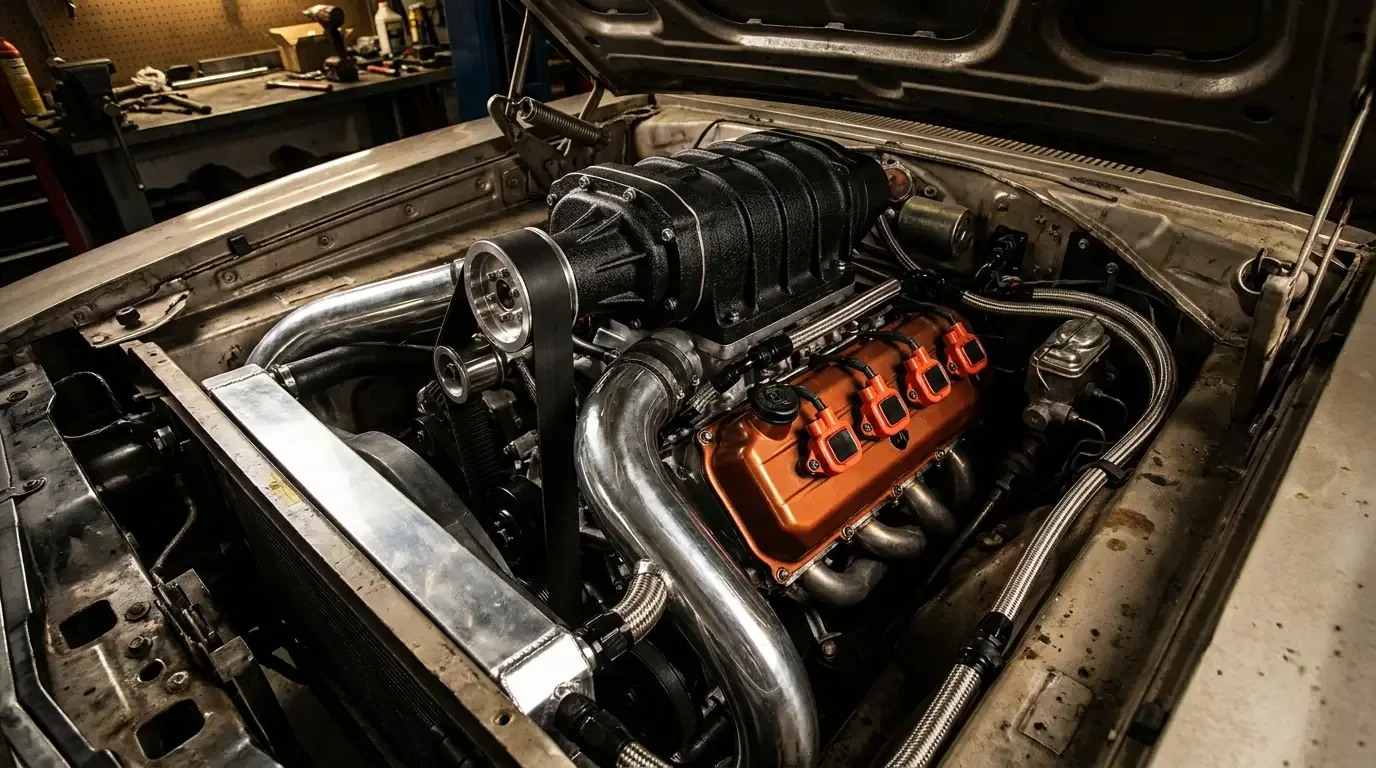
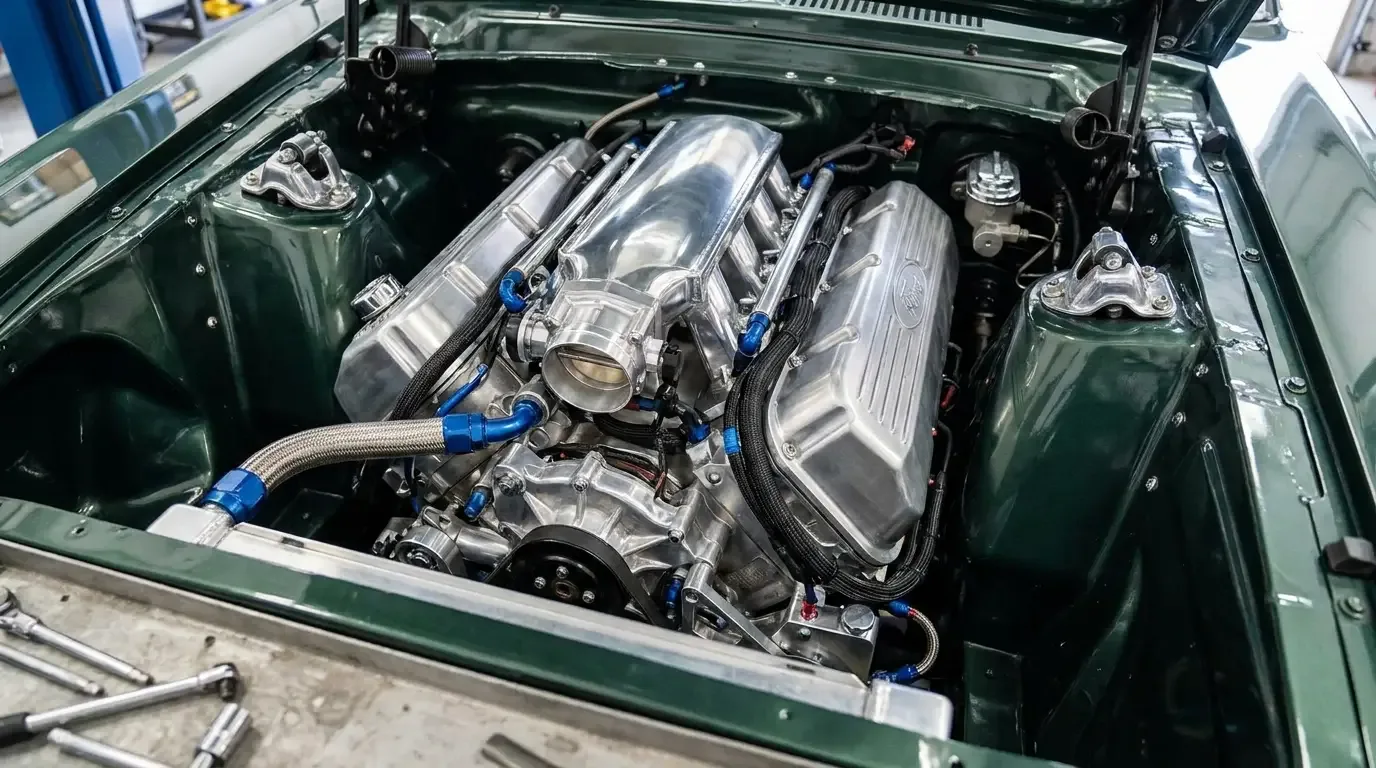
The LS gets all the noise. Ford guys have a better answer, and it's a good one. The Coyote is Ford's 5.0-liter DOHC V8, the engine that showed up in the 2011 Mustang GT and never left. It's the blue-oval reply to the LS: modern, cheap enough to find used, real power straight out of the crate. Putting a fresh V8 in an old Ford body and want it to stay a Ford? This is the one. Dropping one in is a real engine swap with its own quirks, and the biggest one is size: a Coyote is a physically bigger lump than the pushrod Windsor it usually replaces.
What a Coyote actually is
Four valves per cylinder, dual overhead cams, an aluminum block. That's the short version. Ford built it to do what old pushrod motors couldn't: rev high, breathe well, and pass emissions without choking. The name comes from a Ford racing V8 from the 1960s, and the marketing guys liked it enough to stick it on the 2011 engine. What matters to you is that it's a factory motor built by the millions, so parts are everywhere and the used market is deep.
The catch is the heads. All those cams and valves make the Coyote wide. A small-block Windsor is a compact motor. The Coyote is taller and considerably wider across the top, and that width is what eats your time in an old engine bay. The power is easy. Making it fit is the work.
Which generation to buy
Ford has revised the Coyote several times, and each bump changed the power and some of the hardware. Here's the rundown so you know what you're looking at in a junkyard or a listing.
| Generation | Years | Approx. factory power | Notes |
|---|---|---|---|
| Gen 1 | 2011–2014 Mustang GT | around 412 hp | Cheapest to find. Good starter Coyote. |
| Gen 2 | 2015–2017 Mustang GT | around 435 hp | Revised heads, stiffer block. |
| Gen 3 | 2018–2020 Mustang GT | around 460 hp | Direct plus port injection, higher compression. |
| Gen 4 | 2024+ (S650) | roughly 480–500 hp | Newest, priciest, hardest to swap. |
Figures here are factory ratings for the standard Mustang GT of each run and vary a little by application; I've kept them rounded on purpose. For most restomods the Gen 1 or Gen 2 is the sweet spot. They make plenty of power, they're the cheapest, and the port-injection Gen 1/Gen 2 is simpler to wire than the direct-injection Gen 3. The Gen 3 makes more but adds a high-pressure fuel system that complicates a standalone setup. Buy the newest one your budget and patience can stand, not the newest one that exists.
"Everybody wants the Gen 3 for the horsepower number. Then they get the direct injection wiring in their lap and wish they'd bought the Gen 1. Buy the engine you can actually make run, not the one that wins the bench-racing argument."
— Dan Reeves
Crate options and control packs
You don't have to pull a motor out of a wrecked Mustang. Ford Performance sells the Coyote as a crate engine, and that's the clean path if you don't want to chase a used one. The two names to know are the standard Gen 3 5.0 crate and the Aluminator, which is a hand-built version rated around 460 hp on pump gas and built to take boost or high revs. The Aluminator costs more and it's aimed at people who plan to push past stock.
The part that saves your sanity is the Ford Performance Control Pack. That's the plug-and-play harness and computer Ford sells specifically so you can run a Coyote outside of a Mustang. It comes pre-flashed for the engine, it has a clearly labeled harness, and it means you're not paying a shop to build a standalone from scratch. Match the control pack to the generation of your engine. A Gen 1 control pack does not run a Gen 3, and mixing them is how people end up with a no-start and a headache.
Where it fits, and where it fights you
The Coyote drops into a Fox-body Mustang, an SN95, and later Fords with the least drama, because the bay was designed around big V8s. Classic Ford muscle like a first-gen Mustang, a Fairlane, or a Falcon is where the width starts to bite. Those cars were built for a narrow Windsor, and the Coyote's heads crowd the shock towers. It's done all the time, but it usually needs modified or aftermarket suspension mounts and careful header selection.
The honest comparison: an LS is narrower and easier to stuff into almost anything, which is exactly why so many people reach for one even in Ford bodies. The Coyote asks for more room and more planning. What you get back is a motor that stays true to the marque and revs like the modern engine it is. If keeping a Ford a Ford matters to you, the extra fabrication is the price of admission. If you're cross-shopping the loud alternatives, the Mopar route in our guide to Hemi and Hellcat Swaps runs into the same width-versus-character trade in its own way.
🔧 Inspection Priorities
- Engine bay width at the shock towers. This is the make-or-break measurement on a classic Ford. If the heads won't clear, you're into suspension modification before you turn a bolt. Measure first, budget accordingly.
- Control pack generation match. Confirm the harness and computer match the exact engine generation. A mismatch is a guaranteed no-start and often a return-shipping fee.
- Oil pan and crossmember clearance. The stock pan frequently fouls older crossmembers. Price a swap pan in from the start, roughly a few hundred dollars, not a surprise later.
- Header availability for your chassis. Verify a header kit exists for your specific car before buying the engine. Custom long-tubes fabricated one-off get expensive fast.
- Transmission plan. Decide manual or automatic and confirm bellhousing and adapter parts exist. The Coyote's bolt pattern is modular-family, not Windsor, so old transmissions don't just bolt up.
So is it worth it
If you own a Ford and you want it to stay one, yes. The Coyote gives you modern power, a deep used market, and factory-supported crate and control-pack options that take most of the guesswork out of the electrical side. The tax you pay is space and fabrication, especially in a pre-1970 body that never dreamed of a four-cam V8. Go in knowing the heads are wide, measure before you spend, and match your control pack to your generation. Do that and you end up with an old Ford that starts on the first turn of the key and pulls hard to redline, which is the whole point of a restomod.
Sources and notes
- Ford Performance crate engine and control-pack literature (Coyote 5.0 and Aluminator specifications).
- Period and current automotive press coverage of Mustang GT power ratings by model year.
- Engine-family reference material on the Ford Modular and Coyote architecture.
- Builder and shop interviews on classic-Ford Coyote swap fitment and fabrication.