
Everybody talks about the LS. Fewer people talk about what happens when a Mopar guy refuses to bolt a Chevy engine into his Charger. That is where the modern Hemi comes in, and at the top of the pile, the supercharged Hellcat crate. This is the loud, expensive, gloriously stubborn corner of the engine swap world, and it is worth understanding before you spend the money.
Restoration & Tech
6 min read
Hemi and Hellcat Swaps
Gen III Hemi crate options, the Hellcrate, and the honest cost of putting Mopar power under a vintage hood.
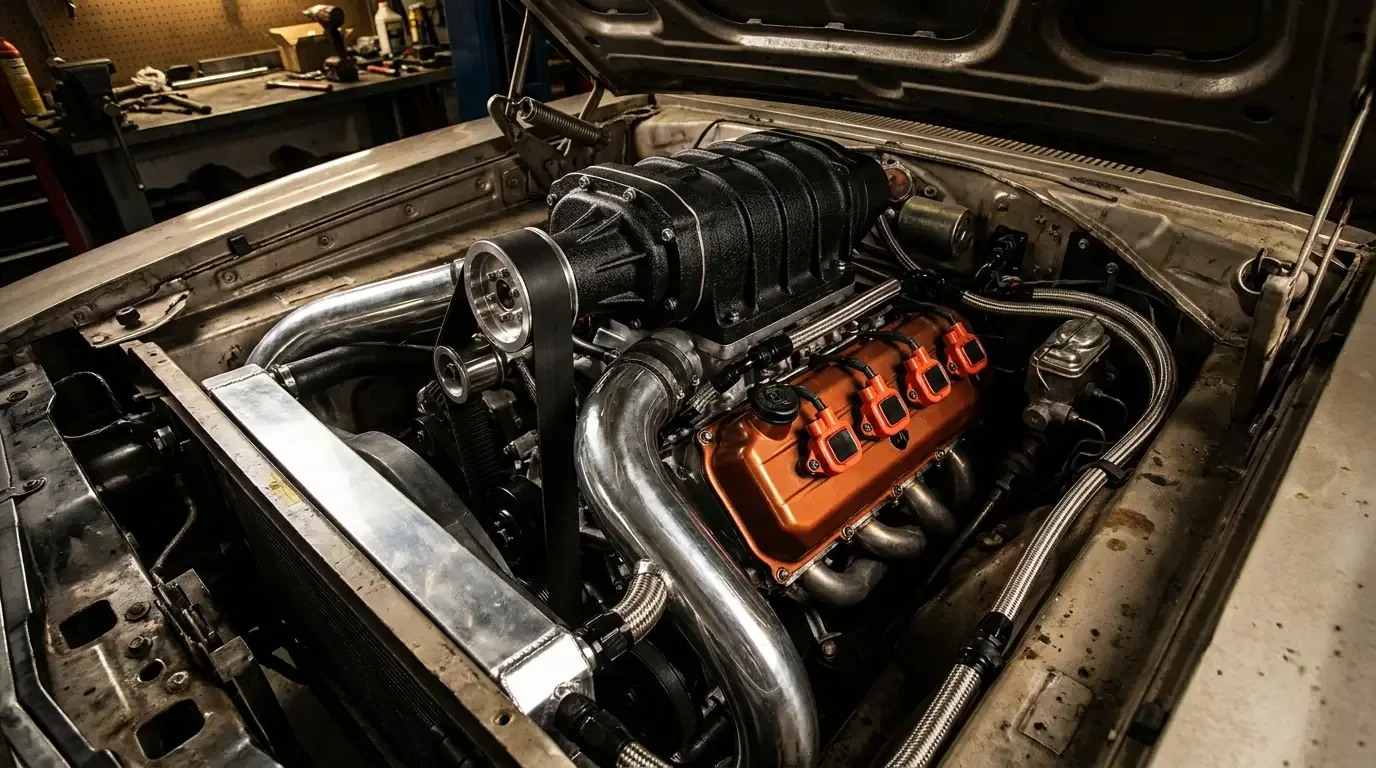
The short version: Chrysler's Gen III Hemi, launched in 2003, gave the Mopar crowd a modern pushrod V8 that fits the same brand loyalty an engine swap is supposed to honor. Then Dodge dropped the supercharged Hellcat into the catalog, and the game changed. Let me walk through the options.
The Gen III Hemi crate options
The Gen III Hemi is the modern engine, not the legendary 426 from the muscle car era. Two different animals that share a name. What you buy from the Mopar crate catalog, or pull from a wrecked truck or car, breaks down into a few common displacements.
The 5.7 is the entry point. It shows up in Ram trucks, Chargers, Challengers, and 300s, and used ones are everywhere. Factory output ran roughly 370 to 395 horsepower depending on year and application. It is cheap, plentiful, and honestly enough engine for most street cars. The 6.4, the 392, is the naturally aspirated hot rod choice, rated around 485 horsepower in crate form. That is the sweet spot for a lot of builders: big power, no supercharger to feed, and a sound that makes the whole thing worthwhile.
Then there is the 6.2 supercharged family, which is where the Hellcat lives. More on that below because it deserves its own section.
| Crate engine | Displacement | Approx. horsepower | Induction |
|---|---|---|---|
| 5.7 Hemi | 345 ci | ~370-395 hp | Naturally aspirated |
| 6.4 (392) Hemi | 392 ci | ~485 hp | Naturally aspirated |
| Hellcat (6.2) | 376 ci | ~707 hp | Supercharged |
| Hellcrate Redeye | 376 ci | ~807 hp | Supercharged |
The Hellcrate: what you are actually buying
Dodge did something no other manufacturer did at the time. They sold the supercharged Hellcat engine as a crate unit, the Hellcrate, so you could put 700-plus horsepower into whatever you wanted. The base Hellcrate is rated around 707 horsepower. Later they offered a Redeye version pushing roughly 807 horsepower. Those are not typos.
Here is the part people skip: the engine is the easy part. The Hellcat is a wide, tall, physically large lump with a supercharger sitting on top and an intercooler system that needs plumbing. Dropping it into a 1968 body means you are fighting for hood clearance, you need the front-end accessory drive to clear the frame, and you have to feed it fuel and air like it means business. Dodge sells a kit with the powertrain control module, wiring harness, and accelerator pedal to make the electronics behave, which saves you a real headache.
Why Mopar guys go this route
Brand loyalty is real, and in the Mopar world it is close to religion. A guy with a Charger, a Challenger, a Barracuda, or a B-body is not going to bolt in a Chevy small block and feel good about it. The Hemi keeps the car correct in spirit even when the numbers-matching purists grumble. That matters more here than in most corners of the hobby.
There is also the sound and the theater. A naturally aspirated 392 has a hard, flat Hemi bark. A Hellcat under boost has that supercharger whine that announces itself from two blocks away. For a lot of builders that whine is the whole point. It is a modern signature the way a lopey cam was a signature 40 years ago.
And the practical case holds up. These are modern engines with fuel injection, coil-on-plug ignition, and real reliability. You get a car that looks period-correct and starts on a cold morning without a prayer. If you want to understand where this whole idea of vintage-body-modern-guts came from, read EV Restomod Swaps for the other end of the spectrum, where guys skip the engine entirely.
"I have shoehorned a Hellcat into a car that never dreamed of that kind of power. It fits, but nothing about it is easy. You are not swapping an engine, you are rebuilding half the car around it. Go in knowing that."
Mike Sullivan
Cost and complexity: the honest math
This is where the Hemi path parts company with the LS. An LS is cheap to source and cheap to swap. The Hemi is neither, and the Hellcat is on another planet entirely.
A used 5.7 is affordable. A crate 392 is a serious purchase before you touch the swap parts. A Hellcrate is a five-figure engine on its own, and that is before the transmission, the cooling, the fuel system that can keep up, and the driveline strong enough to survive it. You do not put 800 horsepower through a 50-year-old rear axle and expect it to live.
Complexity is the other tax. The LS crowd has decades of aftermarket support and every bracket you could want. The Hemi swap market is growing but thinner, so you will spend more time sourcing parts and solving problems yourself. If a turnkey path with the deepest catalog is what you want, plenty of finished builds and projects turn up in the classic restomods for sale listings, and buying one done is sometimes cheaper than doing it yourself.
The bottom line: the Hemi and Hellcat route is for the person who wants Mopar in the fenders and Mopar under the hood, and who has the budget to do it right. It is not the value swap. It is the loyalty swap, and when it is done properly there is nothing else that sounds or drives quite like it.
Sources and notes
- Manufacturer crate engine catalog and published output figures (marked for verification against current spec sheets).
- Engine-family references for the Gen III Hemi and supercharged 6.2 platform.
- Builder and shop interviews on swap fitment, driveline matching, and clearance.
- Enthusiast club and forum records on real-world Hemi and Hellcat installs.
Related Reading
Have a
Classic Car
for Sale?
Reach thousands of serious classic car collectors across the US.
Sell It Here →
Are You a Classic Car Dealer?
List your full inventory and connect with targeted classic car buyers.
Join as a Dealer →

About the author
Mike Sullivan
Detroit-area muscle car enthusiast and restoration specialist with three decades of hands-on experience working on American iron.
More in Restoration & Tech
Comments
Be the first to comment on this article.