
Ask ten builders what makes a restomod a restomod and you will get ten answers, but they all land on the same part: the drivetrain. The body can stay dead stock. The moment you pull the tired old original mill and drop in something modern that starts on the first crank, idles in traffic, and returns real fuel economy, you have crossed the line from restoration into restomod. If you want the longer version of that argument, read up on what a restomod really is. This piece is about the metal. Which engine, how much power, what it costs, and how hard the job actually is.
Restoration & Tech
9 min read
Restomod Engine Swaps: LS, Coyote, Hemi and EV
LS, Coyote, Hemi, Hellcat or EV? A blunt shop-floor guide to the popular restomod engine swaps: power, cost, difficulty, and what fits what.
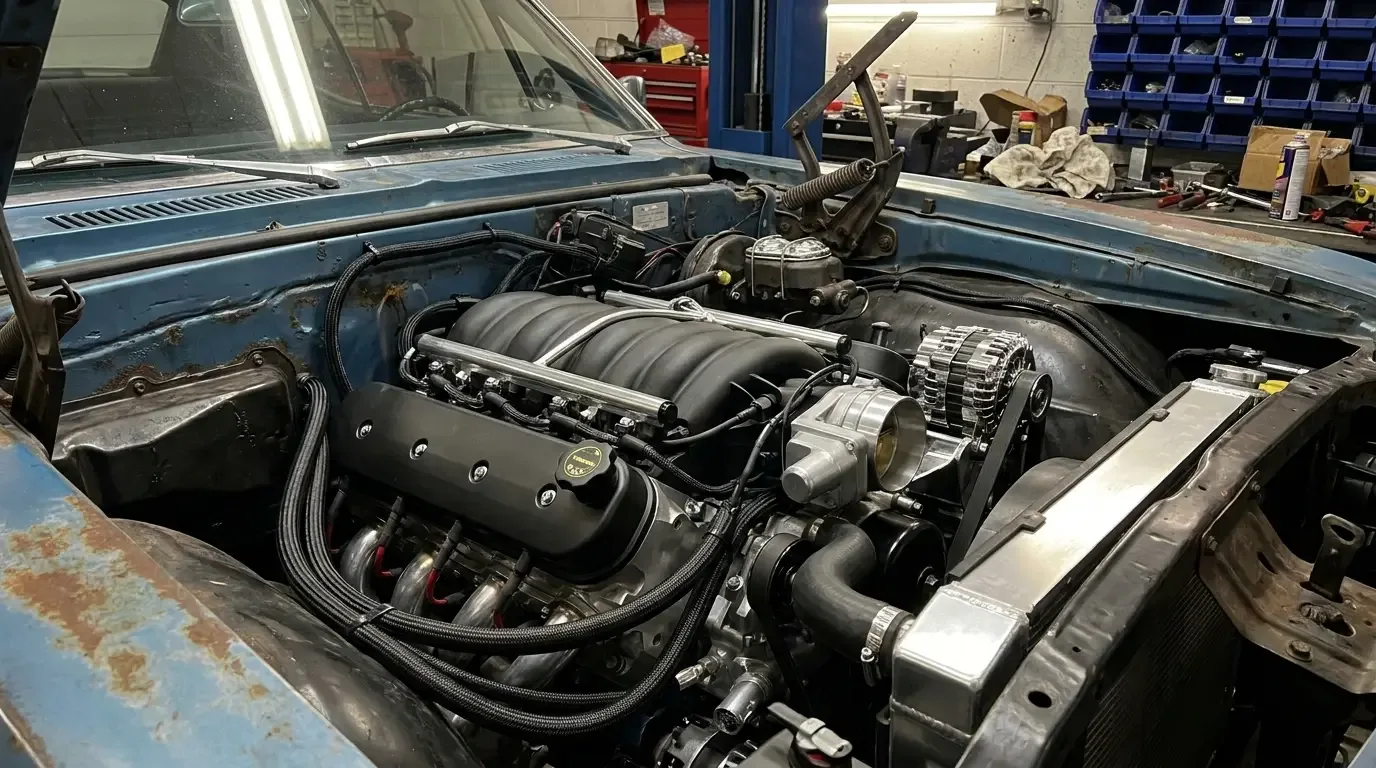
I've built a fair number of these swaps in my own shop, and cleaned up plenty that other people botched. Blunt version: four families own this market, the GM LS, the Ford Coyote, the Chrysler Gen III Hemi and its Hellcat cousin, and the electric conversion. Each fits a different owner. Pick wrong and you'll hate the car.
Why the drivetrain is the whole ballgame
A classic with its factory engine is a museum piece you drive on nice days. It runs hot, it fouls plugs, it wants a rebuild every 60,000 miles, and it makes numbers that were embarrassing even when new. A well-sorted modern engine fixes every one of those complaints at once. That is the entire pitch.
The swap is never just the engine, though. New rule of thumb before you buy anything: the motor is maybe half the job. You need a transmission that can handle the torque, a rear end that will not grenade, mounts, a crossmember, wiring, cooling, fuel delivery, and an exhaust that fits around the steering. Skip the supporting hardware and you have a fast car that breaks. Do it right and you have a car you can drive across three states without a second thought.
The LS swap: the default answer
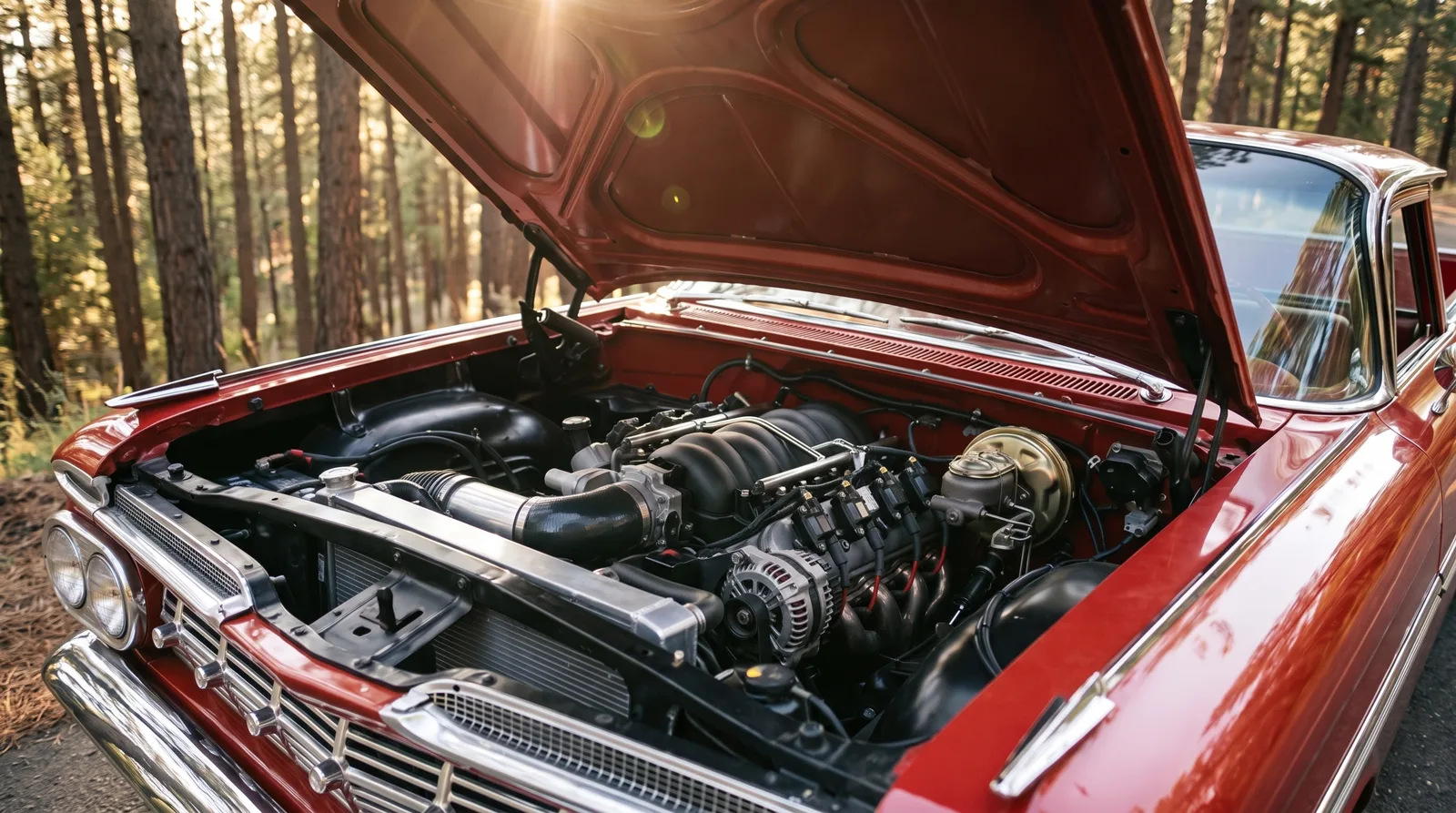
If you do not have a strong reason to pick something else, you pick an LS. It is small, it is light, it makes power cheaply, and the aftermarket has solved every problem you will ever hit. A junkyard 5.3 liter truck LS makes around 300 horsepower stock and will bolt to almost anything with the right parts. Step up to a 6.0 and you are near 360 to 400. Buy a crate LS3, a 6.2 liter, and GM rates it at roughly 430 horsepower and 425 lb-ft, right out of the box with a warranty.
Cost is the reason everyone does it. A running junkyard LS can be had for cheap, and even a full budget build with a used engine, a 4L60E or T56 trans, swap mounts, headers, and a standalone harness lands you a reliable 400-horse classic for less money than any other route here. The parts catalog is endless. Holley, Summit, and a dozen others sell everything as a kit.
Difficulty is low by swap standards. The LS is physically compact, so it clears tight engine bays that a big-block never would. Oil pan clearance over the steering is the usual headache, and you solve it with a swap-specific pan off the shelf. This is the swap I hand to a first-timer.
"People think the LS is the boring choice. It is the smart choice. I have never once regretted talking a customer out of something exotic and into a junkyard 5.3. The car gets driven, that is the whole point."
Dan Reeves
The Coyote swap: for the Ford faithful
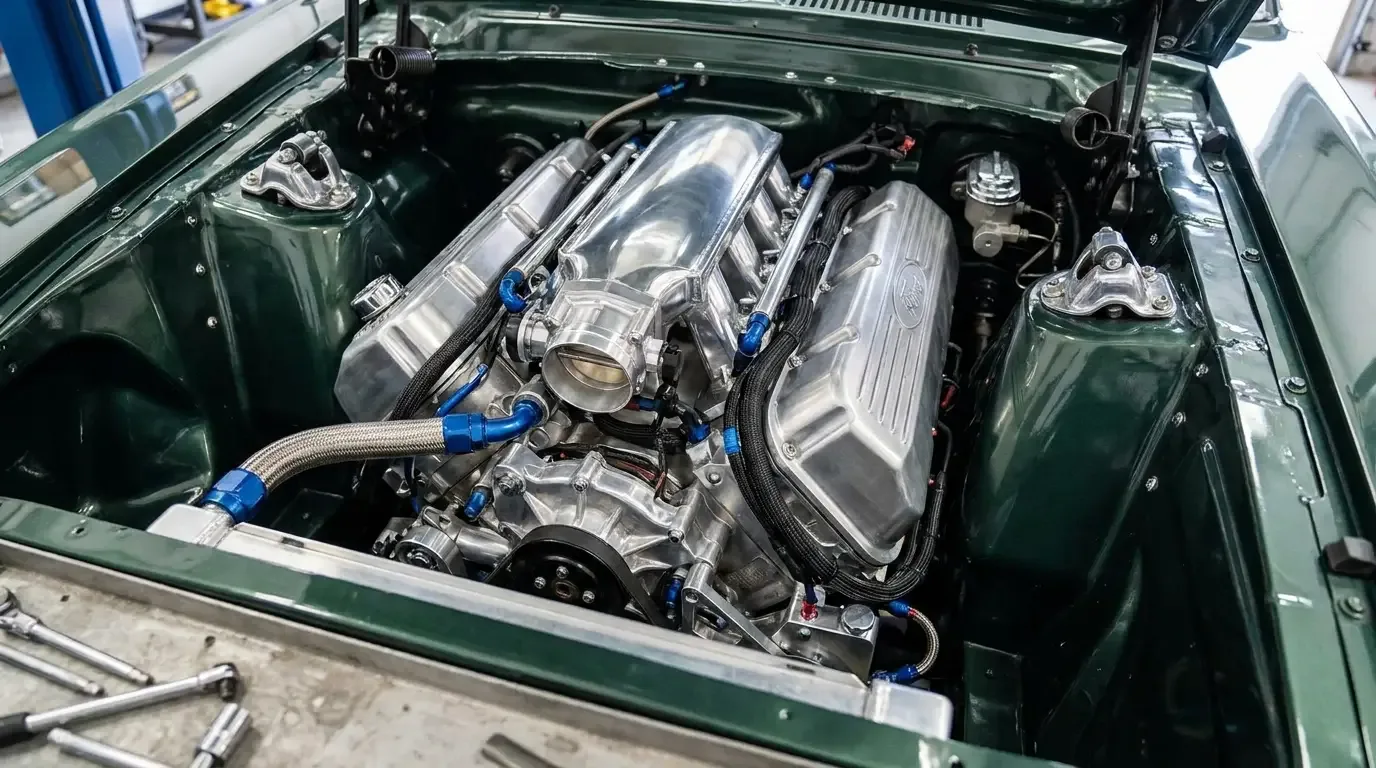
Ford people don't want a Chevy engine in their Mustang. Fair enough. The answer is the Coyote, Ford's 5.0 liter DOHC V8 from the modern Mustang GT and F-150. The current Gen 3 and Gen 4 Coyote makes somewhere around 460 horsepower in Mustang tune, and Ford sells it as a crate engine with a control pack that includes the harness and computer, which takes a lot of the guesswork out.
Here is the honest tradeoff. The Coyote makes great power and sounds fantastic, but it is a physically big engine. Those four cam covers make it wide and tall, and it does not drop into a narrow 1960s engine bay the way an LS does. Early Mustangs, Falcons, and Fairlanes often need shock tower modifications or aftermarket coilover conversions to make room. Budget more labor hours than an LS, and expect to spend more on the engine itself, because there is no cheap junkyard Coyote flood the way there is with truck LS motors.
You do this swap because you are a Ford person and the badge matters, or because you want dual overhead cams and the noise they make. Both are good reasons. Just go in knowing the fabrication is heavier.
| Swap | Displacement | Approx. stock power | Relative cost | Difficulty |
|---|---|---|---|---|
| GM LS (junkyard 5.3) | 5.3L | ~300 hp | Lowest | Easy |
| GM LS3 crate | 6.2L | ~430 hp | Moderate | Easy |
| Ford Coyote crate | 5.0L | ~460 hp | High | Moderate |
| Chrysler 6.4 Hemi crate | 6.4L | ~485 hp | High | Moderate |
| Hellcat supercharged | 6.2L | ~700+ hp | Highest | Hard |
| EV conversion | n/a | Varies widely | Highest | Hard |
Hemi and Hellcat: for the Mopar crowd and the unhinged
Mopar guys have their own path, and it splits in two. The sane version is the naturally aspirated Gen III Hemi. A 5.7 liter Hemi makes solid power, and the 6.4 liter 392 crate engine is rated around 485 horsepower. It is a good, torquey V8 that suits a heavy B-body or a Charger nicely. Cost and difficulty land close to the Coyote: not cheap, not junkyard-easy, but well documented.
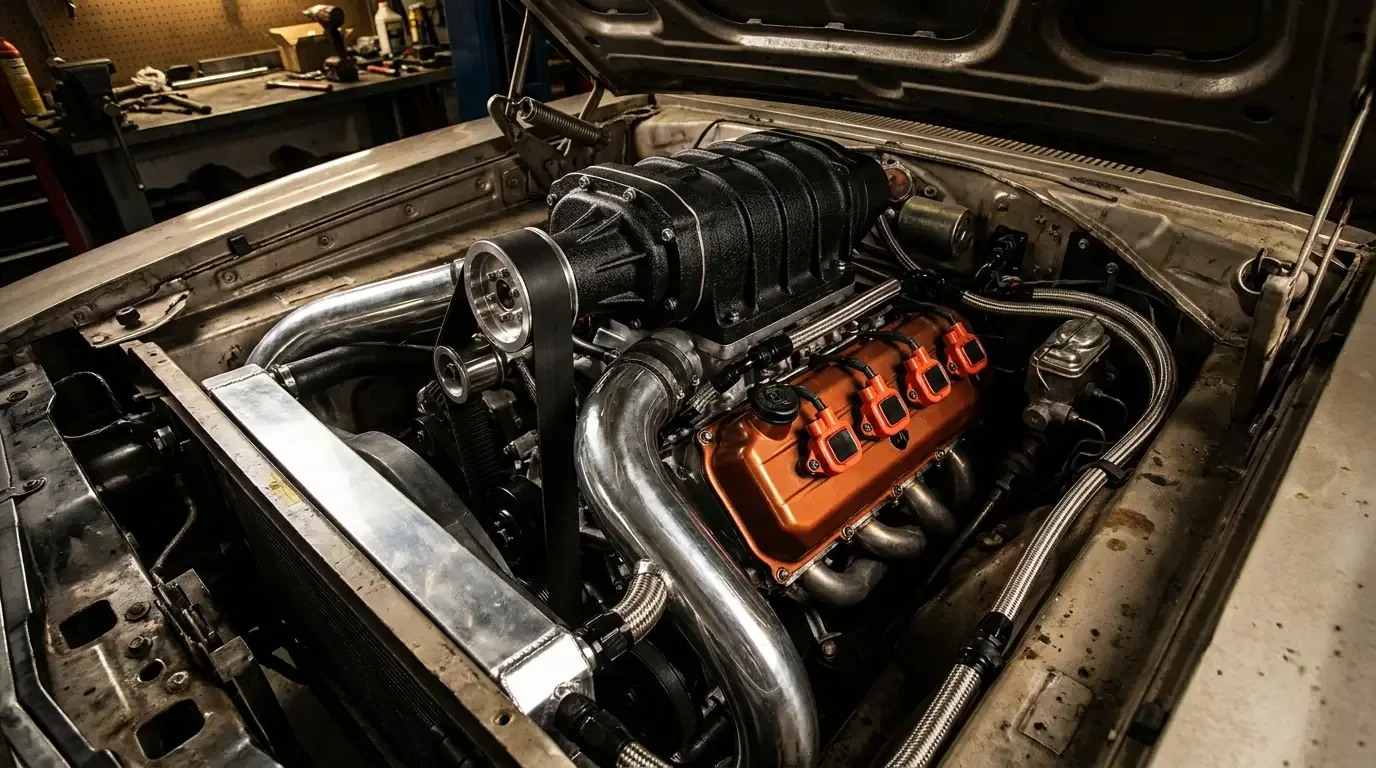
Then there is the Hellcat. The supercharged 6.2 liter Hemi makes 700 horsepower and change, and Chrysler sells it as a crate unit. This is where things get serious. That blower sits tall, so hood clearance is a real problem in most classics. The engine makes so much torque that a stock-style rear axle and driveshaft will not survive, so you are rebuilding the entire back half of the car. Cooling a supercharged engine in a tight vintage bay is its own project. This is not a first swap. This is a swap for someone who has done a couple already and wants to scare themselves.
Credit where it's due: done right, a 700-horse classic that still looks stock from ten feet away is one of the great automotive jokes. Just know what you're signing up for on the fabrication side.
The EV swap: the new frontier
Ten years ago, an electric classic would've been a punchline. Not anymore. The tech's matured, and for the right owner an EV swap makes real sense. You get instant torque, near-silent running, no oil changes, no tuning, and a car that'll happily crawl through city traffic in a way no carbureted V8 ever did.
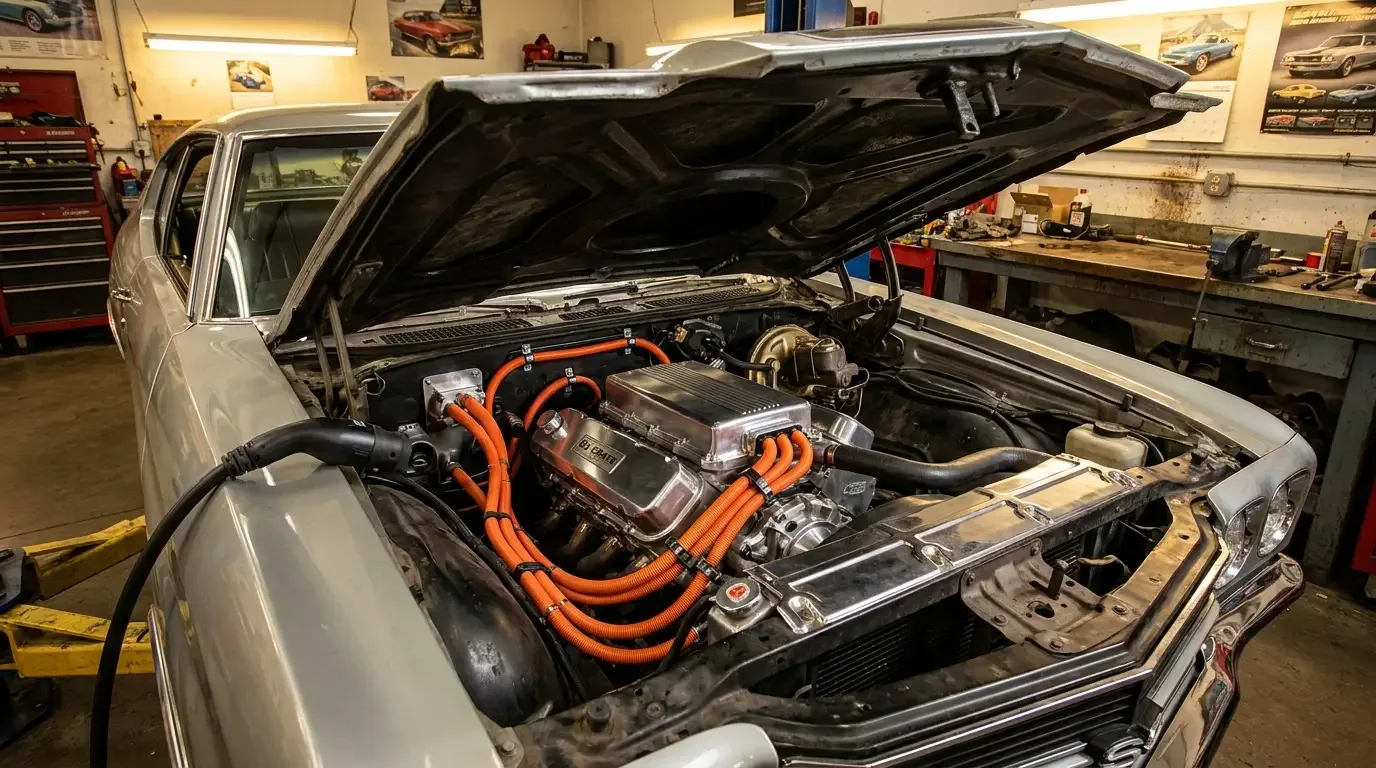
The honest downsides are cost and complexity. There is no cheap junkyard version of this swap. You are buying a motor, an inverter, a battery pack, a charger, and a control system, and you are paying someone who actually understands high-voltage systems to install it, because getting this wrong can kill you. Power figures range all over the map depending on the motor and pack you choose, from mild to genuinely violent. Range is the other honest question, and it depends entirely on how much battery you can fit and afford.
Companies now sell crate EV kits, and the aftermarket is growing fast, but this is still the least standardized of the four paths. Weight distribution changes completely, which ties directly into how the car handles and stops, so an EV swap almost always forces a hard look at the chassis. If you are going down this road, plan the suspension and brakes at the same time, the same way any serious pro touring build does.
How to actually choose
Strip away the badge loyalty and it comes down to four questions. What do you want to spend? What do you want the car to do? How much fabrication can you stomach or pay for? And which brand's blood runs in your veins?
- Cheapest reliable power: LS, every time. Nothing else is close on dollars per horsepower.
- Ford loyalty and DOHC sound: Coyote, and budget for the extra fabrication.
- Mopar torque, sane version: a 6.4 Hemi.
- Maximum lunacy in a stock-looking shell: Hellcat, if you have done this before.
- Silent, modern, zero-maintenance: EV, if your budget and your nerve can handle it.
Whatever you pick, match the transmission, rear end, cooling, and brakes to the power. That is the part people cheap out on, and it is the part that strands them on the shoulder. If you would rather buy a car with the hard work already done and verified, browse the finished restomods for sale and let someone else eat the learning curve.
Sources and notes
- Manufacturer crate-engine specifications from GM Performance, Ford Performance, and Mopar published figures.
- Period and current enthusiast press coverage of LS, Coyote, and Hemi swap builds.
- Aftermarket swap-kit catalogs and installation documentation from major suppliers.
- Builder and installer interviews, including the author's own shop experience.
- EV conversion vendor documentation for crate motor and battery systems.
Related Reading
Have a
Classic Car
for Sale?
Reach thousands of serious classic car collectors across the US.
Sell It Here →
Are You a Classic Car Dealer?
List your full inventory and connect with targeted classic car buyers.
Join as a Dealer →

About the author
Dan Reeves
Performance engine builder from North Carolina's motorsports corridor, focused on swaps, forced induction and making real, repeatable power.
More in Restoration & Tech
Comments
Be the first to comment on this article.