The two rating systems that rewrote Mustang history
Ask most enthusiasts what happened to Mustang horsepower in 1972 and the answer is usually the same: emissions regulations choked the life out of Detroit's engines. It is a tidy story, and it is largely wrong. What actually happened was far more mundane and, in some ways, more interesting. Ford and every other American manufacturer simply switched from one measurement method to another, and the numbers on the spec sheet fell off a cliff while the engines themselves barely changed.
Understanding that single fact is the key to reading any classic Mustang specification card correctly. Without it, the numbers are almost meaningless, and the myths about what these cars actually made are almost inevitable.
SAE gross versus SAE net: what the labels actually mean
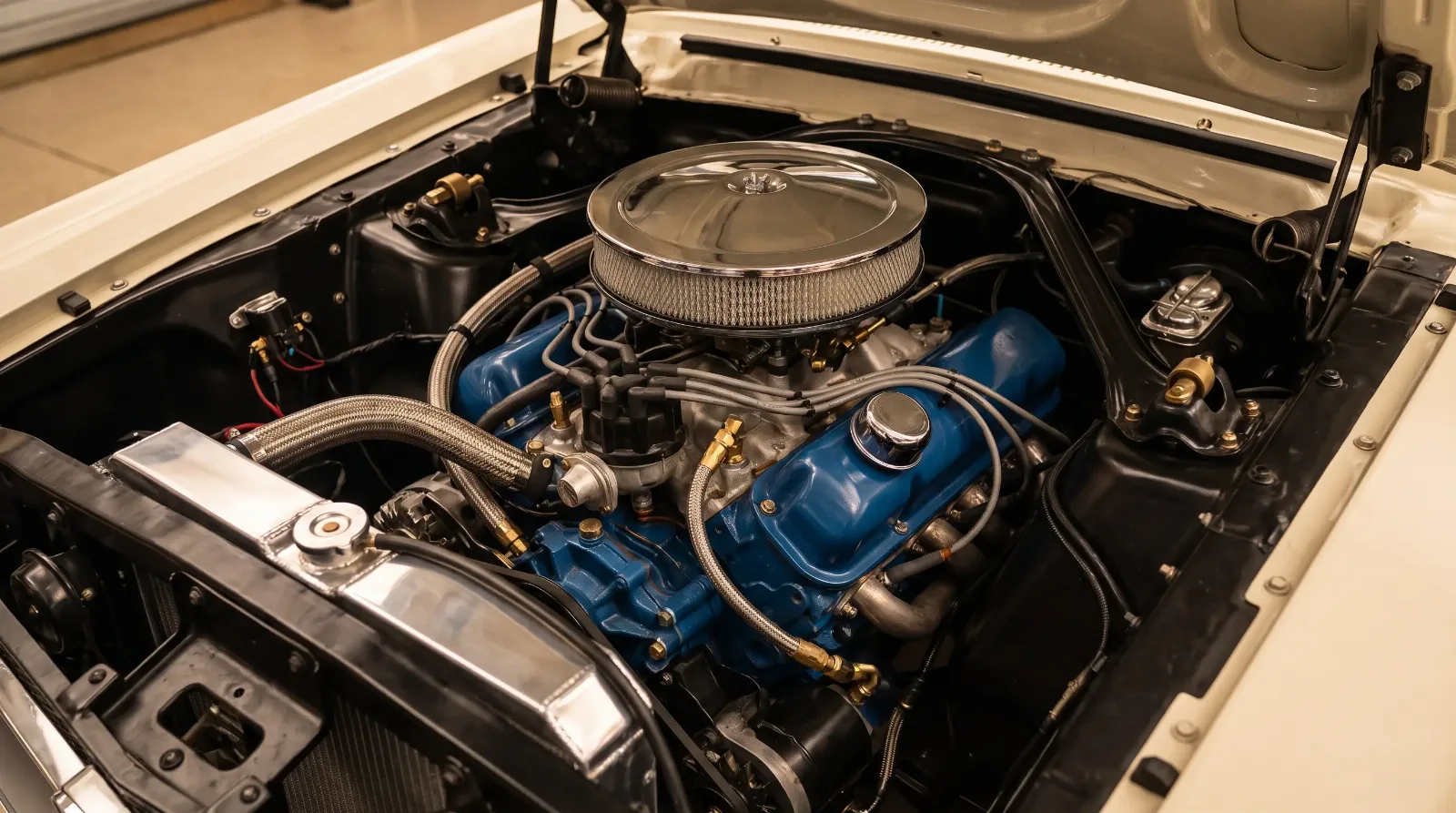
For most of the muscle-car era, horsepower figures published by American automakers used the SAE gross measurement standard. Gross testing measured an engine on a bare dynamometer stand, stripped of accessories: no air cleaner, no production exhaust manifolds, no alternator, no power-steering pump, no smog equipment. The result was the best possible number the engine could produce under ideal conditions, with nothing to rob power from the crankshaft.
SAE net testing, by contrast, measured the engine as it actually lived in the car, with all production accessories installed, the full exhaust system in place, and the air cleaner fitted. The difference between the two figures for the same engine typically ran between 15 and 25 percent, sometimes more on high-winding small-blocks where the air cleaner restriction mattered more.
Ford began publishing net figures for the 1972 model year, following an industry-wide agreement coordinated through the Society of Automotive Engineers. The decision was driven partly by a desire for more honest consumer advertising and partly by the realities of emissions equipment that could no longer be ignored in a gross test environment. The engines did not get weaker overnight. The measuring stick changed.
Why Ford deliberately under-rated its strongest engines
The gross-to-net transition explains the 1972 numbers cliff, but it does not explain everything. For years before that switch, Ford was publishing horsepower figures that factory engineers, racers, and careful testers all knew were conservative to the point of fiction. This was not accidental. It was deliberate policy, driven by two converging pressures: insurance surcharges and racing class rules.
By the late 1960s, insurance companies were using advertised horsepower as a primary variable in rate calculations for younger drivers. A car rated above a certain threshold triggered punishing premiums. At the same time, several racing sanctioning bodies used manufacturer-published figures to determine which class a car competed in. Publishing a lower number kept a car in a more favorable class, or kept it eligible at all.
The Boss 429 is the clearest example. Ford rated it at 375 horsepower at 5,200 rpm, a number that made insurance agents comfortable and class officials satisfied. Independent dyno tests and factory internal documents told a different story. The 429 was a purpose-built semi-hemispherical engine, developed with input from Ford's racing program, with free-breathing cylinder heads that were unlike anything else in the Mustang lineup. Credible contemporary testing suggested actual output was considerably higher, and modern dyno tests of properly built stock-specification engines have placed true output in the neighborhood of 500 horsepower or more at the flywheel, far beyond the conservative figure Ford was willing to print.
The 428 Cobra Jet, which powered more Mustangs than the Boss 429 ever did, carried a rating of 335 horsepower at 5,200 rpm. That figure was viewed skeptically from the moment Ford published it. The 428 CJ used a free-flowing intake manifold, large-port heads, and a healthy cam, and it ran through the quarter-mile at times that 335-horsepower engines simply did not produce. Ford's own engineers referred to the rating in internal communications as conservative. The 335 number served its purpose: it kept insurance costs reasonable for buyers and kept the car legal for certain drag-racing classes without triggering factory team scrutiny.
The Boss 302, built specifically for the SCCA Trans-Am series, was rated at 290 horsepower at 5,800 rpm. That rating needed to satisfy Trans-Am displacement rules and, again, kept insurance costs from scaring off buyers. The high-revving 302 with its canted-valve heads was built to make power at 6,000 rpm and above, a range that gross dyno testing at standard rpm did not fully capture. Enthusiast publications and racers recognized the discrepancy, even if they could not always quantify it precisely.
What the early small-blocks actually made
The under-rating story tends to dominate discussions of Mustang horsepower, but the majority of Mustangs were sold with more ordinary engines, and their ratings deserve the same scrutiny. The early 260 and 289 small-blocks that launched the Mustang in 1964 were straightforward engines with ratings that were more or less honest by gross standards.
The base 170 cubic-inch six-cylinder that appeared in early Mustangs was rated at 101 horsepower, a figure that reflected the engine's modest design accurately. The 260 V8 in its initial form carried 164 horsepower at 4,400 rpm, and the 289 in its high-performance "K-code" form was rated at 271 horsepower. These were gross figures, and applying the rough 20 percent net correction suggests the K-code 289 made something closer to 215 to 220 horsepower in real-world installed conditions. Still a strong engine for the era, still capable of producing the performance the car's reputation rests on, but meaningfully less than the spec sheet suggested.
The 351 Windsor and 351 Cleveland engines that became Mustang staples from 1969 onward had similarly measured gross figures that overstated real-world output. The 351 Cleveland four-barrel, in its best naturally aspirated street configuration, was a genuine performance engine. Its net ratings in 1972 reflected that honestly. Comparing its 1971 gross number to its 1972 net number and concluding the engine had been neutered is a mistake that shows up repeatedly in enthusiast writing.
"The single most important thing you can do when reading a Mustang spec card is check which year it's from and which standard was being used. Everything else follows from that."
— Tom Ramirez
How to read classic Mustang horsepower figures correctly
The practical takeaway for anyone researching classic Mustangs is a simple set of rules that prevent the most common comparison errors.
First, never compare a pre-1972 gross figure directly to a 1972-or-later net figure. The numbers are not on the same scale. A 1971 Mustang Boss 351 rated at 330 gross horsepower is not more powerful than a 1972 equivalent rated at 275 net horsepower. You need to apply the appropriate correction or find a source that converts both figures to the same standard before drawing any conclusion.
Second, treat the factory ratings for the Boss 429, the 428 Cobra Jet, and the Boss 302 as floor figures, not precise claims. These engines almost certainly made more than their published numbers in period testing. The gap between the advertised figure and the real output was a known feature of how Ford managed these programs, not an accident of measurement error.
Third, understand that the 1972 to 1974 period did involve some genuine power reductions alongside the rating-method change. Compression ratios came down across the industry to accommodate lower-octane unleaded fuel, and that did reduce output. But the scale of the apparent drop in those years is substantially explained by the measurement change, not by emasculated engines. The two effects ran together in the same model years, which is why separating them requires looking at specific engine families rather than general trends.
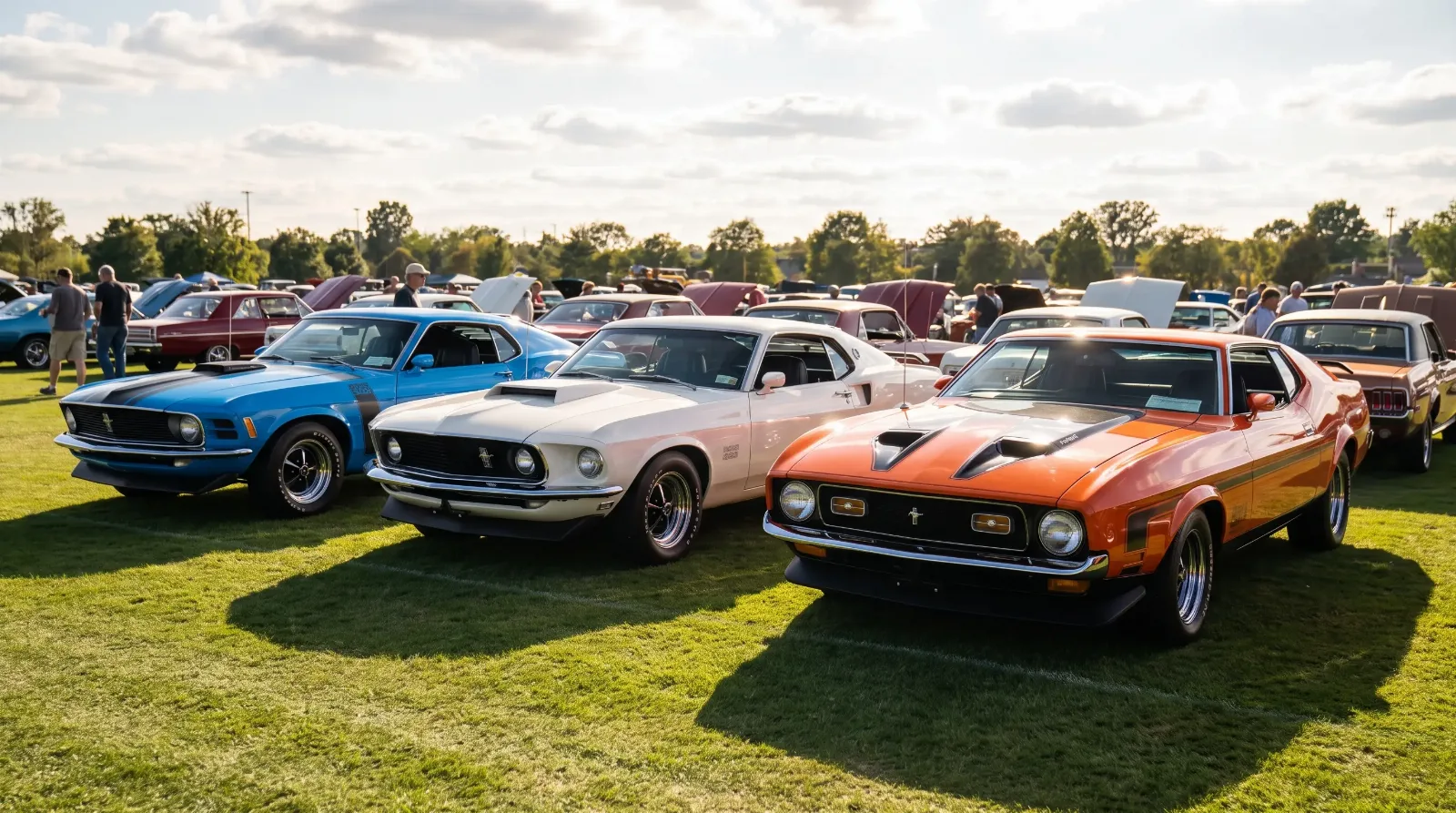
For a broader look at the performance variants that defined the era, the story of Mustang muscle puts the horsepower wars in the context of the cars they powered and the decisions Ford made in building them.
The honest answer to how much horsepower classic Mustangs really had is that it depends on the engine, the year, the measurement standard, and whether Ford was playing the rating game with that particular engine. The numbers on the badge were a starting point for a conversation, not the end of one.
Sources and notes
Every horsepower figure in this article reflects the manufacturer's published rating for the engine and model year named, expressed in SAE gross terms for pre-1972 engines and SAE net terms from 1972 onward, exactly as the text indicates. Dyno output figures cited for the Boss 429, 428 Cobra Jet, and Boss 302 are estimates drawn from independent period and modern testing; because they depend on engine build, tuning, and test conditions, they should be read as informed ranges rather than fixed values. Factory ratings of the era were shaped by insurance and racing-class considerations and were, in several documented cases, deliberately conservative. Figures were verified against the sources below at the time of writing.
- Boss 429 Mustang — Wikipedia: 375 hp at 5,200 rpm advertised rating, Crane Cams period dyno figures, and modern stock-spec output estimates.
- Boss 302 Mustang — Wikipedia: 290 hp at 5,800 rpm SAE gross rating and SCCA Trans-Am homologation background.
- Hagerty — 1971 vs. 1972: How the Horsepower Ratings Change Impacts Value: the gross-to-net transition for the 1972 model year and its effect on published figures.
- Carscoops — How America's Engines "Lost" Up to 130 HP Overnight: California's net-horsepower mandate (SAE J245) and Detroit's industry-wide adoption of net ratings.
- Hagerty — Sorting Out the Mustang's 351 Cleveland Engines: 1971 351 Cleveland four-barrel (285 hp) and Boss 351 (330 hp) gross ratings.
- Ford Mustang (first generation) — Wikipedia: 1964–1965 engine lineup, including the 170 six (101 hp), 260 V8 (164 hp), and 289 K-code (271 hp).