
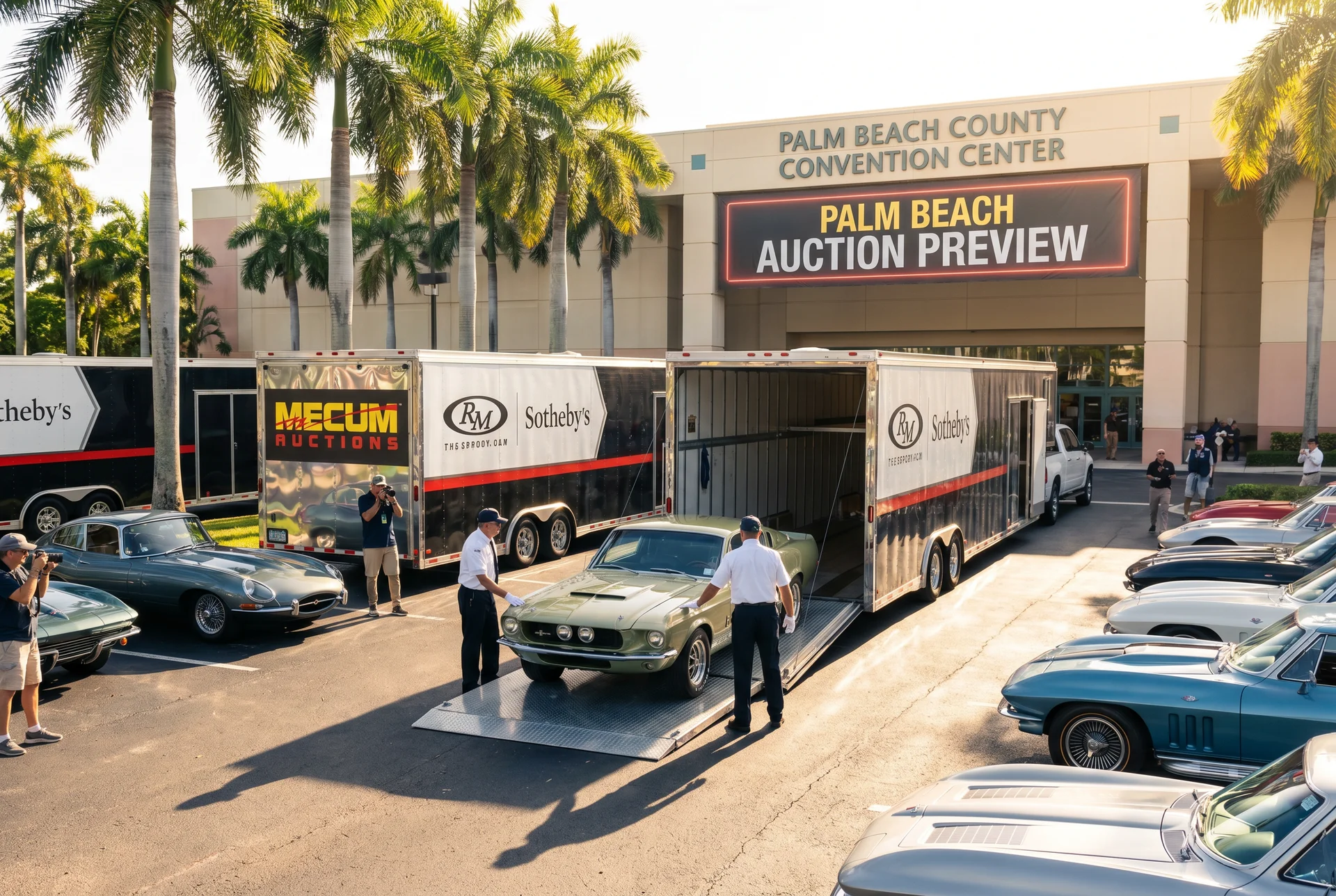
Barrett-Jackson's Palm Beach event has evolved into one of the more useful market-signal auctions on the calendar. It's large enough to show genuine trends, but not so dominant that a single bidding war between two motivated buyers distorts the whole picture. The 2026 Palm Beach results were worth paying attention to, and I spent three days on the floor doing exactly that.
News & Events
5 min read
Barrett-Jackson Palm Beach 2026: Top Results and Market Signals
The Palm Beach auction wrapped its 2026 edition with strong sell-through rates in the documented muscle car segment and softer results for restored clones. Here's what the hammers said.
The Numbers
Total sell-through for Palm Beach 2026 was approximately 74%, solid for the spring market, which typically runs a few points below the major January Scottsdale show. The average hammer price across all classes was up roughly 8% from Palm Beach 2024, the most comparable data point. That number, however, masks significant divergence between categories.
Documented Muscle: The Strong Story
Cars with clear provenance documentation (build sheets, title histories, PHS letters, documented matching numbers) performed well across the board. A 1969 Camaro Z/28 with matching DZ 302, build sheet, and clean Carfax history sold for $92,000 against a $75,000 estimate, which surprised even the seller's representative. A 1970 Plymouth Hemi 'Cuda convertible, one of the most desirable configurations in collector car history, brought $1.85 million, confirming that ultra-rare documented examples remain in their own category regardless of broader market conditions.
More instructive for practical buyers was the mid-market: documented 1970 Chevelle SS454 LS5 hardtops (not LS6, not convertibles) with four-speed manuals and verified matching numbers sold consistently in the $72,000–$88,000 range. That's up from the $62,000–$75,000 range I was tracking at the same event in 2024. The demand for correct, documented mid-tier muscle is real and it's accelerating.
Restored Cars Without Documentation: The Soft Story
The divergence became apparent watching the undocumented restored cars cross the block. A 1969 Camaro that had been through a professional frame-off restoration (beautiful cosmetically, beautiful mechanically, but without a build sheet and with an engine that couldn't be confirmed as matching) struggled at $52,000 against a $65,000 pre-sale estimate. It eventually sold at reserve, barely.
This wasn't an isolated case. Several professionally restored cars from credible shops sold below pre-sale estimate when the documentation story was incomplete. The message from the floor was consistent: buyers in 2026 are prioritizing authenticity over appearance. A car that looks original but can be proven original is the car they want. Consignors can find the practical side of this, from fees to reserves to prep, in our guide to selling at a live auction house.
Pre-War and Brass Era: The Quiet Gainer
Worth noting: the pre-war and brass era section was noticeably more active in 2026 than in recent years. A 1936 Ford Deluxe Tudor Sedan with a cosmetically refreshed interior but original drivetrain and documented single-family ownership sold for $34,500. Three years ago that car would have been $24,000. Something is happening in this segment and I'll be watching it at Indianapolis.
What Palm Beach 2026 Tells Buyers
If you're in the market for classic muscle in the next twelve months, the Palm Beach results support a clear strategy: buy documentation as much as you buy the car. A correct car with paper will find buyers quickly and perform at auction. A beautiful car without provenance will find the same buyers less interested and the same auction more discouraging. The cars to avoid paying top dollar for right now are the recent frame-offs from shops whose documentation is incomplete. Wait for a motivated seller or a private sale from an estate where the original paperwork surfaces with the car.
Have a
Classic Car
for Sale?
Reach thousands of serious classic car collectors across the US.
Sell It Here →
Are You a Classic Car Dealer?
List your full inventory and connect with targeted classic car buyers.
Join as a Dealer →

About the author
Patrick Walsh
Automotive journalist covering classic car shows, events, and the enthusiast community across North America.
Comments (4)
O
Owen
3 days ago
Why would a '36 Ford Tudor jump ten grand in three years?
F
Frank DeLuca
5 months ago
The pre-war section note is consistent with what I saw at a smaller regional auction in March. 1930s American cars moving above estimate pretty regularly. Something is happening there.
G
Gary Tompkins
5 months ago
Attended Palm Beach this year. The floor was busy but the bidding wars were concentrated on well-documented cars. Undocumented cars went through quietly or passed out.
E
Eddie Carlisle
4 months ago
Market for these has been stable longer than I expected. Thought prices would soften after the last run-up. They've held.