The Plymouth Barracuda has two very different lives in classic-car history. The 1964-1969 A-body cars were affordable economy fastbacks built on the Valiant platform β fun, but not legendary. The 1970-1974 E-body cars are an entirely different animal: purpose-built muscle cars sharing platform with the Dodge Challenger, available with everything from the slant-six to the legendary 426 Hemi. Today, documented original 1970-1971 Hemi 'Cudas and AAR 'Cudas trade for seven-figure money, while solid 1973-1974 cars remain the bargain entry into Mopar muscle ownership.
Common Issues
Mopar E-body rust is legendary and follows predictable patterns. The lower fenders behind the front wheels, the rear quarter panels (lower and upper at the rear glass), the trunk pan, the trunk drop-offs, the rear frame rails, and the floor pans are all standard rust zones. The rear window channel on coupes traps water and rots from inside out β invisible until you remove the rear glass.
Mechanically, the Mopar B and RB big-block V8s (383, 440) are bulletproof when maintained. The 426 Hemi requires specialist setup β the cross-ram intake, dual four-barrel carburetors, and solid-lifter valvetrain need attention from someone who knows the engine. The A833 four-speed and Torqueflite 727 automatic are both robust. The 8.75-inch and Dana 60 rear ends are strong; broken stub axles are uncommon except on extremely abused cars.
Electrical issues vary. Original wiring harnesses are 50+ years old and prone to chafing. The voltage regulators on 1970-1972 cars commonly fail. Ammeter wiring on dashboards has caused fires in some cars β always check the back of the gauge cluster for heat damage and consider a voltmeter conversion. Vacuum-actuated systems (heater controls, headlight doors on the Cuda) commonly fail and require careful repair.
What to Look For
Fender tag and broadcast sheet are the gold-standard authentication for any Mopar E-body. The fender tag (riveted to the driver-side inner fender) is a coded plate listing all factory-installed options. The broadcast sheet (the build sheet that traveled with the car through the assembly line) is often hidden under the rear seat, in the springs of the front seat bottom, behind the back panel of the rear seat, or stuffed into the heater box. Cars with intact original fender tags and broadcast sheets carry significant premium pricing.
For any 'Cuda claim β 340 'Cuda, 383 'Cuda, AAR 'Cuda, 440 'Cuda, Hemi 'Cuda β the fender tag verifies the original equipment. The fifth digit of the VIN identifies the engine code: G=318, H=340, J=340 4V (AAR-spec), L=383 4V, N=383 4V (Six Barrel), U=440 4V, V=440 6V (Six Pack), R=426 Hemi 8V. Cross-reference all three (VIN, fender tag, engine block partial VIN) and demand a Galen Govier inspection for any car priced over $150,000.
Body alignment is the second non-negotiable for E-body cars. The unibody is structurally weak compared to the Mustang and Camaro of the same era β heavily flexed cars show up as misaligned doors, cracked windshields, or trunk lids that don't close right. Push down on each corner of the car and watch the doors. They should not move relative to the body.
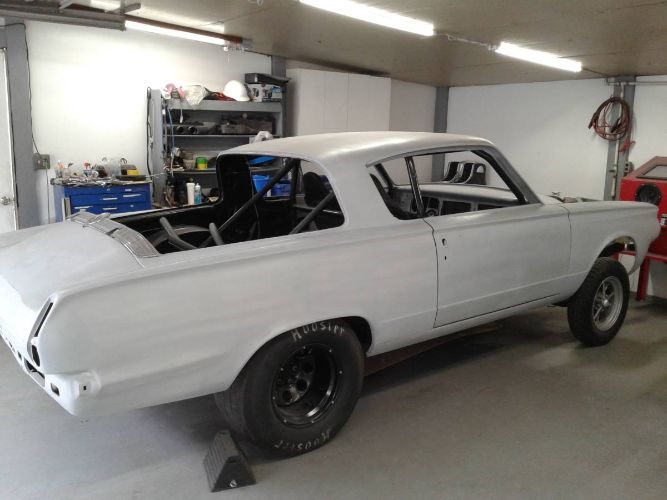
For 1964-1969 A-body Barracudas, the same rust patterns apply but values are dramatically lower. The Formula S package (1965+ with the 273 V8, then 340 from 1968) is the desirable A-body trim. Verify the V code in the VIN and the original options on the dataplate.
Price Guide
The 1964-1969 A-body Barracudas remain the bargain Mopar pony car. Driver-quality 1965-1969 cars with the 273 or 340 small-block run $22,000-$45,000. Documented Formula S 340 cars (1968-1969) trade for $40,000-$75,000.
1970-1971 E-body Barracudas are the muscle-car icons. Driver-quality 318 or 340 cars run $35,000-$65,000. 'Cuda 383 cars: $55,000-$95,000. AAR 'Cuda (1970 only, T/A homologation special): $120,000-$220,000 for documented numbers-matching cars. 440 'Cuda Six Pack: $120,000-$280,000. Hemi 'Cuda: $300,000-$1.5M+ for documented numbers-matching examples. Hemi 'Cuda convertibles (only 14 produced) are $3M-$5M+ at auction.
1972-1974 cars (post-emissions de-tune, post-Hemi) are the smart-money entry into E-body ownership. Driver-quality 1973-1974 'Cuda 340 cars run $32,000-$60,000 β a fraction of equivalent 1970-1971 money for nearly identical styling and a legitimate small-block performance package.
Project cars (running but rough) start around $15,000 for A-body Barracudas and $25,000-$40,000 for E-body cars. Stripped E-body roller candidates without an engine or transmission can still bring $15,000-$25,000 because the demand for proper 1970-1971 'Cuda restoration projects exceeds supply.
Did You Know?
The Plymouth Barracuda technically launched on April 1, 1964 β sixteen days before the Ford Mustang. Both cars were marketed as the first "pony car," but the Mustang's larger marketing budget and broader option list quickly buried the Barracuda's first-mover advantage. Plymouth never recovered the segment leadership.
Only 12 Hemi 'Cuda convertibles were built for 1971, and only 14 for 1970 β making them among the rarest production muscle cars ever built. A 1971 Hemi 'Cuda convertible sold at Mecum Seattle in June 2014 for $3.5 million, setting a record at the time for a production muscle car.
The AAR 'Cuda was a one-year-only homologation special built to qualify the Barracuda for SCCA Trans-Am racing in 1970. Only 2,724 AAR 'Cudas were produced. The car features unique side-exit exhaust, a special 340 Six Pack engine (three two-barrel carburetors), strobe-stripe graphics, and a fiberglass hood scoop. It's now one of the most desirable post-1969 muscle cars in the entire market.