Elite Dealer

1966 Chevrolet Corvette

$74,997
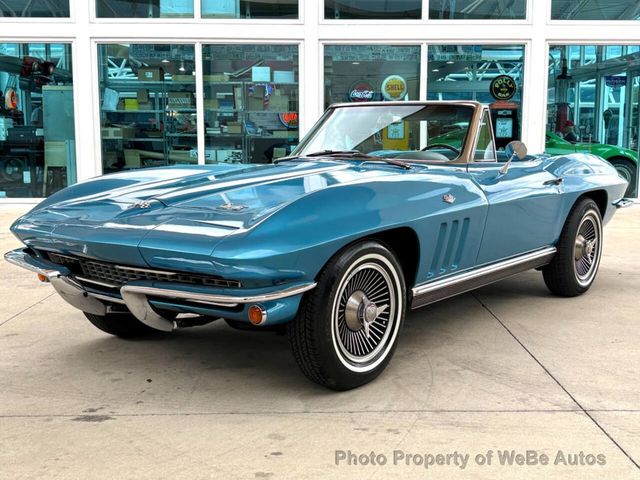
1966 Chevrolet Corvette

Vehicle Details

Make

Chevrolet

Model

Corvette

Year

1966

Mileage

25,744 miles

VIN

194676S117773

Body Type

Convertible

Transmission

Manual

Fuel Type

Gasoline

Engine

350ci

Description

1966 Chevrolet Corvette Convertible — 327/300, 4-Speed, Nassau Blue Why This Car Is Special The 1966 Chevrolet Corvette Convertible occupies a specific and well-earned place in the C2 generation's short four-year run. By 1966, Chevrolet had refined the Sting Ray body — introduced in 1963 — to a point where the engineering and the styling worked together about as well as they ever would. The egg-crate grille was new for 1966, the fender louvers were cleaned up, and the overall package represented the most polished version of Bill Mitchell's original design.

Chevrolet built 17,762 Corvette convertibles for the 1966 model year, and while the big-block cars tend to dominate the headlines, the small-block cars have always attracted a different kind of buyer — one who understands that a 327 cubic inch V8 in a 3,000-pound fiberglass roadster is an entirely satisfying arrangement. This particular 1966 Chevrolet Corvette Convertible is finished in Nassau Blue with a matching bright blue leather interior and a white soft top. The color combination is one of the more distinctive pairings from that model year, and the car carries 25,744 actual miles.

The VIN decodes to a 1966 Corvette convertible built at the St. Louis assembly plant, with the 327 cubic inch 300 horsepower engine and a 4-speed manual transmission. That is a straightforward, honest specification — no inflated horsepower claims, no questionable options added after the fact.

What you see is what Chevrolet built. Features - 327 cubic inch V8, 300 horsepower - 4-speed manual transmission - 4-wheel disc brakes - Knock-off style wheels with white letter tires - Dual exhaust - Wood-rimmed steering wheel - Dashboard tachometer - Full gauge cluster - Bright blue leather bucket seats - Center console - Nassau Blue exterior - White convertible soft top - Chrome bumpers - 25,744 actual miles Mechanical The L75 327/300 was Chevrolet's mid-range small-block offering for the 1966 Corvette. It used a single four-barrel carburetor and hydraulic lifters, which made it more streetable than the higher-output 327/350 or 327/365 versions.

For context, 1966 was actually the final year for the 327 as the Corvette's small-block option — the 350 would replace it starting in 1969. That makes 1966 a historically significant year for anyone who follows the small-block's development arc. The 4-speed manual transmission was the right gearbox for this engine in this chassis.

Rowing through the gears in a mid-1960s Corvette is a tactile experience that later cars with their tighter, more modern transmissions don't quite replicate. The throws are deliberate, the engagement is mechanical and direct, and it rewards a driver who pays attention. One of the most significant mechanical upgrades Chevrolet made to the C2 Corvette was the introduction of four-wheel disc brakes in 1965, and this 1966 Corvette Convertible carries that system.

Before 1965, Corvette buyers had to make do with four-wheel drums, which were adequate at best for a car with this kind of power-to-weight ratio. The transition to four-wheel discs was a genuine improvement in stopping performance, and it is a feature that separates the 1965 and later cars from the earlier C2s in practical terms. The dual exhaust exits cleanly through the rear valance, as confirmed in the underside photos, and the exhaust routing appears correct and tidy.

The knock-off style wheels deserve a note here. The 1966 Corvette offered genuine knock-off aluminum wheels as an option — a design derived directly from racing practice, where a single large spinner could be removed quickly for a wheel change. The spinners thread onto a hub adapter and are tightened with a lead hammer.

They are period-correct and they are one of the more mechanically interesting wheel options that was ever available on an American production car. Interior The interior of this 1966 Chevrolet Corvette Convertible is trimmed in bright blue leather throughout — seat
Options: Factory Premium Sound System

Classic Chevrolet Corvette Buyer's Guide

Full guide
M
Mike Sullivan
Muscle Cars
1953–1982
~6 min read
Updated Apr 2026
Complete buyer's guide for classic Chevrolet Corvette C1, C2 and C3 (1953-1982). Birdcage rust, frame inspection, engine code identification, and current market pricing for split-windows, L88s and LT-1s.
This guide covers
10-point inspection checklist
Common issues & what to avoid
In-person inspection guide
Market pricing by year & condition
5 FAQs answered
History & fun facts

Chevrolet Corvette Market Overview

Based on 616 Chevrolet Corvette listings currently on ClassicCarsArena.com

616
Listed Now
$39,933
Avg. Asking Price
1953–1999
Year Range
Price Position on Our Site — Above Average
This car: $74,997
Low: $4,000 High: $299,995
Transmission Distribution
Automatic 47%
Manual 37% ◄
Condition Distribution
Excellent 13%
Good 12%
Fair 5%
Poor 0%
Data from ClassicCarsArena.com listings Browse all 616 listings →
💰

What is this car worth?

Check sold prices for the 1966 Chevrolet Corvette

Valuation Tool →

Classic Chevrolet Corvette Buyer's Guide

The Chevrolet Corvette has been America's sports car for over seventy years, but the classic Corvette market splits into three distinct generations, each with its own buyer profile and its own pitfalls. The C1 (1953-1962), C2 mid-year (1963-1967), and C3 shark (1968-1982) cover three decades of evolution from solid-axle straight-six convertibles to small-block legends to LT-1-powered chrome-bumper cars. Knowing which Corvette is yours — and what it actually is versus what the seller claims — is the difference between a sound investment and an expensive lesson.

What to Check Before Buying

Verify dashboard VIN against trim tag and engine partial VIN — All three must agree. Engine partial VIN is on driver-side block deck near cylinder head.
Demand original tank sticker for any car over $60K — Glued inside top of gas tank. Lists all original options. Gold standard for premium Corvette verification.
Order NCRS Shipping Data Report ($50) — Available from National Corvette Restorers Society. Confirms original equipment from GM records.
Inspect birdcage at door frames and cowl — Pull door panels, lift carpet at windshield base. Perforation = $8,000-$25,000 structural repair.
Probe frame at kick-up and rear cross-member — Solid steel resists; rotten metal flakes. Frame replacement is $15,000-$30,000 if needed.
Examine fiberglass under raking light — Stress cracks at body mounts, headlight buckets, rear panel. Deep cracks = impact damage or chassis flex.
Check T-top seals and headliner (C3) — Water staining indicates failed seals. Leaks rot birdcage from inside.
Verify Big Block valvetrain on cold start — Solid-lifter L72/L78/L88/ZL1 should tick and subside with oil pressure. Continuous noise = valve adjustment or worn lifters.
Compression test all eight cylinders — Should read 145-185 PSI uniformly across the bank. Variance >15% = head gasket or ring problem.
Test all electrical and pop-up headlights (C3) — Vacuum-actuated headlights commonly fail. Hidden leaks in vacuum lines drop the lights at speed.

Common Issues

Corvette "birdcage" rust is the structural killer for C2 and C3 cars. The birdcage is the steel inner structure that supports the fiberglass body — windshield frame, A-pillars, doglegs, and roof. When the birdcage rots, the body flexes, glass cracks, and door alignment goes off. Birdcage repair on a C2 or C3 is $8,000-$25,000 depending on extent. Frame rust on C1 (boxed steel) and C3 (X-frame) Corvettes is the second major concern. The kickup behind the front wheels, the rear suspension mounting points, and the rear cross-member all rot in salt-belt cars. Probe the frame with a screwdriver — solid steel resists, rotten metal flakes. Mechanical issues vary by generation. C1s commonly have weak Powerglide automatics and tired solid-lifter 283 fuelies. C2s have strong drivetrains but the leaf-spring rear suspension wears bushings and the differential carriers crack. C3s suffer from sloppy T-tops that leak, failing radiators, and worn front coil springs that sag the front end. The L88 cars (1967-1969) had aluminum heads that crack from heat cycling — a deal-breaker if not previously addressed.

What to Look For

VIN authentication is the first stop. The C1 and C2 cars used the dashboard VIN plate; the C3 added the windshield-pillar VIN starting in 1968. Cross-reference the VIN against the trim tag (riveted to the body brace under the glovebox or on the firewall depending on year) and against the engine block partial VIN. Big Block cars (1965+ 396, 1966+ 427, 1970+ 454) and Z06/L88/ZL1 specials must have all numbers matching to claim premium prices. For C2 and C3 cars, inspect the birdcage. Pull the door panels and look at the inner door structure. Lift the carpet at the windshield base and look at the inner cowl. Pull the headliner if practical and look at the roof structure on coupes. Surface rust is acceptable; perforation is structural and expensive to repair. For any high-dollar Corvette claim — L71 427/435, L88, ZL1, Z06, LT-1 — demand the original tank sticker (the build sheet that was glued to the inside top of the gas tank). Tank stickers are the gold standard for verification. Cross-reference the tank sticker codes against the VIN and the engine block partial VIN. Fiberglass condition is uniquely Corvette. Look for stress cracks at the body mount points, around the headlight buckets, and at the rear panel where the bumpers attach. Surface gel-coat cracks are cosmetic; deeper structural cracks indicate impact damage or chassis flex.

Price Guide

C1 (1953-1962) Corvettes range from $45,000 for solid 1958-1962 driver-quality 283 V8 cars up to $300,000+ for documented 1957-1962 fuelie cars in concours condition. The 1953 launch year (only 300 built) is a special case — documented original 1953s sell for $200,000-$400,000. C2 (1963-1967) is the most coveted Corvette generation. The 1963 split-window coupe is the icon — $95,000-$200,000 for drivers and survivors, $300,000+ for documented L84 fuelie cars. 1965-1967 396/427 Big Blocks are $85,000-$180,000 for drivers, with documented L71 Tri-Power cars at $140,000-$280,000. The 1967 L88 is the holy grail — only 20 were built — and documented examples bring $2.5M-$5M at auction. C3 (1968-1982) is the bargain entry to Corvette ownership. Driver-quality 1968-1972 small-blocks run $22,000-$42,000. The 1970-1972 LT-1 (small-block, solid-lifter, 350-360 hp) is the underrated gem at $45,000-$85,000 for documented numbers-matching cars. 1973-1977 cars are the bargain era at $15,000-$28,000. 1978 silver anniversary and 1982 Collector Edition cars trade for $22,000-$35,000.

Did You Know?

The Corvette name was suggested by GM PR director Myron Scott — named after the small, fast warship class. GM trademarked "Corvette" in May 1953, just one month before the car's June launch. The 1963 split-window coupe was a Bill Mitchell design that survived for only one model year. Zora Arkus-Duntov, the Corvette's chief engineer, hated the split window because it killed rearward visibility, and he successfully lobbied to remove it for the 1964 model year. The one-year-only design is now the most iconic Corvette body style ever produced. Only 20 L88 Corvettes were built for 1967, and Chevrolet deliberately under-rated the engine at 430 horsepower to keep insurance companies off the buyer's back. The L88 actually produced approximately 540 horsepower in road-going trim and was conceived purely as a homologation special for road racing — Chevrolet refused to install a heater, radio, or AM/FM in any L88, telling buyers to special-order them at the dealer if they actually wanted comfort features.

Similar Listings

Contact Seller

Share only if you'd like the seller to call you directly.

By contacting this seller you accept the Visitors Agreement

Call this seller?

You're about to call WeBe Autos about the 1966 Chevrolet Corvette.

+1 (631) 339-0399

Before you call: Never wire money or share bank info over the phone. Read our scam-avoidance tips.
Call Now

Send to a Friend

Share this 1966 Chevrolet Corvette listing.

Report this Ad

Help us keep the marketplace clean. Our moderation team reviews every report within 24 hours.