Pro Dealer

1968 GMC

Saskatoon, Saskatchewan

$12,040

1968 GMC

Vehicle Details

Make

GMC

Model

Not Listed

Year

1968

Mileage

19,000 miles

Body Type

Other

Transmission

Manual

Fuel Type

Gasoline

Engine

250 ci 6-cyl

Description

Price: US $12,040 (CAD $16,990 at the dealer).

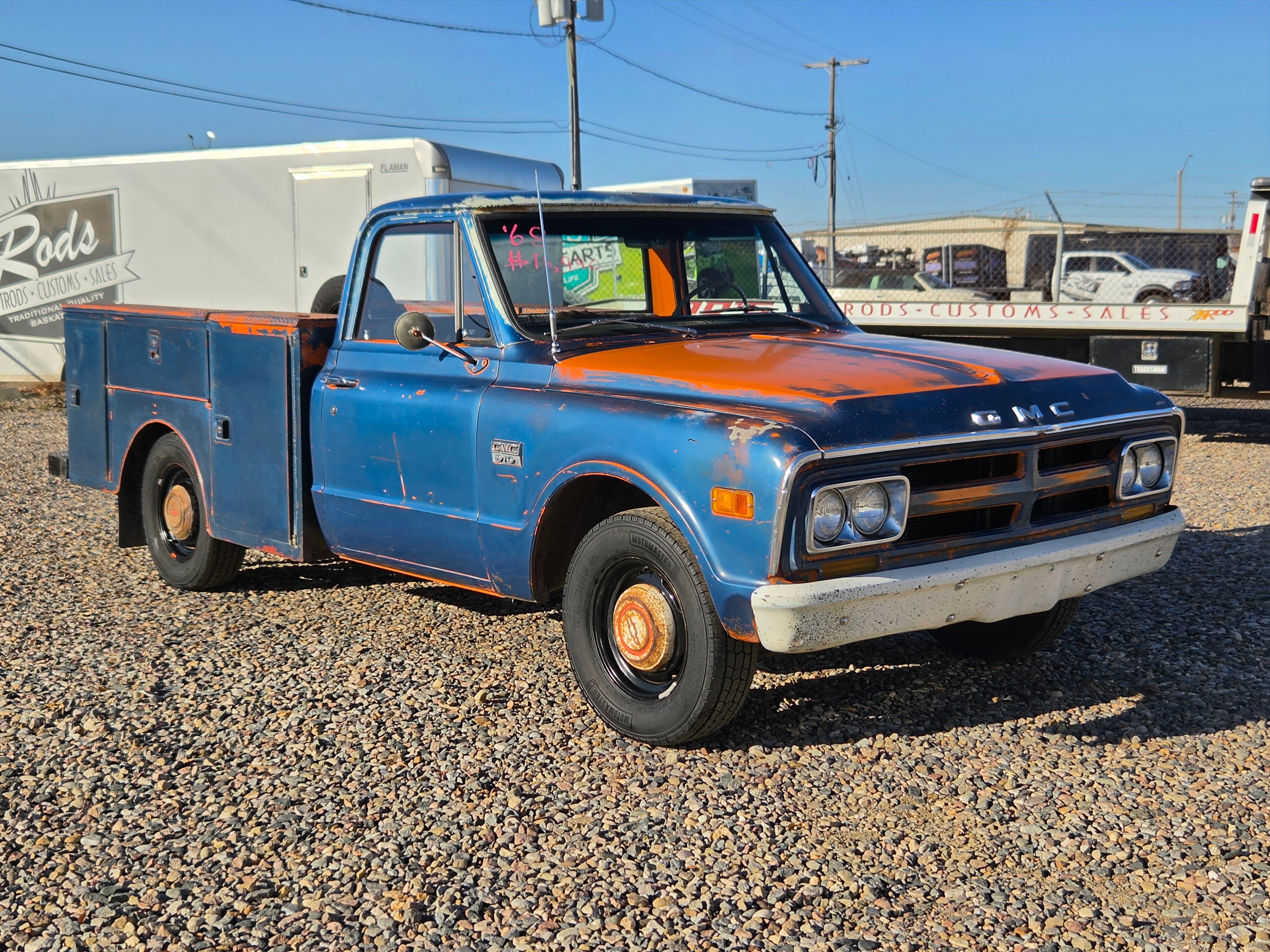
1968 GMC 910 Service truck. Sweet old rig with the period correct service/utility storage compartment box still installed! This truck would have been sold new as a cab and chassis, and the utility box was produced aftermarket (several companies made them) and installed onto the frame. The orange body and white roof showing through the blue top layer of paint suggests this might have been a Sask Power truck at some point, but that’s just a guess.

Incredible patina and condition for it’s age, especially considering this was a well used work truck! Very much factory original with the 292 inline 6-cylinder but now paired with a 5-speed manual transmission allowing the truck to keep up (sorta) on the highway. There’s manual steering and manual drum brakes. With only 170 gross hp (when it was new) the truck won’t win any races, but it’s a proven driver! Recently the truck took part in the Dino’s Git Down all GM car show in Glendale Arizona.

It wasn’t just at the show, it drove down to the show from Regina! Dino’s Git Down is one of the largest outdoor car shows in North America with over 8,000 GM truck showing up every year! This truck was named in the top 100 list of the show, when it went down. The GMC 910 is a Canadian specific model and was produced in low numbers in comparison to the Chev/GMC trucks made in the USA, making it a bit of a rare find, especially in original condition. It’s a very basic truck with crank windows and bench seat, but it does have a heater and a GM radio.

It was optioned with an inside mirror, heavy duty front and rear springs, rear leaf suspension, oil bath air cleaner, dual horns, ammeter and oil gauge, cigarette lighter, block heater, heavy duty battery and 4-speed manual transmission. Under the cover the bench seat is a beige vinyl. The black vinyl flooring has been replaced in the truck making it a nice place to be.

Despite being used and with lots of patina, the body and engine bay are still neat and tidy. We notice a HEI distributor has been installed, and the mechanicals have all been sorted and gone through – proof with a 3000-mile round trip to Arizona and back! The truck shows 19,000 miles, but obviously the odometer has 5-digits and must have rolled over once or twice by now so true milage is unknown. The utility box doors all open and close and there’s all kinds of storage, hooks and holders built into the cabinets.

The wood on the bottom of the box is well weathered but looks great. What you see is what you get with this one. It’s super original, but very straight and has nothing to hide! We think it would make a great shop truck for a business! Stick your logo on this thing, drive it around and turn heads!

Classic GMC Pickup Buyer's Guide

Full guide
R
Robert Halloran
Classic Trucks
1947–1972
~4 min read
Updated Apr 2026
Definitive buyer's guide for classic GMC Pickup 1947-1972. Advance Design, Blue Chip, and Action Line generations, frame and bed inspection, current pricing for survivors and resto-mods.
This guide covers
âś“ 10-point inspection checklist
âś“ Common issues & what to avoid
âś“ In-person inspection guide
âś“ Market pricing by year & condition
âś“ 5 FAQs answered
âś“ History & fun facts

GMC 253 22 Market Overview

Based on 10 GMC 253 22 listings currently on ClassicCarsArena.com

10
Listed Now
$29,145
Avg. Asking Price
1919–1990
Year Range
Price Position on Our Site - Below Average
This car: $12,040
Low: $7,495 High: $94,995
Transmission Distribution
Automatic 50%
Manual 40% ◄
Data from ClassicCarsArena.com listings Browse all 10 listings →
đź’°

What is this car worth?

Check asking prices for the 1968 GMC

Valuation Tool →
🔑

Selling a classic? Here's how

Fees, audience and photo limits compared: compare the places to sell classic cars .

List Yours →

Classic GMC Pickup Buyer's Guide

The classic GMC pickup market spans twenty-five years and three distinct platform generations across the post-war American truck era. The 1947-1955 Advance Design pickups established the modern post-war truck aesthetic. The 1955-1959 Blue Chip era brought V8 power and refined styling. The 1960-1972 Action Line era brought the modern chassis and bed designs that became the foundation of the legendary 1973 square-body. Across all three eras, GMC was positioned as the "professional grade" GM truck, heavier-duty engines, reinforced frames, and commercial-grade options that distinguished it from the higher-volume Chevrolet equivalent. The 1967-1972 Action Line short-bed Fleetside is the most actively collected GMC pickup era today. Don't buy somebody else's project, the frame and the cab are non-negotiable.

What to Check Before Buying

✓
Inspect frame at body mount points , Pre-1973 frames rust at body mount points, rear cross-member, and inside boxed sections. Frame replacement = $8,000-$18,000.
✓
Lift bed mat and check bed floor , Universal rust point on working trucks. Wood bed floor on pre-1955 cars adds different concerns vs steel.
✓
Examine cab corners from outside and inside , Visible from inside through kick panels. Cab corner rust universal.
✓
For Advance Design (1947-1955) cars, inspect wood , Pre-1955 GMC pickups have wood inner body framing. Wood rot = $5,000-$15,000 specialist repair.
✓
Pull floor mats and inspect floor pans , Both driver and passenger sides. Floor pans rot from underneath.
✓
Cross-reference VIN with original engine spec , GMC inline-six engines (228, 248, 270) and V8 engines (305C, 351C, 305E) have specific casting numbers.
✓
Verify body style code on dataplate , Half-ton, 3/4-ton, and 1-ton variants have different value trajectories.
✓
Check tailgate hinges and tailgate seal , Tailgate hinges rust through. Tailgate seal allows water into bed cargo area.
✓
Inspect cowl seam at windshield base , Where windshield meets firewall. Cowl rust drains into cab and rots floor pans.
✓
Compression test all six or eight cylinders , Inline-six should read 130-160 PSI. V8s should read 145-180 PSI uniformly.

Common Issues

GMC pickup rust patterns vary by era. The 1947-1955 Advance Design cars rust at the lower body panels, running boards, fender attachment points, cab corners, and floor pans. Pre-1955 cars have wood inner body framing supporting the steel outer panels, water penetration causes wood rot in addition to steel rust. The 1955-1959 Blue Chip era cars share rust patterns with all-steel construction. The 1960-1972 Action Line cars rust at cab corners, rocker panels, floor pans, frame body mount points, and bed floor. Mechanically, GMC inline-six engines (228, 248, 270, 305) are exceptionally durable when maintained, heavier-duty than Chevrolet equivalents with seven-bearing crankshafts and stronger blocks. Common issues include valve cover leaks, oil pan gasket leaks, worn timing gears, and tired carburetor settings. The 305C, 305E, 351C, and 305 V8 engines (1955-1972) are bulletproof. The Hydra-Matic, Powerglide, and Turbo Hydra-Matic 350/400 automatic transmissions are essentially indestructible. The Advance Design and Blue Chip era trucks used the original Spicer 18 transfer case (4WD configurations) and Dana 25 front axle (4WD only). The Action Line era introduced the NP201 and NP203 transfer cases. Common 4WD issues include tired transfer case bushings and worn front axle u-joints. Electrical issues are universal. Pre-1955 cars used 6-volt positive-ground systems requiring specific bulbs and components. Many cars have been converted to 12-volt negative-ground for modern reliability, verify the conversion was done properly. Original wiring on 1955-1972 cars is brittle 50+ years on. For Advance Design and Blue Chip cars, the wood bed floor common on these eras requires periodic refinishing. Original-condition wood bed floors with proper finish add 5-10% value to documented original cars.

What to Look For

Frame inspection is the first non-negotiable on any classic GMC pickup. Crawl under with a flashlight. Probe the perimeter frame at body mount points, rear cross-member, and front horns. Solid steel resists; rotten metal flakes. Frame replacement on a classic GMC pickup is $8,000-$18,000. The frame and the cab are non-negotiable. Cab corner rust is universal on driver-quality GMC pickups. Cab corners are reproduction parts available, but installation requires skilled bodywork. For 1947-1955 Advance Design cars, probe the wood inner body framing at door pillars, windshield post, and rear body corners. Soft, spongy, or rotten wood requires specialist coachbuilding repair, $5,000-$15,000 typical. Body style verification is essential. GMC pickups were offered in numerous configurations: half-ton (Model 100/1500), 3/4-ton (Model 150/2500), 1-ton (Model 250/3500). Half-ton pickups are most desirable for collector use. Long-bed (8-foot) and short-bed (6.5-foot) variants exist, short-beds command 25-50% premium for 1967-1972 Action Line cars. For Action Line second-generation (1967-1972) cars, verify the body style: Fleetside (smooth bedside) is dramatically more desirable than Stepside (separate fender flares). Crew cab and chassis cab variants exist but are dramatically less collectible. Engine identification is straightforward. GMC inline-six engines (228, 248, 270, 305) and V8 engines (305C, 305E, 351C, 305) all have specific casting numbers and stampings. Cross-reference against original specifications. For 4WD configurations (less common on Action Line cars), verify front axle, transfer case, and rear axle are GMC-specific or appropriate aftermarket. Verify 4WD engagement on a test drive. Document the truck. Photograph every panel, every frame rail, every body mount, every engine bay component, and every identifying tag.

Price Guide

1947-1955 Advance Design GMC pickups: driver-quality half-ton cars run $22,000-$42,000. The 1948-1953 cars are most desirable. Documented original-paint cars: $40,000-$70,000+. Restomod LS-swapped Advance Design pickups: $55,000-$120,000+. 1955-1959 Blue Chip era: driver-quality half-ton pickups run $22,000-$45,000. V8-equipped (1955+ 305C V8) cars command $5,000-$10,000 premium over inline-six equivalents. Documented original-paint cars: $42,000-$70,000. 1960-1966 Action Line first-generation: driver-quality cars run $18,000-$35,000. The 1960-1962 unibody-style cars are increasingly collected for their unusual short production run. The 1963-1966 conventional cab/bed cars are more practical for collector ownership. 1967-1972 Action Line second-generation: driver-quality short-bed Fleetside cars run $30,000-$55,000. Long-bed Fleetside cars: $22,000-$42,000. Stepside cars: $25,000-$48,000. Documented original-paint short-bed Fleetside cars: $50,000-$85,000+. 1971-1972 Sierra Grande short-bed Fleetside (high-trim variant): driver-quality cars run $35,000-$60,000. Documented original Sierra Grande cars: $55,000-$95,000. 3/4-ton and 1-ton pickups across all eras trade at modest discount versus equivalent half-ton cars due to working-truck association. 4WD pickups command 20-30% premium over equivalent 2WD cars across all eras due to off-road desirability. Project GMC pickups start around $8,000-$18,000 across most generations. Stripped roller candidates: $3,500-$10,000. Restoration costs are higher than equivalent Chevrolet restoration due to GMC-specific parts (especially engines).

Did You Know?

GMC was originally founded in 1909 as the General Motors Truck Company, becoming a wholly-owned subsidiary of General Motors. From its founding through the modern era, GMC has been positioned as the upmarket truck-only complement to Chevrolet, sharing platforms but offering distinctive engines, badging, and trim. The "professional grade" marketing positioning was established in the 1950s and continues through modern GMC truck production. The GMC inline-six engines of the 1947-1972 era were significantly heavier-duty than equivalent Chevrolet engines. While Chevrolet trucks of the same era used the 216/235/261 inline-six (with four-bearing crankshaft), GMC used the 228, 248, 270, and 305 inline-six engines (with seven-bearing crankshaft). The seven-bearing GMC engines were among the most durable inline-six engines ever produced for American trucks, commonly exceeding 300,000 miles in commercial service before requiring rebuild. The 1948 GMC pickup featured one of the first uses of the modern "Fleetside" smooth-side bedside design. Most pickup beds of the 1940s used "Stepside" design with separate fender flares. GMC introduced the smooth-side bed as an option for the 1948 model year, the configuration was widely copied by Ford and Chrysler within a few years and became the dominant pickup bed style by the 1960s. The 1948 Fleetside is increasingly collected for its historical significance.

Similar Listings

Contact Seller

Share only if you'd like the seller to call you directly.

By contacting this seller you accept the Visitors Agreement

Call this seller?

You're about to call Rod's Hotrods Customs and Sales about the 1968 GMC.

+1 (306) 242-7637

Before you call: Never wire money or share bank info over the phone. Read our scam-avoidance tips.
Call Now

Car alert

Get an email when a 1963-1973 GMC 253 22 is listed

At most one email a day. Stop anytime with one click.

Send to a Friend

Share this 1968 GMC listing.

Report this Ad

Help us keep the marketplace clean. Our moderation team reviews every report within 24 hours.