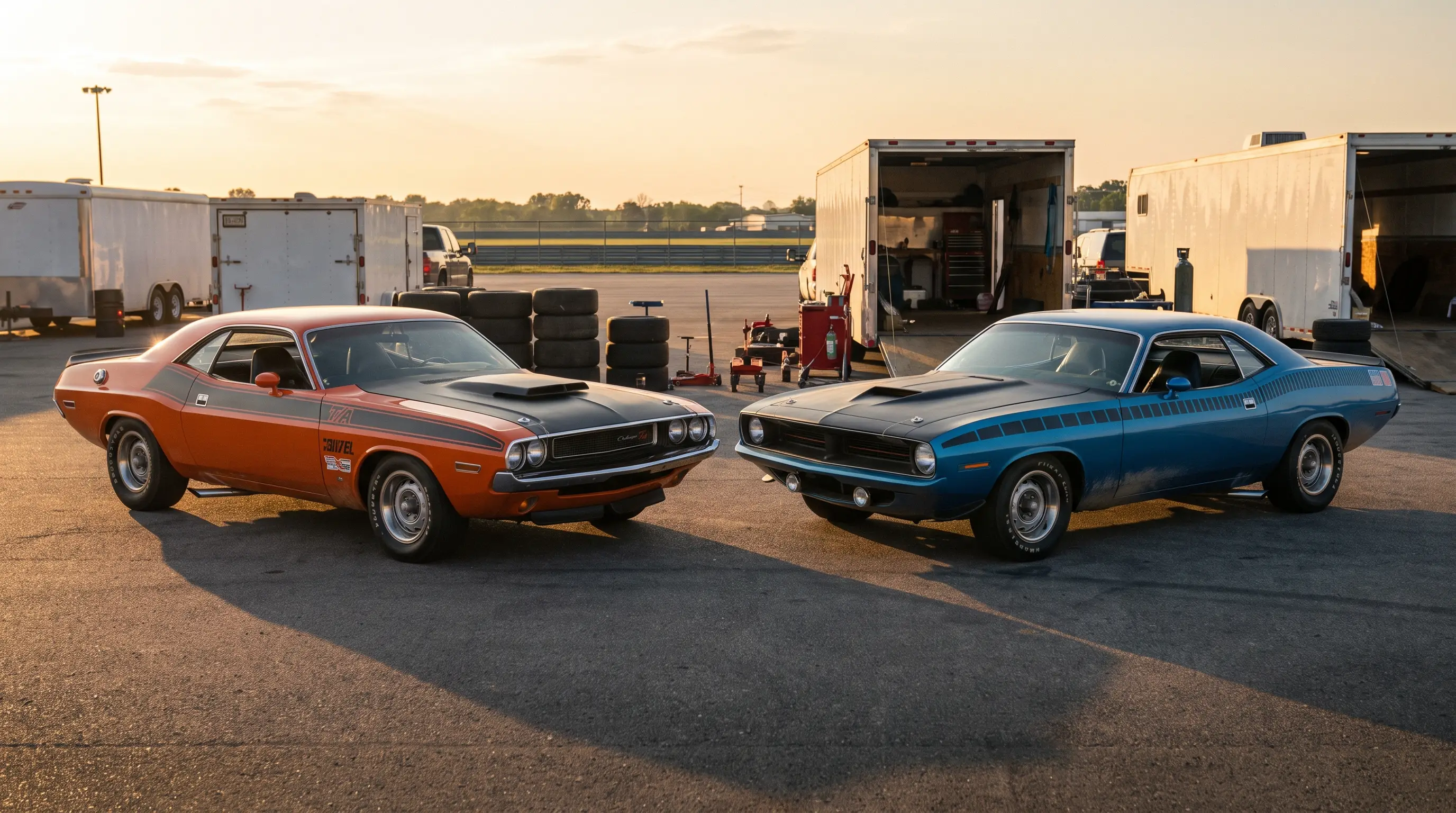
Every classic Mopar club has somebody who wants to relitigate the challenger ta vs aar cuda argument, usually after a few beers at a summer show once both cars happen to be parked close enough for comparison. I've had that conversation more times than I can count, and it never really gets settled, because the two cars were built by the same company for the same racing rulebook and they came out just different enough to keep the debate alive fifty years later.
Two cars, one homologation problem
Both the Dodge Challenger T/A and the Plymouth AAR Cuda existed to satisfy the same SCCA Trans-Am homologation requirement for the 1970 season, and both used a version of Chrysler's 340 cubic inch V8 fitted with the distinctive three two-barrel Six Pack induction setup. On paper that makes them close to siblings, and mechanically they share an enormous amount of engineering underneath the different sheet metal. But Dodge and Plymouth ran separate racing programs with separate teams, Dodge through Ray Caldwell's Autodynamics operation and Plymouth through Dan Gurney's All American Racers, and that separation shows up in how each street car was styled and marketed even though the underlying homologation math was identical.
The AAR Cuda gets its name directly from Gurney's team, All American Racers, stamped right onto the car's identity in a way the T/A's naming convention does not mirror quite as directly. Both names point back to Trans-Am racing, but the AAR name wears its racing pedigree more literally on its badge.
Where the two cars actually differ
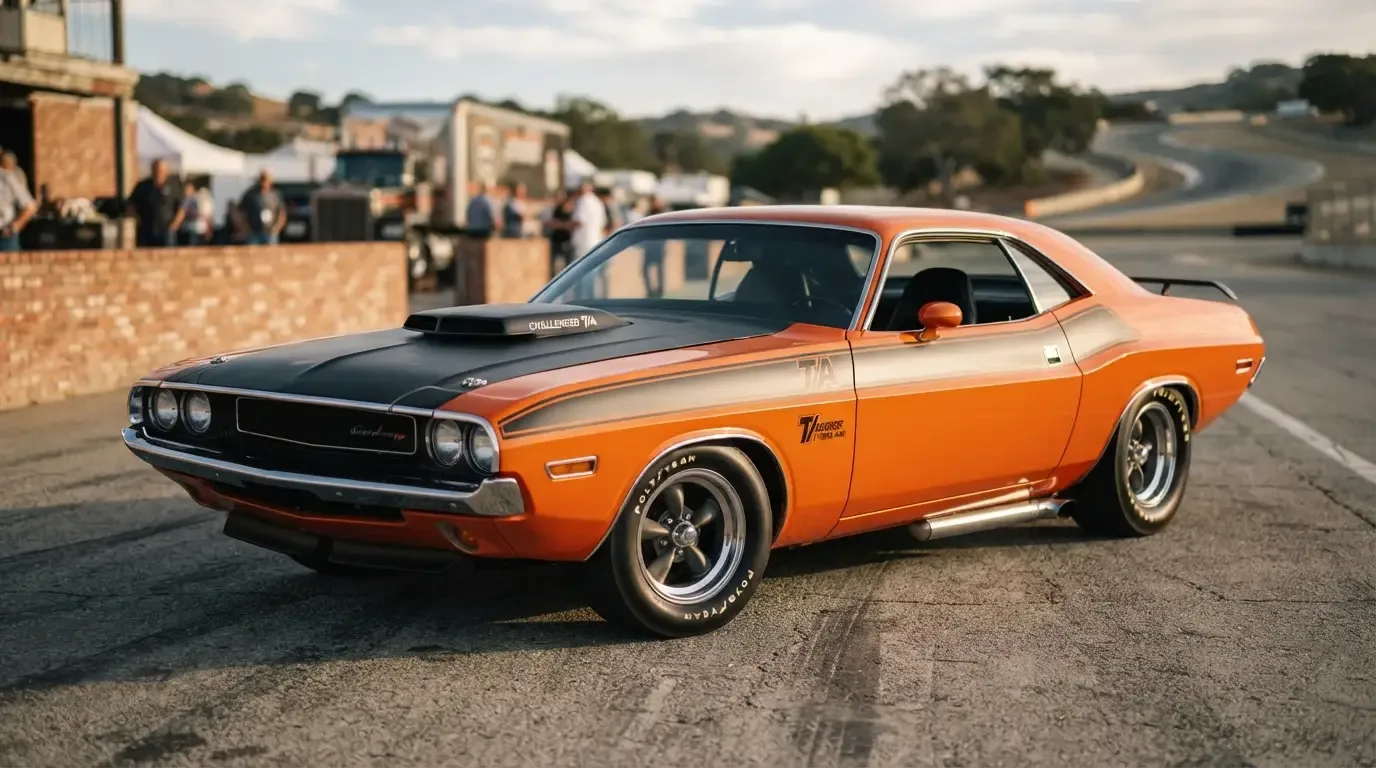
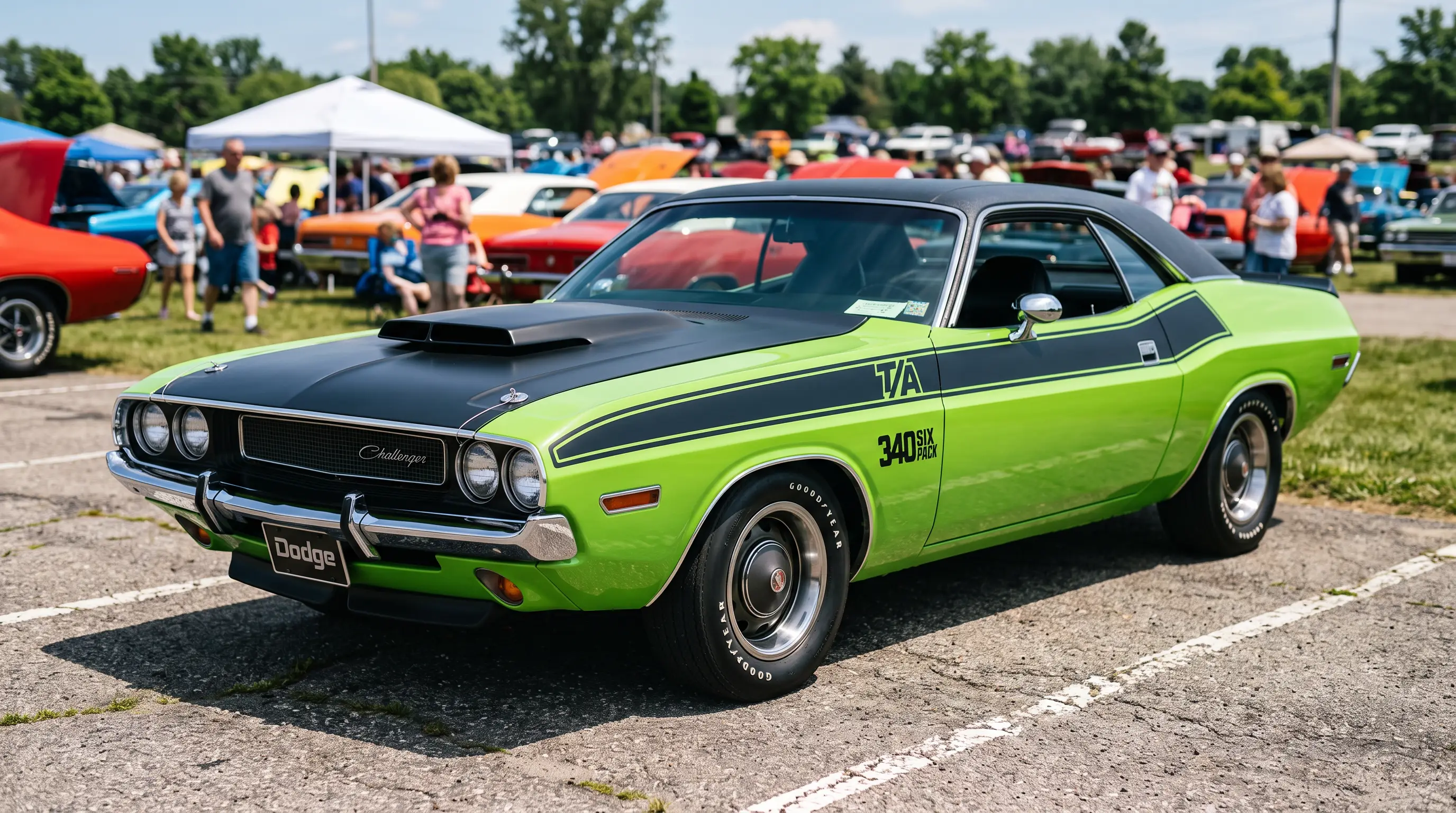
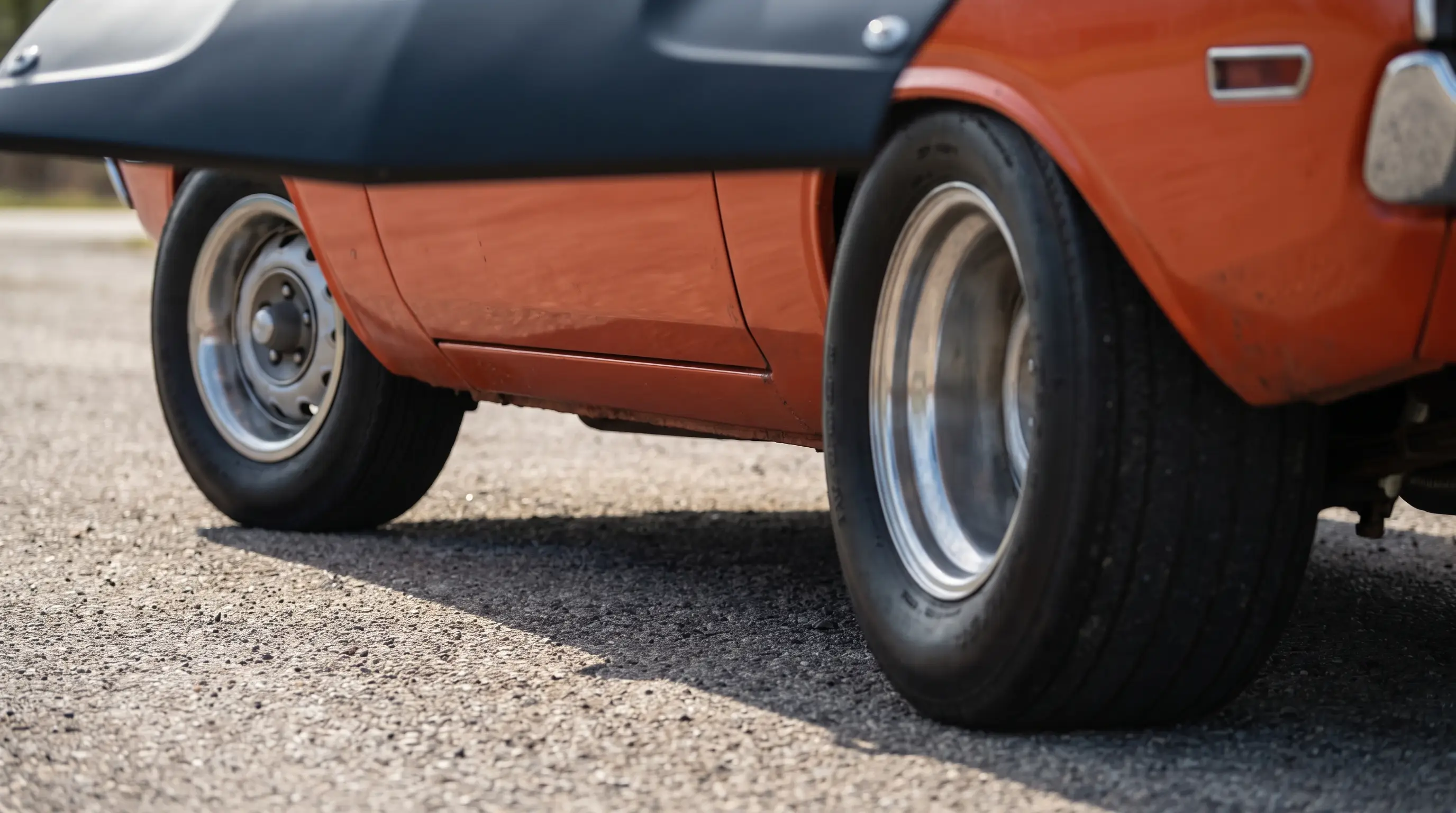
Visually, the AAR Cuda used a more organic looking strobe stripe treatment along its lower body sides, while the T/A went with a bolder, more geometric side stripe and the signature matte black hood. Both cars used side exit exhaust ahead of the rear wheels and staggered tire setups, so from a distance a casual observer might mix them up, but anyone who has spent time around both will tell you the stance and graphics language are genuinely different once you know what to look for. The AAR also had its own hood scoop treatment distinct from the T/A's, another detail that reinforces these were parallel engineering efforts rather than one car wearing two badges.
How the market treats them differently
Both cars occupy similarly rarefied territory in the collector market, both being one year only homologation specials with a documented racing connection, but they do not always trade at identical numbers, and club members will argue at length about which one deserves the premium. Some of that comes down to genuine scarcity differences in surviving documented examples, and some of it comes down to which fan base happens to be more active and more willing to pay up in a given year. Neither argument fully settles the debate, which is honestly part of the fun of it.
What both cars share, and what tends to get lost in the brand loyalty arguments, is that they represent the exact same moment in Detroit's history: a brief window where the same corporation was willing to fund two nearly parallel racing homologation programs under two different divisions competing against each other as much as against Ford and Chevrolet. That is a strange, almost wasteful bit of corporate history when you step back and think about it, and it is also exactly the kind of excess that makes this era of American performance cars so interesting to people who grew up around them.
"My uncle had a T/A and his neighbor had an AAR Cuda, and the two of them argued about which one was faster for twenty years without either one ever actually racing the other. That's the whole story right there. It was never really about lap times."
- Wayne Coburn
What each racing program actually accomplished
On track in 1970, neither the Dodge nor the Plymouth Trans-Am effort managed to unseat the established Ford and Chevrolet programs for the manufacturer's championship, though both scored points and both proved genuinely competitive on their best weekends. Dan Gurney's All American Racers brought a level of open-wheel and sports car racing polish to the Plymouth program that showed up in the car's overall development, while Ray Caldwell's Autodynamics squad worked with a smaller budget and a shorter runway on the Dodge side. Neither program had the multi-year development history that Ford in particular had built up by that point, and that gap showed in the results more than any inherent difference in the two homologation cars themselves.
What both programs share is that they represented the peak, and effectively the end, of Chrysler's factory-level commitment to Trans-Am racing. When the corporate money dried up after the 1970 season, both the T/A and the AAR Cuda lost their reason for existing in their original form, and neither package returned in following years the way it had been originally specified.
Collecting both instead of choosing sides
Plenty of serious Mopar collectors sidestep the T/A versus AAR Cuda argument entirely by simply owning examples of both, treating them as complementary pieces of the same story rather than competitors for a single garage spot. Viewed that way, the two cars make more sense together than apart, as twin answers to the same rulebook problem from two divisions of the same company racing against everybody else and, in an odd way, against each other.
Shared parts, separate personalities
Because both cars drew from the same corporate parts bin, a lot of the underlying hardware is genuinely interchangeable between them, right down to elements of the 340 Six Pack induction system and the basic E-body platform both cars are built on. That shared foundation is exactly why the styling and graphics differences carry so much weight in the ongoing argument between fans of each car. When the mechanical package underneath is this close, the personality of each car has to come from somewhere else, and Dodge and Plymouth each leaned into their own division's identity to make sure the T/A and the AAR Cuda did not simply read as the same car wearing two different grilles.
That divisional rivalry, encouraged rather than discouraged by Chrysler corporate at the time, is part of what makes this pairing such a durable point of debate at car shows even now. Two teams within the same company were given similar tools and told to go beat Ford and Chevrolet, and in the process they ended up competing at least as hard against each other's reputation as against the outside competition they were actually racing.
A shared collector market
In practice, values for both cars tend to move together more than they move apart, since both are subject to the same broader trends in Mopar homologation special demand. A strong year for T/A values is usually a strong year for AAR Cuda values too, and the reverse holds as well. That correlation is a useful reminder that these two cars really are best understood as a pair rather than as rivals competing for the same collector dollar.
Which one should you actually buy
If you are choosing between the two today, the honest answer is that the decision usually comes down to brand preference and which car you happened to grow up around rather than any meaningful performance gap, since the mechanical packages underneath are close enough that the difference in a straight line or through a corner will not decide the argument for you. Documentation, condition, and originality matter more for value in either car than which badge is on the trunk. If you want the deeper background on the T/A side of this rivalry, read the background on how Dodge's car came together, and when you are ready to see what is actually available, you can find a classic Challenger and compare real listings against everything covered here.