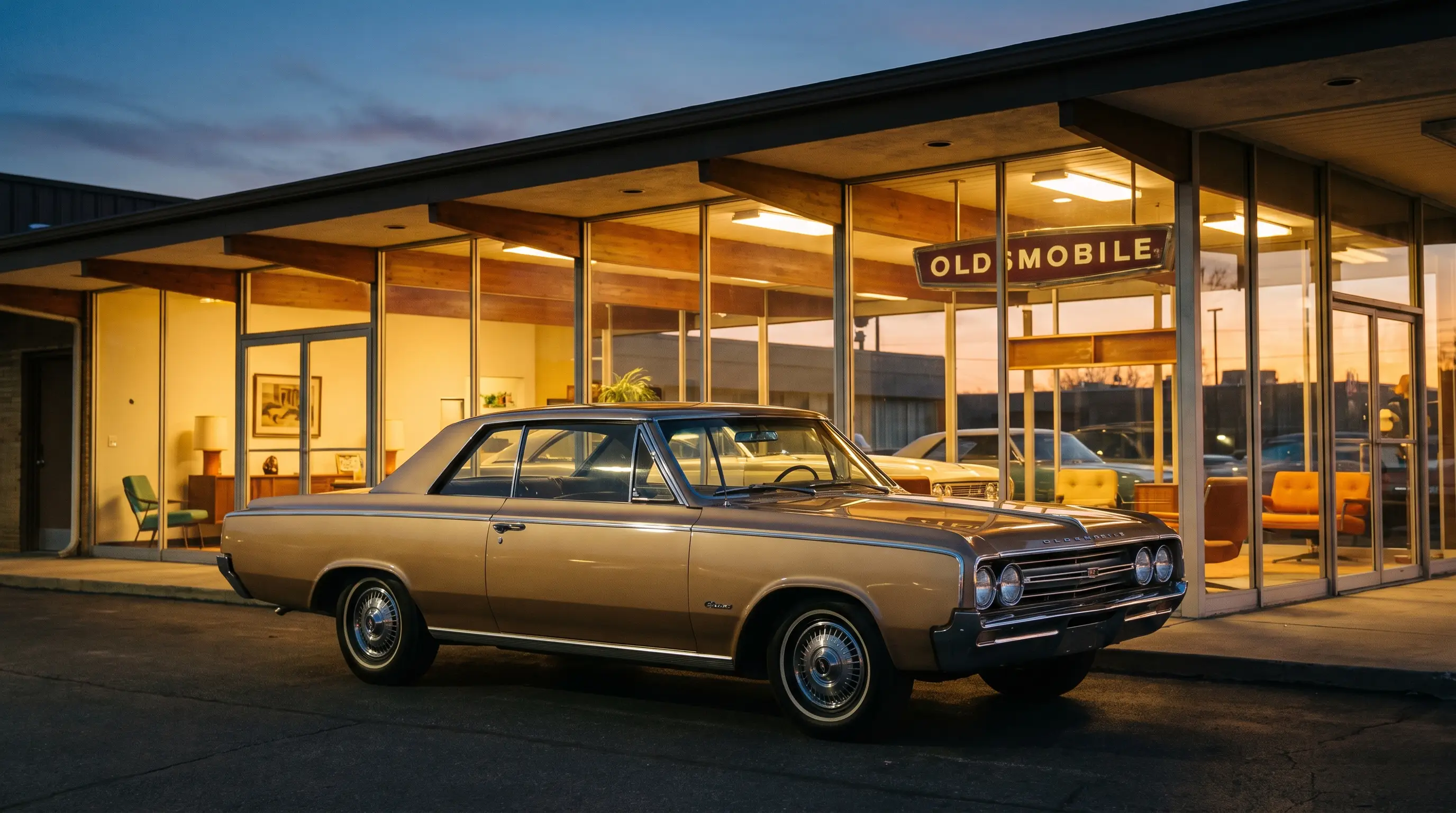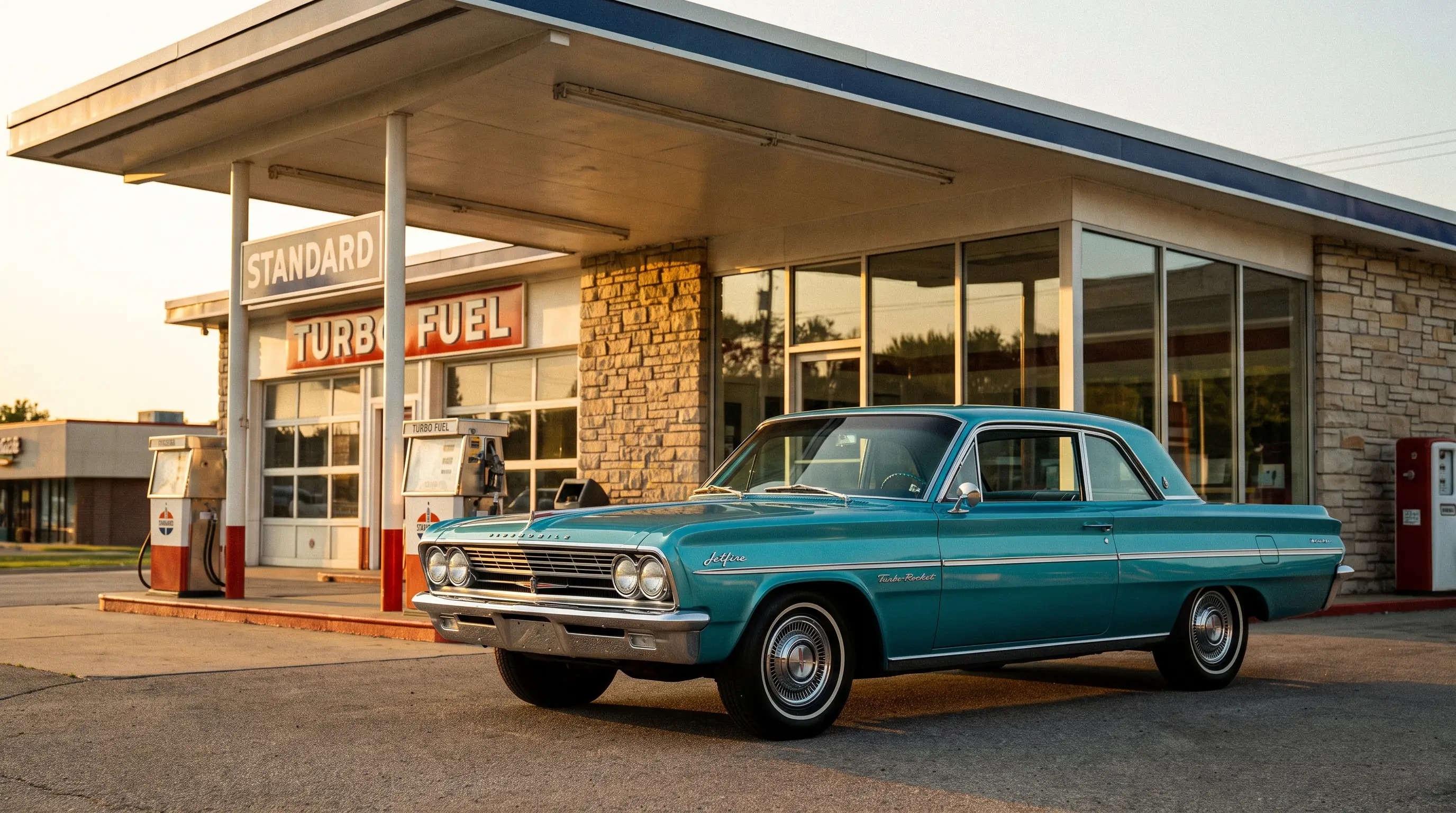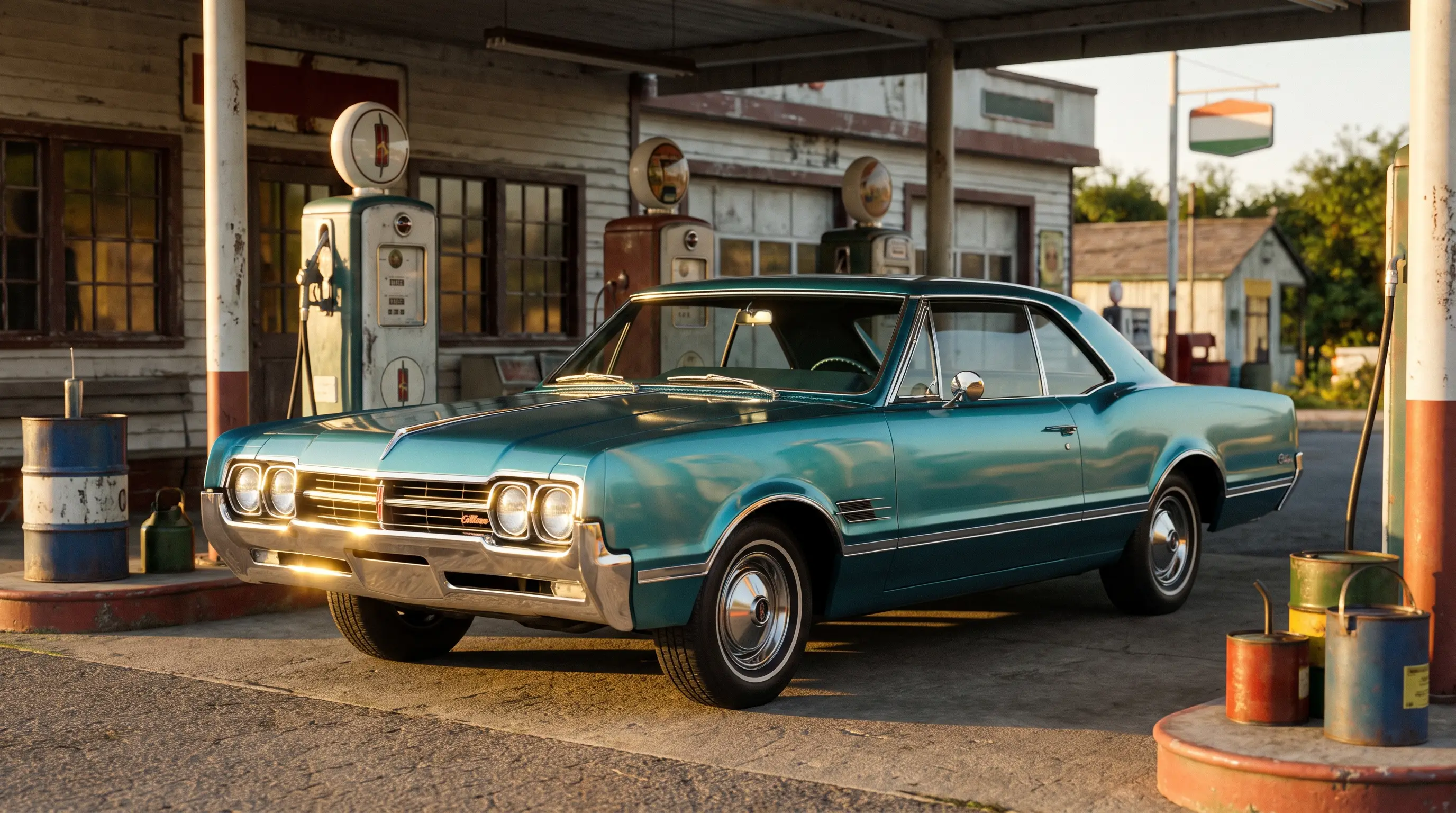
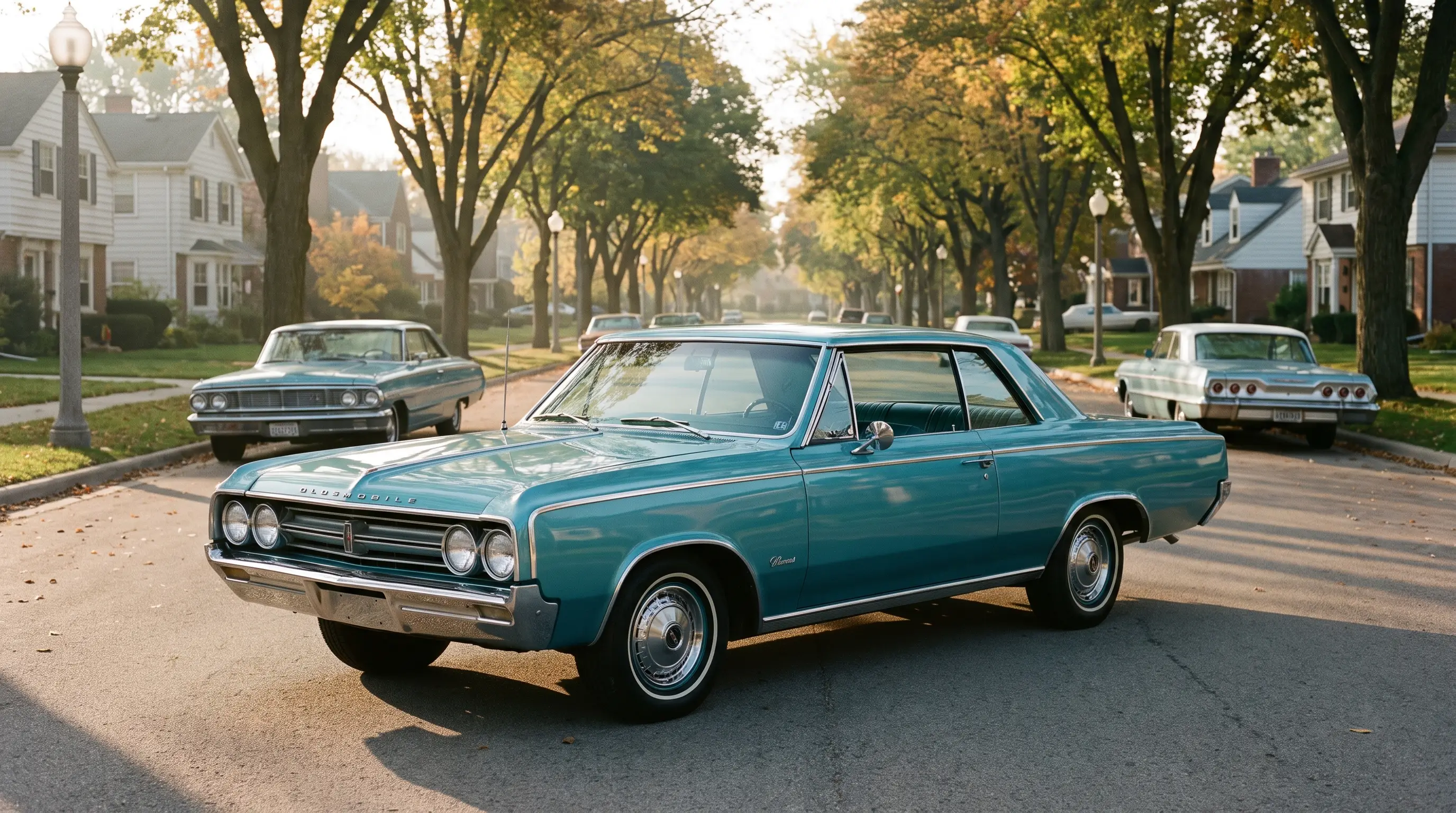
The 1964 Cutlass is not a facelift year. It is the year Oldsmobile's compact-derived F-85 lineup got torn down to the frame rails and rebuilt on General Motors' new A-body architecture, the same platform underpinning the Chevrolet Chevelle, Pontiac Tempest, and Buick Skylark that same season. Every GM division got its own intermediate that year, and the Cutlass name, previously the top trim level on a smaller senior-compact F-85, suddenly had a real car underneath it instead of a dressed-up economy platform. Records place the redesigned wheelbase at 115 inches, a meaningful jump from the outgoing F-85 generation, and that extra size is the whole story of what changed.
Leaving the senior compact behind
Before 1964, the F-85 and its Cutlass trim rode on a platform built to compete with compacts like the Ford Falcon, sized and engineered around economy first. It worked well enough, and the Cutlass name had already built a reputation as the sporty, better-equipped version of that car. But General Motors made a corporate decision for 1964 that every division's mid-size entry would move to a shared intermediate platform, larger, more substantial, and built to compete in a segment that did not really exist yet in its eventual muscle car form. Oldsmobile's version of that platform carried the F-85 nameplate on the base cars and Cutlass on the upmarket trim, exactly as before, but now on a body that had genuinely grown up.
The new A-body brought a longer wheelbase, wider track, and a chassis stiff enough to support bigger engines than the outgoing car had ever been asked to carry. That last part mattered more than anyone at Oldsmobile could have known in early 1964. The same platform that debuted this year would, within months, become the basis for the original 442 option package, and within a few more years, for some of the fastest intermediates General Motors ever built.
Rocket power grows into the new chassis
The 330 cubic inch Rocket V8 became the Cutlass's signature engine for this generation, offered in multiple states of tune depending on carburetion, with the top four-barrel version rated at 290 horsepower, genuinely strong output for a mid-size car of this era. Buyers who wanted something milder could still get a six-cylinder base engine, and Oldsmobile continued offering a range of Rocket V8 displacements below the 330 for shoppers who wanted V8 smoothness without paying for the top-tier engine.
What made the 330 in this new chassis different from the same basic engine family in the outgoing F-85 was simply that the car around it could finally use the power properly. A stiffer frame and a suspension tuned for a heavier, larger vehicle meant the 330's torque translated into confident acceleration rather than wheelspin and cowl shake. Oldsmobile's engineers had built strong engines for the smaller F-85 generation too, but this is the year the chassis stopped being the limiting factor.
Trim levels and what buyers actually chose
Cutlass remained the top trim within the F-85 lineup for 1964 rather than a fully separate model line, a distinction that trips up plenty of shoppers looking at build sheets today. A 1964 Cutlass Holiday coupe, convertible, or sedan carried the same basic F-85 body but with better interior trim, additional brightwork, and access to the higher-output engine options that base F-85 buyers could not order. Body styles spanned two-door hardtops, convertibles, and four-door sedans and wagons, giving Oldsmobile a genuinely broad intermediate lineup rather than a single sporty coupe chasing the performance buyer exclusively.
This distinction between F-85 and Cutlass as trim rather than separate nameplate would not last. Buyer preference shifted hard toward the Cutlass trim through the mid-1960s, enough that Oldsmobile eventually let the F-85 name fade into the background and made Cutlass the primary identity for the whole intermediate line by the back half of the decade. The seeds of that shift are visible in the 1964 sales figures, where the combined F-85 and Cutlass lineup moved 167,002 units (not counting the Vista Cruiser wagon), with Cutlass-trim cars already representing a meaningful share of that volume even in the trim's first year on the new chassis.
| Spec | 1964 Cutlass (F-85 A-body) |
|---|---|
| Platform | New GM A-body intermediate |
| Wheelbase | 115 in |
| Base engine | Inline-six |
| Top V8 option | 330 cubic inch Rocket V8, 4-barrel |
| Body styles | Hardtop coupe, convertible, sedan, wagon |
| Notable mid-year addition | B09 442 performance package |
Why this redesign is the real hinge point
Every later Cutlass, from the 1966-67 cars that refined this same basic architecture to the fully restyled 1968 generation, traces back to the decision Oldsmobile and General Motors made for 1964: build a proper intermediate instead of dressing up a compact. Readers who want the fuller arc of the muscle-era Cutlass will recognize this year as the point where the ingredients, a real chassis, a strong small-block V8, and a trim level with room to grow, all landed in the same car at once. Oldsmobile did not fully understand yet what it had built. That understanding would come fast over the next few seasons, and anyone tracking the lineup year by year should keep reading the series to see how quickly the formula matured.
"The paperwork tells you everything the badge doesn't. In 1964 you have a car that's still technically an F-85 trim level, built on a chassis good enough to carry the 442 package by mid-year. That's not a coincidence of timing. That's Oldsmobile's engineering catching up to what the market wanted before the marketing department had caught up too."
— Tom Ramirez
For shoppers today, a documented 1964 Cutlass with the correct engine code and trim level is a genuinely underappreciated entry point into this era, priced below the more famous 1968-72 cars while carrying real historical weight as the first year of the platform. Anyone actively shopping should look at a classic Oldsmobile Cutlass for sale with this specific redesign in mind, since the 1964 model represents the moment the nameplate stopped being a trim level and started becoming a legend in its own right.
Sources and notes
- Oldsmobile Cutlass, Wikipedia
- 1964 Oldsmobile F-85 Specifications, Conceptcarz
- 1964 Oldsmobile F-85 Cutlass Convertible specs, Automobile Catalog
- Oldsmobile V8 engine, Wikipedia
- 1964 330 hp rating discussion, Antique Automobile Club of America
- 1964 Oldsmobile Mid-Size Cars Fact Sheet, Over-Drive Magazine