Every swap meet has a guy who parks his car at an angle so you have to walk past all four sides before you reach the parts table. A while back that guy in my local club had a white Trans Am with a single blue stripe running nose to tail, and he wasn't showing off the paint. He was showing off the build sheet in a plastic sleeve taped to the driver's window, because half the questions he got were "is that real or did you buy the decals at a parts store." The mix-up he was fighting is the same one I still hear at every show: people assume the 25th Anniversary Trans Am closed out the third generation in 1992. It didn't. It's a fourth-generation car from 1994, and getting that year and platform wrong is the single fastest way to misidentify or overpay for one.
The short version: the third generation Firebird did end its run in 1992, and 1992 was a genuinely low volume year with no anniversary package attached to it. The 25th Anniversary Trans Am came two years later, on the redesigned fourth-generation body, and it celebrated 25 years since the Trans Am nameplate itself arrived in the spring of 1969, not the Firebird nameplate's 1967 debut.
A birthday party with a paint code, two years later than people think
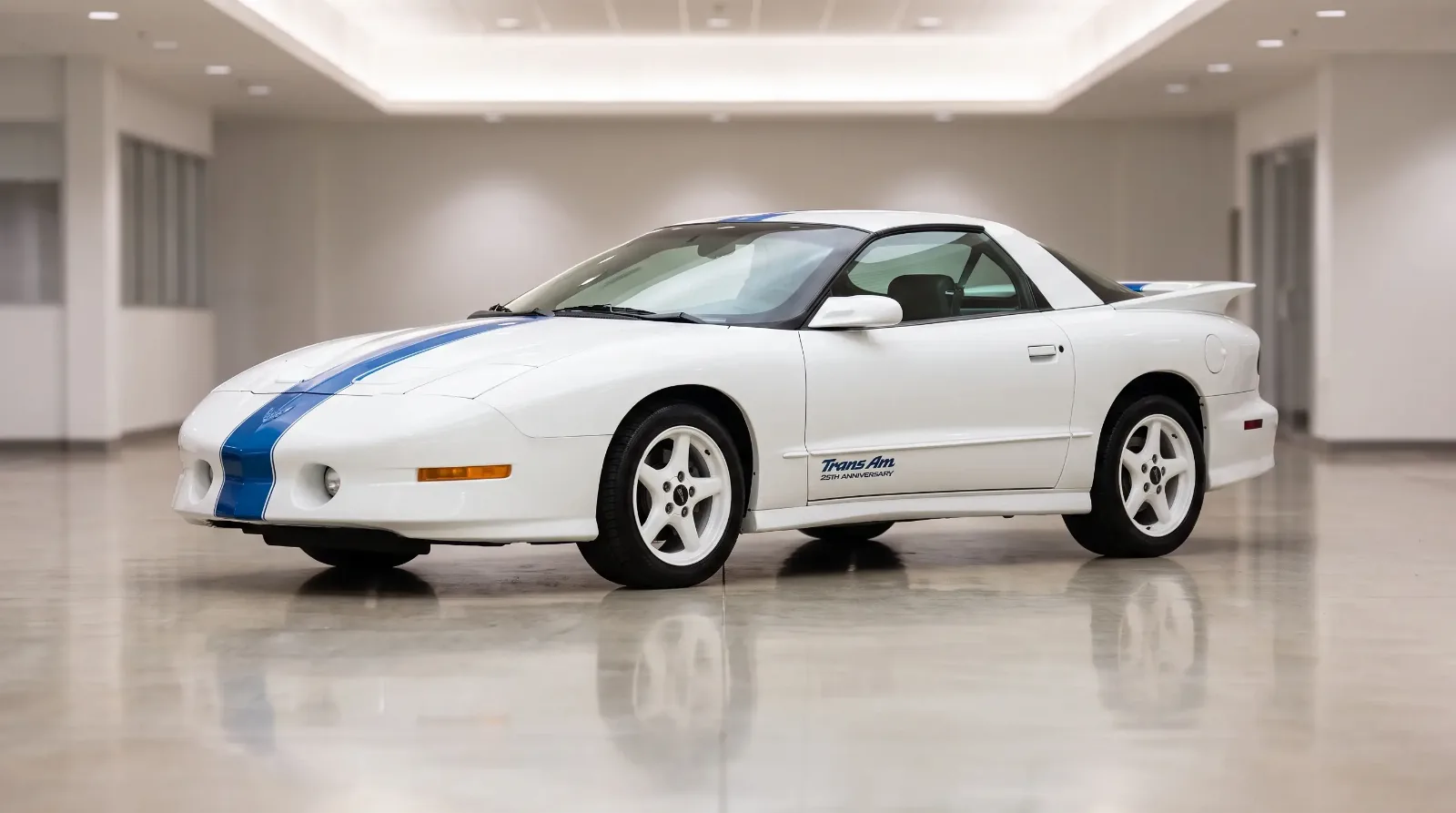
The 25th Anniversary package was built around Bright White paint with a single Tyrol Blue center stripe running from the front fascia, over the hood, and back across the rear spoiler, paired with a white leather interior featuring "25th Trans Am" embroidery on the seatbacks and door panels. It was a direct callback to the white and blue 1969 Trans Am, the Ram Air car that put the nameplate on the map in the first place. Pontiac paired the anniversary graphics with the GT's aero body treatment and the LT1 powertrain rather than inventing a new mechanical package from scratch.
That's an important distinction when you're reading a for sale ad. A 25th Anniversary Trans Am is a specific, factory-built 1994 model year car, not a trim level that carried on for years or a package you could order on a leftover third-generation Formula. If someone offers you a 1992 car with a "25th Anniversary" badge on it, that badge was added after the fact.
What was actually under the blue stripe
1994 25th Anniversary Trans Am buyers got the LT1 5.7 liter V8, rated at 275 horsepower and 325 lb-ft of torque, paired with either the standard four-speed automatic or an optional six-speed manual. Only 128 of the 2,000 anniversary cars built were ordered with the six-speed, which is why manual cars carry a real premium over the far more common automatic ones today.
| Spec | 1994 Trans Am 25th Anniversary Edition |
|---|---|
| Engine | 5.7L LT1 V8, 275 hp / 325 lb-ft |
| Transmissions | 4-speed automatic (standard) or 6-speed manual (128 built) |
| Exterior | Bright White with single Tyrol Blue center stripe |
| Interior | White leather with 25th Trans Am embroidery |
| Total production | 2,000 units |
The other detail that trips people up is the badging. Anniversary cars got specific 25th Anniversary emblems and white-painted five-spoke sixteen inch wheels, and unlike a simple appearance package, this was a genuinely limited production run with a documented total build count, not an open-ended dealer order option. That makes verification more straightforward than on a lot of "special editions," provided you know what year and generation you're actually looking at.
How many were actually built
Pontiac built 2,000 25th Anniversary Trans Ams for the 1994 model year, with only 128 of those getting the six-speed manual. That's a documented, well-sourced number, unlike the vague "special edition" production counts you run into on a lot of factory appearance packages. The scarcity of the six-speed cars specifically is what drives a real price gap between an automatic anniversary car and a manual one today.
"People ask me if the 25th Anniversary car is rare. I tell them two thousand built total is genuinely rare, and a hundred and twenty eight with the six-speed is rare on top of rare. What isn't rare is somebody trying to sell you a 1992 car with a 25th Anniversary badge stuck on it. That car never existed."
— Wayne Coburn
Buying one without getting a story instead of a car
Because the year and generation get confused so often, verification matters more here than on most special editions. A few things worth checking before you hand over a deposit.
None of this is meant to scare buyers off. It's meant to save you from the version of the story where you buy a plain third-generation Trans Am with a nice repaint and find out a year later that the "anniversary" part was added after the fact. The real cars are out there, and the documentation trail for a limited-production model like this usually exists if you're willing to chase it down through a dealer invoice or a Pontiac Historic Services request.
What made the third-gen Firebird worth remembering in the first place is a longer story than one anniversary package, and it's worth being clear that the third generation itself closed out in 1992 with no anniversary special of its own. If you want to see where the value conversation goes from here, the next story in this set picks up exactly where this one leaves off.
Where these cars sit today
Values for genuine, documented 25th Anniversary Trans Ams have climbed steadily as the broader Firebird market has woken up to just how limited a 2,000-unit run actually is, and how much rarer the six-speed cars are within that count. They're not chasing first-gen Trans Am money, and they shouldn't, but they've stopped being the car nobody wanted at a swap meet. The guy with the plastic sleeve on his window was ahead of the market by years. That happens more often than people think with cars that got dismissed as "just a 90s car" the first time around.
Sources and notes
- Beverly Hills Car Club - 1994 Trans Am GT 25th Anniversary Edition 6-Speed
- ClassicCars.com Journal - AutoHunter Spotlight: 1994 25th Anniversary Trans Am
- Hagerty Valuation Tools - 1994 Pontiac Firebird Trans Am 25th Anniversary
- ThirdGen.Org - 1992 Pontiac Firebird
- Phoenix Graphix - 1994 25th Anniversary/Pace Car Trans Am Decals and Stripe Kit
- Wikipedia - Pontiac Firebird