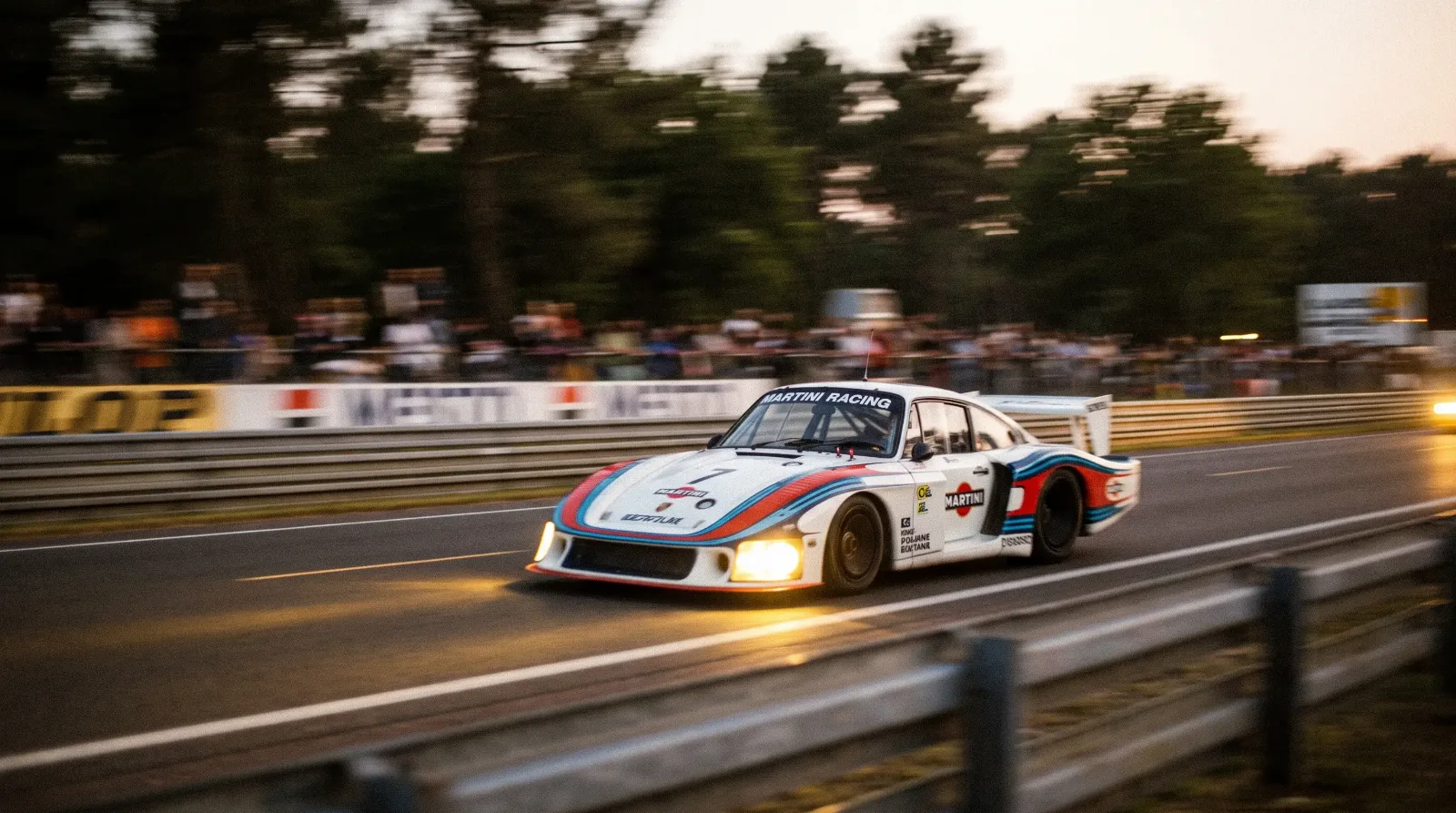
Pit crews at Le Mans in June 1978 started calling the new Porsche by a nickname before the race had even finished practice, and it stuck for good. Low, impossibly long, and finished in stark white bodywork that swelled outward over the rear wheels like something surfacing from underneath the water, the car looked less like a 911 than a sea creature wearing one as a disguise. Porsche's engineers had a type designation for it, 935/78, but everyone else just called it Moby Dick, and the name has outlived the factory paperwork by decades.
Built to exploit a loose rulebook
The 935 raced under Group 5's "Special Production" silhouette formula, a set of regulations that required a car to retain the silhouette of a homologated production model while otherwise leaving enormous room for interpretation. Porsche's engineers read that rulebook the way a good lawyer reads a contract, and the 935/78 is the result of following every permitted modification to its logical extreme. The nose sat dramatically lower than any 911 road car, the rear bodywork stretched back into a long, sloped tail that had almost nothing in common with a production 911's silhouette beyond the barest legal minimum, and the whole car sat closer to the ground than anything wearing a 911 badge had any right to.
Underneath that bodywork was a 3.2-liter twin-turbocharged flat-six with an unusual hybrid design, air-cooled cylinders paired with water-cooled cylinder heads, a solution Porsche engineers developed specifically to allow four valves per cylinder within the constraints of the existing air-cooled architecture. In race trim, run at the lower of its two boost settings for reliability over 24 hours, it produced around 750 horsepower, with the same engine capable of roughly 845 horsepower at full boost on a test bench. At Le Mans that was enough to push the car to a recorded top speed of around 227 to 228 mph on the Mulsanne Straight, a number that made it the fastest car in that year's race and one of the fastest ever to run at Le Mans up to that point.
Le Mans 1978, and a result that undersold the achievement
The 935/78 ran at Le Mans in 1978 under the Martini Racing banner with drivers Rolf Stommelen and Manfred Schurti sharing the car, and it finished eighth overall, a result that looks modest next to the car's engineering ambition. Overall victory that year went to an Alpine-Renault turbo, part of a strong French showing on home soil, and Porsche's more conventional 936 prototypes and customer 935s filled out much of the rest of the leaderboard. The Moby Dick's finishing position undersells what the car actually demonstrated, though, because it wasn't really built to win Le Mans outright in 1978. It was built to prove how far the Group 5 silhouette rules could be pushed, and on raw speed through the Mulsanne kink, it proved that beyond argument.
A dead end that still mattered
Porsche built only one true 935/78, and the car never raced again at Le Mans after 1978, effectively retired as a rolling proof of concept rather than developed into a continuing production run. Group 5's silhouette formula itself didn't last much longer either, giving way through the early 1980s to Group C's fuel-efficiency-based prototype rules, a shift that would define endurance racing for the next decade. In that sense Moby Dick arrived near the end of an era rather than the start of one, a final, extreme statement from a category of racing that was already being phased out.
| Specification | Detail |
|---|---|
| Designation | Porsche 935/78 "Moby Dick" |
| Engine | 3.2-liter twin-turbo flat-six, air/water hybrid cooling |
| Power | approx. 750 hp at race boost (up to 845 hp at full boost) |
| Top speed | approx. 227-228 mph, Mulsanne Straight |
| 1978 Le Mans result | 8th overall (drivers: Rolf Stommelen, Manfred Schurti) |
| Category | Group 5 Special Production silhouette |
What Moby Dick left behind
What the 935/78 left behind wasn't a winning record, it was a demonstration of how far a rulebook can bend before it breaks, and a reminder that Porsche's competition department in this era treated regulations as a design brief rather than a constraint. That same restless, boundary-pushing approach runs through the racing chapter of Porsche's history more broadly, from the 917's early aerodynamic instability through the turbo era that produced this car. Readers interested in where endurance racing went once Group 5 gave way to prototypes should look at a companion piece covering that transition directly.
"Nobody builds a car like Moby Dick to win a championship. You build it to answer a question, how far can this rulebook actually bend, and Porsche answered it about as thoroughly as anyone ever has."
— Patrick Walsh
The name behind the name
Porsche's own engineers reportedly resisted the Moby Dick nickname at first, preferring the plain 935/78 designation on paperwork and press materials, but journalists in the paddock kept using it and eventually the factory gave up fighting the comparison. It fit too well to abandon. The elongated tail did genuinely recall the profile of a surfacing whale when the car came down the Mulsanne Straight at speed, white bodywork catching headlights in the dusk hours of the race, and the name carried an obvious literary weight that suited a car this extreme. Herman Melville's novel had nothing to do with racing, but the image of something enormous, pale, and nearly unstoppable translated well enough that the comparison stuck through every subsequent retelling of the car's one Le Mans appearance.
What separates Moby Dick from most one-off racing specials is that it was never treated as a dead end internally. Porsche's engineers carried lessons from the car's turbocharger packaging and its hybrid cooling solution directly into the 935 customer cars that continued racing successfully in production-based series for years afterward, and some of the aerodynamic thinking behind that long tail resurfaced in later Porsche prototypes built for entirely different regulations. A single extreme car built to answer one narrow question at one specific race ended up quietly influencing far more of the company's competition program than its brief track record would suggest.