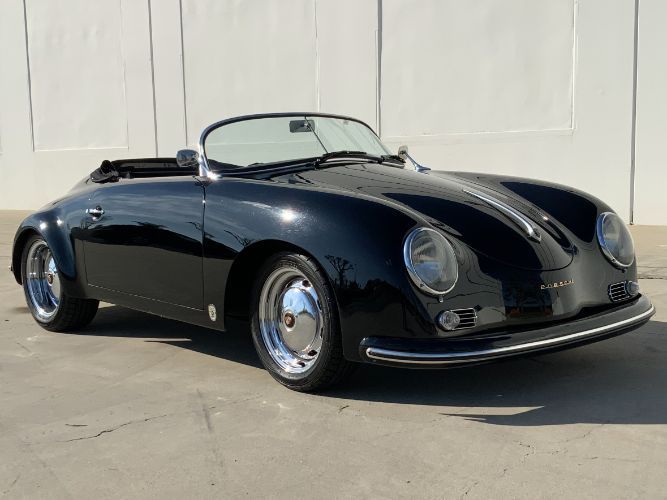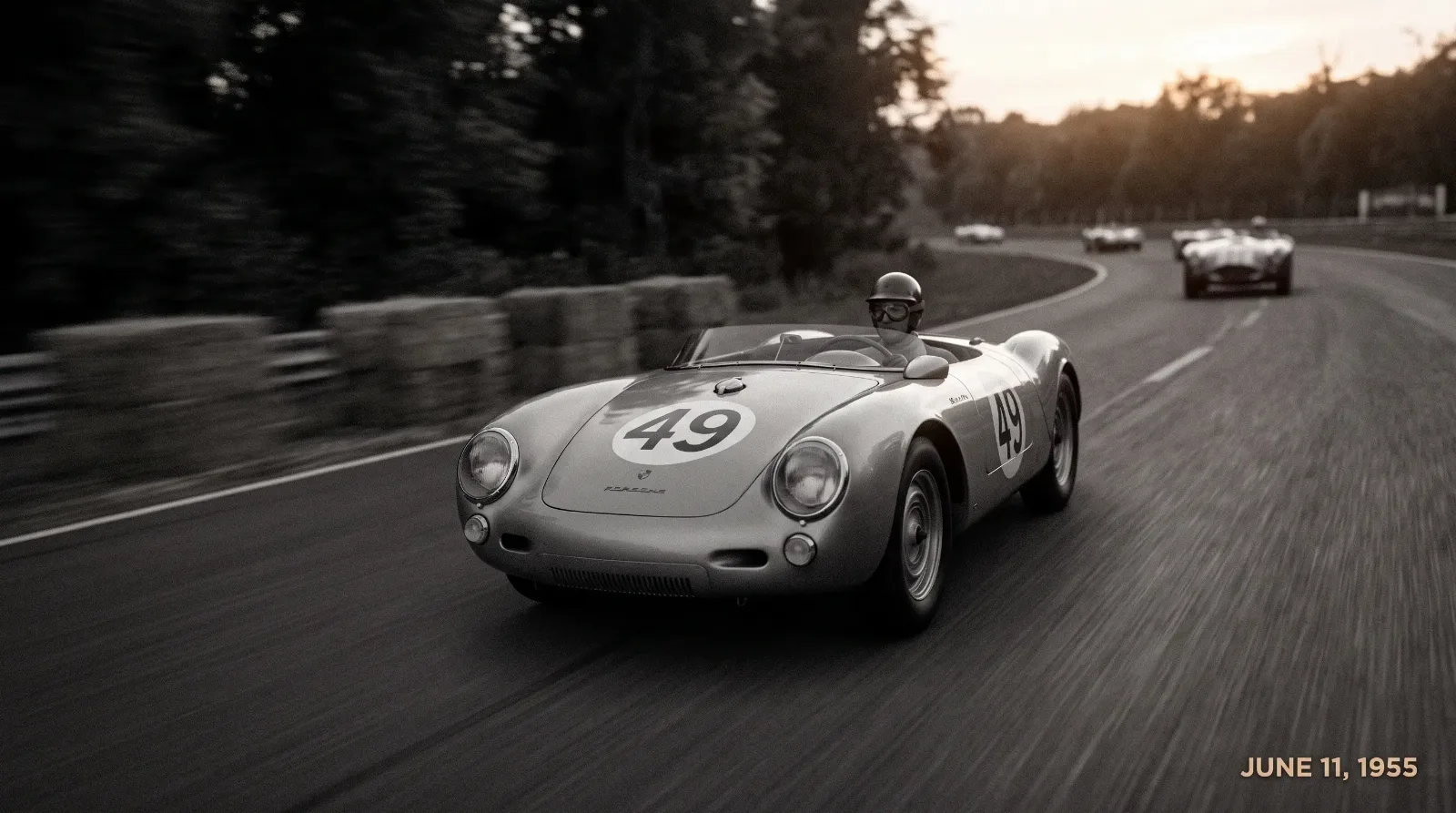
On the Carrera Panamericana in 1954, Hans Herrmann came up on a closing railroad crossing gate with a train bearing down and did the thing that still gets retold in paddocks decades later: he ducked his Porsche 550 Spyder under the barrier and kept racing. It's the kind of story that sounds embellished until you check the era and realize the car underneath him was genuinely small and light enough to make a move like that plausible in the first place. That car, the Porsche 550 Spyder, earned the nickname "giant killer" honestly, by beating machines with two or three times its engine displacement on some of the most demanding road courses in the world.
A small car with an outsized engine
Porsche introduced the 550 in 1953 as a purpose-built competition car, a clean departure from the road-car-derived racers the company had fielded before it. At its heart was the Type 547 engine, a 1.5-liter flat-four designed by Ernst Fuhrmann with dual overhead camshafts on each bank, an exotic and expensive piece of engineering for a car this size. Output was modest by later standards, 110 horsepower at 7,800 rpm, but the entire car weighed only about 1,300 pounds (590 kg), and that power-to-weight balance is what let it embarrass far larger rivals through corners even when it couldn't match them in a straight line.
The mid-engine layout was itself a statement of intent. Porsche's road cars were rear-engined, but for a dedicated racer the company placed the engine ahead of the rear axle instead, improving weight distribution and handling balance in a way that would echo through Porsche's competition cars for the next two decades. Drivers who raced the 550 consistently praised how the car communicated grip through a corner, telling you exactly how much more you had left to give before the front or rear let go.
Giant-killing at Le Mans and beyond
The 550 didn't need to win overall to make its point. At Le Mans, the car took its class in both 1954 and 1955, finishing well up the overall order against cars with far more displacement, and doing it with a reliability that bigger, more highly stressed engines from other marques couldn't always match over 24 hours. That same year at the Carrera Panamericana, the grueling Mexican road race the car's later variant would eventually take its name from, 550s ran class-winning pace against factory teams from Ferrari and Mercedes-Benz, cars that dwarfed the Porsche on paper.
What made this possible wasn't a single trick but a philosophy. Porsche had decided, correctly as it turned out, that a light, well-balanced, meticulously engineered small car could out-race a heavier, more powerful one on a circuit with enough corners in it. That idea became something like a house style, one that shows up again decades later in more from this chapter of Porsche's competition history, even as the specific engineering solutions changed completely.
The 550A and what came after
Porsche refined the design into the 550A in 1956, replacing the original ladder-type chassis with a lighter, stiffer spaceframe that improved handling further and helped the car remain competitive even as rivals caught up. The 550A took the 1956 Targa Florio outright, a result that mattered enormously to a company still establishing itself as a serious motorsport constructor rather than a maker of clever road cars that also happened to race well. That win, on a circuit as brutal and unforgiving as the Targa Florio's mountain roads, did more for Porsche's competition reputation than any class result at a faster, smoother track could have.
| Specification | Detail |
|---|---|
| Engine | 1.5-liter Type 547 flat-four, dual overhead cam |
| Power | 110 hp at 7,800 rpm |
| Weight | approx. 1,300 lb (590 kg) |
| Notable results | Le Mans class wins 1954, 1955; Targa Florio outright win 1956 (550A) |
| Chassis evolution | Ladder frame (550) to spaceframe (550A) |
Why the 550 still matters
The 550 Spyder is where Porsche's identity as a giant-killer, a small manufacturer that beat much larger companies through engineering discipline rather than brute force, first got proven on the biggest stages available. Every later chapter of Porsche's motorsport heritage, right through to the turbocharged monsters of the 1970s, traces back to the same underlying conviction this little car established: that a lighter, smarter machine can out-race a bigger one if the engineering is honest about it. For the full arc of how that conviction played out across decades, the classic Porsche story covers the ground in detail.
"People remember the 550 for one famous owner and one famous accident, and that's a shame, because the car earned its reputation on race tracks years before that, beating cars nobody expected it to touch."
— Patrick Walsh
Original 550s rarely change hands, and when they do the numbers are extraordinary, but the giant-killer spirit they established still runs through the model's descendants. Anyone chasing that lineage today can find classic Porsches for sale that trace their engineering DNA straight back to this one small, fast car from 1953.
Living with a piece of racing history
Very few 550s survive in original configuration, and fewer still ever come up for sale, so most of what the collector world knows about driving one comes from a small circle of owners and the handful of vintage racing events where the cars still appear. Those who have driven an original describe an experience that feels almost delicate by modern standards, light steering, a gearbox that rewards patience rather than force, and a four-cam engine that wants to be worked through its range rather than lugged. It is not a car built for comfort. It was built to be as light and as honest as the engineering of 1953 allowed, and that same honesty is exactly what makes it feel so distinct from anything Porsche builds today.