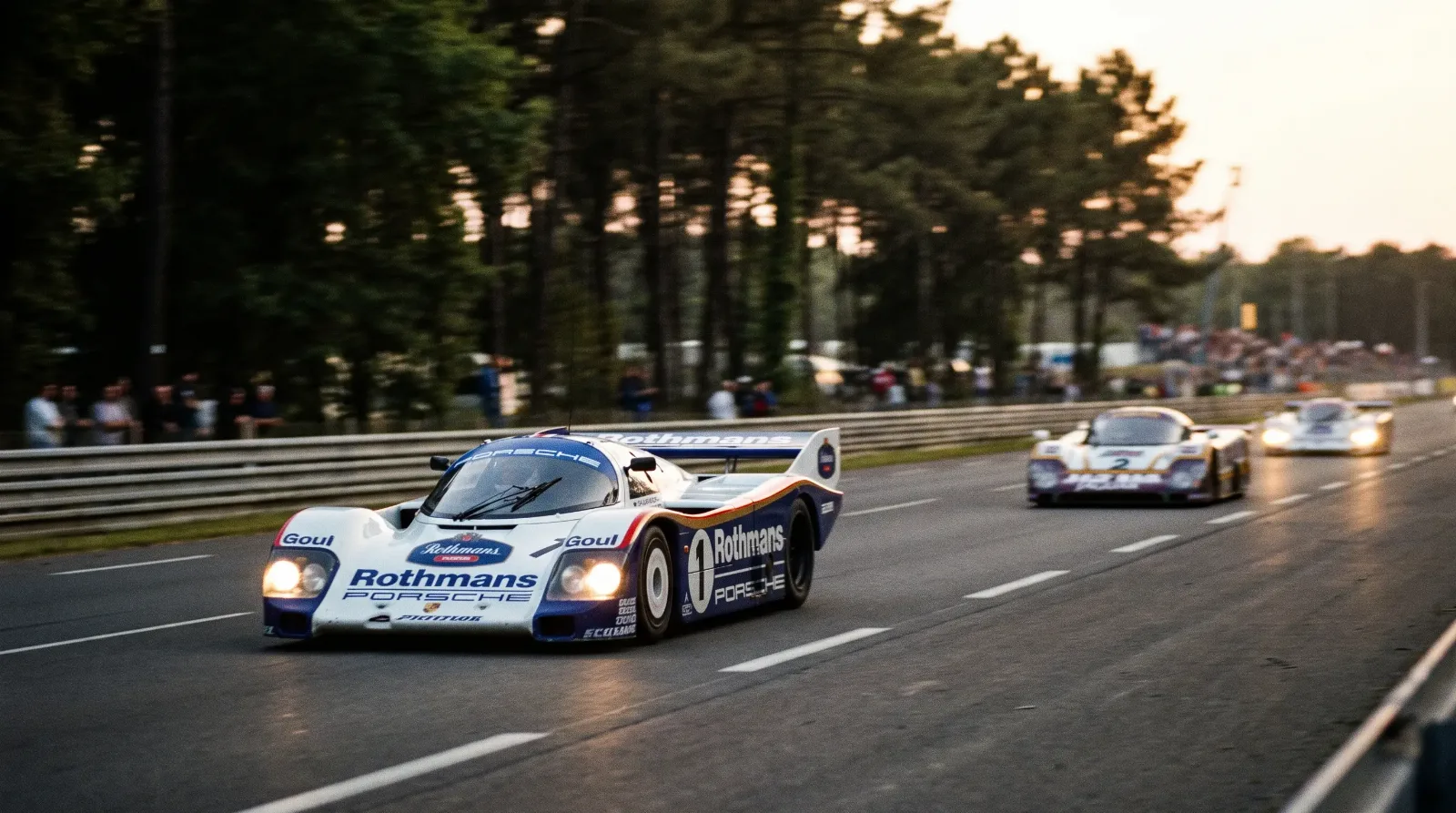
Derek Bell still remembers the first time he sat in a Porsche 956 at Le Mans and realized the car was doing something to his body that no race car had done before. Through the Mulsanne kink, at over 220 mph, the ground effects were pressing him into the seat so hard his cheeks pulled back. "It felt like the car was trying to weld itself to the road," he'd say later, and that image sticks because it captures exactly what made the 956 the car that ended arguments in endurance racing for most of a decade. Porsche 956 racing history is really the story of a company deciding to stop competing on reputation and start competing on physics, and the results speak for themselves: six straight Le Mans wins for the 956 and its successor, the 962, between 1982 and 1987 (Porsche's seventh win in a row overall, counting the 936's 1981 victory, and a new record beating Ferrari's six-in-a-row streak from the early 1960s), plus a trophy case that eventually included Daytona, Sebring, and just about every Group C round worth winning.
Why Group C existed and what Porsche saw in it
Group C arrived in 1982 as motorsport's answer to the fuel crises of the previous decade. Instead of regulating horsepower directly, the rules capped fuel consumption and let engineers chase efficiency and aerodynamics however they liked. Most manufacturers treated this as a constraint to survive. Porsche's engineering department, led by Norbert Singer, treated it as an invitation.
The 956 was built around a concept Porsche had watched Lotus and Chaparral experiment with in Formula 1 and Can-Am: ground effect. Sculpted underbody tunnels accelerated air beneath the car, generating a low-pressure zone that sucked the chassis toward the tarmac without the drag penalty of a big wing. Combined with a twin-turbo, water-cooled version of the flat-six that traced its lineage to the 917, the 956 produced around 620 hp in race trim while sipping fuel carefully enough to satisfy Group C's economy rules. It was the first Porsche race car built with a full aluminum monocoque chassis, a departure from the tubular-frame approach of earlier prototypes, and that stiffness let the aerodynamics do their job without the chassis flexing the numbers away.
1982 to 1987: the winning streak nobody could break
The 956 debuted at Le Mans in June 1982 and finished first, second, and third, a result so complete it embarrassed the rest of the field before the car had even proven itself over a full season. Jacky Ickx and Derek Bell took the win that year, and Porsche didn't relinquish the top step at Le Mans again until 1988, when it briefly lost to a Jaguar. In between, the 956 and its longer-wheelbase, safety-updated cousin the 962 simply rewrote what customer teams could expect from a factory car.
That customer-car detail matters as much as the wins themselves. Porsche sold 956s and 962s to privateer teams across Europe, Japan, and the United States, which meant a car built to beat the best factory efforts from Jaguar, Lancia, and Sauber-Mercedes was also winning in the hands of paying customers. Rothmans-liveried factory cars shared grids with Brun Motorsport, Kremer Racing, and Richard Lloyd Racing entries, all running variations of the same basic architecture. Few race cars in history have managed to be simultaneously the works weapon and the privateer's best shot at a podium.
The 962: America's turbo prototype
Where the 956 was built primarily for the World Endurance Championship and Le Mans, the 962 became the car that dominated IMSA GTP racing in North America through most of the 1980s. Teams like Al Holbert's Holbert Racing and later Bob Akin Motor Racing turned the 962 into a fixture at Daytona and Sebring, and Al Holbert himself won Le Mans three times, twice sharing a 962 with Derek Bell and Hans-Joachim Stuck in 1986 and 1987. That 1986-87 pairing is remembered as one of the strongest driver lineups Porsche ever assembled for a single chassis, and it underlines how much of the 956/962 story runs through Porsche's motorsport heritage as a continuous thread rather than a one-off success.
By the late 1980s, the 962 had been stretched, updated, and re-engined so many times by privateers that Porsche's factory-built version was almost a baseline rather than the definitive article. Some teams ran normally aspirated variants, others pushed boost levels well past what the factory recommended, chasing qualifying speed at the cost of reliability. The chassis simply absorbed the abuse and kept winning, which is a large part of why surviving examples remain so prized among collectors today.
What made the platform last so long
Ten years is an eternity for a race car to stay competitive, and the 956/962's longevity comes down to a few decisions Porsche got right from the start: a chassis stiff enough to support serious downforce, an engine family with enormous tuning headroom, and a design philosophy that treated the rulebook as a puzzle rather than a wall. Group C's fuel-economy formula rewarded exactly that kind of thinking, and Porsche had a decade-long head start on efficient turbocharging thanks to programs going back to the 917/30 Can-Am car.
"You'd watch a 962 come down the Mulsanne straight and the sound alone told you Porsche wasn't just entering these races anymore. They were setting the terms everyone else had to race under."
— Patrick Walsh
| Model | Debut | Primary series | Le Mans wins |
|---|---|---|---|
| Porsche 956 | 1982 | World Endurance Championship | 1982-1985 |
| Porsche 962 | 1984 | IMSA GTP / WEC | 1986-1987 |
Why the story still matters to collectors
The 956 and 962 aren't just trophies in a case; they're the direct engineering bridge between the 917's brute-force era and the more refined, electronically managed prototypes that followed in the 1990s. For anyone tracing how Porsche's road cars absorbed lessons from the track, from turbocharging to aerodynamic thinking, this is one of the central chapters. It's worth reading alongside another angle on the same car's era, since the RSR and the 956 were fighting different battles with shared DNA. And for the fuller picture of how a small Stuttgart manufacturer built a racing empire out of necessity and stubbornness, Porsche's full origin story fills in the decades before Group C ever existed.
What's easy to forget, decades on, is how ordinary the whole enterprise looked on paper: a turbocharged six, an aluminum tub, and a fuel-economy rulebook nobody else wanted to take seriously. Porsche took it seriously, and for the better part of a decade, nobody else got to win.