A car that became a character
Most movie cars are props. They fill the frame, they get wrecked on cue, and they end up crushed or auctioned off without ceremony. Eleanor is different. Across two versions of the same car-theft story, separated by 26 years, this Mustang accumulated a mythology that has outlasted both films, spawned a small industry of tribute builds, and generated a legal dispute that dragged through American courts for the better part of two decades. It is the rare movie car whose owner spent two decades arguing in federal court that it was a fictional character in its own right, distinct from the physical machine that played it, a claim that finally failed only in 2025.
The story starts in 1974, in a production that had almost nothing in common with the glossy remake that most people remember today. Understanding both films side by side is the only way to make sense of why Eleanor matters, and why the fights over her name still simmer among collectors and builders, as explored in the broader world of famous Mustangs on screen.
H.B. Halicki's original Eleanor, 1974
H.B. Halicki wrote, directed, produced, financed, and starred in the original "Gone in 60 Seconds," a film made largely without permits, stunt coordinators, or studio money. Halicki was a salvage-yard operator from Long Island who relocated to Southern California and built a movie around his obsession with car chases. The budget was roughly $150,000. The car-chase sequence at the end ran for approximately 40 minutes of screen time and totaled 93 vehicles during production.
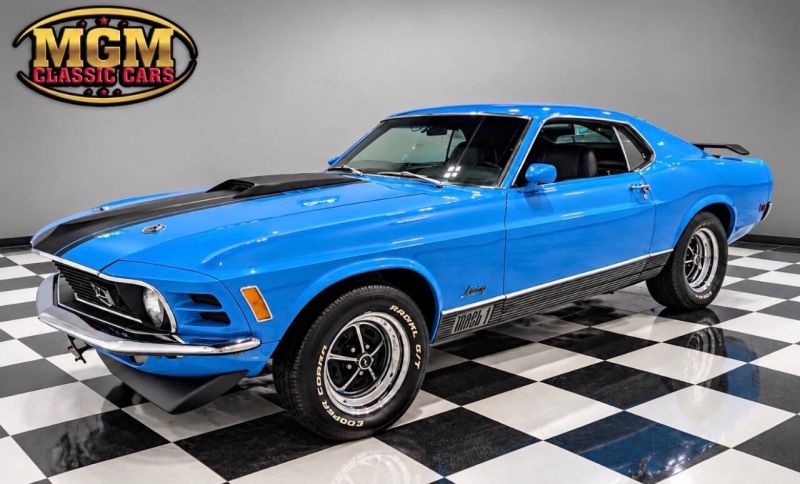
In Halicki's film, Eleanor was presented on screen as a yellow 1973 Ford Mustang Mach 1. The reality behind the camera was more improvised: working on a tight budget, Halicki acquired 1971 Mustang SportsRoof cars (not actual Mach 1s) and dressed them to read as 1973 models, using the later grille and trim cues. Sources consistently note this gap between what Eleanor appears to be and the cars actually used. The name followed the convention used throughout the film: each car on the thieves' list was assigned a woman's name as a code. Eleanor was the last car on the list, the 48th, always the most trouble, the one that kept slipping away. Though Eleanor is shown as several different cars during the action, only two were actually used, with plates and tires swapped as needed; one was modified for the stunt driving in the final chase and wrecked, while the other was kept intact for beauty shots. The Mustang fastback was not a rare or exotic machine in 1974. Ford had been producing the Mach 1 package since 1969, and by 1973 it sat atop a Mustang lineup that had grown considerably heavier than the original 1964 and a half cars.
The film was a regional drive-in success on a scale that surprised everyone. Halicki re-released it multiple times through the late 1970s, and it developed a loyal following among car enthusiasts who appreciated the genuine destruction and the absence of obvious fakery. Halicki died in 1989, killed during the filming of a sequel when a utility pole fell on him during a stunt. His wife, Denice Shakarian Halicki, inherited his estate and the rights to the film and its characters.
The 2000 remake and the Shelby GT500
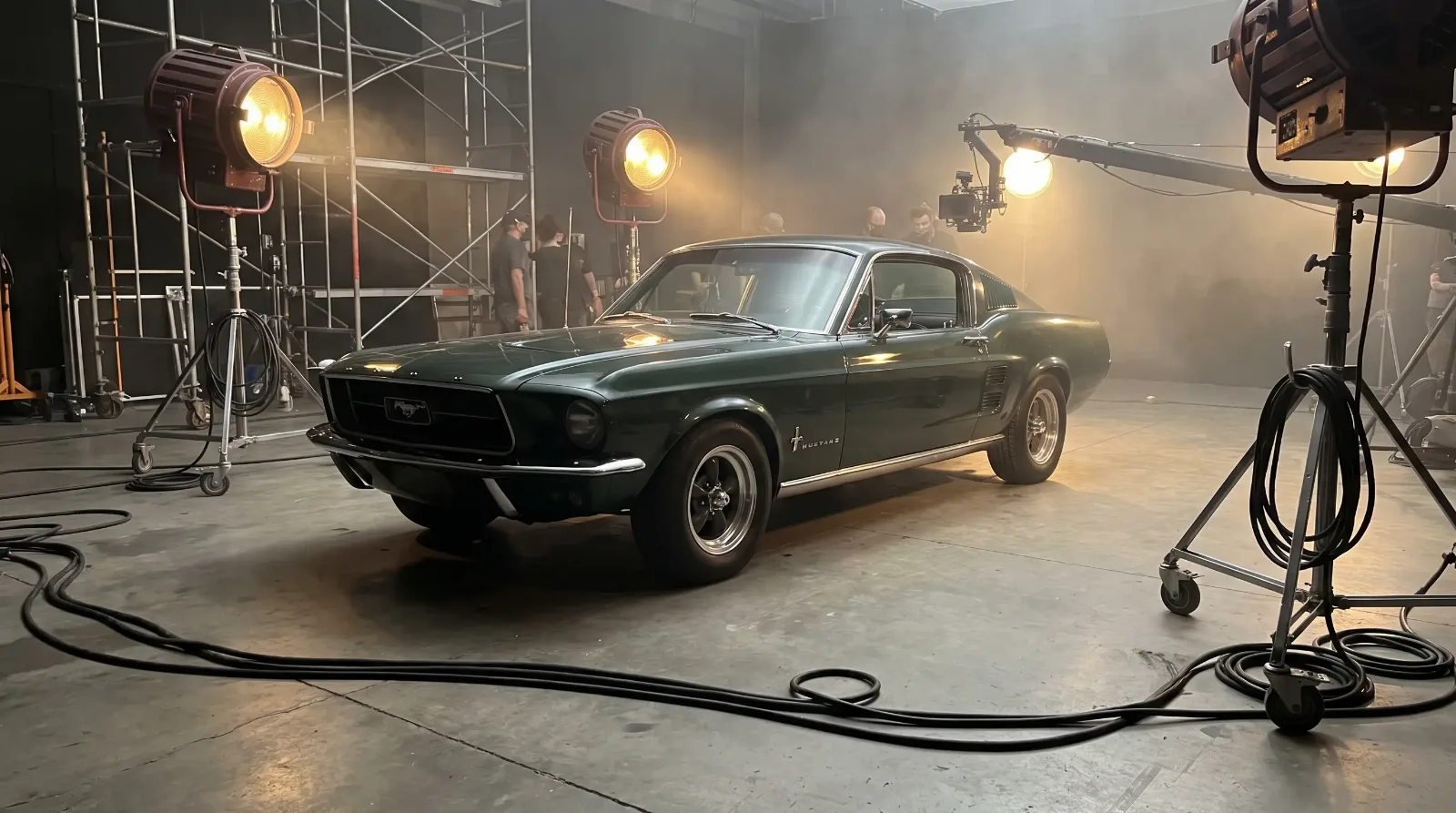
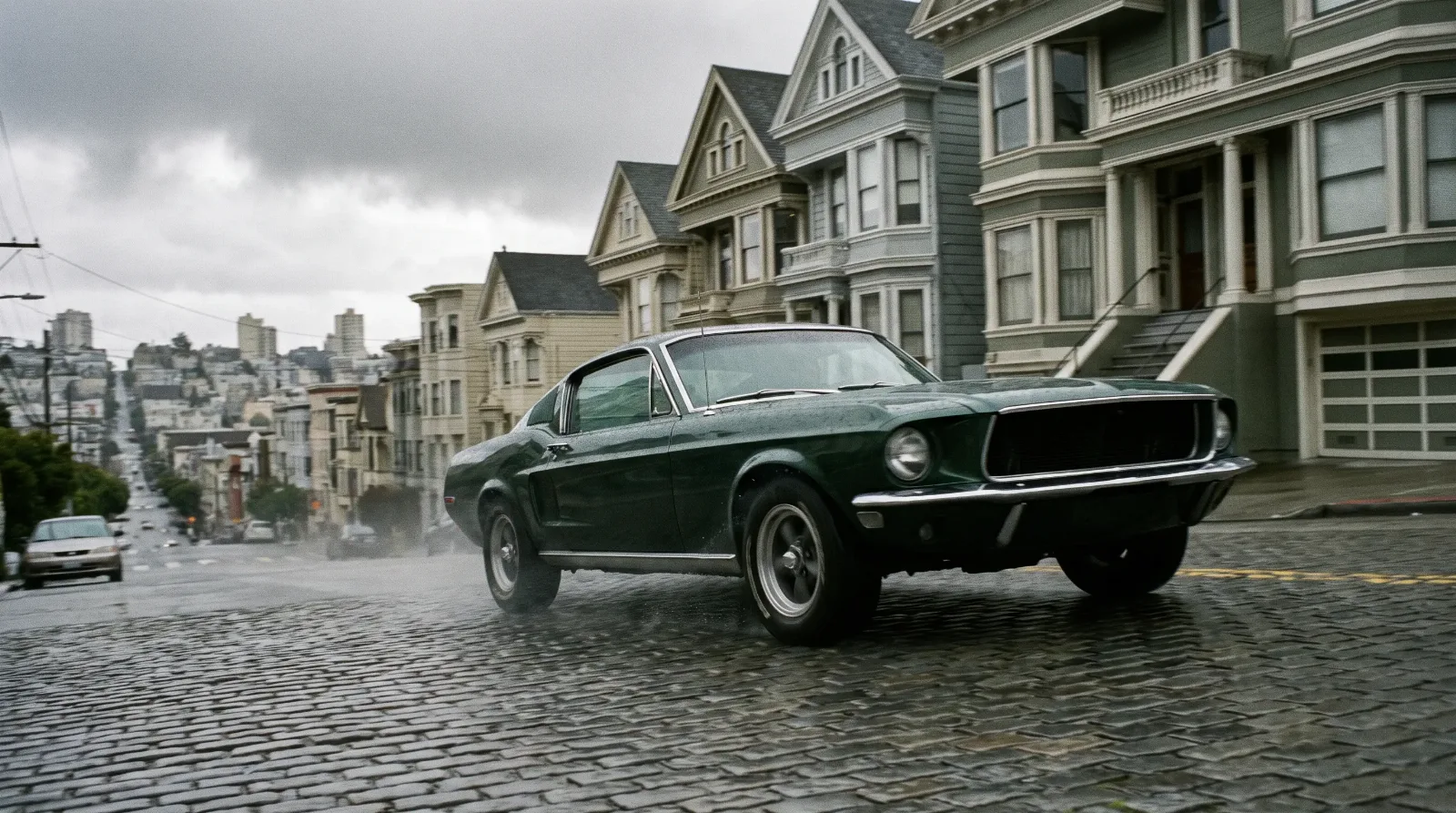
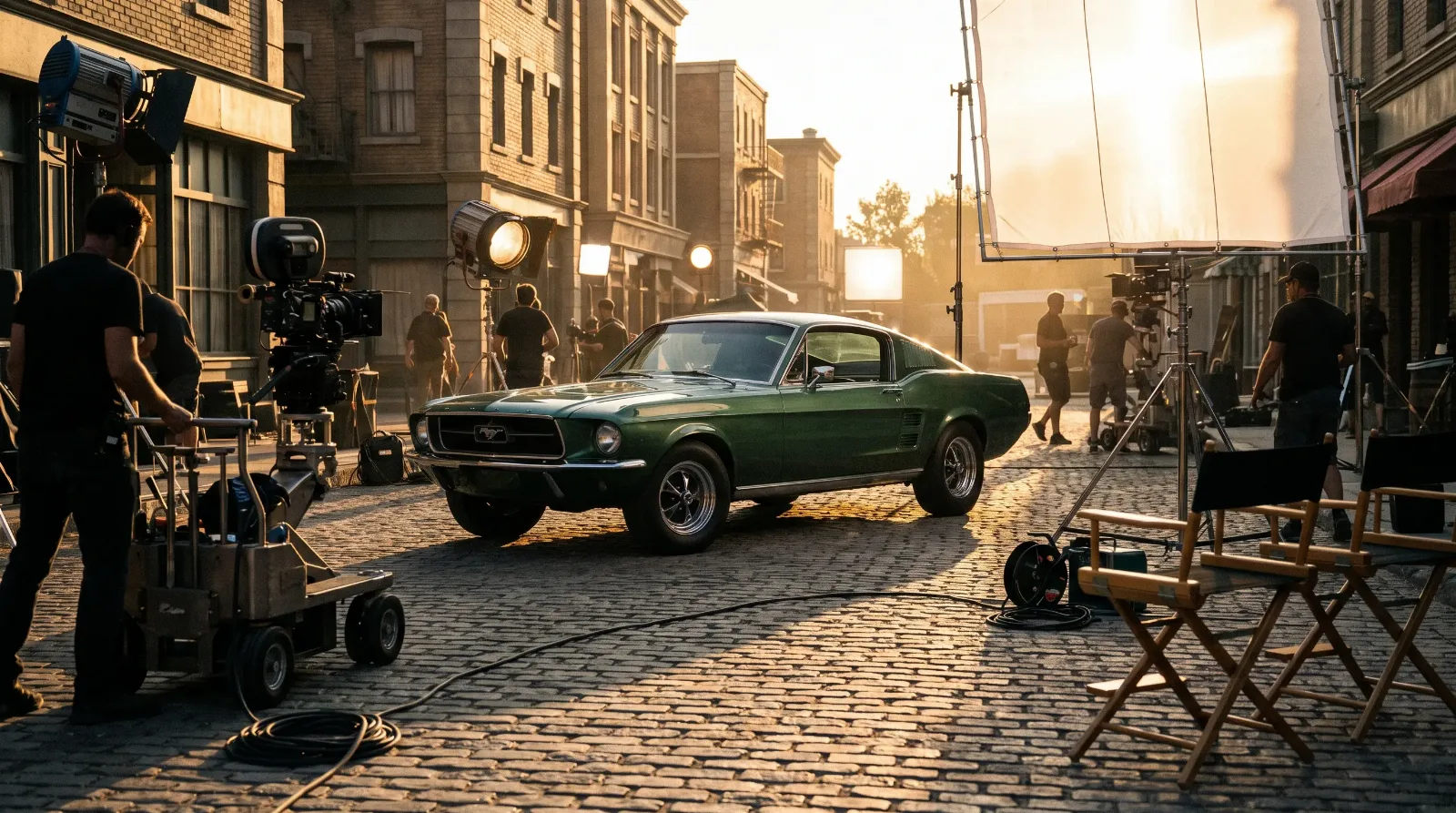
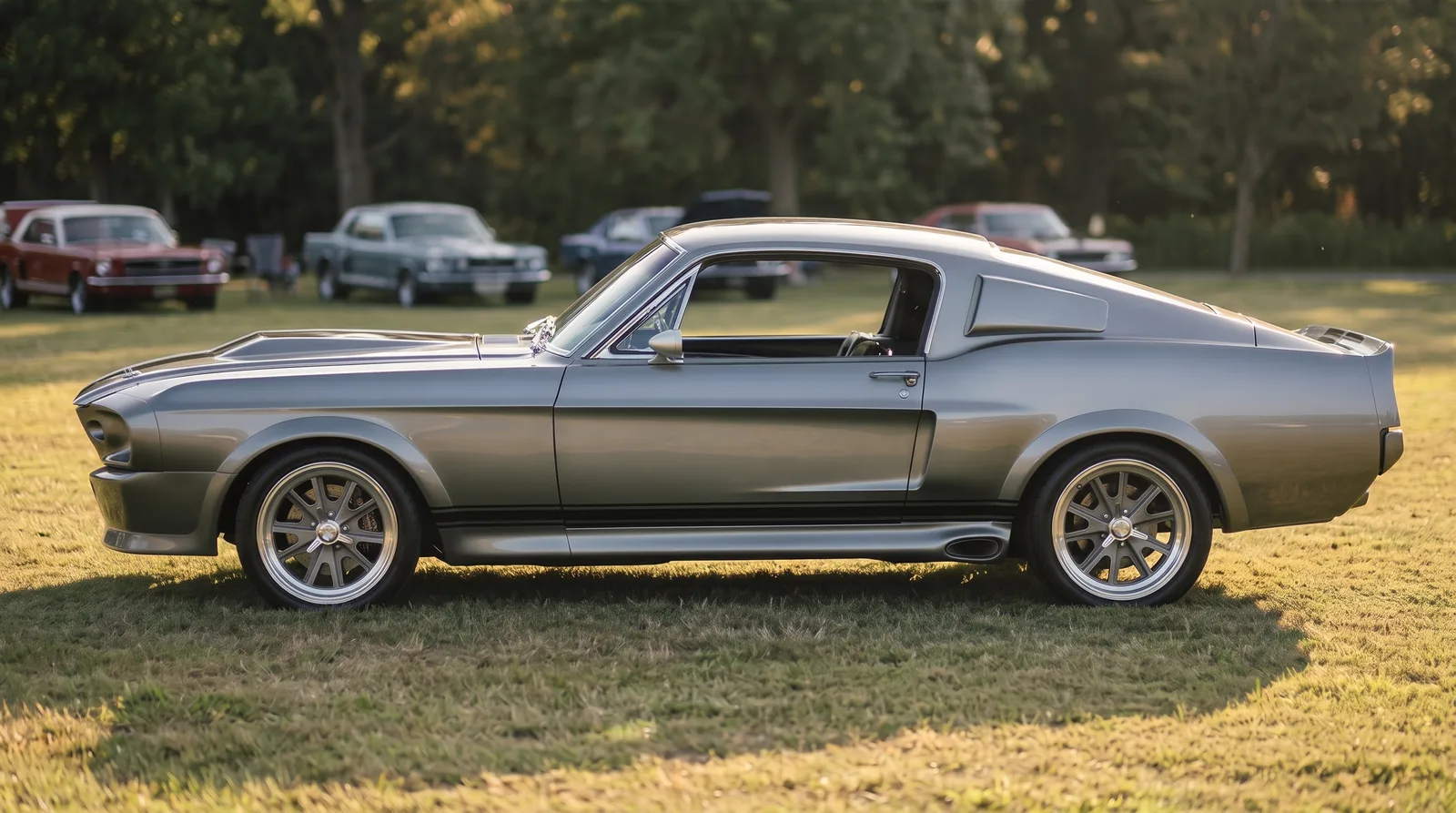
When Jerry Bruckheimer and Disney produced the 2000 remake of "Gone in 60 Seconds," starring Nicolas Cage and Angelina Jolie, Eleanor became something visually and mechanically altogether different. The production chose a 1967 Shelby GT500 fastback as the hero car, finished in DuPont Pepper Grey with black racing stripes. This was not a stock Shelby. The distinctive look began as a sketch by designer Steve Stanford, which Chip Foose then developed and executed into the body kit. The cars themselves were built at Cinema Vehicle Services in North Hollywood, starting from 1967 Mustang fastbacks. In other words, the credit is shared: Stanford conceived the concept, Foose realized the design, and Cinema Vehicle Services fabricated the cars used in the film.
The choice of the 1967 Shelby GT500 was deliberate. By 2000, the first-generation Mustang fastback had become one of the most recognizable automotive shapes in the world, and the Shelby variants carried a prestige that the original film's Mach 1 simply did not. The GT500 designation meant the big-block engine, in period form a 428 cubic-inch unit, though the film cars were modified extensively from any factory specification. Roughly eleven Eleanor cars were built for the production at varying levels of finish, only a few of them fully functional hero cars; the rest were prepared more minimally because they were intended to be destroyed during filming.
The visual package that Stanford, Foose, and Cinema Vehicle Services created, the wide-body flares, the specific stripe pattern, the hood treatment, the overall stance, produced a car that looked more muscular and modern than any stock 1967 Shelby while still reading clearly as a classic. It worked on screen, and it worked on audiences. The 2000 Eleanor became one of the most imitated cars in the tribute-build world almost immediately after the film's release.
The tribute-build explosion
After the 2000 film, the market for Eleanor tribute cars grew steadily and then rapidly. Shops across the country began building 1967 Mustang fastbacks to the general visual specification of the film car, complete with the gray and black color scheme and the widened body work. The cars commanded significant premiums at auction and private sale compared with unmodified 1967 fastbacks. Owners called them Eleanors. Builders marketed them as Eleanor tributes or Eleanor clones. The name and the look had become a commodity.
For collectors who want to understand where Eleanor fits among the wider history of the model, the full range of classic Mustangs provides useful context on how the 1967 fastback ranks against other significant years. The GT500 was already among the most desirable Mustangs before the film. The Eleanor association added another layer of demand on top of an already sought-after platform.
The tribute market created cars at every price point. Serious builds with correct-specification engines, period-accurate interiors, and professional wide-body conversions sold for prices well into six figures. Simpler builds, often starting with standard 1967 fastbacks rather than actual Shelby cars, used the Eleanor cosmetics as a shortcut to visual drama at lower cost. The quality ranged from outstanding to problematic, and buyers who did not know what to look for occasionally paid Eleanor prices for cars with significant mechanical or structural issues hidden under impressive bodywork.
The legal dispute over Eleanor's identity
The question of who owned the right to use the Eleanor name and likeness became one of the more unusual intellectual property cases in automotive history. Denice Halicki, as heir to H.B. Halicki's estate, pursued claims that the character of Eleanor, the car that always slips away, was a protectable fictional character originating with the 1974 film. Her argument was that the 2000 production had used the character without authorization and that the subsequent tribute-build industry was exploiting a character she owned.
In 2008, the Ninth Circuit Court of Appeals issued a ruling in Halicki Films, LLC v. Sanderson Sales & Marketing that read, at first, as a win for Halicki. The court reversed a grant of summary judgment and sent the case back to the district court. Crucially, it did not hold that Eleanor was a copyrightable character. It went the other way procedurally: it observed that Eleanor "could be deemed more akin to a comic book character than a literary character," displaying "consistent, widely identifiable traits," and instructed the lower court to examine whether Eleanor's physical and conceptual qualities qualified her for protection. The significance, at the time, was that the court treated the question as open and fact-intensive rather than foreclosed, applying character-protection analysis to what was essentially a physical object in a film.
For years, that left the tribute-build industry in an uncertain legal landscape. Shops that had been openly marketing cars as Eleanor builds faced potential exposure. Some continued under various arrangements; others rebranded their offerings or avoided the Eleanor name while continuing to build cars to the same visual specification. The Halicki estate pursued action against builders and sellers using the Eleanor name commercially, and Denice Halicki spent the better part of two decades litigating the question.
That uncertainty has now largely lifted, and not in Halicki's favor. On May 27, 2025, in Carroll Shelby Licensing, Inc. v. Halicki, the Ninth Circuit held that Eleanor is not a copyrightable character. Applying the three-part test from its own 2015 Batmobile decision, DC Comics v. Towle, the court found Eleanor failed on every prong: she has no conceptual qualities such as personality or sentience and is "more akin to a prop than a character"; her appearance is inconsistent across the films, ranging from a yellow-and-black fastback to a grey Shelby GT500 to a rusted, paintless car; and she is not sufficiently distinctive. The court affirmed the dismissal of Halicki's copyright and contract claims. The U.S. Supreme Court declined to take the case, denying Halicki's petition in November 2025, which left the Ninth Circuit's ruling as the final word.
The persistence of Eleanor as a cultural reference comes down to something the legal fights inadvertently confirm: the narrative built around this car is more durable than either film that told it. Builders who create Eleanor tributes are not just recreating a paint scheme. They are buying into the story of the car that always gets away, and then gets caught, and that story, across 50 years, has proved worth fighting over. Eleanor is one chapter in a longer story, and a separate guide follows every Mustang on screen that made a name for itself.
"Eleanor is the rare case where the car stopped being a car and became a story, and that is exactly why the legal fights over her name make a kind of sense that they would not make for any other movie vehicle."
Patrick Walsh
Sources and notes
This article was fact-checked against the public record as of June 2026. Production details for low-budget independent films are sometimes reported inconsistently; where sources differ, the most consistently corroborated account has been used. Notably, the on-screen Eleanor of 1974 is presented as a 1973 Mach 1, but contemporary research indicates the cars actually filmed were 1971 Mustang SportsRoof bodies dressed to look like 1973 models. Legal matters are summarized for general interest and are not legal advice.
- Eleanor (automobile): Wikipedia
- Gone in 60 Seconds (1974 film): Wikipedia
- Halicki Films, LLC v. Sanderson Sales & Marketing, 547 F.3d 1213 (9th Cir. 2008): CourtListener
- Carroll Shelby Licensing, Inc. v. Halicki (9th Cir., May 27, 2025), opinion PDF
- SCOTUS Denies Petition Seeking Review of Ninth Circuit's 'Gone in 60 Seconds' Copyright Ruling: IPWatchdog (Nov. 2025)
- A legit "Eleanor" Mustang from "Gone in 60 Seconds": Hagerty Media