
Cadillac Coupe de Ville Buyer's Guide (1949–1970)
The Coupe de Ville defined American luxury for two decades — the pillarless hardtop that turned the Cadillac body into something closer to sculpture. The 1959 and 1960 cars with their jet-age tail fins are the visual apex. A correct, well-documented example is a legitimate piece of American automotive art.

From a concours judging perspective, few cars reward careful evaluation more than the Coupe de Ville. The chrome is complex, the paint is substantial, and the interior materials — leather, wool broadcloth, chrome hardware — were produced to a standard that modern manufacturing cannot easily replicate. What I look for first is authenticity: the correct paint code, the correct interior fabric, the correct wheel covers. Cadillac documented these cars extensively at the factory, and the serial number tag tells you exactly what left the assembly line. A car that matches its documentation is a different asset from one that has been "restored" to a configuration it never had.
The Coupe de Ville — A Pillarless Landmark
Cadillac introduced the Coupe de Ville for the 1949 model year as a pillarless hardtop — a body style that eliminated the B-pillar between the front and rear side windows, allowing all side glass to retract into a completely open-sided configuration. It was a technical tour de force for its era and an immediate style statement that every American luxury brand scrambled to match.
The name itself — French for "town car coupe" — was chosen to evoke the custom coachwork tradition. In execution, the Coupe de Ville democratized a style previously reserved for hand-built coachwork on bespoke chassis. Cadillac could build them on an assembly line. The effect was the same.
1949–1953: The Founding Generation
The original Coupe de Ville arrived with Cadillac's landmark 331 cubic inch overhead-valve V8 — the first modern high-compression OHV V8 in American production. This engine, producing 160 horsepower, was so influential that it is credited with ending the era of the flathead engine. The 1949–1953 cars are the purest expression of the early jet age aesthetic: clean, elegant, and refined.
1954–1958: Fins Begin
Cadillac styling chief Harley Earl began introducing tail fin themes during this period — small in 1954, growing progressively through 1957 and 1958. The 1957–1958 Eldorado Biarritz represented the fin theme at its most extreme before the canonical peak arrived. The 331 grew to 365 cubic inches during this period, and power outputs climbed accordingly.
1959–1960: The Fin Peak
The 1959 Cadillac represents one of the most audacious styling statements in American automotive history. The tail fins — vertical rocket-inspired blades topped with dual bullet taillights — reach their absolute maximum here. No other production car before or since has committed so completely to jet-age optimism in sheet metal. The 1959 Coupe de Ville is the most recognizable American car of the postwar era and has become a cultural symbol beyond automotive collecting.
1961–1970: Refinement and Restraint
The fins retreated sharply after 1960. The 1961 Cadillac adopted a dramatically cleaner design — fins reduced to simple stylized blades, the body cleaned of the previous decade's chrome excess. The 1965–1970 cars represent the mature, restrained Coupe de Ville: powerful, comfortable, well-built, but no longer reaching for the visual extremes that made their predecessors immortal.
What to Inspect
Lower rear quarter panels are the primary rust zone on these cars — the large fin structures trap water and debris at their base. Trunk floor corners accumulate water from trunk lid seal failures. Floor pans are secondary. On cars with wire wheels or accessory hubcaps, check the wheel well seams. The convertible body — offered alongside the hardtop in some years — adds top mechanism and rear corner structural considerations.
| Era | Engine | Defining Feature |
|---|---|---|
| 1949–1953 | 331 ci OHV V8, 160 hp | Original pillarless hardtop |
| 1954–1958 | 365 ci V8 (from 1956), 250–310 hp | Progressive fin growth |
| 1959–1960 | 390 ci V8, 325 hp | Peak fins — the cultural icon |
| 1961–1970 | 390–472 ci V8 | Restrained elegance, clean design |
"The 1959 Coupe de Ville is one of those cars that stops people cold at every show I've attended. But I always tell prospective buyers: the car that stops traffic is not necessarily the car you want to own unless the chrome is correct, the paint matches the trim tag, and someone has documented the history. A 1959 with its original factory color combination and complete correct chrome is a significant automobile. A 1959 repainted in a color it never wore with incorrect trim is a very expensive car to return to authenticity."
— Sarah Whitfield
Pricing
Driver-quality 1961–1966 Coupe de Ville: $12,000–$20,000. Show quality: $24,000–$36,000. The 1959–1960 models carry the strongest premiums: driver quality $28,000–$42,000; show quality $55,000–$80,000. Documented, numbers-correct 1959 Coupe de Ville in concours condition: $90,000–$130,000+. The 1949–1953 original-generation cars are increasingly sought after by pre-chrome-excess buyers: driver $18,000–$28,000, show $35,000–$55,000.
Browse Cadillac Coupe DeVille listings

What to Look For
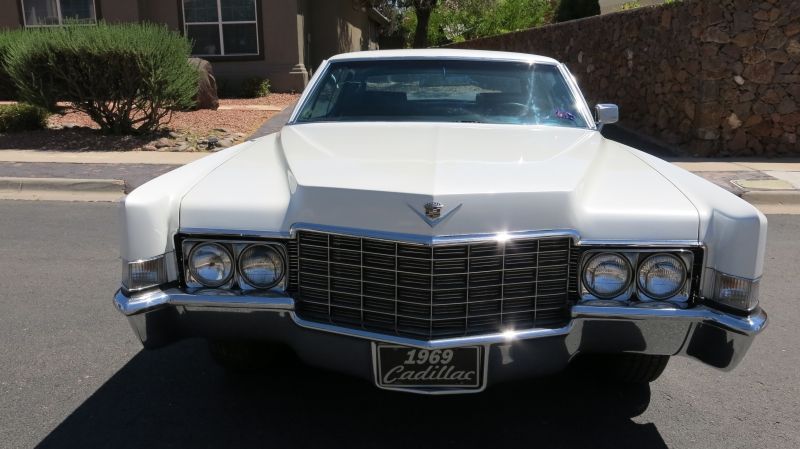
Trim tag verification — confirm factory paint code and interior match the car's actual configuration. Lower rear quarter panels at the fin base for rust and filler. Trunk floor corners. Floor pans. Chrome inventory — document every piece present and assess condition carefully, especially on 1959–1960 cars where chrome is extensive and expensive. Test all electric functions: windows, seats, top if convertible, antenna. Verify 1959 vs 1958 VIN if buying a fin-peak car — year matters enormously to value. Check for correct wheel covers and hubcaps to the specific model year.Pre-Purchase Checklist
-
Trim tag verification
Read firewall/door jamb tag and confirm paint and interior code match the car -
Chrome inventory
Document every chrome piece present — 1959–1960 chrome is the most expensive to restore -
Lower rear quarter rust
Probe fin base area on 1954–1964 cars — primary rust zone -
Trunk floor corners
Remove mat and probe all four trunk corners -
Power window test
Test every window — non-working motors are a known restoration cost -
Power seat test
Test all seat adjustment functions — motor failure is common on unrestored cars -
Hydra-Matic fluid condition
Check ATF color and smell — dark or burnt fluid indicates service overdue -
Headliner condition
Inspect headliner for staining from window seal moisture intrusion -
Year VIN confirmation
For 1959–1960 purchases: confirm year from VIN before paying fin-peak premium -
Wheel cover completeness
Verify correct year-specific wheel covers are present and undamaged
Common Issues
Lower rear quarter rust at the fin base on 1954–1964 cars — the fin structures trap moisture. Chrome deterioration is the most expensive cosmetic issue — correct replating or reproduction sourcing for 1959–1960 cars can exceed $15,000. Power window and seat motor failure is nearly universal on unrestored cars. Hydra-Matic transmission service is overdue on most high-mileage examples — neglected fluid causes clutch pack wear. Air conditioning system recharge and seal replacement needed on most unrestored cars. Headliner deterioration on pillarless hardtops from moisture intrusion at the window seals.More Coupe DeVille for sale
Pricing Guide
Driver-quality 1961–1966: $12,000–$20,000. Show quality: $24,000–$36,000. 1959–1960 driver: $28,000–$42,000; show: $55,000–$80,000; concours correct: $90,000–$130,000+. 1949–1953 original generation driver: $18,000–$28,000; show: $35,000–$55,000. Chrome restoration cost on a 1959–1960 needing full chrome work: $12,000–$20,000 — always factor this into asking price evaluation.Fun Facts
The term "Coupe de Ville" is French for "town car coupe" — a reference to the formal coachwork tradition where a town car had an enclosed passenger compartment with an open or semi-open driver's section. Cadillac's 331 OHV V8 introduced in 1949 directly inspired Chrysler's Hemi development and accelerated the end of the flathead engine era. Elvis Presley owned multiple Coupe de Villes and famously gave them as gifts — the combination of the car with American celebrity culture in the 1950s is inseparable from its mythology.Frequently Asked Questions
Ready to find your Coupe DeVille?
Browse 6+ active Cadillac Coupe DeVille listings on Classic Cars Arena.
View Listings →