
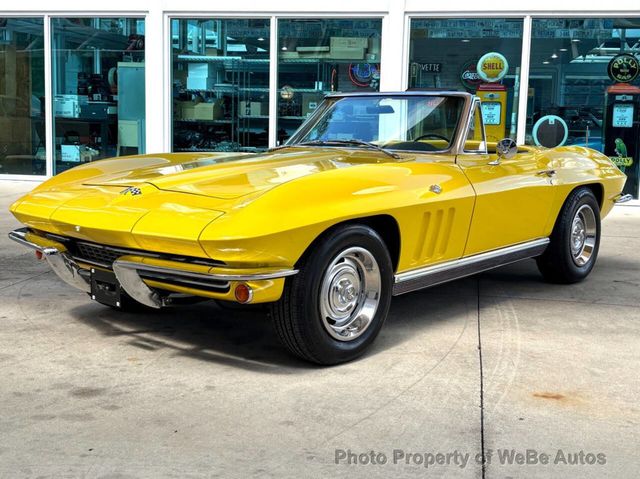
1966 Chevrolet Corvette
$69,997
Vehicle Details
Chevrolet
Corvette
1966
49,728 miles
194676S122310
Convertible
Automatic
327ci V8
Description
1966 Chevrolet Corvette Sting Ray Convertible — 327/350hp, 4-Wheel Disc Brakes, Factory A/C, Sunfire Yellow Why This Car Is Special The 1966 Chevrolet Corvette Sting Ray is widely regarded as the high point of the C2 generation, which ran from 1963 through 1967. By 1966, Chevrolet had refined the Sting Ray into a car that balanced performance, comfort, and style better than any previous Corvette. The split rear window of 1963 was gone.
The body lines were cleaner and more resolved. And the engine lineup had grown to include some of the most capable small- and big-block V8s Chevrolet ever offered in a production car. Chevrolet built 27,720 Corvettes for the 1966 model year, split between coupe and convertible body styles.
Of those, 17,762 were convertibles — making the open-top version the more popular choice by a significant margin. The convertible body style also tends to command the most attention among collectors today, because it captures the open-road character that defined the Sting Ray experience. This particular 1966 Corvette Sting Ray carries the 327 cubic inch V8 in its 350 horsepower configuration, which was Chevrolet's RPO L79 engine — one of the most respected small-block Corvette engines of the era.
The VIN structure on this car confirms it was assembled at the St. Louis plant and is a genuine 1966 model year convertible. It wears Sunfire Yellow paint over a black vinyl interior, a color and trim combination that is visually direct and historically appropriate for the period.
The car has been equipped with a meaningful list of factory options including air conditioning, 4-wheel disc brakes, and side exit exhaust — features that would have significantly increased the original sticker price and added real-world usability and performance. This is not a trailer queen or an over-restored show car. It presents as a solid, well-optioned 1966 Corvette Sting Ray convertible that is ready to be driven and enjoyed.
Features List - 327ci / 350hp V8 (RPO L79 specification) - 2-Speed Powerglide Automatic Transmission - Factory Air Conditioning - 4-Wheel Disc Brakes - Hideaway Headlights - Side Exit Exhaust - Black Convertible Top with Glass Rear Window - Bucket Seats - Center Console - Tachometer - Analog Dash Clock - AM/FM Radio (Delco) - Black Carpet - Seat Belts - Chrome Bumpers - Corvette Steel Wheels - Michelin Tires - Independent Rear Suspension Mechanical The 327 cubic inch small-block V8 in 350 horsepower trim was one of four engine choices available to 1966 Corvette buyers, sitting between the base 300hp 327 and the big-block 427 options. In RPO L79 form, this engine used a higher compression ratio and a more aggressive hydraulic camshaft to produce power that felt stronger than the rated numbers suggested. It was a free-revving, responsive engine that paired well with a wide variety of driving situations — comfortable at highway speeds but capable of serious acceleration when called upon.
Period road tests placed 0-60 times in the mid-six-second range for L79-equipped Corvettes, which was genuinely fast for a street car in 1966. The transmission is the 2-Speed Powerglide automatic. This is worth a direct comment for buyers who may be accustomed to thinking of automatics as compromises.
In the mid-1960s, many drag racers actually preferred the Powerglide for its simplicity, strength, and instant lockup. For a street-driven Corvette, it delivers smooth, effortless power delivery and makes the car accessible to a wider range of drivers without sacrificing the character of the engine. The 4-wheel disc brake system is one of the most important mechanical features on this car.
Disc brakes were optional on the 1966 Corvette, and buyers who checked that box paid a substantial premium for it. Compared to the drum brake setup on base Corvettes of the same era, the disc system provides dramatically better stopping power and fade resistance — a difference that is immediately noticeable in real driving conditions. Thi
Classic Chevrolet Corvette Buyer's Guide
Chevrolet Corvette Market Overview
Based on 436 Chevrolet Corvette listings currently on ClassicCarsArena.com
Selling a classic? Here's how
Fees, audience and photo limits compared: compare the places to sell classic cars .
Classic Chevrolet Corvette Buyer's Guide
The Chevrolet Corvette has been America's sports car for over seventy years, but the classic Corvette market splits into three distinct generations, each with its own buyer profile and its own pitfalls. The C1 (1953-1962), C2 mid-year (1963-1967), and C3 shark (1968-1982) cover three decades of evolution from solid-axle straight-six convertibles to small-block legends to LT-1-powered chrome-bumper cars. Knowing which Corvette is yours, and what it actually is versus what the seller claims, is the difference between a sound investment and an expensive lesson.
What to Check Before Buying
Common Issues
What to Look For
Price Guide
Did You Know?
Also Consider
Similar classic cars shoppers also browse:
How Does It Compare?
Head-to-head matchups for the Chevrolet Corvette:
1966 Chevrolet Corvette
Find a similar Chevrolet Corvette currently for sale.
Browse Similar ListingsCar alert
Get an email when a 1961-1971 Chevrolet Corvette is listed
At most one email a day. Stop anytime with one click.
Similar Past Listings
Buying safely?
Read our scam-avoidance tips before paying →
Listing Actions
Browse by Era
1960s Classics for SaleAll 1966 Classics
Browse all 1966 Cars for SaleOriginal Factory Colors
Official paint codes for the Chevrolet Corvette (1966).
🎨 View Factory ColorsModel History
How the Chevrolet Corvette evolved (1953–1996) across 4 generations.
📈 View Full EvolutionGet classic car alerts
Latest arrivals, newest deals, and discount coupons, straight to your inbox.
Selling your classic car?
Reach millions of classic car enthusiasts on the largest US classics marketplace.
Sell Your Car →Similar Listings

 United States
1917 Chevrolet Touring Car
 United States
1918 Chevrolet 100
 United States
1924 Chevrolet 100
 United States
1925 Chevrolet 100
Call this seller?
You're about to call WeBe Autos about the 1966 Chevrolet Corvette.
+1 (631) 339-0399
Car alert
Get an email when a 1961-1971 Chevrolet Corvette is listed
At most one email a day. Stop anytime with one click.
Report this Ad
Help us keep the marketplace clean. Our moderation team reviews every report within 24 hours.