
1938 Chevrolet Master
$29,997
Vehicle Details
Chevrolet
Master
1938
6,234 miles
14HB0616256
Coupe
Manual
216.5ci Stovebolt Six
Description
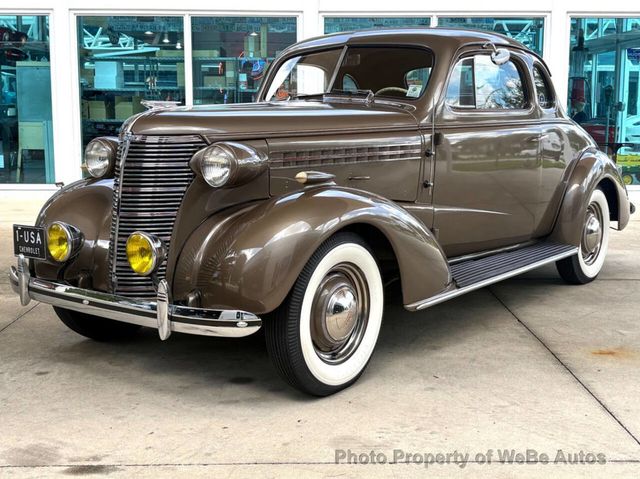
1938 Chevrolet Master Business Coupe — Rust-Free Survivor with Factory-Correct Restoration and Period Accessories Why This Car Is Special The 1938 Chevrolet Master Business Coupe is not a car you see at every show. It was the no-frills workhorse of the Master series lineup — no rear seat in the standard configuration, more trunk space, and a price point that made it accessible to small business owners and tradesmen during the tail end of the Great Depression. Chevrolet built the 1938 Master series on a longer 112.3-inch wheelbase than its cheaper Master 85 sibling, and the body was penned under the direction of GM's Art and Colour Section with input from Harley Earl's team.
The result was some of the most cohesive pre-war American styling ever put into production — a fully integrated pontoon fender design, a waterfall grille with vertical chrome bars, and a roofline that flowed rearward in a single smooth arc. What separates this particular 1938 Chevrolet Master Business Coupe from the ones you occasionally see at shows is simple: the metal is real. There is no filler anywhere on this car.
The body panels are straight because they were never seriously damaged and because someone cared enough to restore this car correctly around 2010 rather than skim over problems with plastic filler and a spray gun. The undercarriage photographs confirm this — the floor pans, frame rails, and body seams are clean, tight, and show no evidence of patch panels or hidden damage. For a pre-war car that has spent time in the southeastern United States, that is genuinely significant.
The exterior is finished in factory-correct Woodleaf Brown, Paint Code 229 — a warm, medium-depth brown with subtle bronze undertones that was available on 1938 Chevrolet models and pairs naturally with the tan interior. This is not a common color choice on restored pre-war Chevrolets, which makes this car stand out at shows where black and two-tone combinations dominate the field. Features - Body by Fisher, as factory-correct - Rust-free body — no filler anywhere on the car - Restored approximately 2010 in factory-correct Woodleaf Brown (Paint Code 229) - 85hp 216.5ci Stovebolt Six inline OHV engine - Floor-shift 3-speed manual transmission - Converted to 12-volt electrical system - Accessory banjo steering wheel - Factory AM radio - Dual amber accessory fog lights - Driver's side accessory spotlight - Dual accessory trumpet horns - Firestone whitewall tires - Chrome Chevrolet hubcaps - Running boards - 4-wheel hydraulic drum brakes - Leaf spring suspension front and rear - Tan leather interior - Suitable as both a driver and a show car Mechanical Power comes from Chevrolet's 216.5 cubic inch inline six-cylinder engine — the engine enthusiasts have always called the Stovebolt Six, a nickname earned from the slotted bolts used on the valve cover.
This OHV engine displaced 216.5 cubic inches and produced 85 horsepower in 1938 trim, which was a meaningful number for a car of this size and weight in that era. The Stovebolt had already earned a reputation for reliability long before 1938, and Chevrolet continued refining it through the late 1940s and into the 1950s. Parts availability remains good, and the engine's mechanical simplicity means a competent shop can work on it without specialized equipment.
The 3-speed manual transmission is operated through a floor-mounted shifter, which is correct for the Business Coupe configuration. The electrical system has been converted from the original 6-volt setup to a modern 12-volt system — a practical upgrade that eliminates the chronic voltage drop issues that plague 6-volt cars when running accessories, particularly the radio and the multiple period accessory lights on this car. The conversion allows this 1938 Chevrolet Master Business Coupe to be driven regularly without the electrical frustrations that come with original 6-volt wiring on an 87-year-old car.
Underneath, the car uses leaf spring suspension at both
Chevrolet Master Buyer's Guide
Chevrolet Master Market Overview
Based on 63 Chevrolet Master listings currently on ClassicCarsArena.com
Chevrolet Master Buyer's Guide
Jim Vasquez here. People forget that Chevrolet was the best-selling car in America for most of the 1930s — not Ford, not Plymouth. The reason was the Master series. It was a bigger, more refined car than the Standard series, powered by the "Stovebolt Six" that became legendary for its longevity, and styled with a care that made Chevrolet buyers feel they were getting something above their price point.
The Master is the foundation of pre-war Chevrolet collecting. The later Master Deluxe got most of the attention, but the base Master that ran through the early part of the decade has a purity and honesty to it that later chrome-laden models lack. These are cars from before planned obsolescence, built to last because that's what buyers expected.
What to Check Before Buying
Common Issues
What to Look For
Price Guide
Did You Know?
1938 Chevrolet Master
Contact Seller
Listed by dealer
Nationwide consignment dealer
WeBe Autos lists vehicles from sellers across multiple states. The vehicle may not be at the dealer's address shown. Contact the dealer to confirm the vehicle's actual location before traveling.
Buying safely?
Read our scam-avoidance tips before paying →
Listing Actions
Browse by Era
Pre-War Classics for SaleAll 1938 Classics
Browse all 1938 Cars for SaleGet classic car alerts
Latest arrivals, newest deals, and discount coupons — straight to your inbox.
Selling your classic car?
Reach millions of classic car enthusiasts on the largest US classics marketplace.
Sell Your Car →Similar Listings
 Dealer
 United States
1918 Chevrolet 100
 Dealer
United States
Dealer
United States
1923 Chevrolet Master
 Dealer
United States
Dealer
United States
1925 Chevrolet Superior K
 Dealer
United States
Dealer
United States
1926 Chevrolet 100
Contact Seller
Call this seller?
You're about to call WeBe Autos about the 1938 Chevrolet Master.
+1 (631) 339-0399
Report this Ad
Help us keep the marketplace clean. Our moderation team reviews every report within 24 hours.