
1970 Chevrolet Monte Carlo
$39,997
Vehicle Details
Chevrolet
Monte Carlo
1970
92,125 miles
138570B186181
Coupe
Automatic
350ci V8
Description
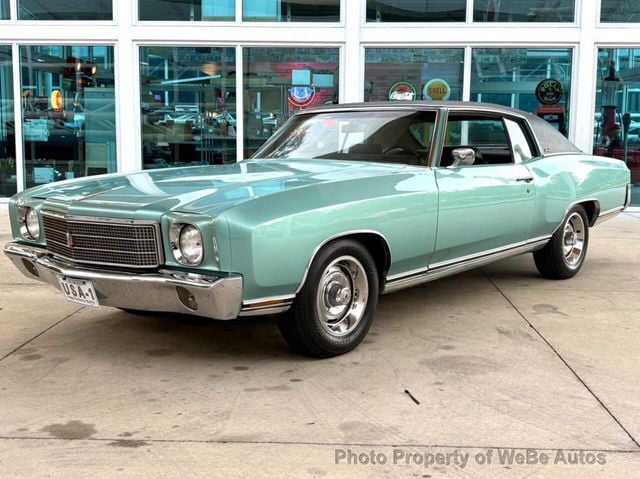
1970 Chevrolet Monte Carlo — Misty Turquoise, 350 V8, Well-Optioned First-Year Example Why This Car Is Special The 1970 Chevrolet Monte Carlo was a brand-new model when this car rolled off the line. Chevrolet introduced the Monte Carlo for the 1970 model year as a personal luxury coupe, slotting it into the A-body platform above the Chevelle and targeting buyers who wanted something more refined than a muscle car but still wanted a V8 under the hood. It was Chevrolet's answer to the Ford Thunderbird and Pontiac Grand Prix, and the market responded immediately — Chevrolet sold over 145,000 Monte Carlos in that first model year alone.
This particular 1970 Chevrolet Monte Carlo wears Misty Turquoise, a factory color that was one of the more distinctive offerings in the 1970 Chevrolet palette. Paired with a black vinyl top and black vinyl interior, the contrast is exactly what the designers at GM intended — the long hood, formal roofline, and wide rear deck look purposeful in this color combination. The VIN on this car confirms it was assembled at the Kansas City assembly plant, one of several facilities that built Monte Carlos during the 1970 model year.
What makes first-year Monte Carlos especially interesting to collectors is that the 1970 model was the only year to carry the longer 116-inch wheelbase before the body was redesigned. The proportions of the 1970 Monte Carlo are widely considered the best of the generation — the hood alone measured nearly six feet in length, which gave the car a stance unlike anything else in Chevrolet's lineup at the time. This car has been kept honest.
It presents as a solid, well-optioned driver with a clean undercarriage and a feature list that reflects how a careful original buyer would have equipped one of these cars. Features List - 350ci V8 Engine - 3-Speed Automatic Transmission - Power Steering - Power Front Disc Brakes - Factory Air Conditioning - Dual Exhaust - Black Vinyl Top - Black Vinyl Interior - Front and Rear Bench Seats - Rear Window Defroster - Dual Sport Mirrors - Front Sway Bar - Delco AM Radio - Woodgrain Dash - Full Gauge Instrumentation - Monte Carlo Script Floor Mats - Chrome Bumpers - Rally Wheels - BFGoodrich Radial Tires - Clean Undercarriage Mechanical Under the hood is the 350 cubic inch V8, which was the standard engine offering on the 1970 Monte Carlo. In base two-barrel form, the 350 was rated at 250 horsepower.
This engine has a well-established reputation for durability and parts availability, which makes it one of the more practical choices for a car that will actually be driven. Backing it is a 3-speed automatic transmission, the correct pairing for this application, sending power through a dual exhaust system. The exhaust setup is visible in the undercarriage photos and presents cleanly — the undercarriage itself shows well, with no visible rust or structural concerns, which is a significant consideration on any 50-plus-year-old car.
Stopping power comes from power front disc brakes, which were a notable feature on these cars. The 1970 Monte Carlo came standard with front drums, so disc brakes represent an upgrade that adds real-world driving confidence. Power steering is also equipped, which is consistent with the Monte Carlo's positioning as a comfort-oriented personal luxury car rather than a sports machine.
The front sway bar helps the car stay composed in corners without dramatically changing the ride character. For a car in this class, that is the correct balance. BFGoodrich radial tires are mounted all around, a practical and period-appropriate choice that complements the Rally Wheels.
Interior The 1970 Monte Carlo interior was designed to compete with personal luxury cars at higher price points. Chevrolet gave it a dedicated instrument panel that was specific to the model — not shared with the Chevelle — and the woodgrain dash on this car is one of the features that defines the Monte Carlo experience. The gauge cluster in
Classic Chevrolet Monte Carlo Buyer's Guide
Chevrolet Monte Carlo Market Overview
Based on 45 Chevrolet Monte Carlo listings currently on ClassicCarsArena.com
Classic Chevrolet Monte Carlo Buyer's Guide
The Chevrolet Monte Carlo ran from 1970 through 1988 and made its collector case in two very different ways. The 1970–1972 first-generation cars are legitimate muscle-era machines — personal luxury coupes built on the Chevelle platform with engine options that climbed to the 454 LS6. The 1983–1988 Aero coupes are NASCAR-influenced collector pieces built to racing homologation rules. Between those two peaks are the middle-generation cars: comfortable, affordable classics with a strong styling identity. The first-gen SS454 is one of the most undervalued muscle cars in the market right now — and that window is not staying open much longer.
What to Check Before Buying
Common Issues
What to Look For
Price Guide
Did You Know?
1970 Chevrolet Monte Carlo
Contact Seller
Listed by dealer
Nationwide consignment dealer
WeBe Autos lists vehicles from sellers across multiple states. The vehicle may not be at the dealer's address shown. Contact the dealer to confirm the vehicle's actual location before traveling.
Buying safely?
Read our scam-avoidance tips before paying →
Listing Actions
Browse by Era
1970s Classics for SaleAll 1970 Classics
Browse all 1970 Cars for SaleModel History
How the Chevrolet Monte Carlo evolved (1970–1988) — 4 generations.
📈 View Full EvolutionGet classic car alerts
Latest arrivals, newest deals, and discount coupons — straight to your inbox.
Selling your classic car?
Reach millions of classic car enthusiasts on the largest US classics marketplace.
Sell Your Car →Similar Listings
 Dealer
 United States
1918 Chevrolet 100
 Dealer
United States
Dealer
United States
1923 Chevrolet Master
 Dealer
United States
Dealer
United States
1925 Chevrolet Superior K
 Dealer
United States
Dealer
United States
1926 Chevrolet 100
Contact Seller
Call this seller?
You're about to call WeBe Autos about the 1970 Chevrolet Monte Carlo.
+1 (631) 339-0399
Report this Ad
Help us keep the marketplace clean. Our moderation team reviews every report within 24 hours.