Elite Dealer

1974 Ford Bronco

$54,997
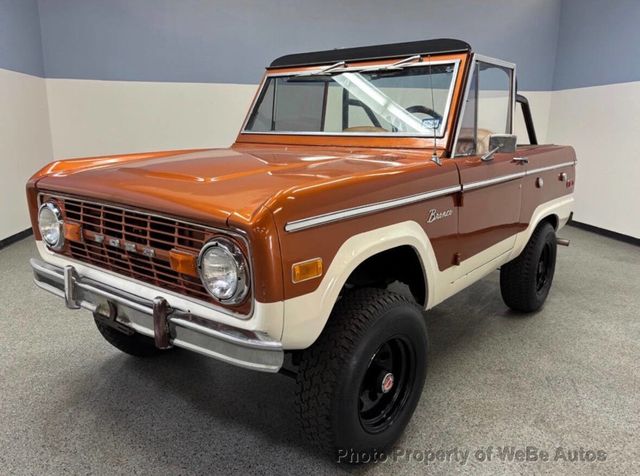
1974 Ford Bronco

Vehicle Details

Make

Ford

Model

Bronco

Year

1974

Mileage

117,362 miles

VIN

U15GLT12287

Body Type

SUV

Transmission

Automatic

Engine

302 V8

Description

1974 Ford Bronco Ranger — 302 V8, 4x4, Two-Tone Burnt Orange, Soft Top Why This Car Is Special The first-generation Ford Bronco ran from 1966 through 1977, and those early trucks have become some of the most sought-after American four-wheel-drive vehicles on the collector market. The reason is straightforward: they were purpose-built, body-on-frame trucks with solid axles front and rear, a short 92-inch wheelbase that made them genuinely capable off-road, and enough factory trim options to give buyers real choices. Ford produced the first-gen Bronco in three body styles — roadster, half-cab, and wagon — but by 1974, the wagon configuration had become the dominant seller, and that's exactly what this truck is.

The 1974 model year is particularly interesting from a drivetrain standpoint. The 302 cubic inch V8 — the same engine Ford had been developing and refining since 1968 — was the go-to engine choice for buyers who wanted a capable street and trail performer without the added weight and fuel consumption of the larger 360. By 1974, Ford had begun fitting emissions controls across the lineup in response to federal regulations, but the 302 remained a proven and parts-friendly small-block that owners and mechanics have understood for decades.

This particular 1974 Ford Bronco Ranger carries that 302, backed by a C4 three-speed automatic and a Dana 20 transfer case — a combination that has logged millions of miles in trucks just like this one. What separates this truck from a basic Bronco Sport is the Ranger trim designation. The Bronco Ranger was Ford's upper-level package for the first-gen truck, bringing a more finished interior and exterior compared to the base Sport trim.

The dash badging visible in the photos confirms the Ranger designation, and the interior reflects it — more on that below. This is the configuration serious collectors and users look for when they want a first-gen that was well-optioned from the factory rather than stripped down. The two-tone Burnt Orange over white exterior is a period-correct color combination that photographs well and reads as a complete, intentional build rather than a tired work truck.

Someone has put real money and thought into this Bronco, with upgrades that add utility without undoing its character. Features List 302 5.0L V8 Engine C4 3-Speed Automatic Transmission Part-Time 4-Wheel Drive Dana 20 Transfer Case Power Steering Dual Exhaust Superlift Shocks Two-Tone Burnt Orange and White Paint Soft Top Black Steel Wheels Goodyear Wrangler Tires Spare Tire Mounted Rear Bronco Ranger Tire Cover Chrome Front and Rear Bumpers Chrome Side Trim Wood-Grain Dash Trim Leather Bucket Seats (Tan) Rear Bench Seat (Tan) Houndstooth Door Panels Ford Logo Floor Mats Pioneer Head Unit (Upgraded) Upgraded Rear Speakers Roll Bar Installed Rear Locking Storage Box Fire Extinguisher Mounted Mechanical Under the hood sits Ford's 302 cubic inch V8 — 5.0 liters in modern terms — wearing its factory-style blue valve covers and a round air cleaner assembly. The 302 was introduced in 1968 and became one of Ford's most versatile and reliable engines, used across the Mustang, F-Series, and Bronco lineups.

In the relatively light first-gen Bronco, it provides adequate power for street driving and enough low-end torque to handle trail work without complaint. Parts availability for this engine is about as good as it gets for any American V8 of this era. Power routes through a Ford C4 three-speed automatic transmission, which was a common and practical pairing for the 302 in truck applications.

The C4 is a straightforward, proven unit with a long service history in Ford vehicles. Behind the C4 sits the Dana 20 transfer case, a two-speed unit that offers a low range for off-road work. The Dana 20 was standard equipment on the first-gen Bronco and has a solid reputation for durability.

The floor-mounted transfer case shifter is clearly visible in the interior photos, sitting alongside the

Classic Ford Bronco Buyer's Guide

Full guide
T
Tom Ramirez
Corvette
1966–1996
~6 min read
Updated Apr 2026
Definitive buyer's guide for classic Ford Bronco 1966-1996. Early Bronco 1966-1977 and Big Bronco 1978-1996 generations, frame and tub rust, 289/302 V8 identification, current market pricing.
This guide covers
10-point inspection checklist
Common issues & what to avoid
In-person inspection guide
Market pricing by year & condition
5 FAQs answered
History & fun facts

Ford Bronco Market Overview

Based on 121 Ford Bronco listings currently on ClassicCarsArena.com

121
Listed Now
$55,584
Avg. Asking Price
1966–1996
Year Range
Price Position on Our Site — Average Range
This car: $54,997
Low: $5,000 High: $278,995
Transmission Distribution
Automatic 60% ◄
Manual 32%
Condition Distribution
Excellent 16%
Good 6%
Fair 2%
Data from ClassicCarsArena.com listings Browse all 121 listings →
💰

What is this car worth?

Check sold prices for the 1974 Ford Bronco

Valuation Tool →

Classic Ford Bronco Buyer's Guide

The Ford Bronco has lived through five distinct platform generations across thirty years of production, but the classic Bronco market splits cleanly into two eras: the "Early Bronco" (1966-1977) and the "Big Bronco" (1978-1996). The first generation has become the single fastest-appreciating American collector vehicle of the past decade, with documented original examples now trading for sums that rival muscle-car territory. I've spent two decades chronicling Ford's SUV history, and the build sheet tells the real story on every Bronco — what was originally optional, what was dealer-installed, and what has been added during the car's lifetime. This guide covers what separates a documented original Early Bronco from a creative "restomod" build sold as factory-original.

What to Check Before Buying

Order Marti Report for any 1967+ Bronco over $30K — Marti Auto Works $25. Confirms original engine, transmission, axle, paint, options, dealer destination.
Cross-reference against Bronco Driver registry — Marque registry maintains records of known-original and known-restored cars. Identifies modifications.
Inspect frame body mount points (Early Broncos) — Six per side. Probe with screwdriver. Solid steel resists; rotten metal flakes. Replacement = $8,000-$18,000.
Examine rear frame cross-member — Common rust point on Early Broncos. Critical for trailer towing capacity and chassis integrity.
Lift rubber mats and check floor pans — Both driver and passenger sides, front and rear. Universal rust point on Early Broncos.
Verify uncut tub vs cut-and-modified — Original sheet metal has factory spot welds and seams. Modified sheet metal has hand-welded joints. Uncut tubs add 25-50% premium.
Cross-reference VIN engine code with block casting — 8th digit of VIN (1968+) = engine code. Block casting numbers verify Windsor 289/302 originality.
Verify Dana axle casting numbers — Dana 30 (1966-1971) and Dana 44 (1972-1977) front axles. Original units add value when verified factory-installed.
Check rear cargo area floor (Early Broncos) — Lift rear seat or storage compartment. Common rust point invisible from outside.
Test all electrical and 4WD engagement — Hubs, transfer case, and 4WD selector should engage cleanly. Failed components on Big Bronco era cost real money to repair.

Common Issues

Early Bronco rust is the structural killer for any 1966-1977 Bronco that lived in salt-belt climates. The frame rusts at the body mount points and the rear cross-member; the body tub rusts at the rocker panels, the floor pans (especially the rear cargo area floor), the lower fenders behind the front wheels, the tailgate hinges, and the cowl seam where the windshield base meets the firewall. Cars described as "uncut, rust-free" with original tubs are increasingly rare and command significant premium pricing. Mechanically, the Early Bronco's engine options are simple. The 170 inline-six (1966-1969), 200 inline-six (1970-1977), 289 V8 (1966-1968), and 302 V8 (1969-1977) are all bulletproof when maintained. The Dana 30 front axle (1966-1971) and Dana 44 front axle (1972-1977) are robust; the Ford 9-inch rear axle is essentially indestructible. The Toploader 3-speed manual transmission is durable; the C4 automatic (1973+) is similarly reliable. Common issues include worn kingpins on Dana 30 axles, leaking transfer case seals, and tired carburetor settings. Big Bronco (1978-1996) issues are different. The 1978-1979 Big Broncos used the Bronco-specific frame; 1980+ Big Broncos shared the F-150 platform. Rust patterns shifted to the rear quarter panels, the cab corners (lower section behind the rear doors), the rear wheel arches, and the tailgate. Mechanically, the 351M, 400, 460, 302, 351W, and 5.8L V8 engines are all robust. Common issues include failed fuel pumps (1980-1989 cars used in-tank pumps that fail expensively), TFI ignition modules, and worn front axle u-joints. Electrical issues vary by generation. Early Broncos have brittle 50+ year-old wiring; Big Broncos have more sophisticated electrical systems prone to module failures.

What to Look For

Marti Auto Works build sheets are the gold-standard documentation for any 1967-and-later Bronco. The build sheet ($25 for basic, more for elite reports) confirms the original equipment of the car: engine code, transmission code, axle ratio, paint code, options, and dealer destination. For any Early Bronco priced over $30,000, the Marti Report is mandatory — too many cars on the market wear emblems and equipment that wasn't original to the car. Frame inspection is the first non-negotiable for Early Broncos. The frame rusts at the body mount points (six per side on Early Broncos) and at the rear cross-member. Lift the body off the frame with a flashlight and probe rusty areas with a screwdriver. Solid steel resists; rotten metal flakes. Frame replacement is a serious undertaking — $8,000-$18,000 for proper professional work. Tub inspection is the second non-negotiable. The Early Bronco body tub is a single welded steel structure that becomes increasingly difficult to repair properly as rust progresses. Inspect the floor pans (lift the rubber mats), the rocker panels (under the doors), the rear cargo area floor (lift the rear seat or storage compartment), the cab corners, and the tailgate hinge area. Cars described as "uncut tubs" with original sheet metal are the gold standard. Engine and drivetrain verification: cross-reference the VIN engine code (eighth digit, on 1968+ cars) with the engine block casting number. The Early Bronco 289 (1966-1968) and 302 (1969-1977) Windsor V8s have specific casting numbers that verify originality. The 170 and 200 inline-sixes are similarly identifiable. Original Dana axles have specific casting numbers and stampings that verify factory installation. Document the build sheet against the car. Cross-reference against the marque registry — the Bronco Driver registry maintains records of known-original cars and known-restored cars. The build sheet tells the real story.

Price Guide

Early Bronco (1966-1977) values have appreciated dramatically over the past decade. Driver-quality 1966-1969 cars (the original 'short' Bronco) run $45,000-$80,000 today. 1970-1977 cars run $35,000-$70,000 in driver condition. Documented original-paint, low-mileage examples can reach $95,000-$150,000+. Documented uncut original tubs in survivor condition are the ultimate Early Bronco — these cars trade for $80,000-$220,000 depending on year, condition, and equipment. The 1966 launch year cars are the most desirable, with documented original 1966 cars approaching $200,000+ when fully verified. LS-swapped restomod Early Broncos (with modern drivetrains, modern brakes, modern interior) run $80,000-$220,000 depending on quality of build. Frame-up restomod builds from recognized specialists (Gateway, Velocity, Maxlider, Icon) run $200,000-$500,000+. Big Bronco (1978-1996) pricing is dramatically more affordable. Driver-quality 1978-1979 cars run $22,000-$42,000. 1980-1989 cars run $15,000-$32,000. 1990-1996 cars run $12,000-$28,000. The 1990s OJ Simpson-era white Broncos have appreciated due to pop-culture interest — clean white 1990-1996 Broncos run $22,000-$45,000. Project Early Broncos (running but rough) start around $15,000-$28,000. Stripped roller candidates can be had for $8,000-$20,000, but rust restoration on a Bronco typically runs $30,000-$70,000 in body and frame work alone before paint.

Did You Know?

The 1966 Ford Bronco was developed under chief engineer Paul Axelrad as a direct response to the original Jeep CJ. Ford Product Planning identified an unmet market for a compact, capable, on-road-and-off-road vehicle that would appeal to suburban families as well as serious off-roaders. The original concept was approved by Lee Iacocca (then Vice President of Ford Motor Company) in 1963, and the car launched in August 1965 as a 1966 model. Only 4,090 Roadster variants (Bronco model U13) were built in 1966 — making them among the rarest Early Bronco variants. The U13 Roadster had no roof and no doors. The Half-Cab Pickup was a separate body style (model U14) with a fixed forward roof and open rear cargo bed. Documented Roadster examples in survivor condition trade for $80,000-$150,000+ today. The Bronco was discontinued in 1996 after 30 years of continuous production, replaced by the four-door Ford Expedition for the 1997 model year. Ford reintroduced the Bronco nameplate for the 2021 model year on an entirely new platform — but the 1966-1996 classic Broncos remain a separate market segment with no direct connection to the new vehicles. I've spent two decades chronicling Ford's SUV history, and the original Bronco's combination of compact dimensions, rugged engineering, and timeless styling explain why these cars have become the fastest-appreciating American collector vehicles of the past decade.

Similar Listings

Contact Seller

Share only if you'd like the seller to call you directly.

By contacting this seller you accept the Visitors Agreement

Call this seller?

You're about to call WeBe Autos about the 1974 Ford Bronco.

+1 (631) 339-0399

Before you call: Never wire money or share bank info over the phone. Read our scam-avoidance tips.
Call Now

Send to a Friend

Share this 1974 Ford Bronco listing.

Report this Ad

Help us keep the marketplace clean. Our moderation team reviews every report within 24 hours.