Elite Dealer

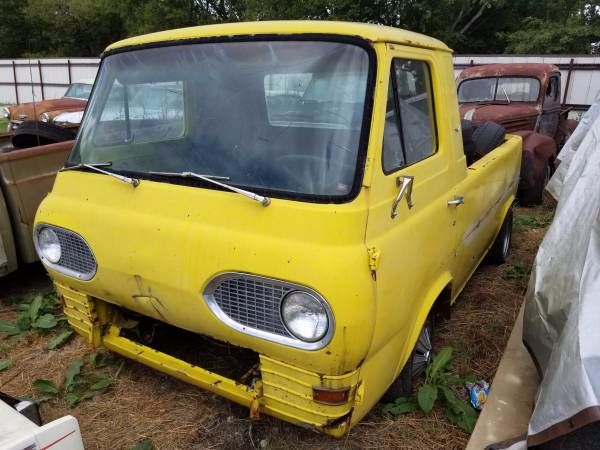
1963 Ford Econoline

Michigan

$6,495

1963 Ford Econoline

Vehicle Details

Make

Ford

Model

Econoline

Year

1963

Body Type

Other

Description

1963 Ford Econoline Truck, super straight body, older yellow paint, 80s 302 engine and AOD automatic transmission, very complete, missing Grill, good restoration project, very rare. -Vehicle is on consignment and at our clients home -Please Call First and talk to a rep at 231-468-2809 EXT 1 -Showroom is by appointment only Please Call -If you would like a FREE Listing please visit our consignment page or Call

Ford Econoline Buyer's Guide

Full guide
R
Robert Halloran
Classic Trucks
1961–1974
~2 min read
Updated Apr 2026
The Ford Econoline pioneered the American van as a practical vehicle — a compact, front-axle-over-engine design that fit more cargo than a pickup in less overall length, and became the foundation of a custom van culture that defined 1970s road culture.
This guide covers
✓ 8-point inspection checklist
✓ Common issues & what to avoid
✓ In-person inspection guide
✓ Market pricing by year & condition
✓ 4 FAQs answered
✓ History & fun facts

Ford Econoline Market Overview

Based on 10 Ford Econoline listings currently on ClassicCarsArena.com

10
Listed Now
$32,393
Avg. Asking Price
1963–1986
Year Range
Price Position on Our Site — Below Average
This car: $6,495
Low: $6,495 High: $139,000
Transmission Distribution
Automatic 50%
Manual 20%
Condition Distribution
Good 10%
Fair 10%
Data from ClassicCarsArena.com listings Browse all 10 listings →
💰

What is this car worth?

Check sold prices for the 1963 Ford Econoline

Valuation Tool →

Ford Econoline Buyer's Guide

Robert Halloran here. The Econoline doesn't get the collector attention of a VW Bus or a Chevy Van, but it probably should. The first-generation E-Series (1961–1967) is one of the most mechanically clever vehicles ever designed for American roads: the engine sits between the front seats, the front axle sits ahead of the driver, and the result is a vehicle that maximizes cargo capacity within a short overall length. It's a practical-engineering tour de force.

The custom van movement of the 1970s adopted the Econoline enthusiastically, and the second and third generations (1968–1974) have a devoted following that treats them as legitimate collector vehicles. A properly sorted classic Econoline — whether it's a clean original van or a period-correct custom — is a genuinely rewarding ownership experience.

What to Check Before Buying

Cab Floor Rust (First Gen) — On 1961–1967 models, inspect cab floor around the front engine location — heat and moisture cause accelerated rust here.
Floor Pan Condition — Check the main floor pan for perforation from underneath and inside.
Lower Body Seams — Probe lower body seams on both sides — water collects here and causes hidden rust.
Inline-Six Carburetor — Test cold start and idle stability — carburetor rebuilds are standard maintenance on Falcon-era sixes.
302ci V8 (if equipped) — Check for rear main seal leaks and cracked exhaust manifolds on V8-equipped second-gen vans.
Cooling System — Verify the operating temperature stays in the normal range — the compact engine bay can trap heat.
Custom Interior Assessment — On custom vans, evaluate whether modifications are period-correct or modern — this determines restoration direction.
Roof Integrity — On raised-roof conversions, inspect the roof seam for leaks and rust.

Common Issues

Lower cab floor rust around the engine on first-gen models. Floor pan perforation from moisture and road salt. Lower body seam rust on both generations. Falcon-derived 144/170ci inline-six carburetor issues on first-gen. Second-gen 302ci V8 rear main seal leaks. Custom van interior modifications that complicate restoration. Roof rust on high-roof conversion vans from leaking roof seals.

What to Look For

Rust is the primary concern and follows specific patterns: the lower cab area around the front wheel wells, the floor pan (particularly around the engine doghouse cover on second-gen), and the lower body seams. On first-gen models, the cab floor is especially vulnerable to rust from the engine's heat and moisture. Verify the inline-six starts reliably and idles smoothly — carburetor issues are common on unrestored engines. On second-gen V8-equipped vans, check for cracked exhaust manifolds and proper cooling system function. Custom van interiors add no monetary value unless they're period-correct and exceptional quality.

Price Guide

1961–1967 first-gen panel van (original): $8,000–$20,000. Clean first-gen: $18,000–$35,000. 1968–1974 second-gen cargo van: $6,000–$15,000. Period-correct custom van (1968–1974, quality build): $15,000–$35,000. Club Wagon passenger van: $8,000–$18,000. V8-equipped second-gen vans command 15–25% premium over six-cylinder equivalents.

Did You Know?

The first-generation Econoline's cab-forward design was so effective that it was widely copied — the Dodge A100 and Chevrolet Corvan followed with similar configurations within a year. The Ford Econoline nameplate has survived continuously from 1961 to the present (now branded as the E-Series Transit), making it one of the longest-running nameplate histories in American commercial vehicles. The custom van movement of the 1970s is now recognized as a genuine folk art movement, with the best examples featuring elaborate murals, airbrushed interiors, and craftsmanship that rivals professional coachbuilding.

Similar Listings

Contact Seller

Share only if you'd like the seller to call you directly.

By contacting this seller you accept the Visitors Agreement

Call this seller?

You're about to call Classic Car Deals about the 1963 Ford Econoline.

+1 (231) 468-2809

Before you call: Never wire money or share bank info over the phone. Read our scam-avoidance tips.
Call Now

Send to a Friend

Share this 1963 Ford Econoline listing.

Report this Ad

Help us keep the marketplace clean. Our moderation team reviews every report within 24 hours.