Elite Dealer

1932 Ford Roadster

$59,997

1932 Ford Roadster

Vehicle Details

Make

Ford

Model

Roadster

Year

1932

Mileage

100 miles

VIN

181225005

Body Type

Convertible

Transmission

Automatic

Engine

383 Stroker 530HP

Description

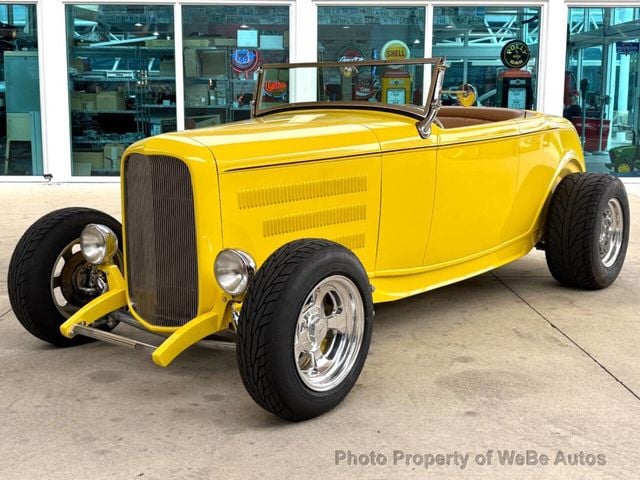
1932 Ford Roadster — 383 Stroker Street Rod with Custom Tan Leather Interior Why This Car Is Special The 1932 Ford Roadster is the car that started it all. When hot rodders returning from World War II needed a cheap, lightweight body to stuff a flathead into, they reached for the '32 Ford. The body was low, the frame was strong, and the styling — penned under the direction of Edsel Ford with input from designer Joe Galamb — had a natural elegance that no amount of modification could ruin.

Ninety-plus years later, the 1932 Ford Roadster remains the definitive American hot rod. Ford built just over 520,000 Model 18s in 1932, the year the company introduced its first flathead V8 to the public. Of all the body styles produced that year, the open roadster is the most coveted by builders and collectors alike.

This particular 1932 Ford Roadster has been built as a proper street rod — not a trailer queen, not a show car that gets trailered to events, but a real driver with serious power, a finished undercarriage, and an interior built for long days behind the wheel. It wears Lemon Ice yellow from every angle, rides on a chrome suspension that looks as clean underneath as it does from the outside, and carries a 383 stroker under the hood rated at 530 horsepower. For the serious hot rod buyer, this one covers a lot of ground.

Features List - 383 Stroker V8, 530 horsepower - TH350 3-speed automatic transmission - K&N air filter - Dual exhaust - Bucnik chrome wheels - Drum brakes all around - Chrome front suspension - Custom tan leather interior - Classic Instruments gauge cluster - Floor shift console - Louvered body panels - Removable soft top Mechanical The engine in this 1932 Ford Roadster is a 383 cubic inch stroker built on the Chevrolet small block platform. A 383 stroker takes the standard 350 block and combines it with a 400 crankshaft, increasing the stroke from 3.48 inches to 3.75 inches and bringing displacement up to 383 cubic inches. The result is more torque across a wider RPM range than a stock 350 can deliver.

At 530 horsepower, this engine produces more than twice what a factory small block ever offered from the assembly line, and it does so in a car that originally weighed around 2,300 pounds. The power-to-weight ratio here is not subtle. The K&N air filter sitting on top of the carburetor improves airflow compared to a standard paper element and is a common, serviceable choice in street rod builds.

The transmission is a TH350 three-speed automatic, which is a sensible match for a 383 stroker in a street-driven car. The TH350 was introduced by General Motors in 1969 and became one of the most widely used automatic transmissions in hot rod and street rod applications due to its compact dimensions, proven reliability, and strong aftermarket support. Gear changes are handled via a floor-mounted shifter, keeping the cockpit clean and functional.

The dual exhaust exits at the rear quarters, and the undercarriage photos confirm that this car has been finished to a show-quality standard underneath — the frame and chassis components have been painted to match the exterior Lemon Ice yellow, the chrome exhaust pipes are polished, and the suspension geometry is neat and well-organized. The front suspension is a chrome dropped axle setup, which is the traditional approach for this style of 1932 Ford build. It lowers the front of the car, improves the visual stance, and keeps the mechanical layout period-correct for a traditional hot rod.

Braking is handled by four-wheel drum brakes, which is consistent with the traditional build style of this roadster. Interior The cockpit of this 1932 Ford Roadster was built to be used. The seating surfaces are covered in a custom tan leather that works directly with the Lemon Ice yellow bodywork — warm tones throughout, nothing competing for attention.

The door panels are custom molded leather pieces with integrated pull handles, shaped with flowing body lines that are cle

Classic Ford Coupe Buyer's Guide

Full guide
J
Jim Vasquez
Hot Rods
1932–1948
~5 min read
Updated Apr 2026
Definitive buyer's guide for classic Ford Coupe 1932-1948. Pre-war and post-war coupe variants, hot rod platform fundamentals, frame and body inspection, current pricing.
This guide covers
10-point inspection checklist
Common issues & what to avoid
In-person inspection guide
Market pricing by year & condition
5 FAQs answered
History & fun facts
💰

What is this car worth?

Check sold prices for the 1932 Ford Roadster

Valuation Tool →

Classic Ford Coupe Buyer's Guide

The Ford Coupe — particularly the iconic 1932-1934 cars and the post-war 1946-1948 cars — represents the foundational platform of American hot rodding. The 1932 Ford with its flathead V8 launched a tradition that defined American performance culture for the next ninety years, and the 1933-1934 cars refined the formula. Period-correct flathead V8 power, chopped tops, channeled bodies, and traditional kustom kulture aesthetics define the genre. Whether you're hunting an original-condition Deuce coupe for restoration or a chopped-and-channeled period-correct hot rod from a recognized builder, the Ford coupe market is one of the most active and most actively-judged segments in the entire American collector hobby. The Goodguys circuit, the Grand National Roadster Show, and SEMA Battle of the Builders all maintain build-quality standards that separate the legitimate traditional builds from the hobby work.

What to Check Before Buying

Verify body style code on firewall dataplate — Three-window vs Five-window vs Standard Coupe distinction is critical. Different collector trajectories.
Inspect frame at body mount points — Pre-war frames rust at body mount cross-members. Probe with screwdriver from underneath.
Probe wood inner body framing on pre-1939 cars — Pre-1939 Ford bodies have wood inner framing. Wood rot = $5,000-$15,000 specialist coachbuilding repair.
Examine running boards and fender attachment — Running boards rust where they meet body. Fender attachment points are universal rust zones.
Check rumble seat (if applicable) for rust — Rumble seat coupes have additional rust concerns at rear deck. Lift rumble seat for inspection.
Verify flathead V8 vs OHV V8 if applicable — Original 1932-1953 Ford coupes used flathead V8. Hot rods often have post-1954 OHV V8 swaps.
For Deuce coupes (1932), demand specialist authentication — Original 1932 Ford coupes are blue-chip hot rod platform. Replicas and replicars exist.
Inspect cowl seam at windshield base — Where windshield meets firewall. Water damage rots wood structure on pre-1939 cars.
Check mechanical brake adjustment (pre-1939 cars) — Mechanical brakes on pre-1939 Fords require specialist adjustment. Convert-to-hydraulic common.
For hot rod builds, verify build documentation — Recognized builder pedigree adds significant value vs hobby builds. Verify build documentation.

Common Issues

Ford coupe rust patterns vary by era. Pre-1939 cars (with wood inner body framing) face wood rot in addition to steel rust — water penetrating through failed weatherseals causes wood to rot from inside, compromising body structure. Common rust zones: lower body panels, running boards, fender attachment points, the rear cargo floor (if applicable), and the cowl seam where the windshield base meets the firewall. Post-1939 all-steel cars rust at the same locations but without wood structure concerns. Mechanically, the Ford flathead V8 (1932-1953) is among the most over-engineered engines of the pre-war era — bulletproof when serviced correctly. Common issues include burnt valves on cars run with poor ignition timing, worn camshaft lobes, oil leaks at the rear main seal, and worn timing gears. Many 1932-1948 Ford coupes have been converted from flathead to post-1954 OHV V8 power (Chevy small-block, Ford Y-block, etc.) for modern performance — verify the conversion was done properly with appropriate motor mounts and engine compartment fitment. The three-speed sliding-gear transmission (1932-1939) is robust but requires specialist knowledge to operate (no synchromesh on first gear, double-clutching required). The three-speed synchromesh transmission (1940-1948) is dramatically more pleasant for daily driving. Many traditional hot rod builds use post-war Ford or aftermarket transmissions for improved drivability. The mechanical brakes (1932-1938) are one of the most safety-critical Ford coupe maintenance items. Failed or poorly-adjusted mechanical brakes are the most common cause of pre-1939 Ford accidents. Brake adjustment requires specialist knowledge — many cars have been converted to hydraulic brakes (1939+ Ford hydraulic system or aftermarket disc brakes). From a concours judging perspective, original mechanical brakes are essential to authenticity on pre-1939 cars; from a daily-driver standpoint, hydraulic conversion is widely accepted. Electrical issues are universal: original 6-volt positive-ground systems on pre-1956 Fords require specific bulbs and components. Many cars have been converted to 12-volt negative-ground systems for modern reliability — verify the conversion was done properly.

What to Look For

Body style verification is the first stop. Three-Window Coupe vs Five-Window Coupe vs Standard Coupe distinctions drive significant value differences. Three-Window Coupes command 25-50% premium over equivalent Five-Window Coupes. Verify the body style code on the firewall dataplate and visual inspection of the side window count. For 1932 Deuce coupe claims, demand specialist authentication. Multiple companies have produced reproduction 1932-style fiberglass and steel bodies over the decades. Original 1932 Ford steel bodies have specific construction details, original Ford date stampings on body components, and chassis number locations that distinguish them from reproductions. Specialist authentication ($300-$800 typical) is mandatory for any Deuce coupe priced over $80,000. Wood structure inspection is critical for pre-1939 cars. Probe the wood inner body framing at the door pillars, windshield post, and rear body corners. Soft, spongy, or rotten wood requires specialist coachbuilding repair. From a concours judging perspective, original-condition wood structure is essential to authenticity; replacement wood reduces concours value. For hot rod builds, verify build documentation and builder pedigree. Period-correct traditional builds from recognized hot rod shops (Roadster Shop, So-Cal Speed Shop, Brizio Street Rods, Pete & Jakes, others) command significant premium over equivalent hobby work. Goodguys Trophy winners, GNRS America's Most Beautiful Roadster pedigree, and SEMA Battle of the Builders awards add documented value. For period-correct traditional hot rod builds, verify the engine and drivetrain specification. Period-correct flathead V8 power (with components like Stromberg 97 carburetors, Edelbrock cylinder heads, finned aluminum intake manifolds, and Mallory ignition) commands premium over modern V8 swaps for traditional-aesthetic cars. Modern resto-mod builds (LS swap, modern brakes, modern air ride suspension) appeal to a different market segment. Document the car. Photograph every panel, every chassis number stamping, every body construction detail (especially on Deuce coupes), every engine bay component, and every identifying tag. Build a comprehensive case file before purchase.

Price Guide

1932 Ford Three-Window Coupe: driver-quality original-condition cars run $80,000-$140,000+. Documented original-paint, low-mileage cars: $140,000-$220,000+. The 1932 Three-Window is the most desirable single Ford coupe ever produced. 1932 Ford Five-Window Coupe: driver-quality original-condition cars run $55,000-$95,000. Documented original cars: $95,000-$160,000. 1932 Ford Standard Coupe: driver-quality cars run $42,000-$75,000. The base Standard Coupe lacks the De Luxe trim of the desirable Three-Window and Five-Window variants. 1933-1934 Ford Coupes: driver-quality cars run $50,000-$95,000. The 1934 model year is the most refined of the era. Documented original cars: $80,000-$140,000+. 1935-1939 Ford Coupes: driver-quality cars run $32,000-$65,000. The 1939 model year is the most desirable of this era (last "early" Ford before 1940 redesign). Documented original cars: $50,000-$95,000. 1940-1948 Ford Coupes: driver-quality cars run $22,000-$48,000. Post-war 1946-1948 cars are slightly more affordable than pre-war 1940-1941 cars. Documented original cars: $35,000-$70,000. Traditional period-correct hot rod builds: prices vary dramatically by builder pedigree. Hobby-built traditional flathead-powered Deuce coupes: $55,000-$120,000. Recognized-builder traditional builds (Roadster Shop, So-Cal, Brizio): $150,000-$350,000+. GNRS America's Most Beautiful Roadster pedigree builds: $300,000-$1M+. Modern resto-mod builds (LS swap, modern brakes, air ride): $80,000-$220,000 typical, with high-end builds reaching $400,000+ for show-quality work. Project Ford coupes start around $20,000-$45,000 across most pre-war years. Stripped roller candidates: $10,000-$25,000.

Did You Know?

The 1932 Ford "Deuce" coupe became the foundational platform of American hot rodding due to three coincident factors: Ford produced enormous quantities (over 270,000 1932 Fords across all body styles), the Ford flathead V8 made hot-rodding economically accessible to ordinary buyers, and post-WWII returning veterans had cash to spend and mechanical skills from military service. The Three-Window Coupe in particular became the most photographed hot rod platform in American history, featured on hundreds of magazine covers from Hot Rod magazine's 1948 launch through modern automotive media. The "Deuce" nickname for the 1932 Ford derives from the 1930s American slang for "two" — referring to the year 1932. The nickname became formalized in hot rod culture during the 1940s-1950s and remains in active use today. Other classic Ford-coupe-era nicknames include "Tudor" (two-door sedan, derived from "two-door"), "Fordor" (four-door sedan), and "Deluxe" (the high-trim 1932-1948 Ford trim level). The Ford flathead V8 powered American performance through the late 1940s and early 1950s, until Chevrolet's introduction of the small-block V8 in 1955 began to displace the flathead in hot rod culture. Period-correct traditional hot rod aesthetic (still actively maintained at events like the Hot Rod Reunion, Goodguys, and GNRS) requires flathead V8 power for authenticity. The flathead remains in active use in traditional hot rod culture and represents one of the most actively-collected pre-war American engine platforms.

Similar Listings

Contact Seller

Share only if you'd like the seller to call you directly.

By contacting this seller you accept the Visitors Agreement

Call this seller?

You're about to call WeBe Autos about the 1932 Ford Roadster.

+1 (631) 339-0399

Before you call: Never wire money or share bank info over the phone. Read our scam-avoidance tips.
Call Now

Send to a Friend

Share this 1932 Ford Roadster listing.

Report this Ad

Help us keep the marketplace clean. Our moderation team reviews every report within 24 hours.