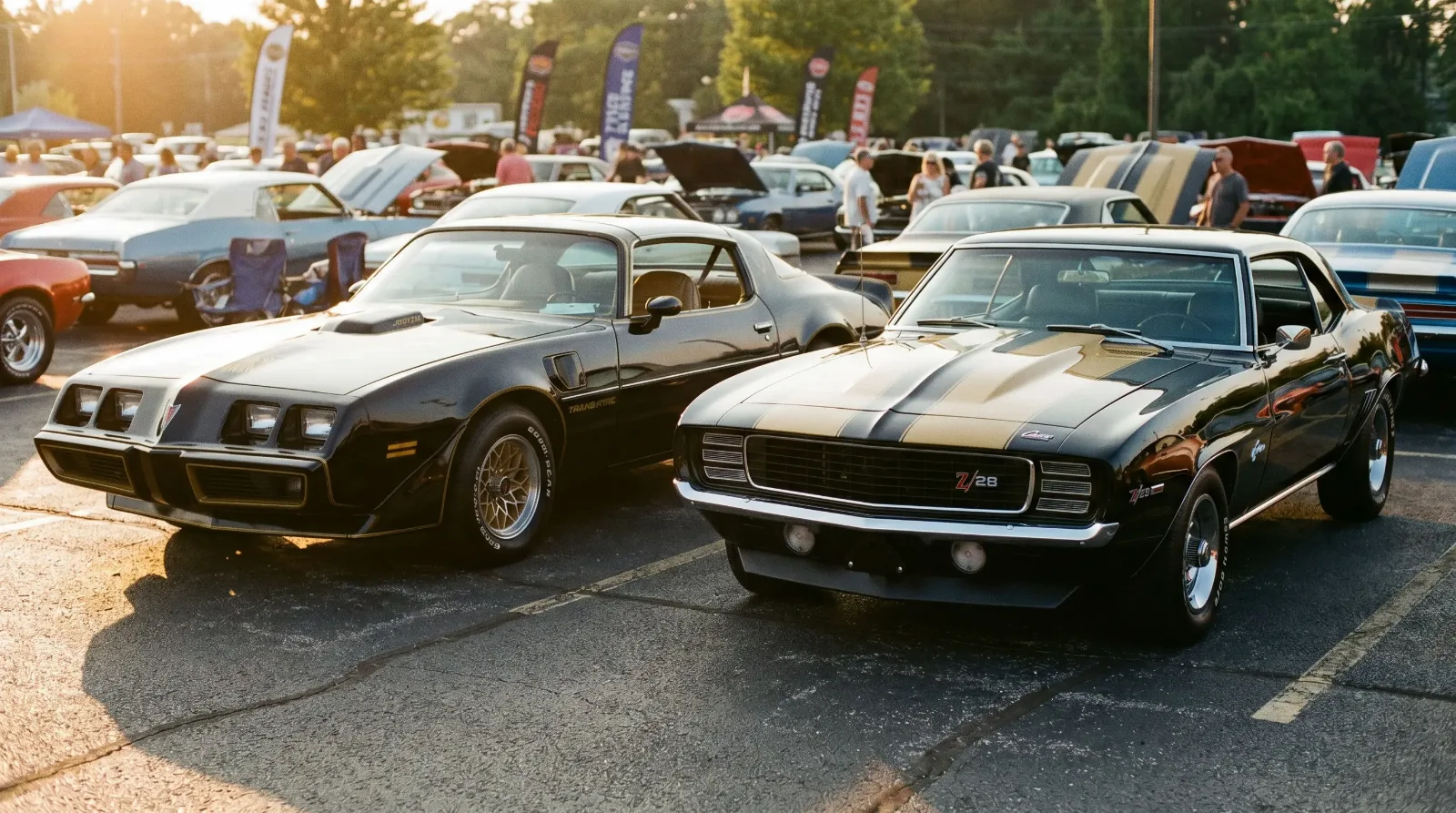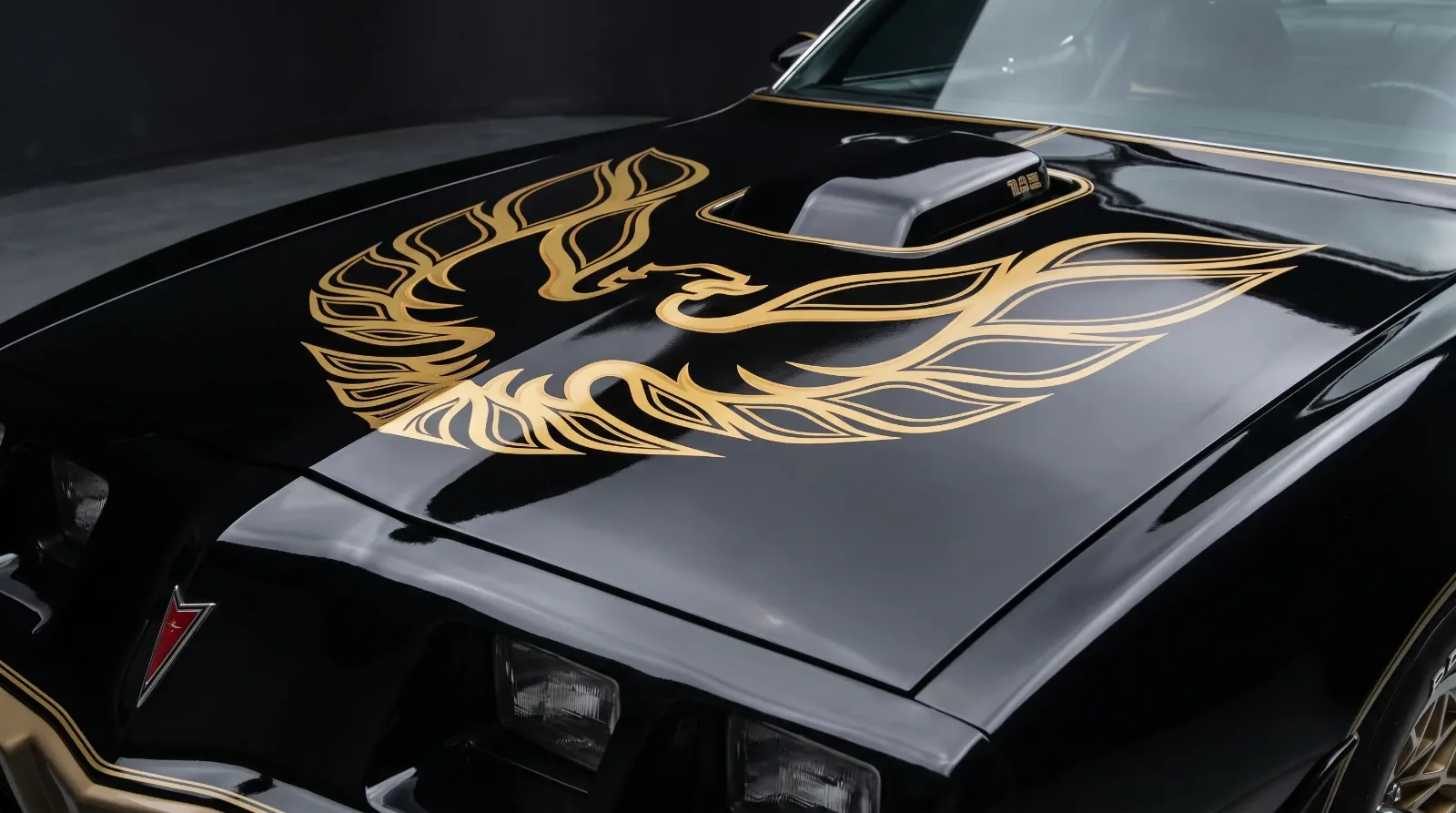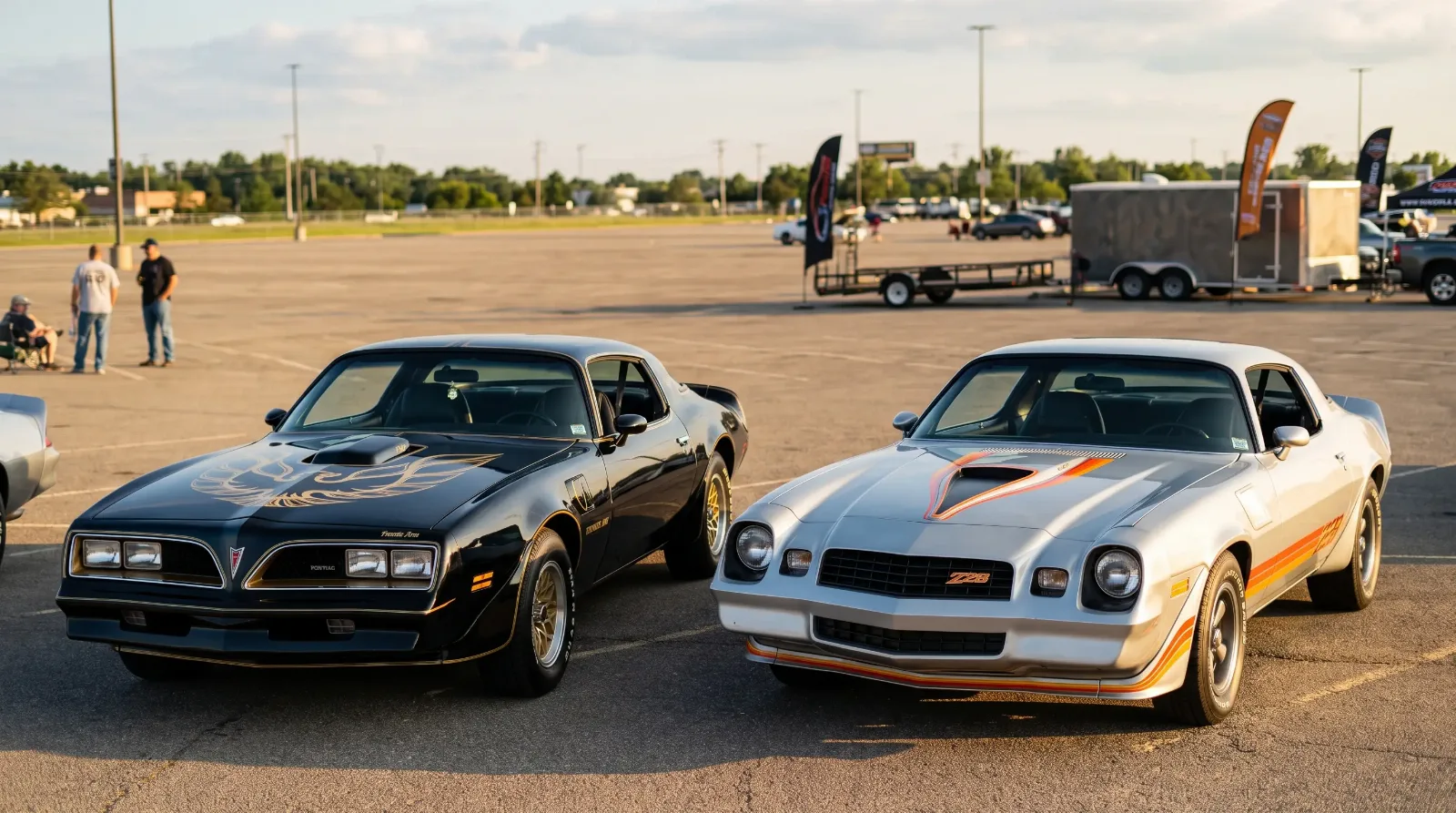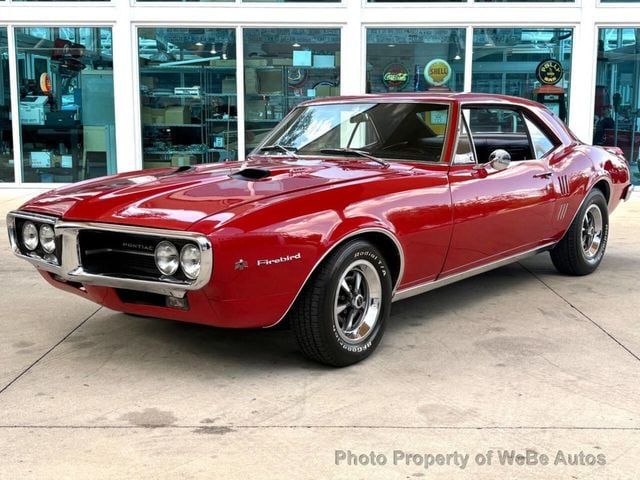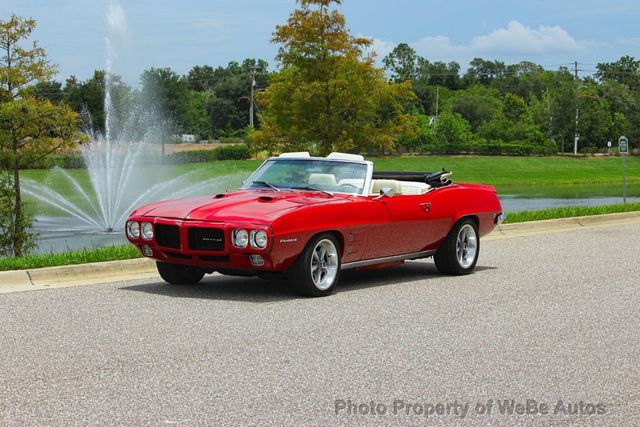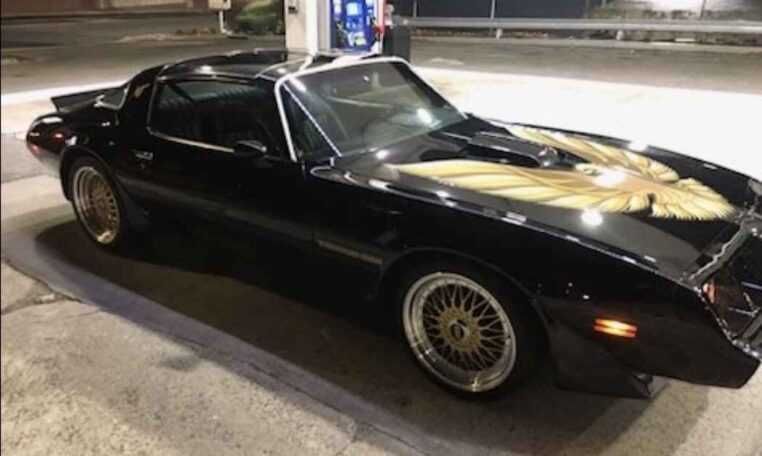
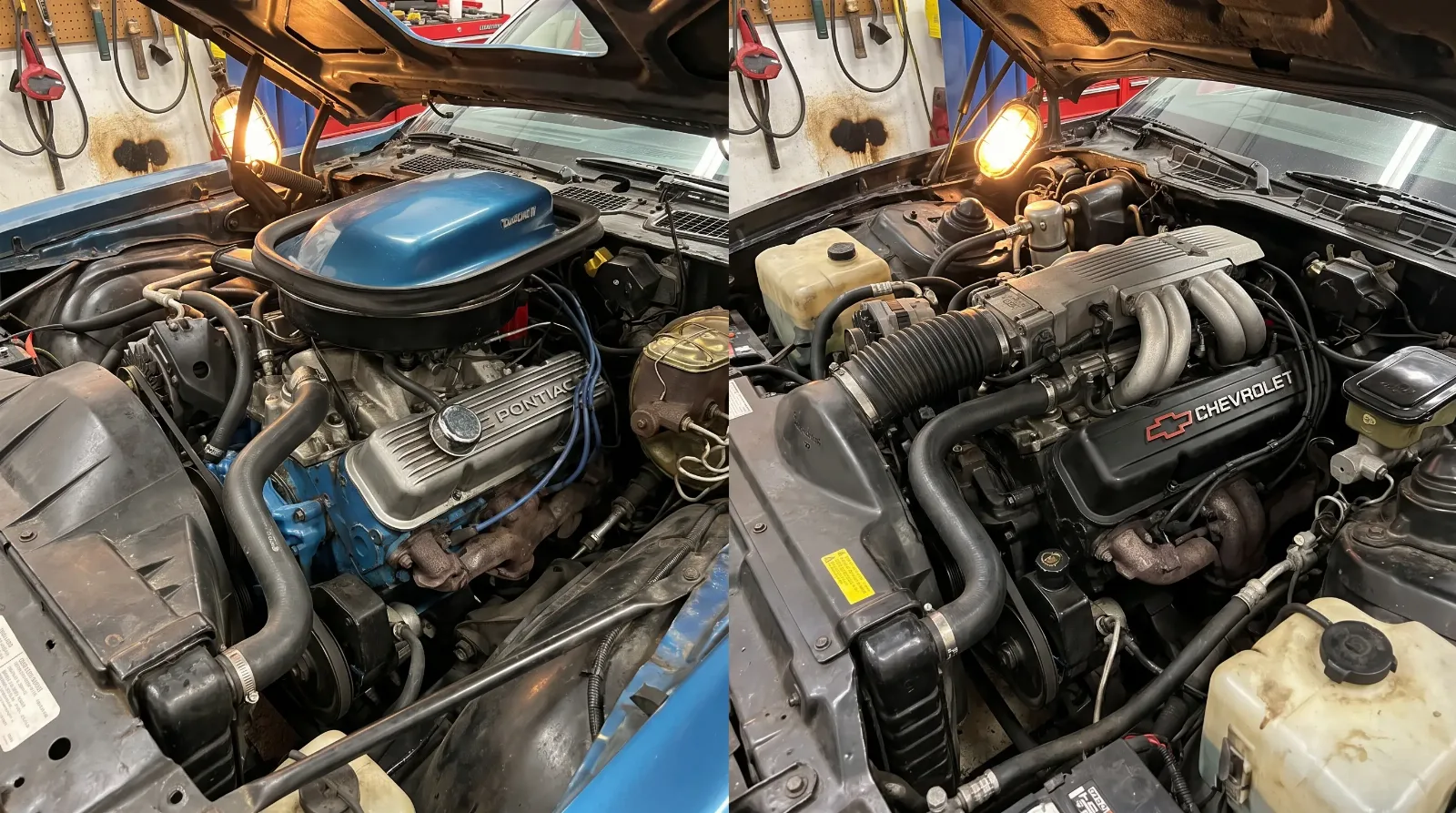
Here is the part of the firebird camaro engines story that surprises even people who grew up around these cars: for a big stretch of the Trans Am's history, there was no such thing as Pontiac power under that hood. The badge said Pontiac. The block said Chevrolet. Understanding how that happened, and when it stopped, is the real story behind the rivalry everyone assumes was purely a Pontiac-versus-Chevy fight.
When Pontiac Power actually meant Pontiac
Through the 1960s and most of the 1970s, Pontiac built its own V8 family, distinct from Chevrolet's small block, and the Firebird ran genuine Pontiac engines almost exclusively. The 326, 350, 400, and the enormous 455 were Pontiac castings, Pontiac heads, and Pontiac engineering, and the Trans Am's reputation was built entirely on that hardware. The 1973-1974 Super Duty 455, one of the last big-inch performance engines to survive the early emissions crackdown, was a Pontiac engineering department project through and through, rated at 310 net horsepower for 1973 and 290 net horsepower for the 1974 production version, figures that undersold how strong the engine actually felt for its era.
Camaro, across the same years, ran Chevrolet's own small block V8 family, the 302 in early Z28s and later the 350, engines that had their own distinct identity and their own loyal following. Through the 1970s, Firebird vs Camaro really was Pontiac engineering against Chevrolet engineering, two separate corporate teams building two separate answers to the same performance question.
1980-81: the last stand of the real Pontiac V8
The turbocharged 301 cubic inch V8, offered in the 1980 and 1981 Trans Am, was the final Pontiac-designed V8 to appear in the Firebird. Pontiac turned to turbocharging as a way to recover performance lost to tightening emissions rules without resorting to a larger displacement engine, and while the turbo 301 never fully overcame its era's reliability reputation, it mattered symbolically. It was the last time a Trans Am buyer got a V8 that Pontiac's own engineers designed from the ground up. After 1981, that changed permanently.
"People love arguing about whether Pontiac or Chevy built the better engine, and half the time in the eighties they were arguing about the exact same block with different valve covers. That is not a knock on either car, it is just what General Motors decided to do."
— Patrick Walsh
The 1980s consolidation nobody advertised
By the start of the third-generation Firebird in 1982, GM had moved decisively toward corporate engine sharing across divisions, a shift that had already caused public controversy earlier in the decade when buyers discovered Oldsmobiles and other GM cars were arriving with Chevrolet-built engines instead of the division's own. The Firebird was swept into that same strategy. The 305 cubic inch small block became the volume V8 choice, and by 1987 the 5.7-liter (350 cubic inch) Chevrolet-sourced small block with Tuned Port Injection powered the Trans Am GTA and Formula, the same fundamental architecture Chevrolet was putting in the Camaro IROC-Z.
This is the detail that tends to surprise people discovering firebird camaro engines history for the first time: for the entire GTA era, "Pontiac Power" on the fender badge sat over a Chevrolet-designed engine block. The distinction between the two cars' performance, by this point, came down almost entirely to tuning, exhaust routing, and accessory calibration rather than any fundamental difference in engineering.
| Era | Firebird V8 Source | Camaro V8 Source |
|---|---|---|
| 1967-1979 | Pontiac-designed (326/350/400/455) | Chevrolet-designed (302/350) |
| 1980-1981 | Pontiac turbocharged 301 (Trans Am) | Chevrolet 305/350 |
| 1982-1992 | Chevrolet-sourced 305/350 (shared architecture) | Chevrolet 305/350 (same architecture) |
| 1989 (20th Anniversary) | Turbocharged Buick-sourced 3.8L V6 | Not offered |
What the shared architecture meant for performance
None of this means the two cars drove identically, even with the same block underneath. Pontiac's engineers tuned the Firebird's induction, exhaust routing, and to some degree the final drive gearing differently across model years, and buyers who cross-shopped a GTA against an IROC-Z in the same showroom season could feel real differences in throttle response and how each car built power through the midrange. Those differences were real, they were measurable on a dyno, and they mattered to buyers making a decision. They just were not, by the late 1980s, differences rooted in two separate corporate engineering philosophies the way they had been a decade earlier. They were tuning differences layered on top of shared hardware, which is a genuinely different story than the one most casual fans assume when they hear "Pontiac power."
Where a real distinction survived
The one genuine departure from shared hardware came in 1989, when Pontiac fitted the 20th Anniversary Turbo Trans Am with a turbocharged and intercooled 3.8-liter V6 sourced from Buick's Grand National program rather than the expected small block V8. It was a striking choice precisely because it broke from the shared-engine pattern that had defined the rest of the decade, borrowing not from Chevrolet this time but from another GM division entirely, and it remains one of the more distinctive engine stories in the whole Trans Am lineage.
For everything else built between 1982 and 1992, the honest answer to which brand's engineering sat under the hood is: mostly Chevrolet's, regardless of what the Firebird's fender badge implied. That does not make the rivalry between these two cars any less real. It just means the rivalry, on the drivetrain side at least, was fought with mostly identical weapons. Readers following the full arc of Firebird vs Camaro should treat the engine bay as the place where the platform-sharing story runs deepest, and the next story in this set picks up exactly where this one leaves off.
It is also worth remembering why GM made this choice in the first place. Consolidating engine production across divisions cut costs and simplified emissions certification at a moment when both were getting harder to manage, and from a pure business standpoint it worked. The tradeoff was a piece of brand identity that Pontiac had spent decades building, and once the Firebird's V8 stopped being a genuinely Pontiac-engineered piece, some of that identity had to be carried by styling, marketing, and nameplate history instead of the hardware under the hood.
Sources and notes
- Pontiac Firebird (third generation) - Wikipedia
- 1973-1974 Pontiac Firebird and Trans Am Super Duty - Horsepower Memories
- Pontiac's 455 Super Duty: The Muscle Car Era's Final Powerhouse - CarBuzz
- Pontiac Firebird Trans Am 455 Super Duty specs - FastestLaps.com
- Chevrolet Camaro (second generation) - Wikipedia
- History of the 1989 Pontiac 20th Anniversary Turbo Trans Am - TurboTransAm.com