The Windsor small-block family: Ford's foundation engine
When Ford introduced the Mustang in April 1964, the car arrived with a range of engines that had little in common with the high-winding Ferraris or big-cube Chevys the press compared it to. What Ford brought to the table was something more pragmatic: a compact, lightweight small-block V8 that would define the Mustang's character through most of the 1960s. That engine was the Windsor, named for the Ontario plant where it was produced, and it spawned two displacements that collectors and historians still argue over today: the 289 and the 302.
Understanding the difference between these two engines, and why Ford made the switch from one to the other, is essential context for anyone tracking down an authentic early Mustang. The engines share a block family and enough external dimensions to look identical at a casual glance, but the internal geometry, the production dates, and the variant lineups tell a different story. For questions about the full engine lineup across the early Mustang years, the picture goes wider still, but the 289 and 302 deserve their own examination.
The 289: bore, stroke, and the variants that defined an era
The 289 cubic-inch V8 entered production in 1963 as a replacement for Ford's smaller 260 cubic-inch unit. Ford achieved the displacement increase by opening the bore to 4.00 inches while keeping the stroke at 2.87 inches. That short-stroke geometry was deliberate. It gave the engine a free-revving character better suited to higher rpm operation than a long-stroke torque motor, and it kept the reciprocating mass manageable for a relatively compact unit.
For Mustang purposes, the 289 launched with the car in 1964 and ran through 1968. Ford offered it in several configurations that covered a wide range of performance expectations:
- 2V (two-barrel carburetor): The base version, rated at 195 hp in its early 1963-64 form and bumped to 200 hp from 1965 onward. This was the volume seller, the workhorse spec for buyers who wanted a V8 without committing to a performance build.
- 4V (four-barrel carburetor): A step up in output, rated at 225 hp. The four-barrel breathed better at higher rpm and gave the engine a noticeably different character under hard acceleration.
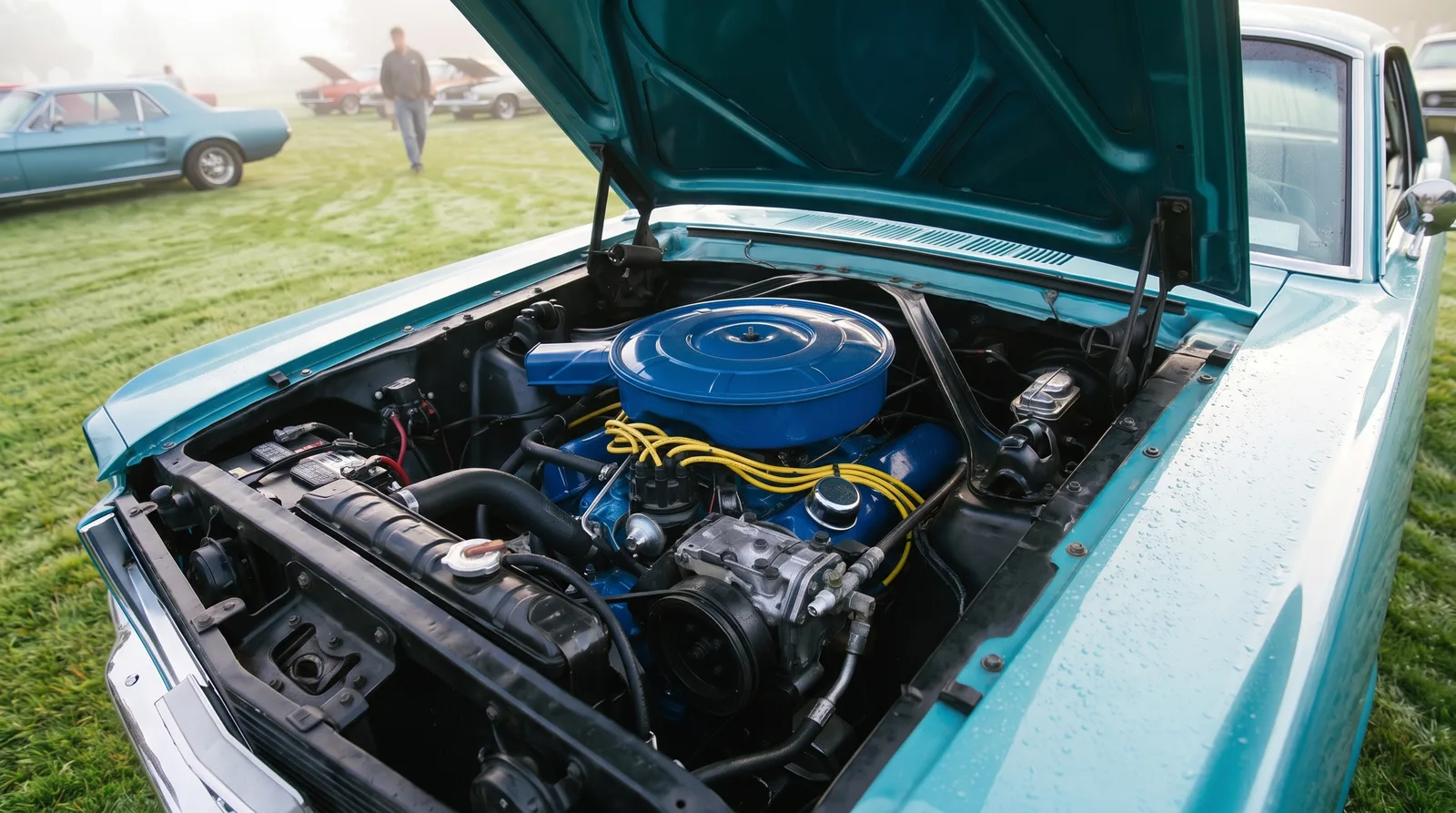
- K-code Hi-Performance (Hi-Po): The 289 in its most serious factory form. Rated at 271 hp at 6,000 rpm, the K-code engine used a solid lifter camshaft, a higher 10.5:1 compression ratio, larger valves, a cast aluminum high-rise intake manifold, and a 600 cfm Autolite four-barrel carburetor. The solid lifter setup required more precise maintenance but allowed the engine to pull cleanly to higher rpm than the hydraulic-lifter versions.
The K-code was not a stripped race engine, but it was a genuine performance unit by mid-1960s standards. Identifying one today relies on the engine code stamp, the solid lifter valley cover, and the correct date codes on components, since many have been modified or partially rebuilt over six decades. Ford produced the K-code in relatively limited numbers compared to the base 289, which makes correctly documented examples significant to collectors and restorers.
The 302: why Ford changed the stroke in 1968
By 1967 and into 1968, Ford faced a practical problem. The 289 was a capable engine, but it was approaching the limits of what the basic architecture could deliver within the rules governing production-based racing classes. The Trans-Am series, which Ford was pursuing seriously with the Mustang, had a 305 cubic-inch displacement ceiling. To maximize displacement within that ceiling while leaving some tolerance margin, Ford lengthened the stroke from 2.87 inches to 3.00 inches, keeping the 4.00-inch bore unchanged. The result was 302 cubic inches, just under the Trans-Am limit.
The 302 entered production for the 1968 model year and effectively replaced the 289 in the Mustang lineup. The base 302 carried a two-barrel carburetor and hydraulic lifters in its standard form, rated at 220 hp (SAE gross) with a 9.5:1 compression ratio. It was a competent street engine but not dramatically different in character from the 289 it replaced. The significance was what the extra cubic inches enabled in the performance variants, and what the architecture would support in future development. The 302 would go on to serve Ford well into the 1990s in various forms, while the 289 ended production with the 1968 model year.
"The stroke change from 289 to 302 is the kind of decision that looks obvious in hindsight, but at the time it was specifically about Trans-Am eligibility. Ford was racing, and the rulebook shaped the engine."
Tom Ramirez
For buyers of standard 1968 Mustangs, the transition from 289 to 302 was largely invisible. The engines fit the same bay, used similar accessories, and the difference in displacement was not something a daily driver would notice. But the engineering change had lasting consequences for the platform, and it positioned the Mustang engine lineup more coherently for the years ahead. If you want to understand how these engines fit into the broader picture of Mustang engine options, the 302's introduction in 1968 is the pivotal transition point.
The Boss 302: high-rev engineering for Trans-Am
If the standard 302 was evolutionary, the Boss 302 was a different animal built for a specific purpose. Ford introduced it for the 1969 model year to homologate the Mustang for Trans-Am competition, and the engine it carried shared little beyond its displacement with the regular 302.
The Boss 302 engine used cylinder heads borrowed from the 351 Cleveland program, then in development. These "canted valve" heads featured large ports with valves staggered in two planes to improve flow at high rpm, a significant departure from the Windsor's more conventional breathing. Combined with a solid lifter camshaft, revised intake manifold, and 10.5:1 compression, the Boss 302 was conservatively rated at 290 hp at 5,200 rpm, though period testing suggested the actual output was higher. The engine was built explicitly to operate at elevated rpm where the Cleveland heads came alive, and it was not particularly tractable at low speeds compared to the standard 302. How those heads set the 351 Cleveland apart from the 351 Windsor is explained in the story of the Windsor and Cleveland split.
Ford sold the Boss 302 in 1969 and 1970 only, pairing it with the Mustang fastback body and a close-ratio four-speed manual transmission as standard equipment. It is among the most sought-after small-block Mustangs today, valued not just for performance but for the specificity of its engineering: it was a racing development program wearing street clothes.
Telling them apart: years, codes, and what to look for
The 289 and 302 share enough external dimensions that identification requires more than a visual inspection. Here is what to check:
- Engine displacement stamp: The block casting date and displacement are stamped on the block, typically on a pad near the front of the engine on the passenger side. The casting number itself identifies the specific block design.
- Model year: The 289 was used in Mustangs from 1964 through 1968. The 302 replaced it beginning with the 1968 model year. For 1968, both engines appear depending on production sequence, so year alone does not settle the question.
- K-code identification (289 Hi-Po): The Vehicle Identification Number encodes the engine. A "K" in the fifth position (under the 1965-1968 numbering scheme) indicates the 271 hp Hi-Po. The solid lifter valvetrain, correct date-coded components, and undisturbed casting numbers matter most to serious authenticators.
- Boss 302 identification: The VIN carries a "G" engine code for the Boss 302. The Cleveland-derived heads are visually distinctive once you know what you are looking at, with the canted valve geometry visible at the port faces.
| Specification | 289 (standard) | 289 K-code Hi-Po | 302 (standard) | Boss 302 |
|---|---|---|---|---|
| Displacement | 289 cu in (4.7 L) | 289 cu in (4.7 L) | 302 cu in (4.9 L) | 302 cu in (4.9 L) |
| Bore x Stroke | 4.00 x 2.87 in | 4.00 x 2.87 in | 4.00 x 3.00 in | 4.00 x 3.00 in |
| Production years (Mustang) | 1964-1968 | 1965-1968 | 1968-1970 | 1969-1970 |
| Valvetrain | Hydraulic lifters | Solid lifters | Hydraulic lifters | Solid lifters |
| Rated output | 195-200 hp | 271 hp | 220 hp | 290 hp |
| Notable application | Base Mustang V8 | High-performance street/Cobra | Standard 1968+ Mustang V8 | Trans-Am homologation |
For most early Mustangs, the 289 or 302 engine is the heart of the car's identity. Understanding which version you have, and whether it is correct to the build documentation, shapes how the car is valued and how it should be restored. The Windsor family is durable and well-documented, and parts support across all variants remains strong compared to rarer Ford engine families. That accessibility, combined with the engineering interest of the variants from K-code to Boss, is why the small-block story stays relevant more than sixty years after the first 289 left the Windsor plant.
Sources and notes
Horsepower figures from this era are SAE gross ratings unless otherwise noted, measured without accessories or full exhaust, and they run higher than the SAE net figures Ford adopted from 1972 onward. Period factory ratings also varied slightly by model year and source document, so individual references may differ by a few horsepower. The specifications above reflect the most widely documented factory values for Mustang applications. This article is provided for general historical and educational reference; anyone authenticating or valuing a specific car should confirm engine codes, casting numbers, and date codes against the original build documentation.
- Ford small-block (Windsor) engine: Wikipedia: 289 and 302 displacement, bore and stroke, production years, and the standard 302 two-barrel rating of 220 hp SAE gross.
- Ford Boss 302 engine: Wikipedia: Boss 302 canted-valve cylinder heads derived from the 351 Cleveland program, 290 hp rating, 10.5:1 compression, and 1969-1970 production.
- Ford 289 V8 Engine Specs: EngineFacts.com: 289 two-barrel ratings (195 hp early, 200 hp later), 225 hp four-barrel, K-code 271 hp, and compression ratios by variant.
- ReKreating the Famed Ford 289 K-code V8: FordMuscle: K-code Hi-Po details including the 271 hp at 6,000 rpm rating, solid-lifter camshaft, 10.5:1 compression, and Autolite four-barrel carburetor.
- History of the Trans-Am Series: Wikipedia: the 5.0-liter / 305-cubic-inch displacement ceiling that motivated Ford to stroke the 289 into the 302.