The man who had to stop racing
Carroll Shelby was one of the most gifted sports car drivers America ever produced, yet it was a heart condition, not a lack of talent, that forced him out of the cockpit. In 1959 he drove an Aston Martin DBR1, powered by Aston's own straight six, to overall victory at Le Mans alongside Roy Salvadori, giving Aston Martin its first outright win at the 24 Hours. It was arguably the finest single performance of his driving career. Within two years, his doctors grounded him permanently.
What happened next defines the second, and arguably more consequential, half of his life. Shelby became a builder of cars, and the machine he created with a simple pairing of a small British roadster and a large American V8 rewrote what a sports car could be. The AC Cobra, born in 1962, was the proof of concept. It demonstrated that Shelby understood leverage, both mechanical and commercial, and it put his name on the map as a constructor. By 1964, Ford Motor Company was paying very close attention.
Ford, Iacocca, and a Mustang with a problem
Lee Iacocca launched the Ford Mustang in April 1964 to extraordinary public response. Nearly 22,000 cars sold on the first day. The Mustang was a cultural phenomenon. But Iacocca, who had shepherded the car from concept to showroom, also understood its limitation: as a sporty personal car, it was fine; as a genuine performance machine capable of competing in the Sports Car Club of America production class, it was not.
The SCCA's B-Production class had become a serious marketing arena. Winning races on weekends sold cars on weekdays, and Corvette dominated the conversation. Iacocca needed someone who could take the Mustang platform and transform it into something that could challenge on a race circuit while still carrying the production-car paperwork. He turned to Shelby.
The arrangement made sense for both parties. Ford supplied cars and engineering support. Shelby supplied his name, his facility, and his racing knowledge. The goal, as the contract framed it, was to produce a minimum number of production vehicles to satisfy SCCA homologation requirements, then build a dedicated racing variant from that base. The clock was tight. The 1965 racing season was approaching, and Shelby had a factory to set up.
Venice, California, and the first GT350s
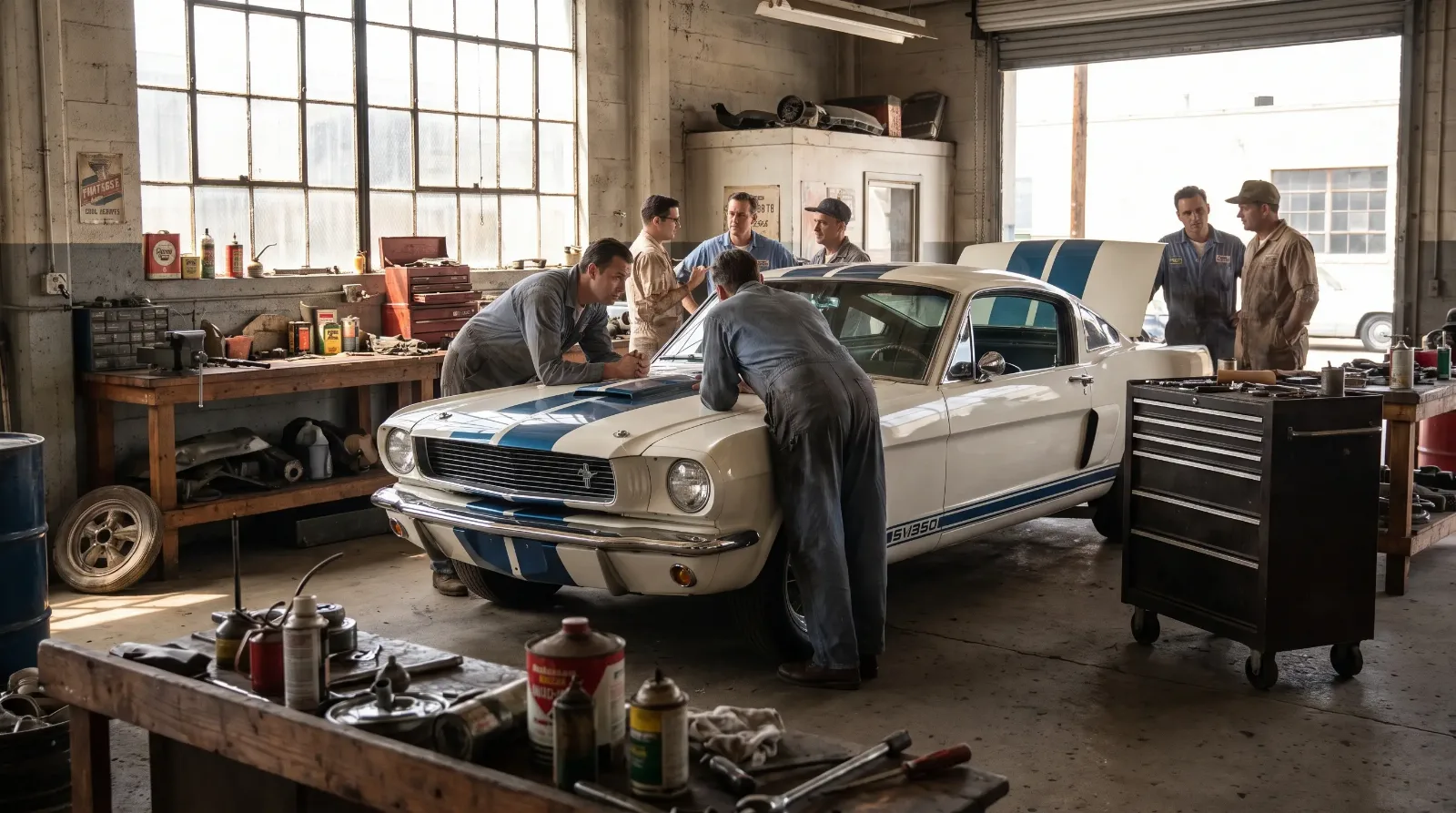
Shelby American had already established operations in Venice, California, adjacent to Los Angeles International Airport. The space was unglamorous, a converted airport hangar with a mix of mechanics, racing preparation specialists, and enough organized chaos to make a factory engineer nervous. It was exactly the kind of environment where someone like Shelby thrived.
Ford sent Shelby a run of 1965 fastback Mustangs equipped with the K-code 289 cubic inch High Performance V8. The K-code engine left the Ford factory rated at 271 horsepower, a genuine high-revving unit with solid lifters, a high-compression ratio, and an aluminum intake manifold fed by a single four-barrel carburetor. Shelby's team went further. They fitted a larger 715 CFM Holley carburetor, revised the intake manifold, added an aluminum high-rise, and reworked the exhaust headers. The result was an engine rated at 306 horsepower at 6,000 rpm, a meaningful gain over the stock K-code and one that transformed the car's character entirely.
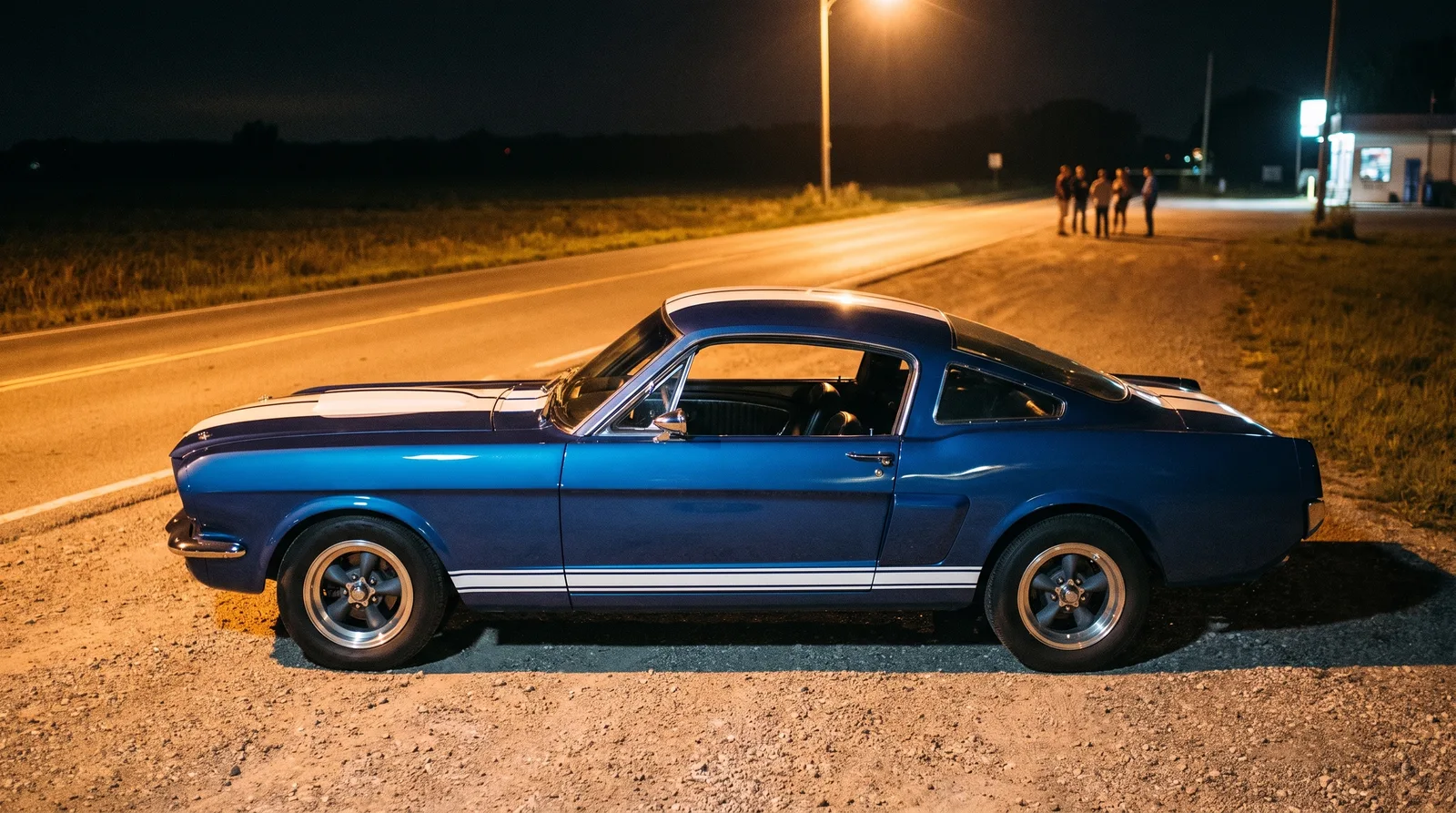
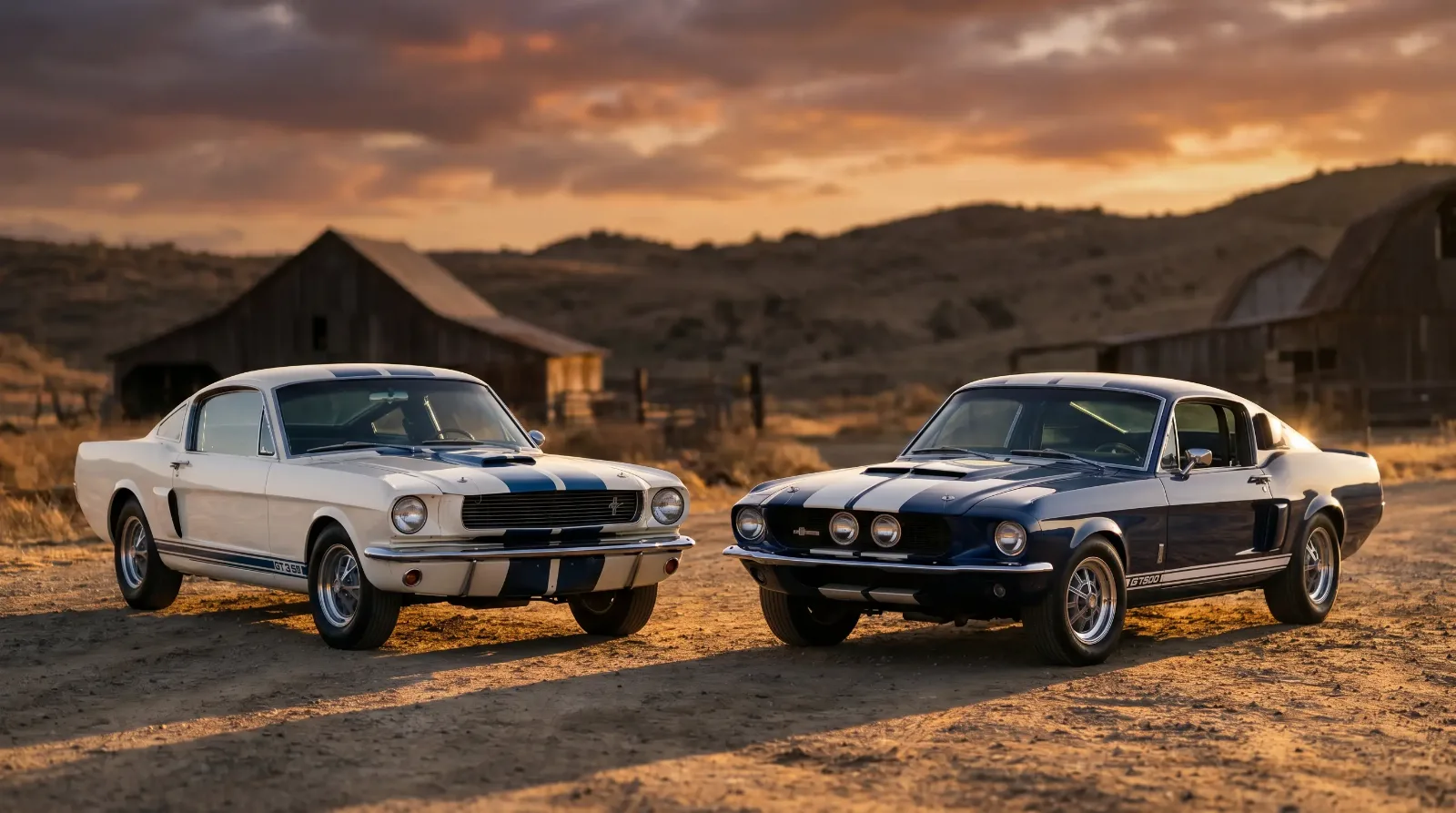
Every GT350 came from the factory in Wimbledon White, the only color available for the street car in the first model year. Broad blue rocker panel stripes ran the length of the car, and a matching blue over-the-top racing stripe was optional. The color combination was not accidental. It echoed the traditional American racing colors, white and blue, and tied the GT350 visually to the Cobra and to Shelby's racing heritage.
What made the GT350 different from a Mustang
The powertrain upgrade was only part of the story. Shelby's team systematically addressed the Mustang's handling shortcomings with a series of suspension modifications that turned a boulevard cruiser into a balanced sports car. The front suspension geometry was revised with a Monte Carlo bar added to the engine bay for additional rigidity. At the rear, the original leaf-spring axle was relocated using Koni shock absorbers and revised mounting points to reduce axle tramp under hard acceleration, a persistent weakness of the stock Mustang setup.
The front disc brakes, available on the base Mustang as an option, were standard on every GT350. Rear drum brakes remained, but the bias was tuned to match the car's intended use. Larger front brake calipers improved stopping power significantly over the stock setup.
The fiberglass hood was a functional piece, not a styling exercise. It was lighter than the steel original and featured an open scoop that fed air directly toward the engine. Side exhaust pipes routed through the rocker panels gave the car a sound unlike anything else on an American production line, a hard, mechanical bark at idle that deepened into a sustained roar under acceleration.
Every 1965 street GT350 left the shop with its rear seat deleted entirely. A spare tire occupied the area where the back cushion had been, making the car a strict two-seater. The rear seat delete was a homologation strategy: the SCCA classified cars partly by weight and by interior configuration, and removing the rear seat and replacing it with a competition-legal spare tire arrangement simplified matters for race teams building from production stock.
"What Shelby did in Venice was not hot-rod tuning. He took the engineering seriously, and the cars showed it. The GT350 drove like something that had been thought through, not just turned up."
Patrick Walsh
The street GT350 was the car most buyers encountered. But a harder, more focused version existed alongside it, and that was where the real racing happened. Learn more about how these cars evolved by reading about the Shelby Mustangs across all their generations and configurations.
The R-model: built to race
Alongside the street GT350, Shelby American produced the GT350R, a purpose-built competition car homologated for SCCA B-Production racing. The R-model stripped out everything not required for circuit work. Glass was replaced with Plexiglas where regulations allowed. The interior was bare aluminum and roll cage. A fiberglass front apron improved aerodynamics and reduced front-end lift. A larger fuel tank replaced the standard unit to allow for extended stints without a pit stop.
The engine in the R-model received more aggressive porting, different carburetion, and a higher-lift camshaft, pushing output to roughly 350 horsepower, well above the street car's figures. A close-ratio four-speed gearbox was standard, and the rear axle ratio was selected for the specific demands of each track. Koni shocks were tuned more firmly than on the street car, and the braking system was upgraded to handle lap after lap of hard use.
Total R-model production for 1965 was 34 cars, a small enough number that each was essentially a hand-built racing machine. They were sold to privateers and factory-supported teams who campaigned them across the country through 1965 and 1966. The R-model's record in SCCA competition was strong from the start, and it established the Shelby Mustang as a legitimate racing proposition rather than a street car that happened to look fast.
If the story of Carroll Shelby, Ford, and the GT350 has caught your attention and you are curious about what these cars look like on today's market, our listings of classic Mustangs include early Shelby-era fastbacks alongside the broader range of first-generation cars.
A legacy built in one model year
The 1965 GT350 did what it was designed to do. It won races, it earned press coverage, and it gave Ford's Mustang a performance credential that the factory could not have manufactured on its own. Total production for the 1965 model year came to 562 cars all told, of which roughly 526 were street GT350s, with the 34 R-models built separately as competition units. How the line developed from there is covered in a separate piece that sets the GT350 against the GT500.
Carroll Shelby had gone from Le Mans winner to heart patient to cobra-builder to official partner of the largest automaker in America, all within six years. The GT350 was the result of that trajectory: a car built by someone who knew what real performance felt like from behind the wheel, who had competed at the highest level, and who understood that the difference between a fast-looking car and a fast car was found in the suspension geometry, the carburetor size, and the willingness to strip out everything that did not serve the purpose. The Venice shop was not glamorous. The cars it produced were.
Sources and notes
Production and specification figures in this article have been cross-checked against the references below. Numbers for early Shelby Mustangs vary slightly between sources because of how prototypes, pre-production cars, and company vehicles are counted; figures are presented as the best-supported consensus and rounded where exact totals are disputed. This article is provided for general historical interest and is not a substitute for the SAAC Shelby American World Registry when verifying a specific car.
- Shelby Mustang: Wikipedia (306 bhp street rating, 715 CFM Holley, rear-seat delete, 562 total / 34 R-models)
- 1965 Shelby GT350: Ultimate Guide: Mustang Specs (306 hp, carburetor, production breakdown)
- 1965 Shelby GT350R: Ultimate Guide: Mustang Specs (R-model competition specification)
- 1965 Shelby Mustang GT350 R Competition: Conceptcarz (R-model output figures, ~350 hp)
- By the Numbers, 1965 Mustang GT350 (registry-based production tally, 562 total)
- 1965 GT350 Serial & VIN Numbers: TheShelbyCars.com (street vs. competition serial breakdown)
Updated October 6, 2026: Corrected the 1959 Le Mans details: the DBR1 used Aston Martin's own six, and the win was Aston Martin's first, not Britain's.