The car that made rivals blink first
In the spring of 1968, Ford and Shelby American were not just building cars. They were playing a name game at full throttle. As the story goes, word had reached Shelby's team that General Motors was preparing to attach "King of the Road" to a high-performance Chevrolet, most accounts pointing to a planned Corvette. The response was swift and characteristically American: get the name on a car first. Within weeks, the GT500KR was announced, and the "KR" suffix entered Mustang history as one of the most boldly claimed crowns in muscle-car lore.
The exact details have softened at the edges over the decades, and the tale carries a touch of legend, but it is widely repeated by Shelby historians and marque specialists: Shelby's camp learned the name was unclaimed, moved to secure it first, and left the rival without its intended crown. What is not disputed is the outcome. Shelby slapped those two letters on a new mid-cycle variant, put an honest engine under the hood to back up the claim, and shipped it to dealers for the 1968 model year. The market agreed with the title. The GT500KR became one of the most celebrated Shelby Mustangs ever made, and part of the Shelby Mustang legacy that collectors still chase today.
A new engine for a bolder claim
The GT500KR was not simply a rebadged GT500. The most important change sat beneath the hood. Ford's 428 Cobra Jet engine replaced the previous 428 Police Interceptor unit that had powered the standard GT500, and the difference mattered in real-world performance even if the factory ratings were deliberately modest.
Ford officially rated the 428 Cobra Jet at 335 horsepower. Most serious enthusiasts understood at the time, and testing confirmed, that the actual output was considerably higher. The conservative rating was a practical decision: insurance premiums were climbing steeply for high-horsepower cars, and keeping the number low kept the cars affordable to own. The engine featured a revised cylinder head design, a larger Holley carburetor, and improved breathing that put it in a different category from the unit it replaced.
The 428 Cobra Jet had already made a strong impression before the KR arrived. Ford built a small batch of lightweight 428 CJ Mustangs in late 1967 to satisfy NHRA Super Stock minimum-production rules, and the engine made headlines at the 1968 NHRA Winternationals in February. Regular retail ordering opened on April 1, 1968, still ahead of the KR, which entered production in May. The GT500KR brought that engine into the Shelby lineup formally, pairing it with the KR branding for a combination that was impossible to ignore on a drag strip or a boulevard.
Fastback and convertible, mid-year arrival
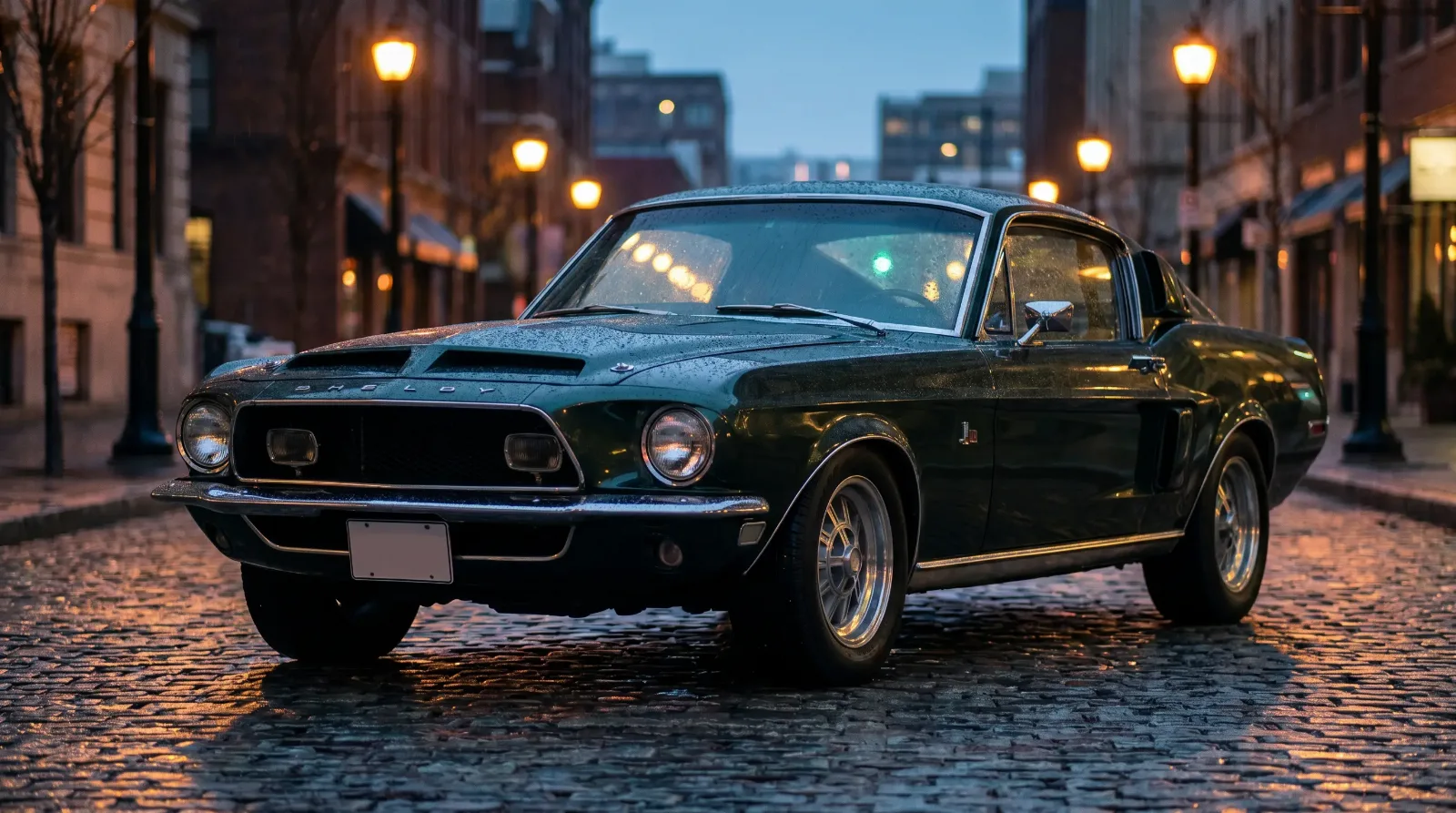
The GT500KR arrived mid-way through the 1968 model year rather than at the traditional fall introduction, which itself gave the car a sense of urgency and event. Shelby offered it in two body styles: the long-roof fastback, which became the signature KR silhouette, and the convertible, which brought open-air drama to the package.
Both wore the full Shelby treatment of the era: the restyled front end with driving lights integrated into the grille opening, the sequential rear turn signals, the side scoops, and the rollbar in the convertible. The interior followed the Shelby template with additional instrumentation and bucket seats. The visual package positioned the KR as something finished and purposeful rather than a simple mechanical update.
Production was compressed into the final months of the model year, roughly May through July of 1968. According to figures tracked by the Shelby American Automobile Club, 1,571 GT500KRs were built in total: 1,053 fastbacks and 518 convertibles. The convertible was produced in considerably smaller numbers than the fastback, making it the rarer find for collectors today. Both versions share the core mechanical identity, but condition, documentation, and body style are factors that move values sharply in the market for classic Shelby Mustangs.
Rarity and the collector market
Surviving GT500KRs occupy a specific position in the Shelby Mustang hierarchy. They are not the earliest Shelby Mustangs, which carry their own mystique from the GT350 era, and they are not the final year cars that close out the first Shelby chapter in 1970. The KR sits at a different intersection: a car built around a name race, powered by one of the strongest production V8s of the era, and produced in limited numbers during a compressed window. The story of where the GT350 began, and Carroll Shelby's part in it, is told separately.
The convertible variant in particular draws consistent attention at auction and in private sales. Numbers were small enough that finding a documented, numbers-matching example takes patience and carries a premium. The fastbacks appear more frequently, but KRs in any configuration with original drivetrains and matching documentation are in demand in a way that has not softened over the years.
Originality is the central issue, as it is with most desirable Mustangs of this period. The Marti Report, a production record service derived from Ford's original build data, is considered essential documentation for any serious KR transaction. Engine stampings and VIN decoding are standard verification steps before any significant purchase changes hands.
"The KR story is really about what happens when a brand plants its flag in a hurry and then has to live up to the name, and in this case, the car genuinely delivered."
Patrick Walsh
Why the name stuck
The "King of the Road" title could have been hollow. A badge applied in haste to a warmed-over variant with a new sticker would not have survived forty years of scrutiny from a community of collectors who know their production codes, their casting dates, and their horsepower figures. The GT500KR survived because the substance matched the story.
The 428 Cobra Jet was a genuine upgrade. The limited production run created real scarcity. The mid-year timing gave the car a sense of moment rather than routine. And the visual identity, refined through the Shelby conversion process, made it one of the better-looking performance Mustangs of the late 1960s. For a car whose name was partly born from competitive anxiety, it turned out to have earned the crown.
The 1968 GT500KR sits in a chapter of American performance history where the pace of development was relentless, the competition between manufacturers was genuine, and the cars that came out of that period still define the standard against which everything since is measured.
Sources and notes
This article has been fact-checked against the sources below. Production figures follow data tracked by the Shelby American Automobile Club, the recognized authority on Shelby Mustang build records. The "King of the Road" origin story is well documented but retains an element of period legend; it is presented here as the account most commonly cited by marque historians rather than as a fully documented corporate record. Horsepower figures reflect the manufacturer's gross ratings of the era, which were widely understood to be conservative.
- Hagerty: The GT500 KR "King of the Road" was the Shelby for the street and strip
- Classic & Sports Car: Shelby GT500 KR: hail to the king
- The Mustang 428 Cobra Jet Registry: The Introduction of the 428 Cobra Jet
- The Mustang 428 Cobra Jet Registry, 428 CJ Mustangs at the 1968 NHRA Winternationals
- Revology Cars: Why the 1968 Shelby GT500KR Was Called "King of the Road"
- The Coral Snake, 1968 Shelby Production Figures (SAAC data)