One platform, two divisions, one deadline
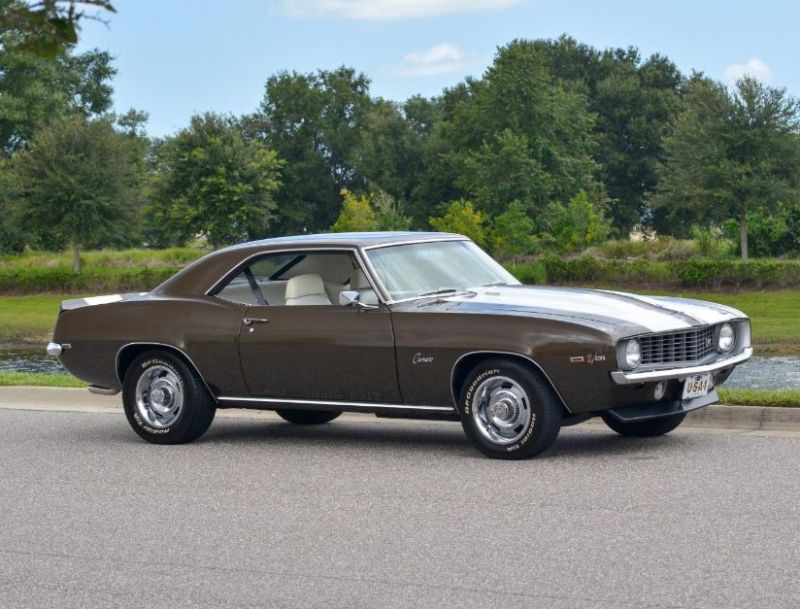
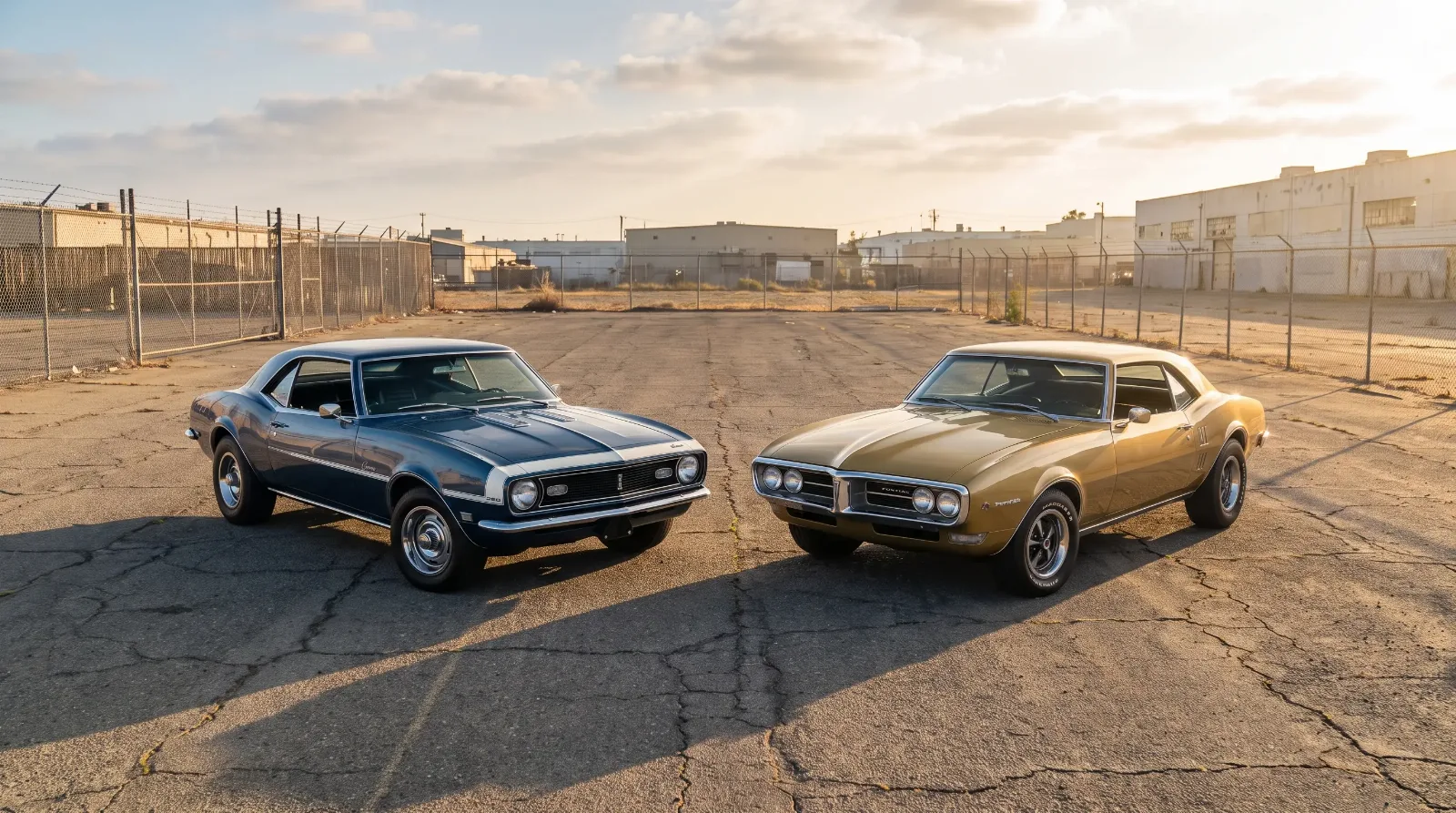
When General Motors approved the F-body program in 1964, the plan was always to give Pontiac a version alongside Chevrolet's Camaro. Pontiac had been pushing for its own pony car since the Mustang's debut, and the political reality inside GM -- where divisional loyalty ran deep -- demanded that Pontiac get something it could call its own. The compromise was the shared F-body unibody platform with distinct body panels, separate engine calibrations, and enough styling differentiation to let each division claim a unique product.
The Firebird arrived five months after the Camaro, on February 23, 1967, for the same 1967 model year. Both cars rode a 108-inch wheelbase. Both used essentially the same front subframe with upper and lower A-arm front suspension, the same rear leaf-spring arrangement, and the same basic firewall and floor structure from Fisher Body. What differed was the sheet metal from the A-pillars forward and the trim, interior design, and engine calibrations that each division specified.
What the F-body actually consisted of
The term "F-body" refers to GM's internal body-style classification system, not a specific engineering document. Technically, the platform combined a front subframe bolted to a unibody structure -- a construction method that differed from the Chevy II/Nova's fully unitized approach by providing the front clip as a semi-isolated cradle. This subframe design helped isolate engine and steering vibration from the passenger compartment, and made it easier to swap engines during production since the front clip could accept different engine mounts without modifying the main body structure.
Front suspension was a double-wishbone (A-arm) setup with coil springs and an anti-roll bar. The geometry was derived from the Chevy II but modified for shorter control arm lengths to package within the Camaro's narrower front track. Rear suspension was a conventional four-link with leaf springs -- proven, cost-effective, and capable of handling the torque loads from large-displacement V8s without exotic engineering.
Steering was recirculating ball, available in manual and power-assisted configurations. The standard manual box used a 24:1 gear ratio, and Chevrolet also offered a faster-ratio manual steering box as an option for buyers who wanted quicker response. Front disc brakes became available in 1967 as a factory option (required on the Z/28) and remained optional through 1969, while rear drums were standard throughout the generation.
"The F-body's front subframe was actually more sophisticated than people give it credit for. You could pull the entire front clip as a unit, swap engine mounts, and drop in a different V8 -- which is exactly what the COPO and ZL1 programs exploited for the 1969 model year."
-- Tom Ramirez
How the Camaro and Firebird diverged on the same bones
Despite the shared platform, driving a first-gen Camaro and a first-gen Firebird back to back reveals real differences in character. Pontiac tuned its suspension for a slightly softer initial response and specified different shock absorber valving. Chevrolet's SS and Z/28 packages went the opposite direction -- stiffer springs, firmer shocks, and front disc brakes as a condition of the performance packages.
Engine choices diverged significantly because each division sourced its own powertrains. The Camaro got Chevrolet's small-block 327 and 350 V8s and the big-block 396. The Firebird got Pontiac's own 326, 350, 400, and -- in the HO and Ram Air versions -- high-output 400-cubic-inch V8s that were entirely Pontiac-engineered. The Firebird 400 H.O. with Ram Air induction, factory-rated at 325 horsepower, carried a very different character from the Camaro SS396; same platform, entirely different powertrain philosophy.
Why the shared platform mattered for production efficiency
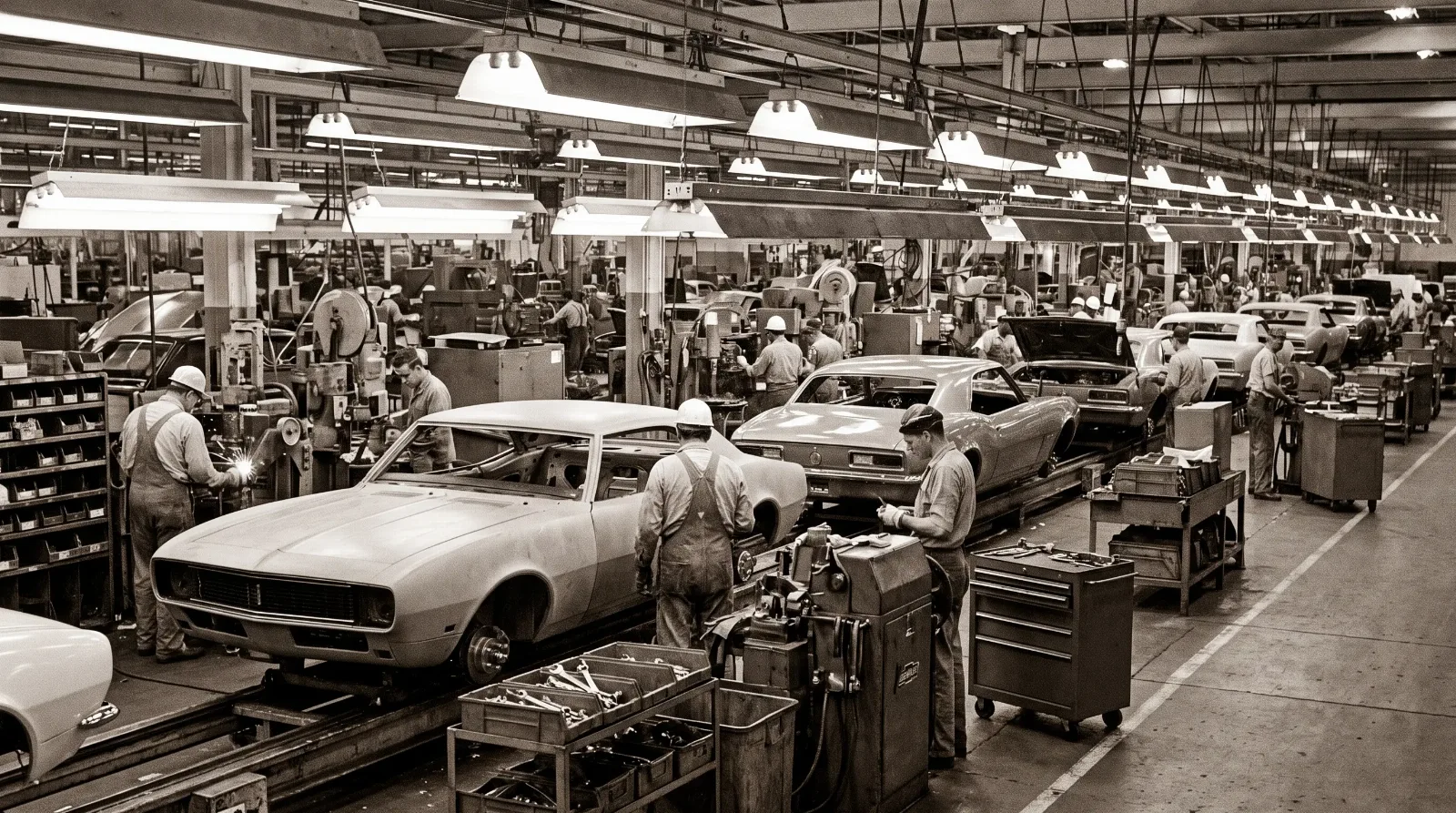
From a manufacturing standpoint, the shared F-body platform let GM consolidate tooling costs for the unibody structure across two divisions. Fisher Body built the body shells at its plants, and the same basic jigs and tooling -- modified for the different front clip sheet metal -- served both the Camaro and Firebird. This shared investment helped justify the program's economics at a time when GM was committing to aggressive new model launches across multiple divisions simultaneously.
The Norwood, Ohio assembly plant built Camaros exclusively from the start. Van Nuys, California built both Camaros and, after 1967, was retooled periodically to handle production changes. Pontiac's assembly at its Pontiac, Michigan plant handled Firebirds. The separation of final assembly meant that while the platforms were shared, the completed cars never ran down the same line -- each division maintained its production independence at the final stage.
The F-body through the lens of parts compatibility
For restorers, the shared F-body platform creates some useful parts compatibility between Camaro and Firebird. Front subframe dimensions, many suspension components, and firewall geometry are interchangeable across the two nameplates. This is both a convenience and a complication: a 1969 Camaro restoration using Firebird suspension parts might be functionally correct but incorrect for concours judging. Documentation of parts provenance has become increasingly important as the collector market has matured.
The next article in this series goes deeper into the assembly plants themselves: where the first-gen Camaros were built -- Norwood versus Van Nuys -- and what the plant codes on your VIN actually mean. If you are also exploring the full history of this generation, the first-generation Camaro editorial on Classic Cars Arena is a solid starting point.
Sources and notes
Production figures, engine specifications, codes, and dates in this article are cross-referenced from established Camaro references, period documentation, and owner registries. Where sources differ, the most commonly cited value is used. Cost figures are indicative and vary by supplier, region, and condition.