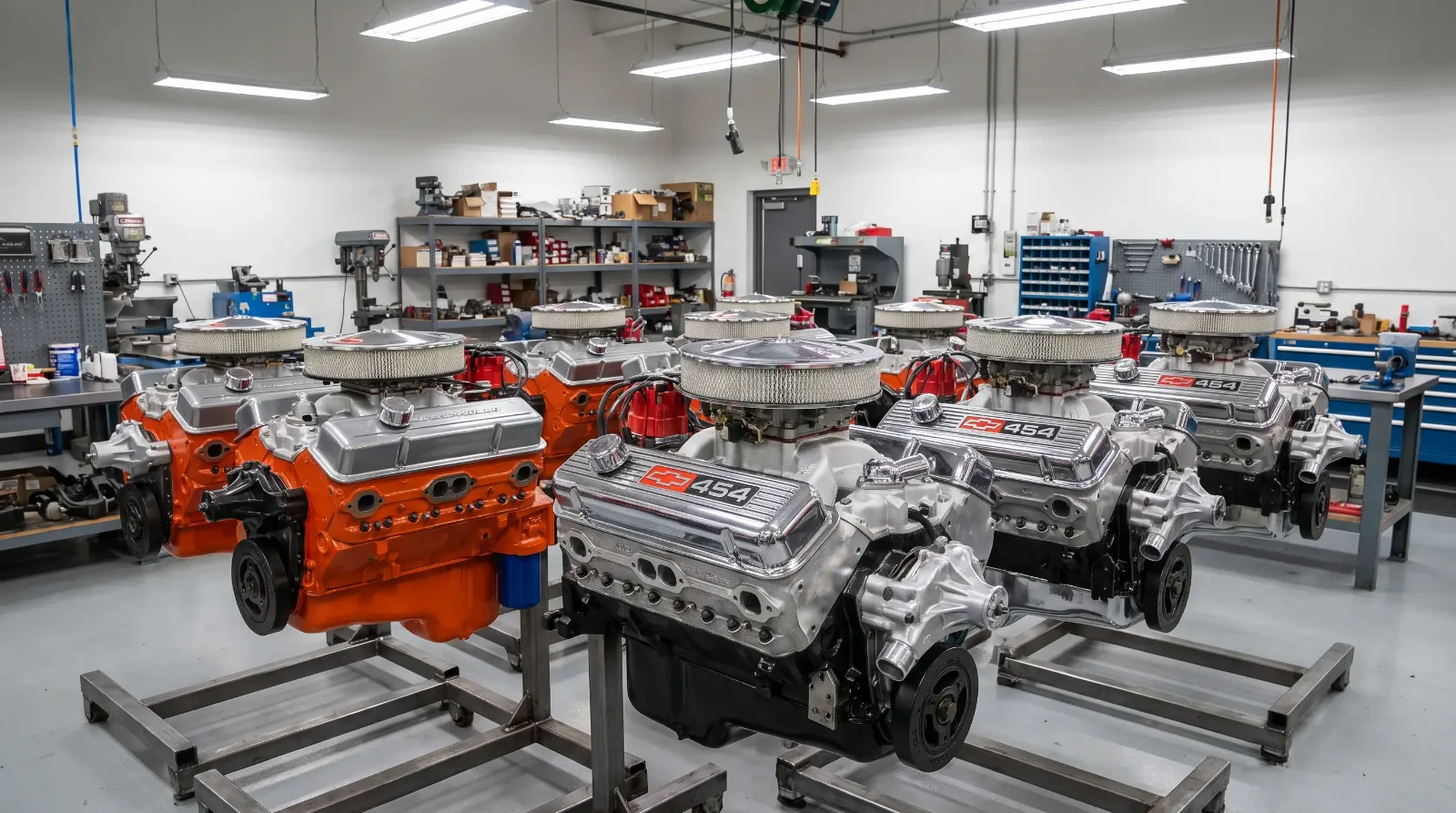
The engine that changed everything
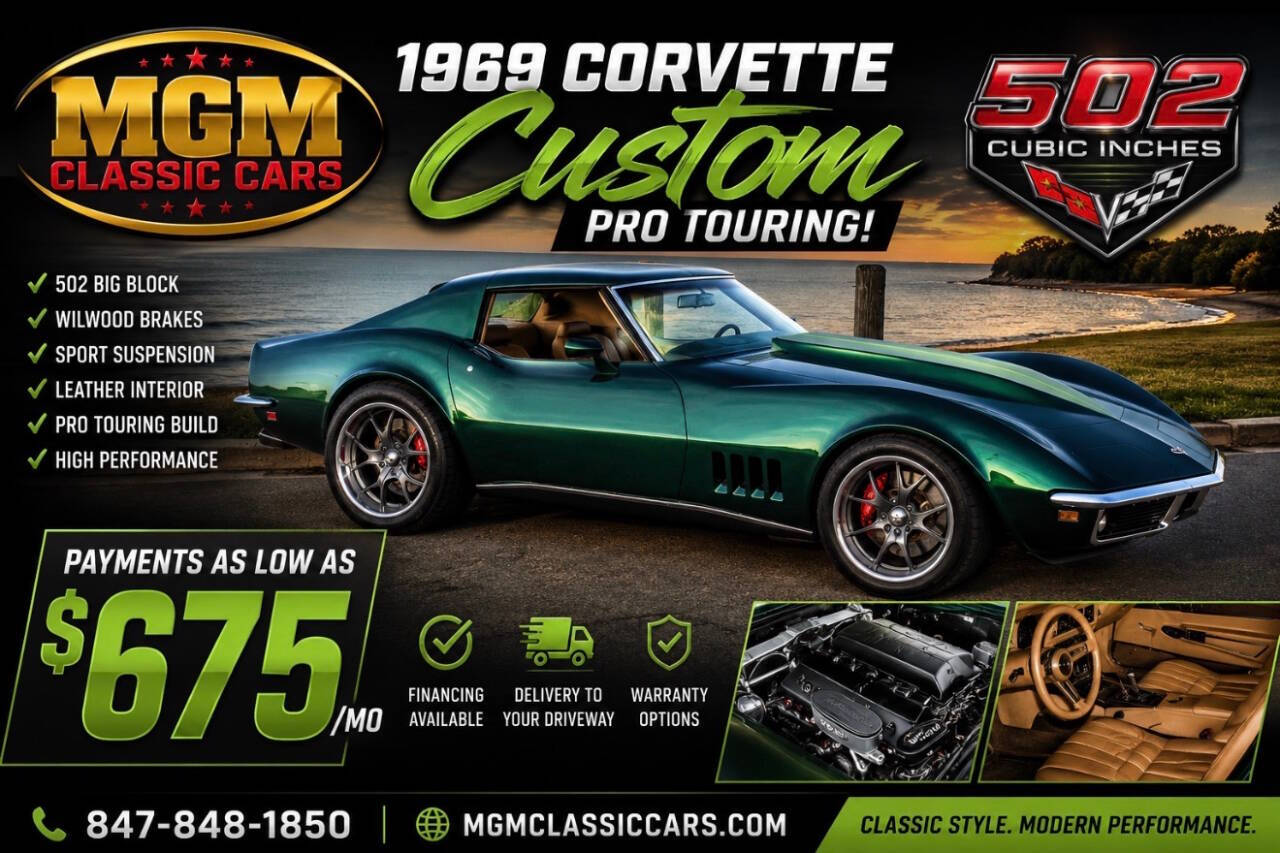
Chevrolet introduced the big-block Corvette in 1965, and it immediately made every previous sports car Chevrolet had built look like a warm-up act. The 396 cubic-inch Mark IV engine arrived mid-year, rated at 425 horsepower, dropped into a chassis that had been carrying small-blocks since 1953. The fit was not subtle. The hood required a functional bulge to clear the air cleaner. That bulge became the visual signature of one of the most consequential ten-year runs in American automotive history.
What followed from 1965 through 1974 was a sustained engineering effort to extract the maximum from what the factory could legally sell, followed by an equally abrupt retreat once federal emissions and insurance pressures made that effort untenable. The Chevrolet Corvette big-block era produced the most powerful production Corvettes ever built, some of the rarest factory configurations in American muscle car history, and a collectibility hierarchy that the market has been sorting out ever since. This is the history of those engines, those years, and why they matter.
The 396 and the Mark IV architecture (1965–1966)
The Mark IV big-block was not a bored-out small-block. Chevrolet engineered it as a purpose-built large-displacement architecture, with a wider bore spacing and a different deck height than the small-block family. The 396 that arrived in the 1965 Corvette mid-year was rated at 425 horsepower with solid lifters, a high-compression ratio, and a Holley four-barrel carburetor. It was not a street engine dressed up for the brochure. It was a racing engine with a license plate.
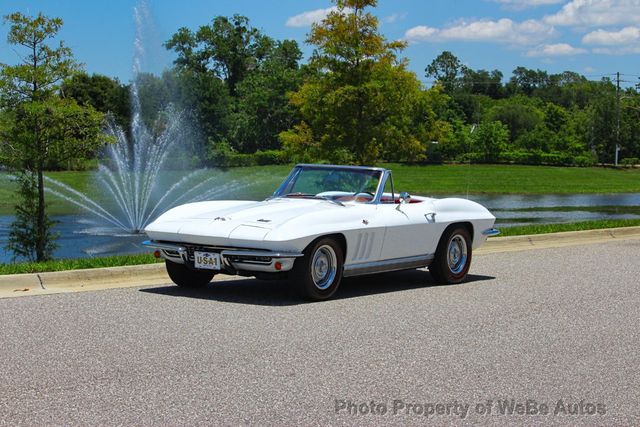
For 1966, the 396 grew to 427 cubic inches through a longer stroke, and Chevrolet offered it in three states of tune. The base L36 produced 390 horsepower with hydraulic lifters, a relatively tractable setup for daily use. The L72 pushed the rating to 425 horsepower with a solid-lifter camshaft, larger carburetor, and more aggressive tuning. Both shared the same external dimensions, which meant the hood bulge stayed regardless of which engine was under it. Buyers who wanted the 427 emblem on the hood had to specify it; the car did not advertise its contents otherwise.
| Year | Engine code | Displacement | Rated horsepower | Carburetion | Lifters |
|---|---|---|---|---|---|
| 1965 (mid-year) | L78 | 396 cu in | 425 hp | Holley 4-bbl | Solid |
| 1966 | L36 | 427 cu in | 390 hp | Holley 4-bbl | Hydraulic |
| 1966 | L72 | 427 cu in | 425 hp | Holley 4-bbl | Solid |
| 1967 | L36 | 427 cu in | 390 hp | Holley 4-bbl | Hydraulic |
| 1967 | L68 | 427 cu in | 400 hp | 3x2-bbl | Hydraulic |
| 1967 | L71 | 427 cu in | 435 hp | 3x2-bbl | Solid |
| 1967 | L88 | 427 cu in | 430 hp* | Holley 4-bbl | Solid |
| 1969 | ZL1 | 427 cu in | 430 hp* | Holley 4-bbl | Solid |
| 1970 | LS5 | 454 cu in | 390 hp | Holley 4-bbl | Hydraulic |
| 1970–71 | LS6 | 454 cu in | 450 hp (1971: 425 hp) | Holley 4-bbl | Solid |
*Factory-listed figures for L88 and ZL1 were widely understood to be conservative. Both engines were built around racing specifications and produced substantially more power under real conditions.
The 427 variants and the L88 question (1967–1969)
Nineteen sixty-seven was the year Chevrolet's big-block lineup reached its most complicated expression. The 427 was available in four distinct configurations, ranging from the practical L36 at 390 horsepower to the barely-street-legal L88 at a factory-listed 430 horsepower. The middle ground included the L68, which used three two-barrel carburetors on an aluminum intake manifold and was rated at 400 horsepower, and the L71, which combined the same tri-power setup with a solid-lifter camshaft for 435 horsepower. The L71 is the one that most buyers wanted. The L88 is the one most serious collectors want now.
The L88 deserves its own discussion. Chevrolet did not want to sell it to street buyers. The engine required 103-octane racing fuel to run correctly, had a 12.5:1 compression ratio, and came with a cold-air induction system that drew outside air rather than hot underhood air. To discourage civilian buyers, Chevrolet deleted the heater and defroster as standard equipment on L88-equipped cars and listed the horsepower rating at 430, below the L71's 435. The strategy worked imperfectly. Some buyers figured out what the L88 actually was and ordered it anyway. Production numbers for the 1967 L88 are documented at 20 units. For 1968 and 1969 combined, production reached roughly 196 more examples before the option was discontinued.
The tank sticker on an L88 car tells the story clearly. The RPO code L88 on the original build documentation is the starting point for any authentication discussion. What follows from there is NCRS documentation, the casting numbers on the block and heads, and the presence of the original cold-air induction components. This is the kind of car where the paper trail matters as much as the hardware. As part of the broader history of Corvette special editions, the L88 sits near the top of any list of factory configurations that were genuinely racing equipment with nominal road certification.
"The L88 factory listing at 430 horsepower was not an accident. Chevrolet's people knew exactly what they had. The lower number was a deliberate attempt to keep the wrong buyers away from an engine that needed race fuel and a driver who understood what they were doing. Some of those wrong buyers ordered it anyway. The twenty-unit 1967 production figure reflects how well the strategy worked that first year."
— Tom Ramirez
The 454 and the peak of factory power (1970–1971)
For 1970, the 427 gave way to the 454 cubic-inch LS-series engines. The displacement increase came through a longer stroke on the existing Mark IV architecture. Chevrolet offered the LS5 at 390 horsepower as the base big-block and introduced the LS6 as the top option, rated at 450 horsepower. The LS6 used an 11.25:1 compression ratio, solid lifters, a Holley four-barrel carburetor on an aluminum intake, and rectangular-port cylinder heads that Chevrolet had developed from racing experience. It was the most powerful engine Chevrolet would ever install in a production Corvette under the gross horsepower measurement system.
The 1970 model year is complicated by production realities. A UAW strike in the fall of 1969 pushed the start of 1970 production back significantly, resulting in a shortened model year with total production of 17,316 units, the lowest since 1962. The LS6 in its 1970 form is consequently rare, with production figures in the range of around 25 examples, though documentation on this point has been the subject of ongoing research within the Corvette community. The 1971 LS6 reached approximately 188 units, with the rating adjusted to 425 horsepower under the same gross measurement system following slight compression and tuning changes.
The horsepower crash: 1972 onward
Nineteen seventy-two began the period that Corvette historians describe with varying degrees of frustration. Federal emissions regulations, rising insurance rates tied to high-horsepower ratings, and the industry's shift toward low-lead fuel compatibility combined to drive compression ratios down and power outputs with them. Chevrolet compressed its big-block lineup, dropped the LS6 after 1971, and continued with the LS5 in progressively detuned form through 1974, when the big-block Corvette option was discontinued entirely.
The net horsepower figures from this period require context to interpret correctly. The 1972 LS5 at 270 net horsepower was not dramatically less powerful than the 1971 LS5 at 365 gross horsepower. Net measurement accounts for real-world losses that gross measurement ignored. The actual performance difference was real but smaller than the numbers suggested. What was genuinely declining was compression ratio, which fell from 10.25:1 in 1971 to 8.5:1 by 1974, and with it the engine's ability to convert fuel into mechanical work efficiently. By 1974, the LS4 454 produced 270 net horsepower on paper and felt it. The car that had once been capable of factory-documented quarter-mile times in the 13-second range now ran comfortably in the 15s.
The big-block option disappeared after 1974. Chevrolet's engineering resources were moving toward the L82 small-block and eventually the overhead-cam architectures that would define later Corvette generations. The 454's exit was quiet, without ceremony. The cars that carried it in its peak years had already been sold and were beginning the long process of either being driven into the ground or recognized as something worth preserving.
Collectibility and what the market actually values
The big-block Corvette collectibility hierarchy follows the production numbers with reasonable consistency. Lowest production equals highest value, with condition, documentation, and originality as the secondary variables. The 1967 L88 sits at the apex, followed by the 1968 and 1969 L88 variants, the 1969 ZL1 (two known Corvette examples), and the 1970-71 LS6 cars. Below those extreme examples, the 1967 L71 with its tri-power setup is the most desirable of the broadly available big-block configurations, followed by any numbers-matching L72 from 1966 or 1967.
The LS5 cars from 1970 through 1974 occupy a different market position. They are correct big-block Corvettes with proper hood bulges and period-correct presence, but without the documentation story or rarity of the performance variants. A solid driver-quality 1971 LS5 can be found in the $45,000-$65,000 range depending on condition and color. A documented numbers-matching 1971 LS6 is a substantially different transaction, with recent auction results placing strong examples above $150,000. The gap reflects not just horsepower but the entire documentation and authentication process that comes with a car that was rare when new and has been extensively studied since.
For anyone seriously considering a big-block Corvette purchase, the NCRS documentation process is worth understanding before the buying conversation starts. The registry has seen enough restamped blocks and swapped components to have developed detailed authentication protocols. A car that passes NCRS scrutiny carries that verification forward to every subsequent owner. A car that has not been through that process, regardless of what the seller says about it, requires independent verification before a premium is justified. If you're searching for a big-block Corvette for sale, that documentation question is the first one to ask, not the last.
Sources and notes
- Antonick, Michael. Corvette Black Book 1953–2024. Michael Bruce Associates, 2024. Primary source for production figures, option codes, and year-by-year specifications.
- National Corvette Restorers Society (NCRS). Technical Information Manual. NCRS, multiple editions. Authentication standards, casting number references, and documentation protocols.
- Hendricks, Randy. "L88 Production Documentation." Corvette Fever, June 2019. Detailed analysis of surviving build records for the 1967-1969 L88 option.
- Falconer, Ryan and Miles Cook. Corvette: America's Sports Car. MBI Publishing, 2003. Contextual history of the C2/C3 era engineering decisions.
- Cheetah, Steve. "Net vs. Gross: Understanding the 1972 Power Rating Transition." Corvette Action Center, 2021. Explanation of the SAE measurement change and its effect on published specifications.
- Bloomington Gold Certification Standards. Bloomington Gold, 2023 edition. Current authentication criteria for Gold certification on big-block Corvette variants.