The 427 Corvette at the strip
By 1965, Chevrolet had given the Corvette something that changed its relationship with drag strips permanently: a 427 cubic inch big-block V8. The small-block cars had been quick, but the 427 was a different animal. At strips from Pomona to Englishtown, Corvette owners were running times that put purpose-built drag cars on notice. This was still a production sports car. It came with a heater and a radio. And it could run mid-12-second quarter miles with the right driver and options.
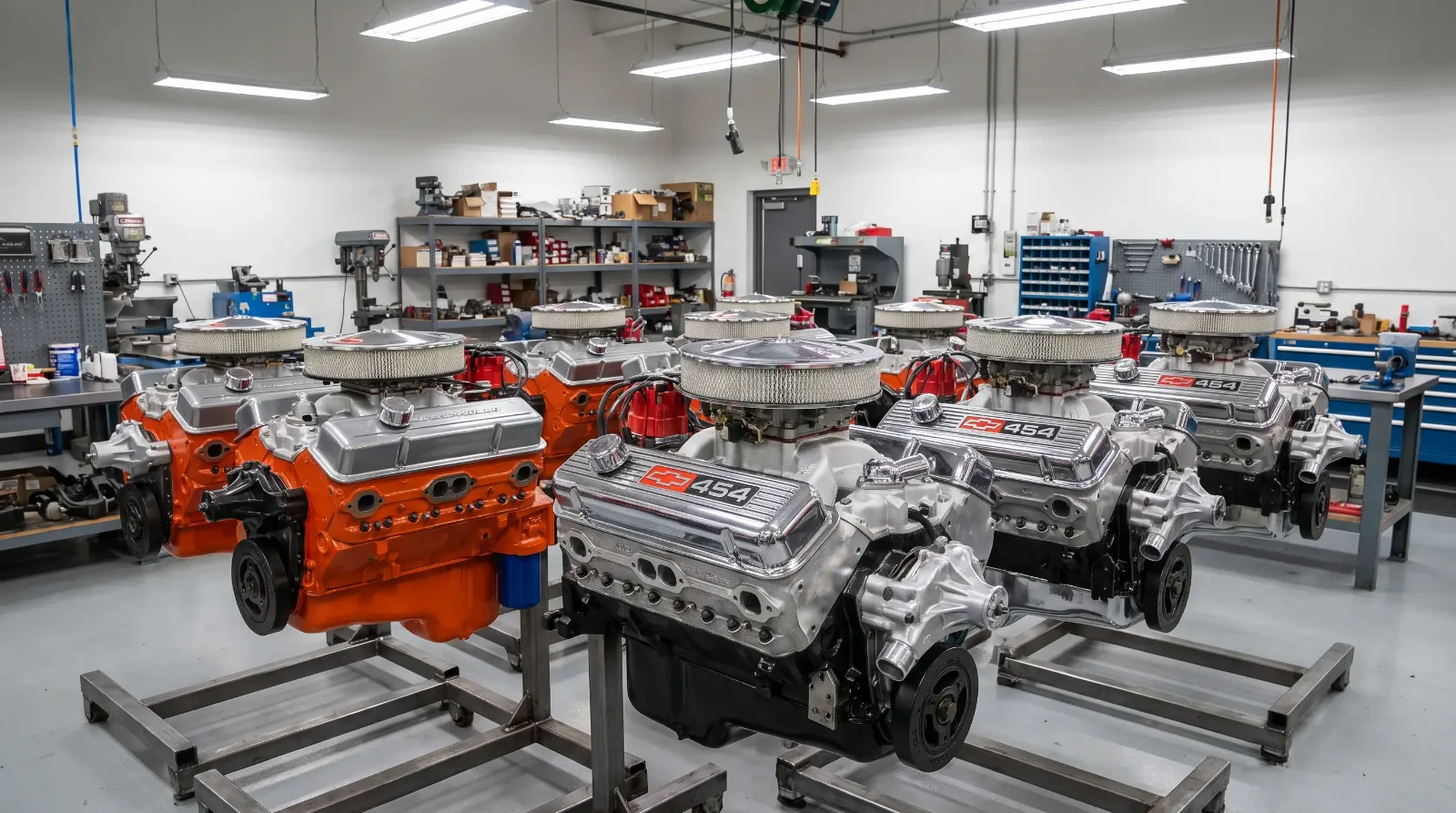
The L36 427 arrived rated at 390 horsepower. The L68 version, with three two-barrel carburetors, was rated at 400. Neither of those is what serious drag racers were after. What they wanted was the L71, the triple-carb 427 rated at 435 horsepower, or better still the L88, which Chevrolet listed at a deliberately understated 430 horsepower to keep insurance companies from panicking. Anyone who actually ran an L88 at the strip knew that number was fiction. The engine made well over 500 horsepower on a conservative dyno. Chevrolet did not want ordinary buyers ordering it; the order form required the deletion of the radio, the heater, and various other comfort items. The price was steep. The car was genuinely difficult to drive on the street. All of that was intentional.
The full story of how these cars were developed and campaigned belongs to the broader arc of Corvette racing history, which covers everything from the early Le Mans efforts through the factory's IMSA years. But the drag strip chapter is its own thing: more democratic, more American, louder, and shorter. You showed up on Saturday morning, paid your entry fee, and went.
NHRA Super Stock and the factory connection
Chevrolet's involvement in drag racing during the mid-1960s was officially unofficial. The AMA racing ban of 1957 was still nominally in effect, which meant General Motors could not directly support factory racing programs. In practice, the line was blurry. Parts found their way to racers through dealers. Engineers consulted informally. What Chevrolet could not do openly it accomplished through a network of well-connected dealers and regional distributors who understood how the game worked.
In NHRA competition, the Corvette competed primarily in Super Stock and various modified production classes. The Super Stock classes were organized by weight-to-power ratio, which put the big-block Corvette in serious company: factory lightweight Dodge A-990 cars, Ford Thunderbolts, Pontiac Catalinas. The Corvette's advantage was its curb weight, which ran roughly 3,200 pounds in production trim. Against the full-size factory lightweights, the 427 Corvette was competitive. Against other sports cars and pony cars, it was frequently dominant.
By 1966 and 1967, the Modified Production classes were opening up more heavily modified cars. Racers who had started with production Corvettes were cutting weight, improving suspension geometry for launch, and working the carburetors and ignition timing to the edge of what the rules allowed. The cars were still recognizably Corvettes on the outside. Underneath and under the hood, they were purpose-built race cars wearing Corvette bodies.
| Engine | Years available | Rated HP | Carb setup | Primary use |
|---|---|---|---|---|
| L36 427 | 1966–1969 | 390 hp | Single 4-bbl | Street/touring |
| L68 427 | 1967–1969 | 400 hp | 3x2-bbl | Street performance |
| L71 427 | 1967–1969 | 435 hp | 3x2-bbl | Street/strip |
| L88 427 | 1967–1969 | 430 hp (understated) | Single Holley 850 | Racing |
| ZL1 427 | 1969 only | 430 hp (understated) | Single Holley 850 | Dedicated racing |
The ZL1: an all-aluminum racing engine in a production car
The ZL1 is where the story gets unusual. By 1969, Chevrolet engineers had developed an all-aluminum version of the 427 that was intended specifically for Can-Am racing. The block, the heads, the intake manifold: all aluminum. A conventional iron-block 427 weighed around 680 pounds. The ZL1 weighed roughly 500 pounds. That weight reduction, placed in the front of a Corvette that was already well-balanced, changed what the car could do at the strip.
The ZL1 option was technically available on the Corvette for 1969, listed in the order guide as RPO ZL1. The price was $4,718.35 on top of the base Corvette price, at a time when you could buy a complete base Corvette for around $4,400. Approximately 2 Corvettes were built with the ZL1 in 1969, though documentation on the exact number has been a subject of discussion in Corvette research circles for decades. The option was not meant for ordinary buyers. It required deletion of nearly all comfort equipment and was ordered by racers who understood exactly what they were getting.
At the strip, the ZL1-equipped Corvette was genuinely frightening to race against. The weight reduction translated directly into launch performance. On a prepared surface with a good driver, these cars could run in the 11-second range in nearly stock configuration. With tuning and a small amount of preparation, 10-second passes were achievable. That was territory that had previously belonged to purpose-built dragsters and factory experimental cars.
"The tank sticker on a ZL1 tells a story that the VIN alone never could. You need to see the option codes to understand what actually left the factory. A lot of cars have been represented as ZL1s over the years. The documentation trail on the real ones is specific and traceable, but you have to know what you're looking at."
— Tom Ramirez
Notable racers who campaigned big-block Corvettes
Don Yenko is a name that comes up immediately in any discussion of factory-connected Corvette drag racing. The Yenko Chevrolet dealership in Canonsburg, Pennsylvania had a long relationship with the performance end of Chevrolet's lineup, and Yenko understood how to work with factory connections to put serious hardware in front of serious racers. Yenko-prepared Corvettes appeared at strips across the Northeast through the late 1960s, and the dealership's relationship with the COPO (Central Office Production Order) system gave it access to equipment that was not available through normal ordering channels.
Tony DeLorenzo was one of the most visible Corvette campaigners of the era, though his primary focus was road racing and endurance events. At the strip, the more dedicated drag racers tended to be regional figures: men who ran their cars at local tracks weekend after weekend and were less visible nationally but no less serious about the results. Names like Dick Guldstrand appear in the Corvette performance narrative of the late 1960s, though Guldstrand's focus was primarily road racing.
In NHRA national competition, the Corvette's drag racing profile was strongest in regional and divisional events rather than at Nationals-level competition, where the factory lightweight programs from Ford and Chrysler were fielding cars that pushed the legal limits of stock classification in ways that required corporate infrastructure to match. The Corvette was competitive within its class. It was not the dominant force in professional-level drag racing that it was at the club and regional level.
Why the big-block Corvette ended, and what it left behind
The 1970 model year brought the 454, which replaced the 427 in the Corvette lineup. The LS6 454, rated at 450 horsepower, was in some ways the peak of the big-block era, a last statement before everything changed. It was also available only for a single model year in the Corvette in that configuration. By 1971, compression ratios were dropping across the board as Chevrolet began recalibrating its engines to run on regular-grade fuel with lower octane ratings. The 454 continued, but at reduced output.
The 1973 and 1974 model years saw bumper regulations change the Corvette's appearance and add weight. The LS4 454, which continued through 1974, was rated at 270 net horsepower in its final year. Net horsepower ratings measure differently from the gross ratings used through 1971, so a direct comparison overstates the decline slightly, but the direction was unmistakable. The same Federal emissions and safety requirements that were reshaping the entire American auto industry were, by 1974, making the big-block Corvette a different car than it had been in 1969.
After 1974, the 454 was gone from the Corvette. The small-block L82 carried on, and the base L48 350 continued as well. The drag strip presence that the 427 and 454 cars had built over a decade of weekends did not simply disappear, but the character of what you could build from a showroom Corvette changed. The cars that had run serious times from nearly stock configuration in 1968 and 1969 were increasingly period pieces rather than starting points. Racers moved to other platforms or built from existing big-block cars rather than new ones.
What the big-block era left behind was a body of documented race history, a collector market that values L88 and ZL1 cars among the most seriously of any American production vehicles, and a reasonable argument that the 1967–1969 period represents the point where Chevrolet built the most capable drag racing Corvettes it would ever sell to the public through a dealership window.
Sources and notes
- Antonick, Michael. Corvette Black Book 1953–2012. Michael Bruce Associates. Production numbers and option codes for L88 and ZL1 by model year.
- Falconer, Ryan and Antonick, Michael. Corvette: America's Sports Car. Publications International. Factory documentation on big-block option availability and pricing.
- National Corvette Restorers Society (NCRS). Technical Information Series. Tank sticker interpretation, authentication standards, and production documentation for 1967–1969 Corvettes. ncrs.org.
- Grist, Peter. Zora Arkus-Duntov: The Legend Behind Corvette. Motorbooks International. Factory engineering decisions on the L88 and ZL1 development, including the deliberate underrating of horsepower figures.
- Yenne, Bill. The Complete Book of the Corvette. Motorbooks International. Year-by-year production changes, 1965–1974 big-block era documentation.
- NHRA National Dragster archives. Divisional and national event coverage, 1965–1974. Records of Super Stock and Modified Production class competition involving Corvette entries.