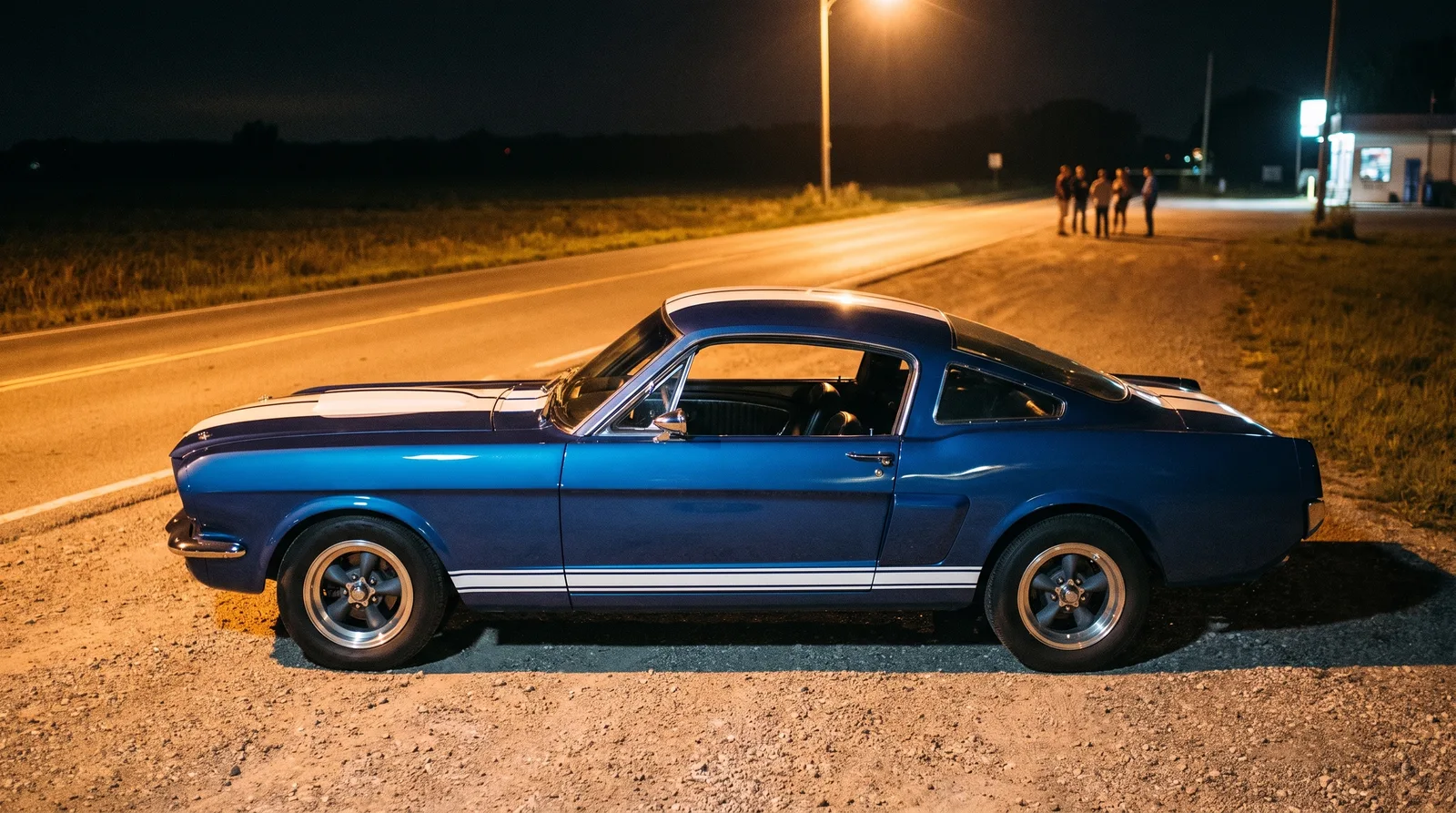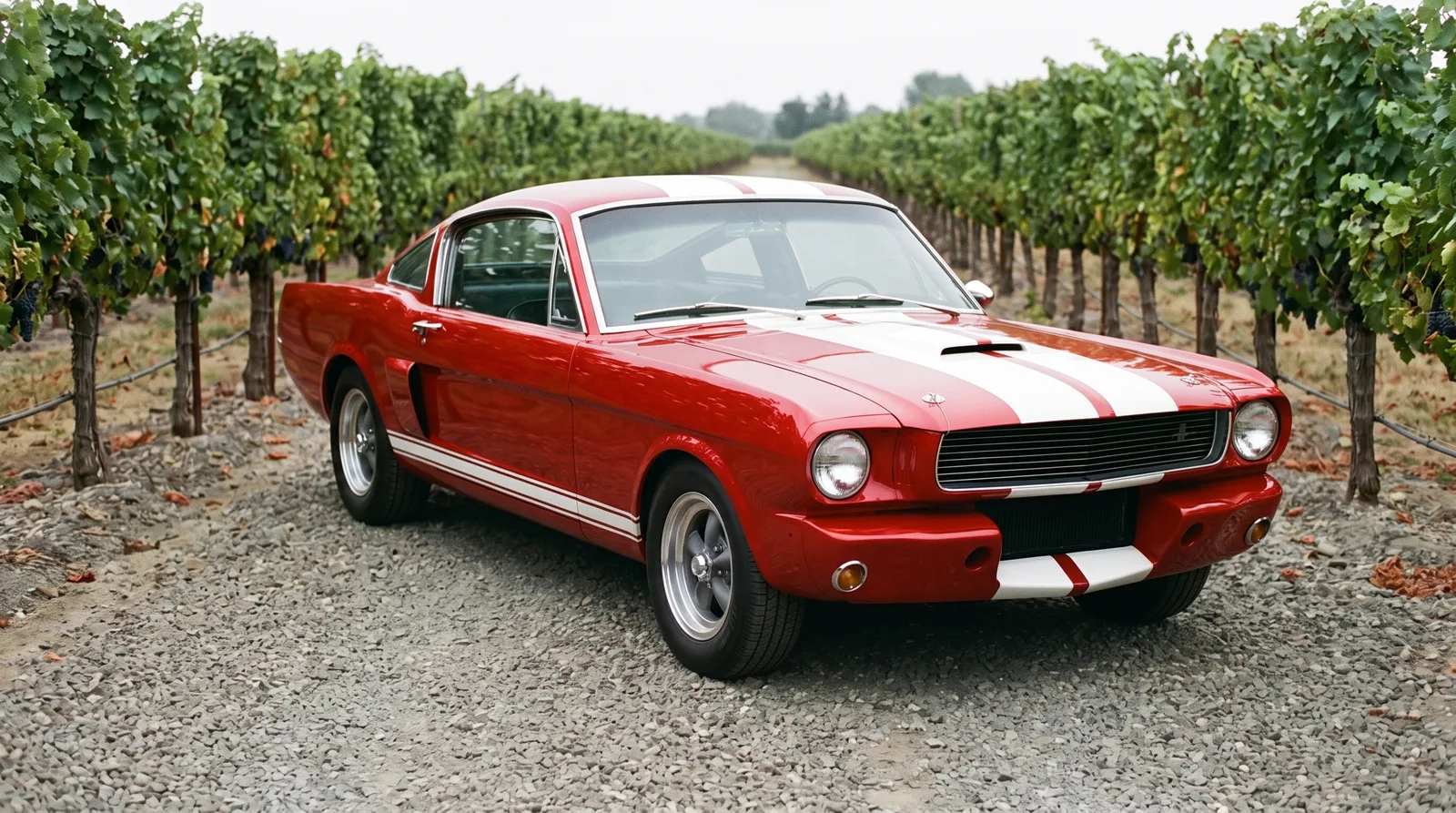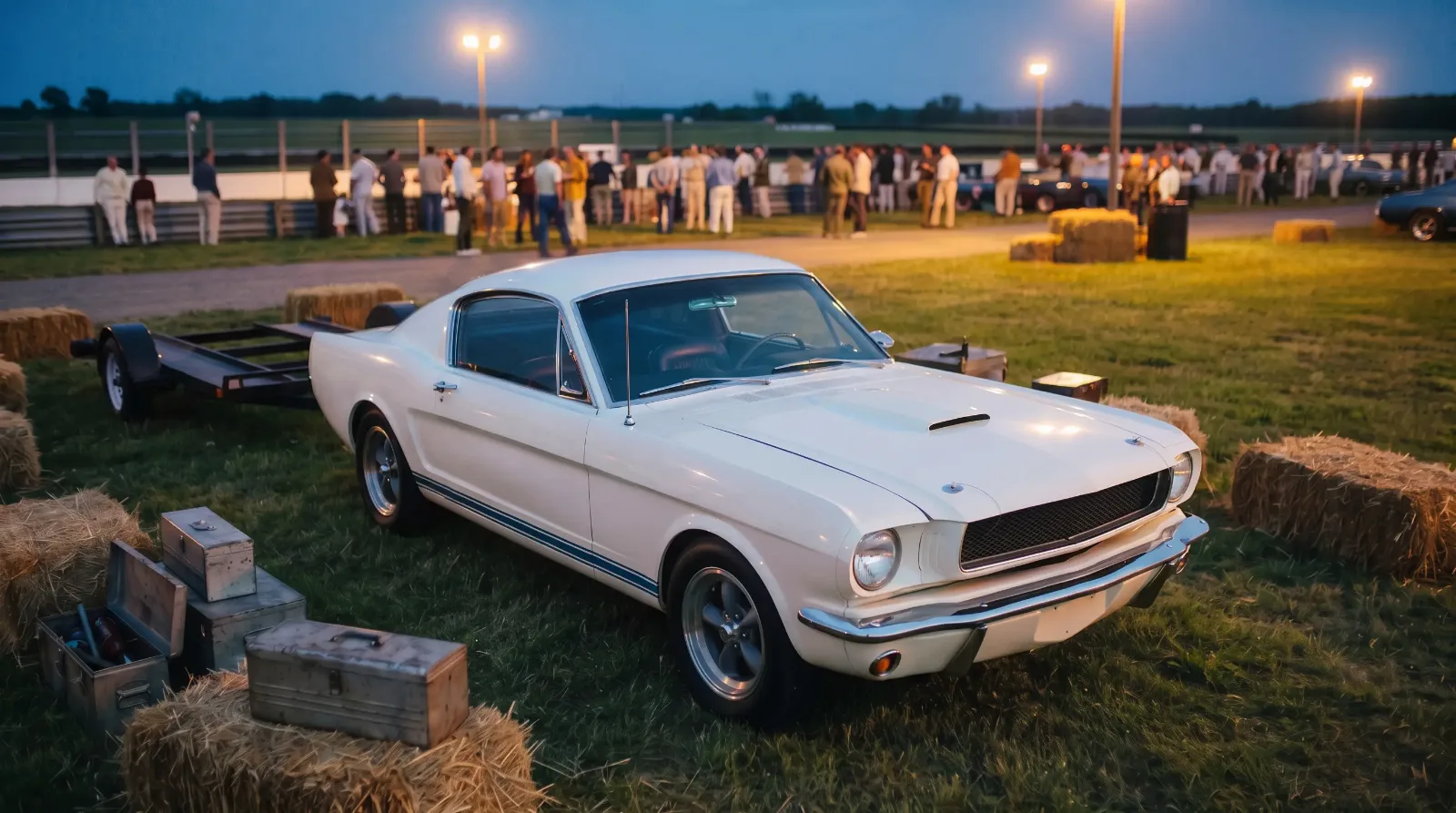
From the street to the track: the GT350 enters competition
When Carroll Shelby transformed the Ford Mustang into the GT350 in late 1964, he was not merely building a high-performance street car. He had a racing program in mind from the start. The GT350 was homologated for SCCA B-Production class, and Shelby American wasted no time putting it to work on the nation's road courses. The combination of the 289 cubic-inch high-performance V-8, a carefully tuned suspension, and a significant weight reduction over the standard fastback gave the car genuine competitive credentials. Where lesser pony cars were playing at performance, the GT350 was engineered to win.
The SCCA B-Production championship became Shelby American's primary battleground in the mid-1960s, and the results spoke directly to the quality of the engineering coming out of the Venice, California shop. The GT350 claimed the national B-Production title in 1965, 1966, and 1967, establishing a run of dominance that remains one of the defining chapters in American road-racing history. Carroll Shelby's Mustangs, covered in depth in our Carroll Shelby's Mustangs overview, were doing something no other American manufacturer had managed: winning consistently at the national level with a car that shared its basic architecture with a production street machine.
The GT350R: purpose-built for the circuit
The street GT350 was already a serious performance car, but Shelby American understood that championship-level racing demanded something more focused. The result was the GT350R, a competition-only variant built in small numbers specifically for SCCA racing. Shelby American stripped the R cars of everything unnecessary: sound deadening, interior trim, and the rear seat were discarded early. In their place went a roll bar, a full competition fuel system, and a heavily revised suspension tuned exclusively for circuit use.
The 289 high-performance engine in the R cars received additional attention, with ported and polished heads, a higher-lift camshaft, and a larger Holley carburetor bringing output to roughly 306 horsepower, well above the street car's rated figures. The result was a car that could be loaded on a trailer on Saturday morning, raced hard through Sunday afternoon, and sent back to the shop for a rebuild before the next weekend. Shelby American produced roughly 36 R-specification cars for 1965 (34 production examples plus two prototypes), making them rare then and extraordinarily significant today.
The GT350R's suspension modifications were particularly noteworthy. Shelby engineer Chuck Cantwell oversaw much of the chassis development, addressing the standard Mustang's inherent understeer bias with revised front geometry, stiffer springs and shocks, and a relocated rear suspension pickup point that brought the handling closer to neutral. These were not bolt-on parts but genuine engineering solutions to the limitations of a mass-production platform.
Notable drivers and the Shelby American racing effort
The success of the GT350 program was inseparable from the drivers who campaigned it. Ken Miles was the most prominent face of Shelby American's racing operation in those years, a gifted British-born driver whose mechanical intuition and development feedback were invaluable to the program. Miles was more than a quick driver; he could communicate exactly what the car was doing and what it needed, making him essential to the continuous development of both the GT350 and the GT40 program running in parallel.
Jerry Titus was another key figure in the Shelby Trans-Am story. A journalist and racer in equal measure, Titus brought analytical depth to his driving and eventually became a central figure in the Ford and Shelby Trans-Am effort. Mark Donohue, later famous for his work with Roger Penske, also campaigned Mustangs in this era, though his most celebrated Trans-Am years came with the Camaro. The GT350 attracted serious talent because it was, genuinely, a car capable of winning in skilled hands.
Shelby American's operation in Venice was not a large factory team by modern standards. The shop ran with a relatively small group of dedicated engineers and mechanics, many of whom had come from racing backgrounds and understood that every ounce saved and every suspension geometry change mattered. The culture was intensely practical, and the results in B-Production validated the approach. The development side of that story, including the full role of Ken Miles, is told in a separate piece.
The 1966 Trans-Am season and Ford's manufacturers' title
The Sports Car Club of America launched the Trans-American Sedan Championship in 1966, a new road-racing series aimed at production-based sedans and pony cars divided into classes by engine displacement. The timing was ideal for Ford and Shelby. The GT350's development was mature, the driver roster was experienced, and the basic car was already a proven winner in B-Production. Ford entered the inaugural Trans-Am season with factory support channeled through Shelby American, and the effort paid off.
Ford claimed the manufacturers' championship in the very first Trans-Am season in 1966, edging Plymouth by seven points (46-39) with the Mustang accumulating points across the season's rounds. The series brought road racing to a broader American audience and gave manufacturers a compelling new stage on which to prove their performance credentials. For Ford, the Trans-Am was the natural continuation of the Total Performance marketing strategy that had made Le Mans, the drag strip, and the stock-car oval all part of the same sales message. Winning the inaugural manufacturers' title amplified that message considerably.
The Mustang's success in 1966 Trans-Am was built on the foundation that Shelby's B-Production program had established. The cars were developed, the setups were understood, and the team knew how to prepare a Mustang for a road course. Shelby American's contribution went beyond building the cars; the knowledge accumulated through two seasons of SCCA competition made the transition to Trans-Am considerably smoother than it might otherwise have been. If you are looking at the cars that resulted from all this development, our listings of classic Mustangs include examples from across the GT350 era.
"The Shelby program was never just about one race or one title -- it was about proving that an American company could build a real racing car, not just a fast street machine dressed up with a roll bar."
Patrick Walsh
The Boss 302 takes over: the end of an era
By 1968 and into 1969, the Trans-Am landscape had shifted dramatically. The Chevrolet Camaro Z/28 had arrived with a purpose-built small-block, factory backing, and Roger Penske's organization behind it. The competition intensified, and it became clear that the GT350's 289 was no longer the right weapon for the fight. Ford's answer was the Boss 302, a new small-block built explicitly around Trans-Am regulations, featuring canted-valve cylinder heads derived from the 429 big-block and a short-stroke design optimized for high-rpm power.
The Boss 302 Mustang debuted in Trans-Am competition in 1969, with Bud Moore Engineering running the official Ford factory effort. The car was a significant step forward in pure technical terms, yet the 1969 title still went to Roger Penske's Camaro, with Mark Donohue successfully defending the championship Chevrolet had also taken in 1968. The Boss 302 finally broke through in 1970, when Parnelli Jones and George Follmer drove the Bud Moore Mustangs to the Trans-Am manufacturers' championship for Ford, Jones taking five wins and Follmer one across the season. Ford withdrew its factory support after the 1970 season, effectively ending the works effort.
The shift from the GT350 to the Boss 302 was a logical evolution, not a repudiation of what Shelby had built. The GT350 program had demonstrated that a Mustang could win consistently at the national level and had given Ford the organizational and technical infrastructure to compete in Trans-Am from the first season. The Boss 302's success was built on a foundation that Carroll Shelby and his team had laid through years of competition development in B-Production and the inaugural Trans-Am seasons. The racing heritage that makes the GT350 so compelling today runs directly through those national championships and those early Trans-Am rounds, a legacy earned on the track, not the showroom floor.
Sources and notes
The competition history, championship years, and technical figures in this article were verified against the published record at the time of writing. Period race results and production numbers can vary slightly between sources; horsepower and build-count figures are quoted as approximations where original documentation itself is inconsistent. Readers researching a specific car should confirm details against its individual SAAC registry documentation and Marti Report where applicable.
- Shelby Mustang: Wikipedia (GT350R specifications, 306 bhp competition rating, B-Production championships, R-model production)
- 1966 Trans-American Sedan Championship: Wikipedia (Ford's inaugural manufacturers' title, final points 46-39 over Plymouth)
- Boss 302 Mustang: Wikipedia (1969 debut, 1970 Trans-Am championship, Bud Moore Engineering)
- History of the Trans-Am Series: Wikipedia (Penske/Donohue Camaro titles in 1968 and 1969)
- 1965 Shelby GT350R history: Hagerty Media (R-model build counts and prototypes)
- The Shelby Mustang GT350R: The Henry Ford (Jerry Titus and the 1965 B-Production championship)