
1967 Chevrolet Camaro
$49,997
Vehicle Details
Chevrolet
Camaro
1967
7,579 miles
124377N221105
Coupe
Automatic
327 V8
Description
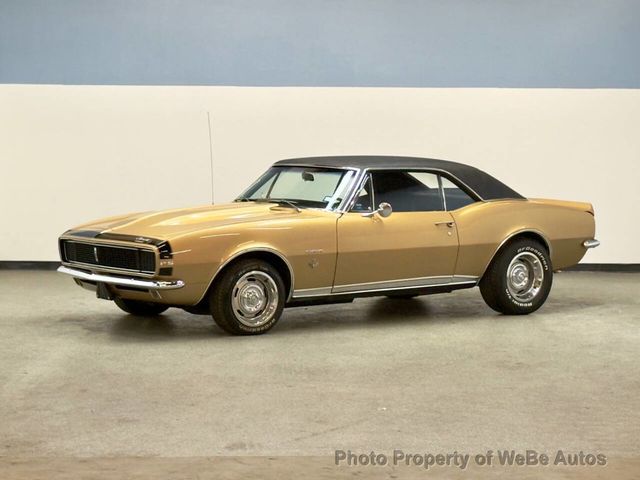
1967 Chevrolet Camaro RS — 327 V8, Granada Gold, Black Vinyl Top, Rally Wheels Why This Car Is Special The 1967 Chevrolet Camaro was General Motors' answer to the Ford Mustang, and it arrived fully formed. Chevrolet engineers had studied the Mustang carefully and came back with a longer wheelbase, a lower roofline, and a wider stance — a car that felt more planted and more purposeful from day one. The first-generation Camaro went on to become one of the most collected American muscle cars in history, and the 1967 model year holds a special place in that lineage as the very first.
This particular 1967 Chevrolet Camaro RS is finished in Granada Gold with a black vinyl top and black interior — a combination that carries the kind of period-correct confidence you don't often see on a car that has survived nearly six decades. The RS, or Rally Sport, package was a separate option in 1967 that buyers could layer on top of any engine choice. It was a cosmetic and convenience package, not a performance one, and that distinction matters.
The RS package's most recognized feature is the vacuum-operated hideaway headlight system, which concealed the headlamps behind body-colored doors that retracted on demand. It also added full-width taillamps, a blacked-out grille, RS badging, and revised exterior trim. Roughly 64,800 Camaros were ordered with the RS package in 1967 out of a total first-year production run of approximately 220,000 units — a significant number, but far from the majority, which makes a documented RS car worth seeking out.
The VIN on this car decodes to confirm it was built at the Norwood, Ohio assembly plant and is a sport coupe body style. The engine designation in the VIN aligns with the 327 cubic inch V8 that sits under the hood today, supporting the car's documented configuration. Features - 327 cubic inch V8 engine - Turbo-Hydramatic Powerglide 2-speed automatic transmission - Rally Sport (RS) package with vacuum-operated hideaway headlights - Granada Gold exterior with black vinyl top - Black leather interior - Bucket seats - Rally wheels - BFGoodrich Radial T/A tires - Power steering - Front disc brake conversion - Replacement digital instrument cluster - Chrome bumpers - Clean undercarriage Mechanical The 327 cubic inch small-block V8 was one of Chevrolet's most respected engines through the 1960s and earned that reputation honestly.
In 1967 Camaro applications, the 327 was offered in multiple states of tune, ranging from 210 horsepower in base trim up to 275 horsepower in the higher-output L30 configuration. The 327 shares its bore spacing and block architecture with the later 350, which means parts availability is excellent and the engine has been well understood by mechanics for decades. This car pairs the 327 with a Powerglide 2-speed automatic — a transmission that was the subject of jokes in its day but has since been recognized for its simplicity and durability.
With only two gears and a straightforward hydraulic design, the Powerglide has remarkably few failure points, and its torque converter lockup characteristics actually suit relaxed, comfortable driving quite well. A front disc brake conversion has been fitted to the car, which is a meaningful safety upgrade. The 1967 Camaro left the factory with four-wheel drums as standard equipment, and the front disc swap significantly improves stopping distance and fade resistance under hard braking.
Power steering is also present, making the car easy to maneuver at lower speeds without losing the road feel the original suspension geometry provides. The undercarriage has been inspected and presents cleanly — the photos taken from the lift confirm a floor and frame that have not been compromised by serious rust or damage, which is not something you can take for granted on a 57-year-old car from any region of the country. Interior The interior of this 1967 Chevrolet Camaro RS is finished in black leather with bucket seats up front — a com
Classic Chevrolet Camaro Buyer's Guide
Chevrolet Camaro Market Overview
Based on 329 Chevrolet Camaro listings currently on ClassicCarsArena.com
Classic Chevrolet Camaro Buyer's Guide
The Chevrolet Camaro launched in September 1966 as Chevy's direct response to the Ford Mustang, and for over five decades it has defined American performance for an entire generation of enthusiasts. Whether you're hunting a numbers-matching first-generation Z/28, a survivor split-bumper second-gen, or a clean third-gen IROC-Z, the Camaro buyer's market is deep, varied, and full of pitfalls for the unprepared.
What to Check Before Buying
Common Issues
What to Look For
Price Guide
Did You Know?
Also Consider
Similar classic cars shoppers also browse:
How Does It Compare?
Head-to-head matchups for the Chevrolet Camaro:
1967 Chevrolet Camaro
Find a similar Chevrolet Camaro currently for sale.
Browse Similar ListingsComparable Sales
Buying safely?
Read our scam-avoidance tips before paying →
Listing Actions
Browse by Era
1960s Classics for SaleAll 1967 Classics
Browse all 1967 Cars for SaleGet classic car alerts
Latest arrivals, newest deals, and discount coupons — straight to your inbox.
Selling your classic car?
Reach millions of classic car enthusiasts on the largest US classics marketplace.
Sell Your Car →Similar Listings
 Dealer
 United States
1918 Chevrolet 100
 Dealer
United States
Dealer
United States
1923 Chevrolet Master
 Dealer
United States
Dealer
United States
1925 Chevrolet Superior K
 Dealer
United States
Dealer
United States
1926 Chevrolet 100
Call this seller?
You're about to call WeBe Autos about the 1967 Chevrolet Camaro.
+1 (631) 339-0399
Report this Ad
Help us keep the marketplace clean. Our moderation team reviews every report within 24 hours.