
1969 Chevrolet Camaro
$79,997
Vehicle Details
Chevrolet
Camaro
1969
80,817 miles
124379L511923
Coupe
Automatic
396 V8 Turbo-Jet 375hp Big Block
Description
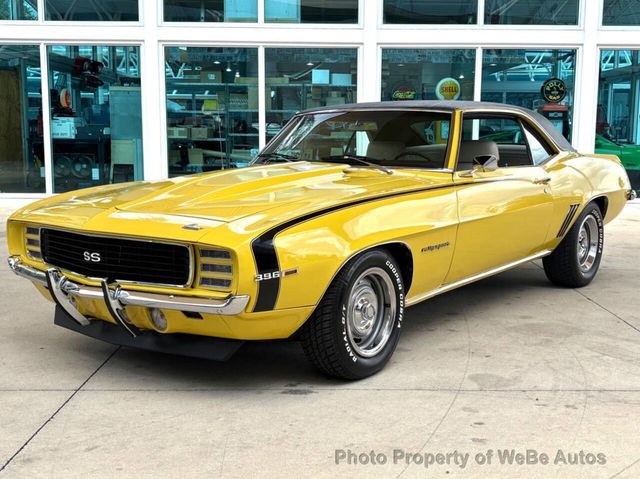
1969 Chevrolet Camaro SS/RS 396 — Frame-Off Restoration Why This Car Is Special The 1969 Chevrolet Camaro SS/RS 396 sits at the top of the first-generation Camaro hierarchy, and for good reason. The SS/RS combination package was the most optioned-out configuration a buyer could check off on the order sheet in 1969, layering the performance credentials of the Super Sport onto the cosmetic refinements of the Rally Sport. Chevrolet built the first-generation Camaro from 1967 through 1969, and the 1969 model year is widely considered the most desirable of the three.
It received a more aggressive body redesign — lower beltline, longer nose, tighter roofline — and production ran longer than planned, extending into late 1969 to compensate for the delayed launch of the second-generation car. That extended run has no negative effect on collectibility. If anything, the 1969 Camaro has only grown in stature over the decades.
The VIN on this car decodes to confirm it is a 1969 Camaro sport coupe, built at the Norwood, Ohio assembly plant, with the 396 cubic inch big block engine. The 'L' in the VIN sequence identifies the Norwood plant, and the engine code confirms the 375-horsepower Turbo-Jet L78 specification — the highest output version of the 396 offered that year, short of the rare L89 aluminum head option. This is a documented big block car, not a small block with a big block hood badge swapped in.
That matters when you are buying at this level. What makes this particular 1969 Camaro SS/RS 396 stand out beyond its documented credentials is the quality of the restoration behind it. This is a complete frame-off build, which means the body came off the frame, everything was stripped down, and the car was rebuilt from the ground up.
The results are visible both on top and underneath. The undercarriage is clean and finished correctly, not just pressure-washed and photographed. The engine bay is detailed and tight. And the mechanical upgrades that were made during the restoration were chosen thoughtfully — performance-oriented without being track-only, and livable in everyday driving conditions.
Features - 396 cubic inch Turbo-Jet V8, 375 horsepower — L78 big block specification - SS/RS combination package — Super Sport and Rally Sport options together - Turbo-Hydramatic TH400 3-speed automatic transmission - GM 12-bolt rear axle with multi-leaf rear suspension - Aluminum cylinder heads on the big block - Edelbrock intake manifold with Holley carburetor - Patriot ceramic-coated headers with 2.5-inch exhaust, crossover pipe, and Flowmaster mufflers - Detroit Speed electric headlight actuator kit (replaces the vacuum-operated RS system) - Champion aluminum radiator - Vintage Air air conditioning system - Power steering - Power front disc brakes - Steel cowl induction hood - PPG base coat / clear coat paint in yellow - Black vinyl roof - Rally wheels with Cooper Cobra Radial G/T tires - RS front end with hidden headlights and RS steering wheel - Front and rear spoilers - Chrome bumpers with deluxe bumper guards front and rear - 396 hood badge - Bucket seats with center console - White vinyl interior - Complete frame-off restoration - Clean undercarriage Mechanical The heart of this 1969 Camaro SS/RS is the 396 cubic inch Turbo-Jet big block, built to L78 specifications at 375 horsepower. In factory trim, the L78 was one of the most aggressive engines Chevrolet offered in the Camaro — it came with solid lifters, a high-rise intake, and an 800 cfm Holley four-barrel from the factory. This car has been upgraded during restoration with an Edelbrock intake and a Holley carburetor, along with aluminum cylinder heads, which improve both airflow and heat dissipation compared to the original iron units.
The combination makes for an engine that pulls hard across the entire RPM range and runs cooler doing it. Backing the big block is a Turbo-Hydramatic TH400 3-speed automatic, one of the most durable transmissions General Mo
Classic Chevrolet Camaro Buyer's Guide
Chevrolet Camaro Market Overview
Based on 329 Chevrolet Camaro listings currently on ClassicCarsArena.com
Classic Chevrolet Camaro Buyer's Guide
The Chevrolet Camaro launched in September 1966 as Chevy's direct response to the Ford Mustang, and for over five decades it has defined American performance for an entire generation of enthusiasts. Whether you're hunting a numbers-matching first-generation Z/28, a survivor split-bumper second-gen, or a clean third-gen IROC-Z, the Camaro buyer's market is deep, varied, and full of pitfalls for the unprepared.
What to Check Before Buying
Common Issues
What to Look For
Price Guide
Did You Know?
Also Consider
Similar classic cars shoppers also browse:
How Does It Compare?
Head-to-head matchups for the Chevrolet Camaro:
1969 Chevrolet Camaro
Find a similar Chevrolet Camaro currently for sale.
Browse Similar ListingsComparable Sales
Buying safely?
Read our scam-avoidance tips before paying →
Listing Actions
Browse by Era
1960s Classics for SaleAll 1969 Classics
Browse all 1969 Cars for SaleGet classic car alerts
Latest arrivals, newest deals, and discount coupons — straight to your inbox.
Selling your classic car?
Reach millions of classic car enthusiasts on the largest US classics marketplace.
Sell Your Car →Similar Listings
 Dealer
 United States
1918 Chevrolet 100
 Dealer
United States
Dealer
United States
1923 Chevrolet Master
 Dealer
United States
Dealer
United States
1925 Chevrolet Superior K
 Dealer
United States
Dealer
United States
1926 Chevrolet 100
Call this seller?
You're about to call WeBe Autos about the 1969 Chevrolet Camaro.
+1 (631) 339-0399
Report this Ad
Help us keep the marketplace clean. Our moderation team reviews every report within 24 hours.