SOLD on May 27, 2026
Elite Dealer

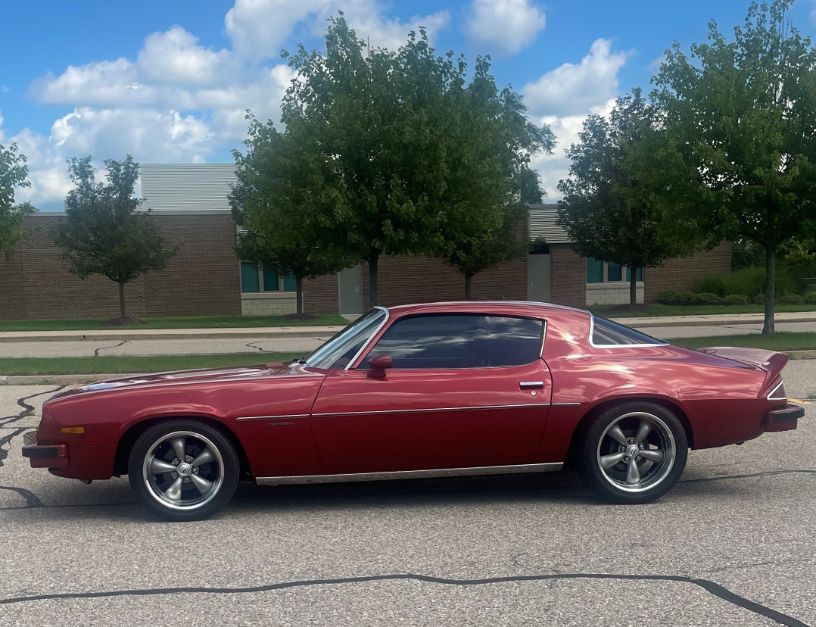
1976 Chevrolet Camaro

Indiana

$19,900

1976 Chevrolet Camaro

Vehicle Details

Make

Chevrolet

Model

Camaro

Year

1976

VIN

KMR8364LR

Body Type

Coupe

Description

1976 Chevrolet Camaro LT Engine, Ls1 from a 2001 Camaro had 60,100 miles when pulled. Now has around 68,000 on build. SI5V2 cam Pac Dual valve springs titanium retainers Viton seals FAST Intake & Throttle body Doug’s 1 7/8 long tube headers 1999 Camaro ECM been tuned with HP tuners.

Segment swap done to control 4L80E Electric Vacuum pump for brakes due to low vacuum from cam. Transmission, 4l80E maybe has 2000 miles on it. Was rebuilt before being installed. Drive shaft is custom made from DTS (Drive Train Specialties) B&M shifter for the 4L80E Rear Axle, Stock rebuilt less than 1000 miles 4:10 gears all new bearings with posi.

Both axles were replaced. Ring & Pinion Waterford mi did the work. Wheels, Coy wheels 17x7 fronts 18x8 rears. Maybe has 2000 miles on them. Tires are still like new. Fuel System, Tanks Inc put together a fuel pump and drop in baffle system for the application.

All (an) fittings with stainless steel braided lines. Corvette fuel filter with built in fuel pressure regulator. Body, Procar front seats with tracks AEM Wideband, has data logging cable ready for the laptop Brand new carpet Tinted windows 20% rear 35% doors Paint matched front and rear bumpers Solid body mounts 1’ drop front springs 1’ drop rear leaf springs Rear shocks have the spring over the shock to help with load.

Front steering components all been rebuilt New headliner AM/FM CD radio with 2 6x9 speakers in the rear Non-AC Paint is pretty nice for its age, it does have some spots that have been touched up with touchup paint. Overall the car is really nice. I got the car about 15 years ago bone stock.

Swapped in a Chevy 350 and wasn’t happy. Got a LS1 and this is where the car started. Car runs, drives shifts fine. It does need finishing touches; the tune is close but could be better on a dyno. Car has only been street tuned.

Exhaust stops just before rear axle has dynomax mufflers 3 inch. Speedometer does NOT work since it was for a cable transmission that would need to be changed or upgraded. Only reason for selling is I just dont use it, I have lost interest in the car and have a lot going on in life.

Body Style: Coupe
Doors: 2

Classic Chevrolet Camaro Buyer's Guide

Full guide
M
Mike Sullivan
Muscle Cars
1967–2002
~4 min read
Updated Apr 2026
Everything you need to know about buying a classic Chevrolet Camaro — from 1967-1969 first-generation icons to the third-gen IROC era. VIN authentication, common rust hotspots, engine identification, and current market pricing.
This guide covers
10-point inspection checklist
Common issues & what to avoid
In-person inspection guide
Market pricing by year & condition
5 FAQs answered
History & fun facts

Chevrolet Camaro Market Overview

Based on 360 Chevrolet Camaro listings currently on ClassicCarsArena.com

360
Listed Now
$46,743
Avg. Asking Price
1967–2001
Year Range
Price Position on Our Site — Below Average
This car: $19,900
Low: $4,995 High: $259,900
Transmission Distribution
Automatic 63%
Manual 28%
Condition Distribution
Excellent 14%
Good 8%
Fair 2%
Poor 1%
Data from ClassicCarsArena.com listings Browse all 360 listings →

Classic Chevrolet Camaro Buyer's Guide

The Chevrolet Camaro launched in September 1966 as Chevy's direct response to the Ford Mustang, and for over five decades it has defined American performance for an entire generation of enthusiasts. Whether you're hunting a numbers-matching first-generation Z/28, a survivor split-bumper second-gen, or a clean third-gen IROC-Z, the Camaro buyer's market is deep, varied, and full of pitfalls for the unprepared.

What to Check Before Buying

Verify VIN against cowl tag and build sheet — Cross-reference all three for matching production date, paint, trim, and option codes. Mismatched cowl tag = body swap.
Check engine block partial VIN — Stamped on driver-side block deck near cylinder head. Must match dashboard VIN for "numbers matching" claim.
Inspect rear window channel and trunk pan — Rust here is hidden but ruins structural integrity. Pop the rear seat and look at the rear window inner channel.
Magnet test rocker panels and quarters — Body filler is non-magnetic. If the magnet doesn't stick, the panel has been filled — meaning underlying rust.
Verify Z/28 RPO code on cowl tag — Genuine Z/28s carry the "Z28" code. Without it, the car is a clone, regardless of badging.
Inspect 12-bolt rear end (first-gen) — Z/28s and SS396s used the 12-bolt. Check for original gear ratio code stamped on axle housing.
Check transmission stamp and ratio — Muncie M21 close-ratio four-speed in Z/28s. Stamping on the side of the case identifies original.
Examine motor mounts and frame rails — Big-block cars are notorious for breaking motor mounts. Look for cracked rubber, lifted engines, or aftermarket safety chains.
Test drive on highway and parking lot — Listen for differential whine, transmission slip, brake pulsation, steering wander. Drive at least 20 minutes.
Document with HD photos before purchase — Photo every panel, every stamp, every sticker. Document VIN, cowl tag, engine, transmission, rear axle. Build the case before you wire money.

Common Issues

Rust is the silent killer of every Camaro generation. First-gen cars (1967-69) hide rust under the rear window, in the trunk pan, around the rear wheel arches, and at the cowl seam where the windshield meets the firewall. Second-gen cars (1970-81) are notorious for rotten quarters, rocker panels, and floor pans — many cars on the market have been patched poorly or filled with body filler. Mechanical issues vary by generation. First-gens commonly suffer from worn 12-bolt rear ends, leaky Muncie transmission seals, and broken motor mounts (a Big Block specialty). Second-gens add tired steering boxes, crumbling vacuum lines, and EGR issues post-1972. Third-gens (1982-1992) are plagued by failing TPI sensors, sloppy T-tops that leak, and worn front coil-over-shock units on the IROC-Z.

What to Look For

Always start with the VIN. The first character tells you the country, the third tells you the model line, and the eighth (on 1972-and-later cars) tells you the engine. Cross-reference the VIN against the cowl tag and the trim tag — mismatches mean somebody swapped a body or a clip. For first-gen cars especially, find the partial VIN stamped on the engine block (driver's side, near the head, on Big Blocks) and on the transmission. Original drivetrains can add $15,000-$30,000 to a Z/28 or SS valuation versus a date-coded replacement. Look closely at the rocker panels, lower quarter panels, and the rear wheel arches with a strong magnet. Body filler is non-magnetic. If the magnet doesn't stick, you've got Bondo — and that's the cheap fix being hidden, not the expensive metal repair.

Price Guide

First-generation Camaros (1967-1969) are the gold standard. A driver-quality 1969 SS396 in good condition runs $55,000-$85,000 today. Z/28 prices range from $60,000 for a clean driver up to $200,000+ for documented, numbers-matching, low-mileage examples. Base 1967-1968 small-block coupes start around $28,000 for project cars, $45,000-$65,000 for nice drivers. Second-generation cars (1970-1981) have appreciated significantly in the last decade. 1970 Z/28 LT-1 cars are the high-water mark at $60,000-$120,000. Split-bumper 1970-1973 base coupes run $25,000-$45,000. Mid-second-gen cars (1974-1977) are the bargain entry point, often available for $15,000-$30,000 for solid drivers. Third-generation IROC-Zs (1985-1990) have entered serious collector territory. Clean L98 IROC-Zs sell for $18,000-$35,000, with low-mileage 1LE and B4C cars commanding $45,000+.

Did You Know?

The original 1969 Z/28 was conceived purely to homologate the Camaro for SCCA Trans-Am racing — the 302 V8 (a destroked 327) was built specifically because Trans-Am rules required engines under 305 cubic inches. The Mustang outsold the Camaro throughout the entire first generation. The Camaro did not outsell the Mustang until 1977, during the second generation. Only 69 ZL1 Camaros were built in 1969 — they were essentially a factory drag racing special with an all-aluminum 427 big block, and they cost more than a new Corvette. A documented original ZL1 sold at Mecum's Indianapolis auction in 2018 for $1.05 million.

Similar Listings

Share only if you'd like the seller to call you directly.

By contacting this seller you accept the Visitors Agreement

Call this seller?

You're about to call HaggleMe about the 1976 Chevrolet Camaro.

+1 (844) 424-4538

Before you call: Never wire money or share bank info over the phone. Read our scam-avoidance tips.
Call Now

Send to a Friend

Share this 1976 Chevrolet Camaro listing.

Report this Ad

Help us keep the marketplace clean. Our moderation team reviews every report within 24 hours.