
1970 Dodge Challenger
$114,970
Vehicle Details
Dodge
Challenger
1970
44,412 miles
JS23N0E117613
Other
Gasoline
Description
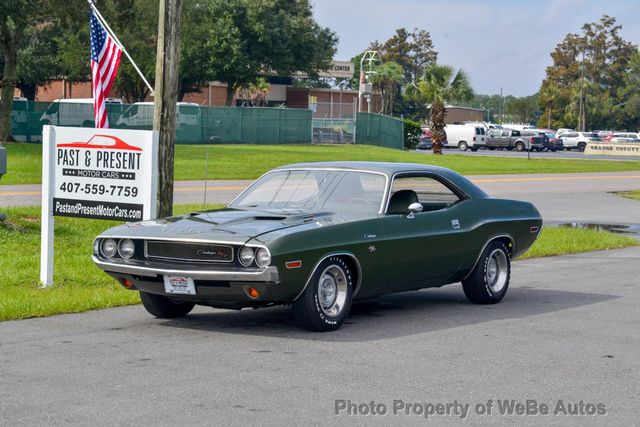
1970 Dodge Challenger, 44,412 Believed Original Miles, Remarkable Survivor, Believed Original Paint & Interior, Pistol Grip 4-Speed Every once in a while, a car comes along that makes even seasoned collectors stop and take a closer look. This 1970 Dodge Challenger is one of those cars. Showing just 44,412 miles, believed to be original, this Challenger is an extraordinary survivor that appears to have escaped the restoration, repainting, and modification that happened to so many of these cars over the past five decades.
Mopar experts who have inspected or discussed the car with us have indicated that examples preserved like this have become extremely difficult to find, and several have expressed the opinion that the car may be worth considerably more than our current asking price. What makes this Challenger so special is not what has been changed it is how much appears not to have been changed. The car remained in Kentucky with its original owner until 2019, an exceptional ownership history that helps explain how a 1970 Challenger could remain this intact for so many years.
The car is believed to retain its original paint and original interior, presenting today with the character, patina, wear, and authenticity that can only come from an unrestored automobile. You can restore a Challenger many times over, but you only get original paint and original materials once. Finished in factory Code EF8 Dark Green Metallic, the exterior has the unmistakable appearance of an honest survivor.
The interior trim code H5F8 denotes the factory Dark Green Cloth and Vinyl Bucket Seat Interior, creating an outstanding period-correct color combination that represents exactly how these cars looked when they were new. Inside, the bucket seat interior and iconic Pistol Grip 4-Speed Shifter immediately remind you that this is a true driver's-era Mopar. Few features are more recognizable or more desirable to muscle-car enthusiasts than Dodge's legendary Pistol Grip shifter.
According to the previous owner, the engine and transmission are original to the car. Because drivetrain originality and stamping authenticity are extremely important to collectors, we encourage all prospective buyers to independently inspect and verify the engine numbers, transmission numbers, casting dates, stampings, body numbers, and other identification points prior to purchase. Outside of routine maintenance and preservation items, the car is believed to remain extraordinarily original.
The known newer items include shocks, battery, and Wide Oval Tires. Beyond those items, the vehicle is represented to us as being largely untouched. That is what makes this Challenger so compelling. Highlights: 1970 Dodge Challenger 44,412 Miles Believed to be Original Believed Remarkable Unrestored Survivor Long-Term Original Ownership Remained in Kentucky with Original Owner Until 2019 Believed Original Paint Believed Original Interior Code EF8 Dark Green Metallic Code H5F8 Dark Green Cloth & Vinyl Interior Bucket Seats Pistol Grip 4-Speed Shifter Engine Believed Original to the Car Transmission Believed Original to the Car New Wide Oval Tires Newer Shocks Newer Battery Otherwise Believed to Remain Largely Original Outstanding Collector-Car Character Extremely Difficult to Duplicate A Must-See Automobile There are restored Challengers.
There are modified Challengers. There are tribute cars, recreations, and beautifully restored examples. And then there are survivors. Cars like this simply cannot be recreated. Restoration can produce beautiful paint, perfect chrome, and flawless upholstery, but it cannot reproduce more than 50 years of genuine history.
The small imperfections, aging materials, original finishes, low believed-original mileage, factory details, and overall character are exactly what serious collectors increasingly appreciate in an unrestored automobile. This Challenger tells its story everywhere you look. It is the kind of car that experienced Mopar enthusiasts spend time studying because the details have not been restored away.
The longer you look at it, the more you appreciate just how unusual it is to find a first-generation Challenger that appears to have remained this original for this long. We have been told by knowledgeable Mopar enthusiasts that the preservation and originality of this car make it particularly special, and some have expressed the opinion that the vehicle is worth more than our current asking price. Ultimately, the next owner should make that determination for themselves.
We strongly encourage serious buyers especially those purchasing the car based upon originality, mileage, or drivetrain authenticity to have the vehicle inspected by a qualified Mopar expert before purchase. Engine, transmission, stampings, paint originality, mileage, body numbers, and other authenticity-related items should be independently verified if they are important to your buying decision. What we can say with confidence is that this is a beautiful, fascinating, and remarkably preserved 1970 Dodge Challenger showing just 44,412 believed-original miles that deserves to be seen in person.
Cars like this are becoming harder and harder to find. If you have been searching for a Challenger that feels like a piece of 1970 rather than a modern recreation of one, this may be exactly the car you have been waiting for. They restored thousands of Challengers.
Very few survived like this one. This vehicle is a new arrival and has not yet completed our service department’s inspection process, professional detailing, or full photography. It is currently being offered for purchase in its present AS-IS condition at the advertised price.
Once the vehicle completes our inspection, servicing, detailing, and photography process, the advertised price may increase accordingly. Buyers interested in securing the car at its current offered price are welcome to purchase it today before that process is completed. While we do our best to provide the highest quality muscle cars with an honest and reliable description and realize the importance of transparency when selling vehicles.
That being said, we have not built, modified, changed or personally owned this vehicle. Whether this vehicle is consigned or owned by Past & Present Motor Cars we do not know the vehicles complete history since new. We want to be clear and try to answer any questions our customers might have prior to purchasing.
Additionally, we not only welcome but we encourage 3rd party independent inspections. Please inquire prior to purchase to make sure the advertised vehicle has not already been sold. We list our vehicles on multiple websites and a vehicle can sell at any time.
If a customer chooses to purchase sight unseen (many of our customers choose this option) the customer accepts the vehicle AS IS and WHERE IS and understands we cannot address concerns after purchase. For this reason, it's important all concerns are addressed prior to purchase. We make every effort to present accurate and reliable information, but use of this information is voluntary, and should only be deemed reliable after an independent review of its accuracy, completeness, and timeliness.
It is the sole responsibility of the customer to verify the existence of options, accessories and the vehicle condition before time of sale. Financing is Available with low rates and Vehicle Shipping is available from our Showroom to your Garage. A Classic Car Warranty is Available for Purchase from a 3rd Party.
Please speak to our Sales Associate or Company Representative for more information. Our team is working and available anytime by Phone or Text for your convenience at 407-559-7759. Thank you for your interest!
Trim: Low Original Miles, Remarkable Survivor, Pistol Grip 4-Speed
Classic Dodge Challenger Buyer's Guide
Dodge Challenger Market Overview
Based on 18 Dodge Challenger listings currently on ClassicCarsArena.com
Classic Dodge Challenger Buyer's Guide
The Dodge Challenger launched for the 1970 model year as Chrysler's second E-body offering, sharing platform with the already-released Plymouth Barracuda but with Dodge-specific styling and trim. Across just five model years of classic-era production (1970-1974), the Challenger established itself as one of the most desirable American muscle cars ever produced, particularly the rare Hemi R/T variants and the 1970-only T/A homologation specials. The 1970-1971 cars are the high-water mark of E-body Challenger performance with engine options spanning from the slant-six up to the legendary 426 Hemi. The 1972-1974 cars represent the smart-money entry into E-body Challenger ownership at a fraction of equivalent early-E-body pricing. This guide covers what every buyer should verify before paying premium money for any Challenger variant.
What to Check Before Buying
Common Issues
What to Look For
Price Guide
Did You Know?
Also Consider
Similar classic cars shoppers also browse:
How Does It Compare?
Head-to-head matchups for the Dodge Challenger:
1970 Dodge Challenger
Contact Seller

Nationwide consignment dealer
WeBe Autos lists vehicles from sellers across multiple states. The vehicle may not be at the dealer's address shown. Contact the dealer to confirm the vehicle's actual location before traveling.
Buying safely?
Read our scam-avoidance tips before paying →
Listing Actions
Browse by Era
1970s Classics for SaleAll 1970 Classics
Browse all 1970 Cars for SaleModel History
How the Dodge Challenger evolved (1970–1974) across 1 generations.
📈 View Full EvolutionGet classic car alerts
Latest arrivals, newest deals, and discount coupons, straight to your inbox.
Selling your classic car?
Reach millions of classic car enthusiasts on the largest US classics marketplace.
Sell Your Car →Similar Listings


 United States
1919 Dodge Rat Rod
 United States
1920 Dodge 1 Ton
 United States
1920 Dodge 1 Ton
Contact Seller
Call this seller?
You're about to call WeBe Autos about the 1970 Dodge Challenger.
+1 (631) 339-0399
Report this Ad
Help us keep the marketplace clean. Our moderation team reviews every report within 24 hours.